MEDDPICC: The Two Letters MEDDIC Left Out, and When They Earn Their Place
MEDDPICC is an eight-check enterprise sales qualification framework: Metrics, Economic buyer, Decision criteria, Decision process, Paper process, Identify pain, Champion, Competition. It extends MEDDIC with two checks, one for the administrative route to a signature and one for who else the buyer is considering.
Key takeaways
- The six MEDDIC checks ask whether the buyer wants to buy; the two added letters ask what stands between wanting and paying.
- Paper process covers procurement, legal, security review and the signature chain, and is the usual cause of a deal slipping rather than dying.
- Competition includes the internal build option and doing nothing, which is the real alternative in most B2B purchases.
- Ask both added questions in week two, when they read as logistics, rather than week ten, when the forecast is already submitted.
MEDDPICC: The Two Letters MEDDIC Left Out, and When They Earn Their Place
MEDDPICC is an eight-check enterprise sales qualification framework that extends MEDDIC with two additional tests: Paper Process and Competition. The full set reads Metrics, Economic buyer, Decision criteria, Decision process, Paper process, Identify pain, Champion, Competition. Everything MEDDIC does, it does identically. The argument for the longer acronym rests entirely on the two added letters, and whether they earn their place depends on how your deals actually die.
The useful way to hold the framework is that the six original checks ask whether the buyer wants to buy, and the two new ones ask what stands between wanting to buy and money moving.
Teams describing a MEDDPICC sales process are applying these eight checks to live opportunities inside the stages they already have, rather than replacing those stages with the acronym.
The two added checks
Paper process. The administrative and legal route from a verbal yes to a countersigned contract. Security review, vendor onboarding, procurement thresholds, legal redlines, insurance certificates, data processing agreements, purchase order creation, and the internal signature chain. Each one has an owner, a queue and a typical duration, and none of them appears in a demo.
This letter exists because of a specific, extremely common failure. A deal is won in October, everyone agrees, and it signs in February. Nothing went wrong in the sales conversation. The seller simply had no visibility into a procurement process with a six-week security review and a legal team that closes for the holidays. Every quarter that ends short of forecast contains several of these, and they are invisible to a framework that stops at decision process.
Competition. Who else is being considered, including the internal build option and the option of doing nothing at all. Not a name on a shortlist but an understanding of where you are stronger, where you are weaker, and which of the decision criteria each of you is quietly shaping.
This letter exists because a well-qualified deal can be perfectly understood and still lost. MEDDIC measures your grasp of the buyer. It says nothing about whether a rival has a better relationship with the economic buyer, and a forecast built only on your own evidence has a systematic optimism problem.
- Metrics: the number they want moved
- Economic buyer: who can release the money
- Decision criteria: how they will choose
- Decision process: the steps to a decision
- Identify pain: what inaction costs
- Champion: who argues for you internally
- Paper process: the route from verbal yes to signature
- Competition: rivals, internal build, and doing nothing
- Both are about the deal slipping rather than the deal being lost
- Both are answerable earlier than most sellers ask
When the longer version is worth the overhead
The MEDDPICC sales qualification framework is the longest of the family in common use, which is the argument for it and against it at once: more checks find more gaps, and every one of them is a question somebody has to ask on a call.

The extra checks cost real time to fill in, and the honest answer is that they are not always worth it.
Paper process earns its place when contracts pass through procurement, when security or compliance review is mandatory, when the buyer is in a regulated sector, when public money is involved, or when your deal value sits above an internal approval threshold you have not identified. In practice, if you have ever been surprised by a step you did not know existed, this letter would have caught it.
Competition earns its place in an established category where the buyer already has a shortlist before they meet you. In an emerging category the real competitor is usually the spreadsheet they use today, and naming that as the competitor produces better positioning than listing three vendors nobody in the account has mentioned.
Neither is worth it on transactional deals with one signer and a credit card. There the framework becomes a reporting exercise, and the operating discipline that matters instead is speed of response and a clean sales pipeline with fewer stages.
Where the textbook definition breaks
The acronym family is genuinely confusing, and the confusion has practical cost. MEDDIC is six. MEDDICC adds Competition. MEDDPICC adds Paper Process and Competition. Teams routinely adopt one name and run a different set of checks, so the first thing to establish in any organisation using it is which letters are actually in the CRM. The base six are covered in MEDDIC.
Filling in the paper process late defeats the point. Asked in week ten, "what does your procurement process look like" gets an answer that arrives after the forecast was already submitted. Asked in week two, it is a routine logistics question that buyers answer readily and that shifts the close date to something defensible. The letter is early-deal work presented as late-deal work, which is why it gets skipped.
Competition invites a losing conversation. A seller who asks who else is being evaluated and then argues against those vendors has handed the buyer's criteria to a rival. The productive use of the letter is internal: it tells you which criteria to influence and which deals to stop working. It is not a script.
Eight checks make an impressive-looking record of a deal you do not have. The framework operates on live opportunities with an engaged buyer. It cannot be run against a stranger, a downloaded contact or a fresh enquiry, and the instrument for that stage is lead qualification rather than any letter here.
- Depends: You know whether the contract passes through procurement, and at what value threshold
- Depends: You know whether a security or data review is mandatory and how long it usually queues
- Depends: You have a named owner for each administrative step, not just the buyer
- Depends: You know whether the real alternative is a rival, an internal build, or doing nothing
- Depends: You can name which decision criterion a competitor is shaping in their favour
- Depends: Your close date reflects the paperwork route rather than the decision date
How the paper process is actually mapped
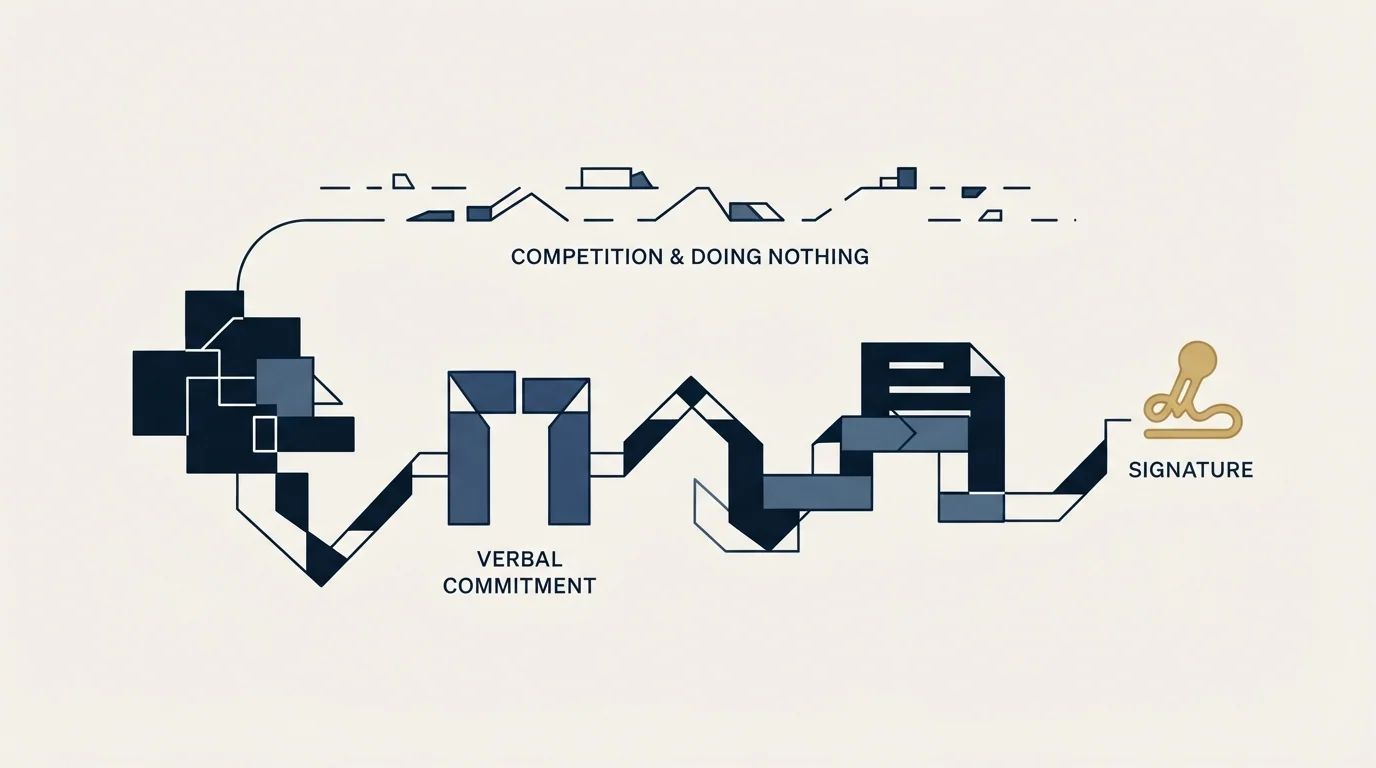
The letter is easy to describe and awkward to fill in, and the reason is that no single person at the buyer knows the whole answer. The champion knows the approval chain, procurement knows the vendor onboarding, legal knows the redline queue, and security knows the review calendar. A seller who asks only the champion gets the champion's share of the picture and treats it as the whole.
The workable approach is to map it as a set of gates rather than as a duration, and to get each gate from the person who owns it.
Ask what happened last time. The most productive single question is how the buyer's most recent comparable purchase went, step by step, including how long each part took. People answer this readily because it is a story about the past rather than a commitment about the future, and it surfaces steps nobody would have thought to name.
Get a named owner per gate. Security review is not a duration, it is a person with a queue. Knowing who they are makes the step schedulable and occasionally makes it parallel with something else.
Find the thresholds. Value bands that trigger extra approval, and whether a multi-year commitment crosses one that an annual commitment does not. This is one of the few pieces of deal information that can change the shape of what you propose.
Ask what is already in place. An existing master services agreement, an approved vendor list, or a prior security review can remove weeks. Buyers rarely mention these because they do not know they are unusual.
Establish the calendar constraints. Committees that meet monthly, fiscal year ends, freeze periods, and the holiday weeks where legal is unreachable. These are the steps that convert a two-week task into a six-week one.
The output is a dated list of gates with owners against them, and its purpose is a close date somebody can defend. The secondary benefit is larger and less obvious: a seller who has mapped this can help the buyer navigate it, which is genuinely useful to a champion who has to run the process internally and who has usually never done it before either.
What it implies for the conversations before the deal
Two things reach backwards from MEDDPICC into how the first conversation is set up.
The first is that paper process is a firmographic property before it is a deal property. Companies of a certain size, sector and ownership structure have predictable procurement behaviour, and knowing that before you target them changes what a realistic deal length looks like for that segment. It is one of the more useful and least used dimensions in an ideal customer profile.
The second is that competition sets what a first message can honestly say. In a crowded category the buyer has read the same three claims from everyone, so a message that repeats them is filtered on arrival. Knowing what the incumbent option actually is gives you the one line nobody else is writing, and that is a targeting and research problem long before it is a selling problem. The disqualifying half of this happens on the discovery call, where the cheapest possible outcome is finding out early that the paperwork route makes the deal impossible this year.
Related terms
MEDDIC is the base framework. BANT is the lighter, older checklist that both were built to improve on. Sales cycle is the number the paper process letter is quietly protecting. And an account executive is usually the person who owns the record.
The short version
MEDDPICC is MEDDIC plus two checks: the paperwork route from yes to signature, and the competition, including the option of doing nothing. It is built for enterprise deals with procurement, several stakeholders and a shortlist. Ask both added questions in week two rather than week ten, keep the competition answer internal, and do not try to run any of it against a person you have not yet spoken to.
Getting to the conversation where these questions become answerable is a separate job, and it is the one we do: see how a first campaign works.
Frequently asked questions.
Frequently asked questions- What is the difference between MEDDIC and MEDDPICC?
- MEDDPICC adds two checks to the six in MEDDIC: Paper Process, meaning the administrative and legal route from a verbal yes to a countersigned contract, and Competition, meaning who else is being considered including an internal build and doing nothing. Everything else is identical.
- What does the paper process check actually cover?
- Security review, vendor onboarding, procurement thresholds, legal redlines, insurance and data processing agreements, purchase order creation and the internal signature chain. Each has an owner, a queue and a typical duration, and none appears in a demo. The useful output is a dated list of gates with named owners against them.
- When is MEDDPICC too heavy for a deal?
- On transactional deals with a single signer and a credit card. There the framework becomes a reporting exercise that costs more time than it saves, and the disciplines that matter instead are speed of response and a pipeline with fewer stages. The checks earn their place where several people must agree and procurement is involved.
- Should you ask a prospect who else they are evaluating?
- You can, but the productive use of the answer is internal rather than conversational. A seller who asks and then argues against the named vendors has handed the buyer's criteria to a rival. The letter exists to tell you which criteria to influence and which deals to stop working.