Command of the Sale: Force Management's Process Programme
Command of the Sale is Force Management's sales process and qualification programme, not its messaging one. What the vendor says it is, delivers and how it runs.
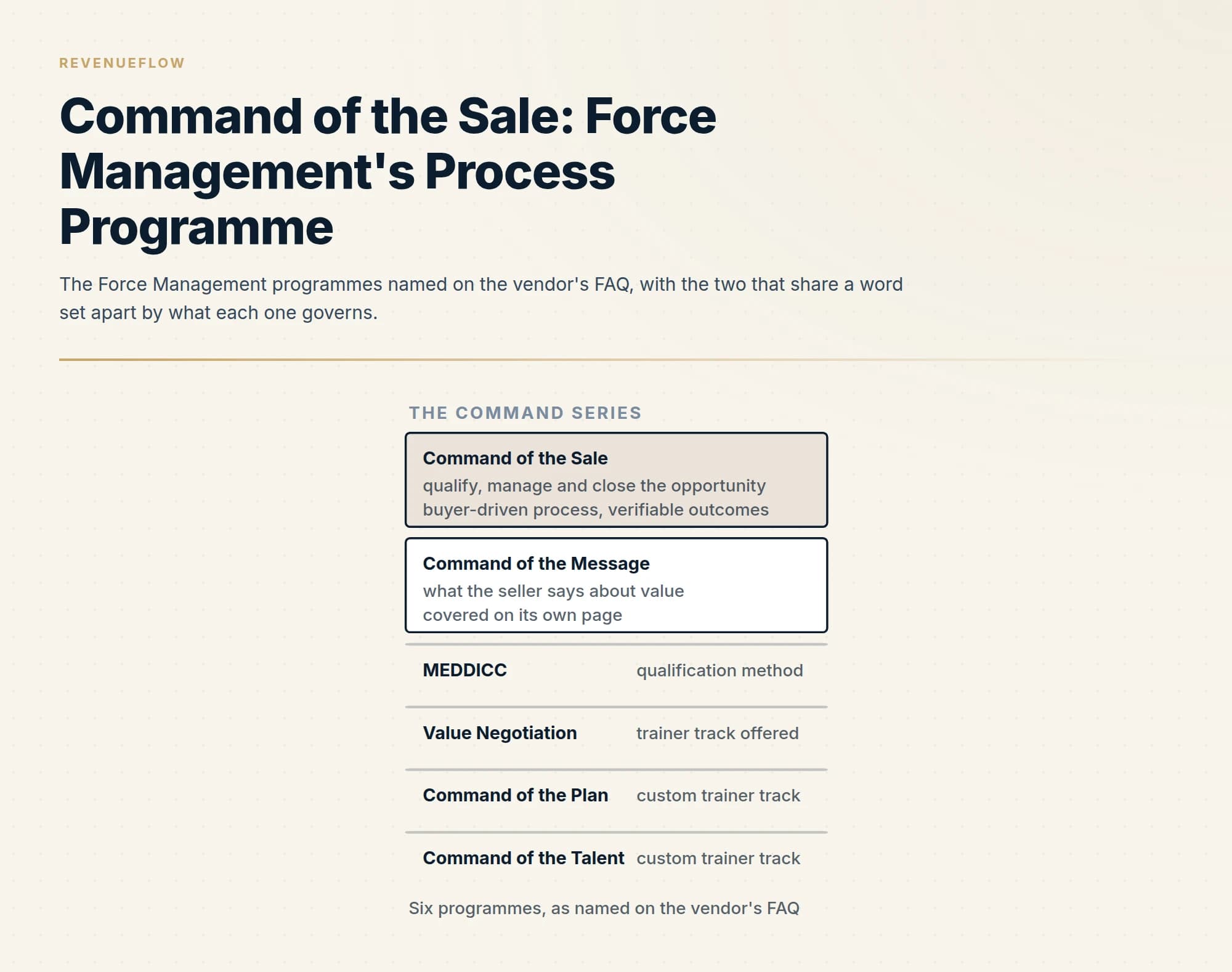
Command of the Sale is Force Management's sales process and qualification programme, defined on its product sheet as a buyer-driven sales methodology that equips reps to consistently qualify, manage and close opportunities. Sales managers and leadership buy it, it is delivered as customised tools including an Opportunity Qualifier, and it runs in three phases: Align and Embed, Deliver, Sustain.
Key takeaways
- It is a different programme from Command of the Message: the messaging programme governs what a seller says about value, Command of the Sale governs how the opportunity is qualified, managed and closed, and the vendor's FAQ lists both as peers in its Command Series.
- The product sheet names the buyers, sales managers, sales operations and leadership, and the sample deliverables, an Opportunity Qualifier, a Value Proposition Tool, a Quote Tool and an ROI Tool, of which only the qualifier is explained on any vendor page.
- The offering page describes a three-phase engagement, discovery that assesses the current process and buyer engagement, delivery of cross-functional training and customised tools, and sustainment through the Ascender platform, plus a train-the-trainer track.
- Everything the vendor describes starts at an opportunity that already exists; the programme says nothing about the message that creates one, and its qualification checks belong after the first conversation, not at list-build time.
Reviewed and updated September 19, 2026
Search for the name and much of what comes back is about a different programme. Command of the Sale is one of two Force Management offerings whose names begin with the same word, and the better-known one, Command of the Message, is about what a seller says. Command of the Sale is about the other side of the job: whether the opportunity in front of that seller is real, how it is moved, and when it is closed or dropped. Read the wrong page and you will come away with a messaging framework when you were looking for a sales process.
This page is about Command of the Sale only, taken from Force Management's own offering page and its own product sheet: what the vendor says the programme is, who it is for, what it delivers, how the engagement runs, where it sits in the vendor's family of programmes, and where a qualification methodology of this shape does and does not fit an outbound motion. The messaging programme has its own page on this site, Command of the Message, and nothing from it is restated here.
What the vendor says it is
Force Management publishes a one-page product sheet for the programme, dated 2024 in its footer and in the file's own metadata, fetched on 19 September 2026. Its headline instruction is to "PROVIDE SALES REPS WITH A BUYER-DRIVEN SALES METHODOLOGY", and the definition follows in the same breath: one "that equips them with the knowledge and tools to consistently qualify, manage, and close sales opportunities."
Three verbs carry that sentence: qualify, manage, close. None of them is about the value story, which is the messaging programme's territory. The offering page on the vendor's site, fetched the same day, puts the same object in organisational terms: "Equip your entire customer-facing organization to efficiently qualify, progress and close sales opportunities." and describes the deliverable as a sales execution plan based on your buyers, with the instruction to "Build a B2B sales process and qualification structure" that is "aligned to how your buyers make decisions and to your tech stack."
The word buyer-driven does specific work. The product sheet names the challenge it answers in a customer's voice: "OUR SALES PROCESS ISN'T ALIGNED WITH THE" customer's buying process. The remedy it offers is a common sales language, processes and tools based on customer-verifiable outcomes: not a stage the seller declares complete, but something the customer did that can be checked. That is the design principle underneath the whole programme, and it is the same principle as writing a pipeline stage as a step a buyer has to complete, which is worked through in the sales process.
Who it is for, and what it delivers
The product sheet names a target group of three: "Sales Managers, Sales Operations Managers," and sales leadership. Reps are the audience the methodology is delivered to; managers and operations are the buyers of it, which matches a programme whose subject is process and qualification rather than individual craft.
It lists sample deliverables by name: an Opportunity Qualifier, a Value Proposition Tool, a Quote Tool and an ROI Tool. Of those four, the sheet explains one. Against the customer challenge "WE DON'T DO A GOOD JOB OF CONSISTENTLY" qualifying sales opportunities, it answers: "Our Opportunity Qualifier resolves the challenge of" "consistently qualifying leads." The vendor's MEDDICC page names the same instrument as part of that programme too, describing sales consumable tools "like Opportunity Qualifiers and Opportunity Coaching Guides to provide a consistent approach for your sales qualification." So the qualifier is the shared object between Force Management's qualification training and its sales process programme, and a buyer evaluating either should ask to see it. What the other three tools contain is not described on any vendor page fetched for this article, so nothing is claimed about them here beyond their names.
The outcomes the sheet promises are a list of six, each a short imperative: "Use a consistent sales language", "Improve your deal velocity", "Win more late stage deals", "Consistently qualify opportunities", "Leverage your internal resources", and aligning the sales process with the customer's buying process. The sheet also says the programme addresses the causes of lengthy sales cycles and will prevent reps from "taking shortcuts during the sales process." No figure accompanies any of these on the sheet, and none is invented here.
The offering page adds the four things the programme focuses on, under the heading of working back from what is most important to the customer: "Gain a comprehensive understanding of how to align sales activities with complicated buying processes", "Define customer outcomes to move an opportunity forward", "Inspect, dissect and analyze current pipeline opportunities to determine what's needed to improve qualification", and "Understand when to walk away from the opportunity". The last of the four is the one to notice. A qualification programme that names walking away as a skill is telling you that its output includes deals removed from the forecast, which is the output a forecast committee actually needs.
How the engagement runs
The offering page describes a three-phase engagement, and the phases are worth having because they say what is bought.
The first is discovery. "Our Command of the Sale methodology starts with discovery, so we can align and embed a solution that will help your company reach the desired outcomes." What is assessed is stated: "We will assess how the sales process is working now, how your buyers engage with your organization and important marketplace dynamics that impact your customer engagement process." The product sheet's curriculum note says the same thing from the tools side: "Then we'll develop customized tools to" "support your sales process, working to integrate" "and leverage your existing tools."
The second is delivery: "When we launch the program to the sales organization, we train your cross-functional teams on aligning your sales process to how your customers buy." and "We roll out the customized tools that will drive execution in the sales organization." Cross-functional is the operative word: the page elsewhere says the process only works when the entire company understands its roles and accountabilities, and the product sheet names undefined roles as one of the three challenges it solves.
The third is sustainment, and it is where the vendor places its own difference: "Our methodology focuses on adoption from the start so immediately after training, the entire company is aligned on the critical steps for sales execution." Reinforcement runs through Ascender, which the page describes as a mobile application and engagement platform giving reps, managers and executives round-the-clock access to content, and which the vendor says powers all of its engagements. The manager's role is named too: "Our methodology plans for adoption at the beginning, ensuring your managers know how to find opportunity gaps early in the forecast, which improves qualification and overall process efficiency."
A fourth element sits outside the three phases. The vendor's FAQ, fetched on 19 September 2026, says its train-the-trainer programme "certifies your designated facilitators to independently train during refresher events, new hire programs, and cross-functional sessions." and lists the programmes it covers: "We offer Train the Trainer (T3) for Command of the Message", MEDD(P)ICC, Command of the Sale and Value Negotiation, with custom-built tracks for Command of the Plan and Command of the Talent. That list is also the clearest statement anywhere on the vendor's site of what the family contains, and it places Command of the Sale as a peer of the messaging programme rather than a module inside it.
Where it sits against MEDDICC and the messaging programme
Force Management also sells MEDDICC training, and the overlap with Command of the Sale is real, because both are about qualification. The vendor's MEDDICC page says the framework "enables your sales team to quickly qualify deals in or out, so sellers can focus on accounts with the highest potential opportunities." and that "It ensures that the way you sell is aligned with the way your customers" buy. The same alignment claim appears on the Command of the Sale sheet.
The difference, on the vendor's own pages, is scope. MEDDICC is a qualification framework: six or seven checks a deal must satisfy, taught as a certification and inspected in pipeline reviews, and what those checks are is set out in MEDDIC and MEDDPICC. Command of the Sale is a sales process programme that includes qualification as one of its parts, alongside roles and accountabilities, hand-offs between departments, the tech stack and the tools reps use to quote and to build a return-on-investment case. The Opportunity Qualifier is the instrument they share.
The relationship to Command of the Message is division of labour. The vendor's tools page describes the whole series as helping organisations "balance an external focus on the customer, with an internal focus on sales management best practices." The messaging programme supplies the words a seller uses about value; the sales programme supplies the process those words are used inside, and the checks that decide whether the opportunity was worth the words. A company that buys one without the other gets either a well-argued story with no way of knowing which deals to tell it in, or a rigorous process with nothing distinctive to say at each step.
Where a programme of this shape fits an outbound motion, and where it does not
Everything the vendor describes operates on an opportunity that already exists. The qualifier is applied to a deal; the process governs a buyer who is already engaging; the walk-away decision presumes something to walk away from. That is the right scope for a sales organisation and the wrong scope for the top of an outbound programme, where the question is not whether a deal is real but whether a stranger is worth a message.
Two boundaries follow. The first is where qualification starts. Budget, authority and timing are facts about a buyer's situation that nobody outside it can observe before a conversation, so a process that scores them at list-build time is inventing them. On this site the criteria that make a booked meeting qualified are agreed in writing before a campaign launches, and budget, timing and authority are never among them; that boundary is the same one the vendor's programme respects by starting at the opportunity. The discovery call is where the first checks the programme cares about can honestly be answered.
The second boundary is the send. A buyer-driven process with a defined cadence of activities is normally distributed through a sequence of touches per prospect. This site runs one message per campaign, with no bumps and no thread replies, and reaches an unresponsive audience again only with a new campaign on a different premise; the argument and its cost are in why we stopped using follow-ups. Nothing on the vendor's pages fetched for this article prescribes a touch cadence, so no disagreement is claimed; the point is that the programme begins after the message has done its work, and a team adopting it still has to decide the message separately.
What to ask before buying it
The vendor's pages give the questions, because they name what is customised and what is standard. Ask to see the Opportunity Qualifier, since it is the one deliverable the sheet explains and the one shared with the MEDDICC programme. Ask which customer-verifiable outcomes the process will be built on for your buyers, because that is the discovery phase's output and the thing that separates this from a generic stage list. Ask how the three remaining tools, the value proposition, quote and ROI tools, are built for your offer, since the vendor's public pages do not describe them. Ask who inside your company will own the process after the sustain phase, because the vendor's own train-the-trainer track exists for exactly that reason. And ask what the programme says about the top of the funnel, because on the vendor's pages the answer is nothing, and that is where most outbound teams are actually short.
- Yes: A discovery phase assessing the current process, buyer engagement and marketplace dynamics
- Yes: Customised tools integrated with the tools you already run, the Opportunity Qualifier among them
- Yes: Cross-functional training on aligning the sales process to how customers buy
- Yes: Reinforcement through Ascender and a train-the-trainer track for internal facilitators
- No: A public description of the value proposition, quote and ROI tools
- No: Any guidance on the cold message that creates the opportunity in the first place
The short version
Command of the Sale is Force Management's sales process and qualification programme, defined on its own product sheet as a buyer-driven sales methodology that equips reps with the knowledge and tools to consistently qualify, manage and close sales opportunities. It is bought by sales managers, operations and leadership, delivered as customised tools including an Opportunity Qualifier, and run as three phases the vendor calls Align and Embed, Deliver and Sustain, with reinforcement through Ascender and a train-the-trainer option.
It is not Command of the Message, which governs what a seller says; it is the process those words are used inside, and the vendor lists both as peers in its Command Series alongside MEDDICC, Value Negotiation, Command of the Plan and Command of the Talent. It starts at the opportunity, which is the right place for a sales organisation and says nothing about the message that creates the opportunity. If the constraint is the number of qualified conversations entering the process rather than the process itself, we plan the first campaign for free.
The definition, target group, sample deliverables, outcomes, challenges and curriculum note are taken from Force Management's Command of the Sale product sheet (PDF, copyright 2024, modified July 2024 in the file's metadata), fetched 19 September 2026. The focus points, the three-phase engagement and the Ascender description are from the vendor's Command of the Sale offering page; the programme family and the train-the-trainer track from its FAQ; the MEDDICC statements from its MEDDICC page; the Command Series description from its tools page, all fetched the same day. Verify current terms with the vendor before relying on them.
Sources: Command of the Sale offering page, Command of the Sale product sheet (PDF), Force Management FAQ, Force Management MEDDICC, Force Management tools and resources
Frequently asked questions.
Frequently asked questions- What is Command of the Sale?
- Force Management's sales process and qualification programme. Its own product sheet, dated 2024, defines it as a buyer-driven sales methodology that equips reps with the knowledge and tools to consistently qualify, manage and close sales opportunities, built on a common sales language and customer-verifiable outcomes. It is sold to sales managers, sales operations and sales leadership and delivered as customised tools and training.
- How is Command of the Sale different from Command of the Message?
- They govern different halves of the job. Command of the Message is about what a seller says about the value of what they sell. Command of the Sale is about the process those words are used inside: whether the opportunity is real, how it is progressed, who owns each hand-off and when to walk away. The vendor lists both as separate programmes on its FAQ and offers train-the-trainer certification for each.
- What does a Command of the Sale engagement include?
- Three phases on the vendor's offering page. Align and Embed is discovery of the current sales process, buyer engagement and marketplace dynamics, producing customised tools. Deliver is training for cross-functional teams on aligning the sales process to how customers buy, with the tools rolled out. Sustain plans adoption from the start, equips managers to find opportunity gaps early in the forecast, and runs reinforcement through Ascender.
- Does Command of the Sale help with outbound prospecting?
- Not directly. The vendor's pages describe a programme that operates on an opportunity that already exists: qualifying it, progressing it, closing it or walking away. The cold message that creates the opportunity is outside its scope, and budget, authority and timing are facts a seller can only observe once a conversation has started. An outbound programme owns fit, agreed in writing before launch; the process programme starts at the first conversation.
About the author.

B2B cold email experts helping companies generate qualified leads through done-for-you outreach campaigns.
RevenueFlow Team
Explore more.
Ready to scale your outreach?
We build GTM engines that book real meetings. See the receipts.
Related articles.
MEDDIC vs BANT: What Each Qualifies and When to Use Which
MEDDIC and BANT from the originators' own text: IBM's BANT form as a gate after the first call, PTC's six themes as an audit of a live deal, and when to run each.
ValueSelling Framework: The Stages and the Prospect Formula
The ValueSelling Framework is a licensed methodology, not the generic idea. Its four stages, the Qualified Prospect Formula and its delivery, from the vendor's pages.
The Urgency Close: Real Deadlines and Manufactured Ones
The urgency close from the publishers who teach it, the test that separates a real deadline from a manufactured one, the structure, and why we never invent one.
Objection Handling Frameworks: LAER, AAA and Others Compared
The named objection-handling frameworks with their publishers quoted: Carew's LAER, RAIN Group's four steps, HubSpot's five, Gong's three and both AAAs.
The Summary Close: Restating What Was Agreed Before the Ask
The summary close restates the buyer's needs, the agreed answer to each and then asks. What the publishers say, the structure, a worked example, and where it fails.
The Columbo Close: One More Thing, and Where It Works
The Columbo close is the question asked from the door once the buyer thinks the selling is over. Its two readings, the buyer it suits, and where it fails.