MEDDIC vs BANT: What Each Qualifies and When to Use Which
MEDDIC and BANT from the originators' own text: IBM's BANT form as a gate after the first call, PTC's six themes as an audit of a live deal, and when to run each.
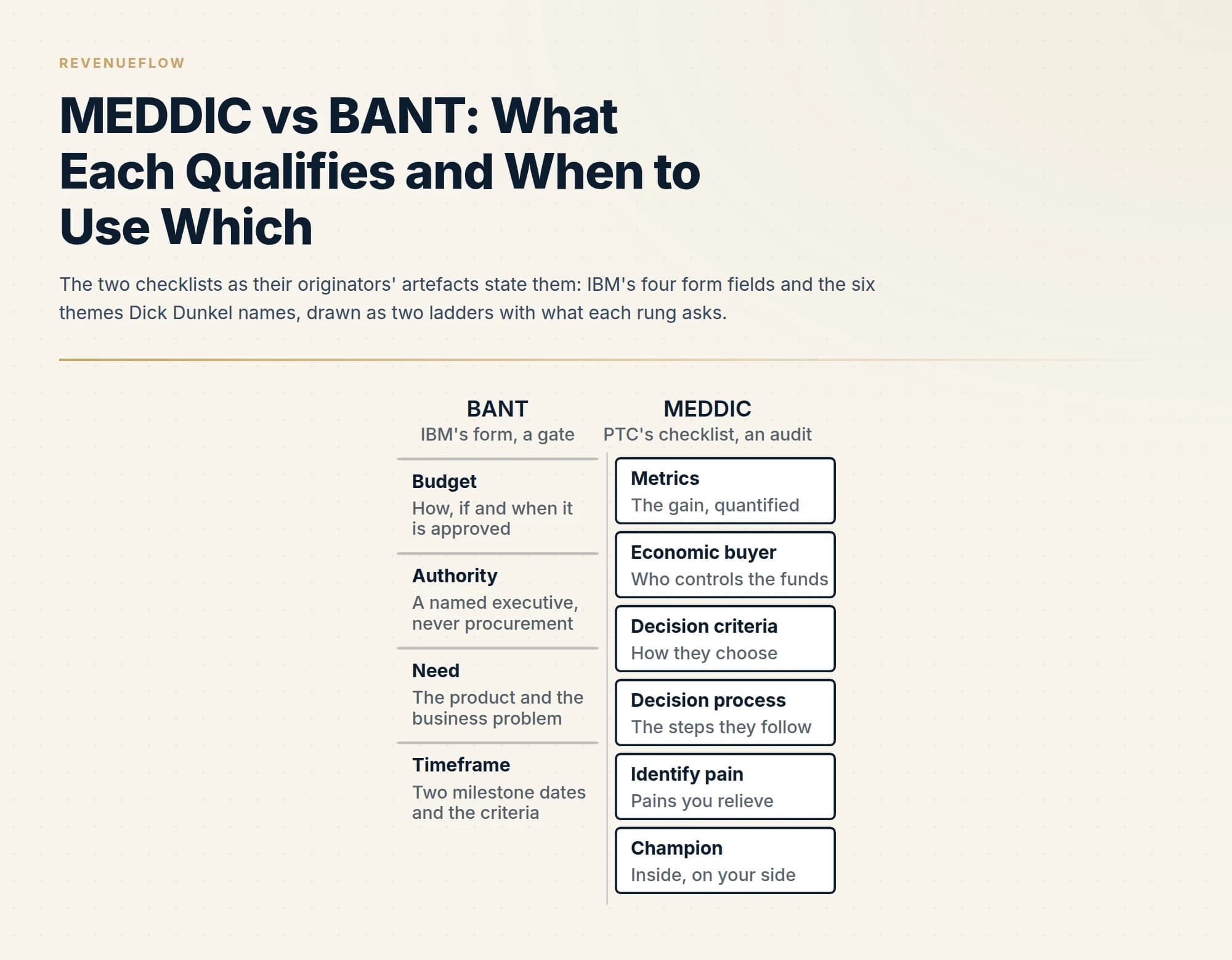
BANT, on IBM's own partner forms, is a gate: after one sales call, describe the budget, name an executive who is not procurement, state the need and give dated milestones, or the opportunity is rejected. MEDDIC, in its creator's words, is six recurring themes of why deals won, lost or slipped, used to grade forecast confidence. BANT first, then MEDDIC.
Key takeaways
- IBM's own BANT Criteria Template defines a validated opportunity as one sales call plus known budget, authority, need and timeframe, rejects records with a field missing, and rules that procurement and purchasing contacts are not valid executive decision makers.
- IBM's form already asks, under Timeframe, for decision milestones and the decision criteria that will be used, so the four-letter gate was reaching for two of MEDDIC's six letters before MEDDIC named them.
- MEDDIC's creator, Dick Dunkel, describes the six themes as recurring answers to why PTC won, lost or slipped deals, and MEDDIC Academy states the checklist's output as a degree of confidence in the sales forecast; the two lineage publishers disagree on the year and the credit.
- The two are not rivals: BANT qualifies whether an opportunity may enter the pipeline, MEDDIC audits whether a deal in it may be forecast, and a team running both draws an explicit line on deal size or on whether a procurement step exists.
Reviewed and updated September 19, 2026
BANT and MEDDIC are usually compared as if they were rival answers to one question, and they are answers to two. BANT, as IBM's own partner forms operate it, is a gate: four things a seller has to know before an opportunity counts as validated. MEDDIC, as the people who built it at PTC describe it, is an audit: six recurring reasons deals were won, lost or slipped, turned into a checklist for deciding which deals to believe. This page sets the two side by side from the originators' own text, says what each qualifies, and says when a team should run one, the other, or both with a line between them.
The wider family, including CHAMP, SPICED and the rest, and the blind spot each one carries, is on sales qualification frameworks; the definitions of each acronym alone are the glossary entries for BANT and MEDDIC. This page stays on the pair and on what the artefacts behind them actually ask for.
BANT as IBM operated it
BANT is attributed to IBM, and IBM's own artefacts for it are still served from the company's public download host. The one this page works from is a partner-programme form titled Budget Authority Need Timeframe (BANT) Criteria Template, version 3.3, a PDF whose metadata dates its creation to January 2013, fetched on 19 September 2026. A second version, for a European government sales programme and dated June 2012 in its title, carries the same four headings. Neither is a definition; both are the form a partner had to fill in for IBM to accept an opportunity, which is a more useful thing than a definition because it shows what the four letters were for.
The 2012 form states the threshold in one sentence: "A validated opportunity is one where you have made at least one sales call and know the customer's Budget, Authority, Need and Timeframe." The 2013 form adds the consequence of leaving a field empty: "Opportunity records lacking descriptions of a Customer's Budget, Authority, Need and Timeframe (BANT) will be rejected as incomplete."
Each letter is then a question on the form, and the questions are narrower than the summaries suggest. Budget: "Describe how / if / when budget has been, or will be, identified and approved for this project." Authority: "Include at least one Customer C-level or Line-of-Business Executive on the Contacts tab in the GPP record.", followed by a rule that survives every later reordering of the acronym: "Procurement and Purchasing contacts are not valid executive decision makers." Need, on IBM's form, is the product being proposed and a section headed business problem asking the partner to describe the customer's problem and the key benefits of the proposed solution. And Timeframe is not one date. The form asks: "What is the timeline of key decision milestones, and what decision criteria will be used?" and requires "at least 2 dates which are important in the customer's decision making."
That last question is the one to notice. IBM's own BANT form, under the letter T, asks for decision milestones and decision criteria, which are two of MEDDIC's six letters. The four-letter checklist as IBM ran it was already reaching for what the six-letter one names.
MEDDIC as the people who built it describe it
MEDDIC has no form of its own. It was an internal training artefact at PTC in the 1990s, and the two organisations that now teach it commercially, both run by people from that lineage, publish accounts of where it came from that agree on the substance and differ on the credit. Like the Agoge sequence, it is a rare named method with an author and a company it was built inside, which makes it unusually easy to check against the summaries.
The creator's own account is a published interview transcript. Dick Dunkel, described by MEDDICC Ltd as the creator of the MEDDIC acronym, told Andy Whyte on the Masters of MEDDICC podcast, published on 4 September 2022 and fetched on 19 September 2026, that the six letters came out of a training exercise he ran with colleagues, built on three questions, why do we win, why do we lose and why do deals slip: "We started to see some recurring themes." The result, in his words: "So we had six things: Metrics, Economic Buyer, Decision Criteria, Decision Process, Pain, and Champions."
MEDDICC Ltd's own history page, published on 13 August 2026, dates that to 1996 and credits Dunkel working under John McMahon alongside Jack Napoli. MEDDIC Academy, founded by Darius Lahoutifard, a former PTC sales leader, publishes a different account on its checklist page, fetched on 19 September 2026: "No one single person. The methodology results from the best practices of the initial sales leaders at PTC, where MEDDIC took shape." It places the work in the early 1990s and names Dunkel and Napoli as the training facilitators who "formalized the initial programs and delivered MEDDIC training to many salespeople during the new hire onboarding". Both accounts put the six themes inside PTC's sales organisation in the 1990s; the reader should know the two publishers disagree on the year and on how much of the credit is one person's.
What the six letters mean is stated most compactly on the MEDDIC Academy page, and its definitions are the ones the diagram above shortens. Metrics: "Quantification of the potential gain and, ultimately, the economic benefit". Economic buyer: "Interaction with the person who has decision control on the funds for the PO". Decision criteria: "Criteria used by the company to make the purchase decision and choose among options". Decision process: "Process defined by the company to reach the purchase decision". Identify pain: "Actual pains at the company that would require your product/service to be relieved". Champion: "Powerful & influential persons at the company who are favorable to your solution".
The same page states what the checklist is for, and it is not the same job as IBM's form: "Reviewing the MEDDIC CHECKLIST will result in an objective assessment of the level of qualification in the sales campaign and the degree of confidence in the sales forecast." The output of MEDDIC is a confidence level on a deal that already exists. The output of BANT, on IBM's form, is a yes or no on whether the opportunity may be registered at all.
What each one qualifies
Put the two artefacts next to each other and the difference is in what they take as given.
IBM's form assumes nothing exists yet. It is filled in after one sales call, it is rejected if a field is blank, and its purpose is to stop a partner registering a name and a hope. Three of its four fields describe readiness, whether money, a decision maker and a date exist, and one describes fit. It is a gate on the way into the pipeline.
MEDDIC assumes the deal exists and asks how much to believe it. Its six themes were extracted from deals that had already been worked to a win, a loss or a slip, and the checklist is applied to deals in the same position. Four of its six letters are about the buying organisation's mechanics, who controls the money, how the decision is made and against what criteria, and who inside is arguing for you; the other two are about the value case. It is an audit of a deal that is already in the pipeline.
That is why the two are not rivals. A team can run BANT at the door and MEDDIC in the room, and many do, whether or not they use either name.
| The question | IBM's BANT form | The MEDDIC checklist |
|---|---|---|
| Is there money? | How, if and when budget is approved | Metrics: the economic benefit, which is what makes money appear |
| Who decides? | One named C-level or line-of-business executive; procurement does not count | Economic buyer, who controls the funds, plus a champion arguing inside |
| Why buy? | The product proposed and the business problem | Identify pain: the actual pains the product relieves |
| How and when? | Two dated milestones and the decision criteria | Decision process and decision criteria, as two separate checks |
| What is the output? | Registered or rejected as incomplete | A degree of confidence in the forecast |
When to use which
The choice is usually presented as a matter of deal complexity, and that is part of it. The other part is stage, and stage decides more.
At the first conversation, BANT. IBM's threshold, one sales call and four things known, is the right amount of qualification for a first conversation, because a first conversation cannot produce six pieces of evidence and should not try. Used as four things to find out rather than four boxes to tick, the checklist organises a new seller's attention. Used as a gate on a database it discards early buyers, which is the failure the glossary entry on BANT sets out.
Once an opportunity exists, MEDDIC. The moment a deal is in the forecast, the question changes from whether it is worth a call to whether it will close, and that is the question the six themes were extracted to answer. A deal that has cleared BANT and cannot name its economic buyer or its decision process is a deal the forecast should not yet count.
Both, with a line between them. The line is drawn on deal size or on whether a procurement step exists, and it should be explicit. Below it, four questions on the first call and a fast yes or no; above it, six fields with evidence in them, inspected outside the pipeline review. The frameworks guide on this site sets out why the inspection matters more than the acronym, and it is the part most teams skip.
Neither, for the message. Both artefacts start after a conversation exists. Nothing in IBM's form or in the six themes reaches back to the first email, because there is no buyer yet to answer any of it.
A deal scored both ways
The example is invented for this page. A seller at a fictional data-quality vendor has had one call with the operations director of a fictional retailer, Harrowgate Stores, who confirmed a budget line for the coming year, said the decision is theirs, described duplicate customer records as the problem, and named March as the target. On IBM's form that is four fields filled and an opportunity registered.
Scored against the six themes the same deal is thin. Metrics: no figure for what duplicate records cost. Economic buyer: the director said the decision is theirs, and nobody has checked whether the funds are theirs to release. Decision criteria and process: unknown, because nobody asked what the retailer will compare vendors on or who else signs. Identify pain: real, in the buyer's words. Champion: the director, possibly, untested. Four of six unanswered, so the deal is registered and not yet forecastable, which is exactly the position the two artefacts were designed to distinguish.
BANT: registered
- Budget a line confirmed for next year
- Authority the director says the call is theirs
- Need duplicate customer records
- Timeframe March named
MEDDIC: not yet forecastable
- Metrics no cost of the problem
- Economic buyer claimed, not checked
- Decision criteria not asked
- Decision process not asked
- Identify pain in the buyer's words
- Champion possibly the director, untested
What an outbound team owes before either
Both checklists begin after a conversation exists, and for a team whose job is to start conversations, the qualification decision that matters most sits earlier and costs less. Our own doctrine is that a meeting is qualified against criteria agreed in writing before a campaign launches, and that budget, timing and authority are never billing conditions: a real conversation with the right person is the thing the campaign produces, and it should not be argued away afterwards because the buyer's budget line is next year's. That written definition is neither BANT nor MEDDIC; it is the sentence that decides which conversations reach the person who will run them. Our campaigns send one message per person, on one premise, with nothing scheduled behind it, so the conversation either starts on the reply or it does not, and no checklist is applied to silence. The questions that test each of the five things are its raw material, and the discovery call is where the four questions get asked and where the six themes start to fill in.
One more thing IBM's form says that belongs in any outbound team's rules: a validated opportunity needs at least one sales call. Marketing campaign and seminar leads are not applicable as validated opportunities, in the 2012 form's words, and neither is a reply. A reply is the start of the conversation in which qualification happens; it is not the qualification. If the constraint is that too few of those conversations start, a first campaign is where that is fixed, and the checklist comes after.
The short version
BANT, on IBM's own partner forms, is a gate: after one sales call, describe how budget is approved, name an executive who is not procurement, state the product and the business problem, and give at least two dated decision milestones and the decision criteria, or the opportunity is rejected. MEDDIC, in its creator's words, is the six recurring themes of why PTC won, lost or slipped deals, and MEDDIC Academy states its output as a degree of confidence in the forecast. Run BANT at the first conversation, MEDDIC once the deal exists, both with an explicit line on deal size, and neither before a buyer exists to answer.
Every quotation above is from the named source as fetched on 19 September 2026: IBM's BANT Criteria Template v3.3 (PDF metadata dated January 2013) and the EMEA government BANT form (dated June 2012 in its title) on public.dhe.ibm.com; MEDDIC Academy's checklist page (undated); MEDDICC Ltd's history page (published 13 August 2026) and its Dick Dunkel interview transcript (published 4 September 2022). Publishers revise these pages; confirm the current text before relying on it.
Frequently asked questions.
Frequently asked questions- What is the difference between MEDDIC and BANT?
- They answer different questions. BANT, as IBM's partner forms operate it, is a gate applied after one sales call: budget, an executive with authority, the need and a dated timeframe, or the opportunity is rejected as incomplete. MEDDIC, as its creator describes it, is six recurring themes from won, lost and slipped deals, used as a checklist to grade how much confidence a forecast should place in a deal that already exists.
- Which is better for a small sales team, MEDDIC or BANT?
- Stage decides more than team size. At the first conversation four questions are the right amount of qualification, and IBM's own threshold is one call and four things known. Once a deal is in the forecast the question changes to whether it will close, which is what MEDDIC's six themes were extracted to answer. Below a deal size every team can feel, running six evidential fields costs more than the deals justify.
- Can you use MEDDIC and BANT together?
- Yes, and many teams do without using either name: BANT at the door, MEDDIC in the room. The line between them should be explicit and drawn on deal size or on whether a procurement step exists. Below it, four questions on the first call and a fast yes or no; above it, six fields with evidence in them, inspected outside the pipeline review rather than filled in for it.
- Who created BANT and who created MEDDIC?
- BANT is attributed to IBM, whose own BANT Criteria Template forms, dated 2012 and 2013, are still served from its public download host. MEDDIC took shape inside PTC's sales organisation in the 1990s: MEDDICC Ltd credits Dick Dunkel in 1996, working under John McMahon alongside Jack Napoli, while MEDDIC Academy says no single person created it and names Dunkel and Napoli as the trainers who formalised it.
About the author.

B2B cold email experts helping companies generate qualified leads through done-for-you outreach campaigns.
RevenueFlow Team
Explore more.
Ready to scale your outreach?
We build GTM engines that book real meetings. See the receipts.
Related articles.
Command of the Sale: Force Management's Process Programme
Command of the Sale is Force Management's sales process and qualification programme, not its messaging one. What the vendor says it is, delivers and how it runs.
ValueSelling Framework: The Stages and the Prospect Formula
The ValueSelling Framework is a licensed methodology, not the generic idea. Its four stages, the Qualified Prospect Formula and its delivery, from the vendor's pages.
Objection Handling Frameworks: LAER, AAA and Others Compared
The named objection-handling frameworks with their publishers quoted: Carew's LAER, RAIN Group's four steps, HubSpot's five, Gong's three and both AAAs.
The Urgency Close: Real Deadlines and Manufactured Ones
The urgency close from the publishers who teach it, the test that separates a real deadline from a manufactured one, the structure, and why we never invent one.
The Summary Close: Restating What Was Agreed Before the Ask
The summary close restates the buyer's needs, the agreed answer to each and then asks. What the publishers say, the structure, a worked example, and where it fails.
B2B Sales for Financial Services Companies: Regulated Seller
For the bank, agency, broker-dealer or adviser selling to businesses: the buying group, the credit and renewal windows, and the rules that bind the seller's own message.