Sales Qualification Frameworks: What Each One Cannot See
BANT, CHAMP, MEDDIC and MEDDPICC test a subset of the same five questions. What each one checks, what each is blind to, and the part that decides whether it works.

Sales qualification frameworks are checklists for deciding whether an opportunity deserves a seller's time, each a subset of five tests: a felt problem, its cost, the ability to fund a fix, who has to agree, and a reason to act now. BANT, CHAMP, MEDDIC, MEDDPICC and SPICED differ in which they keep.
Key takeaways
- Every sales qualification framework is a selection from five tests plus an argument about order, so the choice is smaller than the acronyms suggest.
- CHAMP stands for Challenges, Authority, Money and Prioritisation: BANT reordered to lead with the problem, with money asked as the ability to fund a fix.
- MEDDICC's own history page says MEDDIC was created in 1996 inside PTC by Dick Dunkel, working under John McMahon alongside Jack Napoli; MEDDPICC later added Paper Process.
- A framework works when each criterion is a field holding evidence, such as a name, a date or a quotation, read outside the pipeline review.
Reviewed and updated September 21, 2026
A sales team adopts MEDDIC in January. By June the CRM carries six new required fields, the pipeline review has a new vocabulary, and the forecast is exactly as accurate as it was in December. Nobody lied and nobody skipped the training. The framework was adopted as a set of boxes rather than as a set of tests, and a box that gets filled in is not evidence of anything.
The sales qualification frameworks in circulation are not competing theories of selling. They are arguments about which check a seller most often skips, and each one asks a subset of the same five questions. Understanding what each one tests, and more usefully what each one is blind to, makes the choice smaller and the implementation the part worth thinking about.
What are sales qualification frameworks?
Sales qualification frameworks are checklists for deciding whether an opportunity deserves a seller's time. Each one is a subset of five tests: a felt problem, its cost, the ability to fund a fix, who has to agree, and a reason to act now. BANT, CHAMP, MEDDIC, MEDDPICC and SPICED are the common ones, and they differ in which tests they keep and in what order. BANT, the shortest, asks about Budget, Authority, Need and Timing.
The oldest of the evidential family has a documented origin. MEDDICC's own history page says MEDDIC was created in 1996 inside PTC by Dick Dunkel, working under SVP John McMahon alongside teammate Jack Napoli, and its glossary expands MEDDPICC as Metrics, Economic Buyer, Decision Criteria, Decision Process, Paper Process, Implicate the Pain, Champion and Competition, noting that MEDDICC added Competition and MEDDPICC added Paper Process. SPICED is Winning by Design's framework, and its page expands the acronym as Situation, Pain, Impact, Critical Event and Decision.
The five questions underneath every framework
Strip the acronyms and the same five tests appear, in different orders and with different weights.
Is there a problem, and is it felt by someone rather than merely present in the market. Is that problem worth more than the cost of fixing it. Can this organisation fund a purchase of this size, which is a different question from whether a budget line already exists. Who has to agree, which in most B2B purchases is a group rather than a person. And is there a reason to act now rather than next year.
Every named framework is a selection from that list plus an argument about ordering. Once you can see the five, the letters stop being the point.
BANT
- A felt problem: Need
- What it costs: none
- Ability to fund: Budget, as allocation
- Who has to agree: Authority, one name
- A reason to act now: Timing
- Can it be won: none
CHAMP
- A felt problem: Challenges
- What it costs: none
- Ability to fund: Money
- Who has to agree: Authority
- A reason to act now: Prioritisation
- Can it be won: none
MEDDPICC
- A felt problem: Implicate the Pain
- What it costs: Metrics
- Ability to fund: Economic Buyer
- Who has to agree: Decision Process
- A reason to act now: none
- Can it be won: Competition
SPICED
- A felt problem: Pain
- What it costs: Impact
- Ability to fund: none
- Who has to agree: Decision
- A reason to act now: Critical Event
- Can it be won: none
Three more appear often enough to place. NEAT leads with need and economic impact and is closest to CHAMP in spirit. ANUM puts authority first, which suits a market where reaching the right person is the hard part. SPICED, Winning by Design's framework, adds a critical event as a named criterion, which its page defines as the deadline, milestone, or external force that creates urgency, and that single addition is the sharpest answer to the timing question any of them offers. The four arguments that group all sixteen named methodologies places the qualification family against the conversation, posture and account-selection families, which is the wider map this page sits inside.
What does the CHAMP sales qualification framework mean?
The CHAMP sales qualification framework stands for Challenges, Authority, Money and Prioritisation. It is BANT reordered to lead with the problem: the challenge is asked first, money is asked as the ability to fund a fix rather than an allocated budget line, and timing becomes prioritisation, a rank against everything else the buyer has on. Its fuller treatment is in the CHAMP sales qualification framework guide.
The reordering is the whole point, and it only works if it is taught. A team that recites CHAMP's letters in BANT's order has renamed its checklist and changed nothing.
Where each one is blind, stated plainly
The blind spots are more useful than the criteria, because a framework's criteria tell you what a team will discuss and its blind spots tell you what will surprise them in month four.
BANT's blind spot is the buying group. Its authority criterion reduces to one name, and most B2B purchases above a modest size are decided by a group with a procurement step behind it. A deal that passes BANT can still fail because the one named person was never able to carry it alone.
BANT's second blind spot is a fit problem disguised as a readiness problem. Three of its four letters describe readiness and only one describes fit, so a good-fit company with no allocated budget today gets marked unqualified and disappears. That is a targeting asset filed as a rejection, and it is the most expensive routine error in the whole area. Qualification's two questions separate them.
CHAMP's blind spot is process. Leading with the challenge fixes the interrogation problem that leading with budget creates, and it says nothing about how the purchase gets approved once the challenge is agreed. In an enterprise deal that is where the time goes.
MEDDIC's blind spot is upstream. It scores an opportunity that already exists and asks nothing about whether the opportunity should have been created. A team can score every deal rigorously and still spend the quarter on accounts that were never a fit.
Every framework's shared blind spot is the competitive one. Only SCOTSMAN's extra letters and MEDDPICC's added competition criterion ask whether a real deal is a winnable one. A qualified deal you lose is a different failure from a deal that was never real, and a framework carrying no competitive criterion cannot tell them apart.
Choosing one, in the order that actually decides it
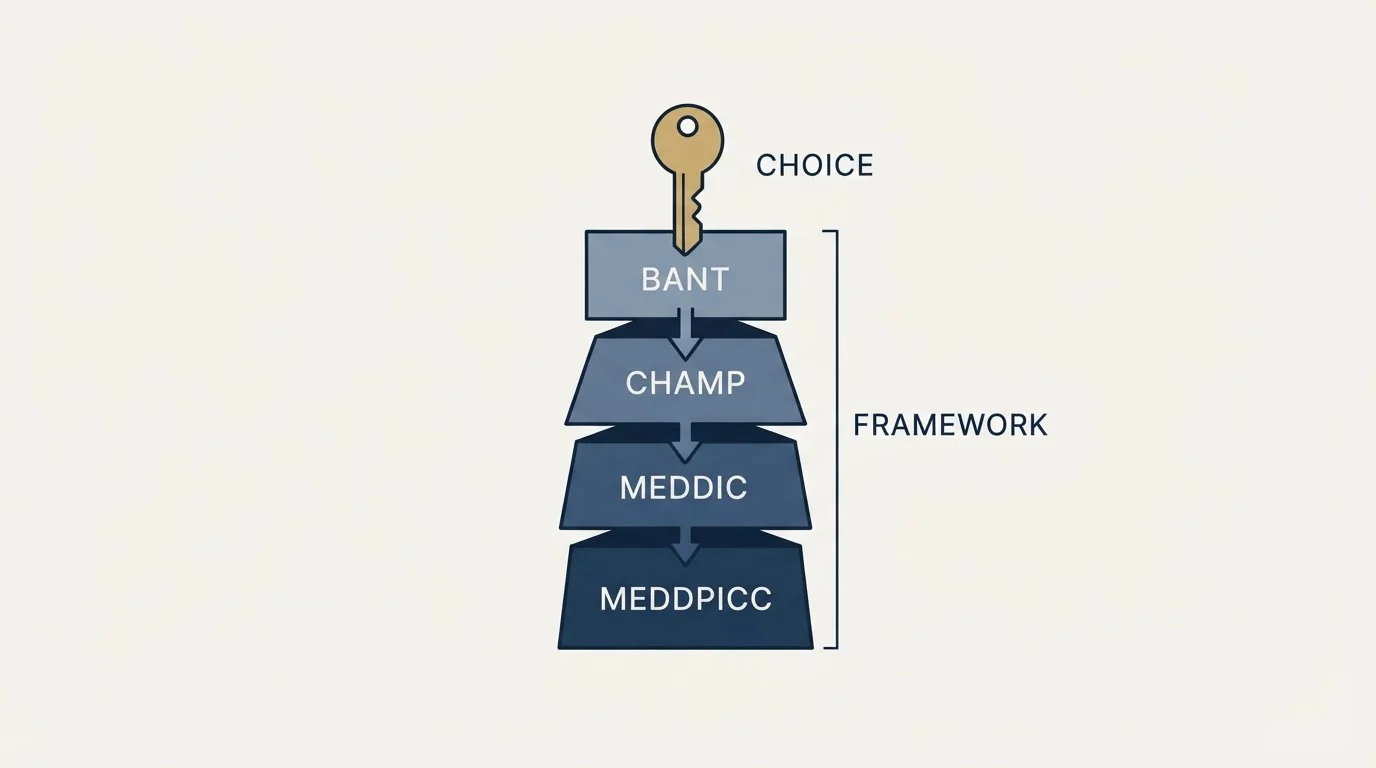
The published advice is to match the framework to deal complexity and cycle length. That produces a shortlist. Three questions produce a choice.
A yes to the first two points at the evidence-heavy end, MEDDIC or MEDDPICC, because the failure is that opportunities were forecast without proof. A yes to the third points at a framework that treats authority as a group rather than a name, which in practice means MEDDIC's economic buyer and champion criteria rather than BANT's single approver. A yes to the fourth is a process problem before it is a methodology problem, and adopting a framework to fix it will produce the CRM-fields outcome described at the top of this page.
A yes to the fifth is the one worth pausing on. It means the stages have no exit criteria, and a methodology cannot supply those, because stages are specific to your company and a framework is portable by design.
Deal size settles the rest of it. Below a threshold every team can feel, the evidential frameworks cost more to run than the deals justify: a seller collecting six pieces of evidence on a purchase that closes in three calls is spending the margin on the paperwork. Above it the reverse holds, and a four-letter checklist gives a forecast committee nothing to inspect. Teams that run both motions are usually better served by two frameworks with an explicit line between them than by one stretched across the range, and the line is drawn on deal size or on whether a procurement step exists rather than on which team the seller sits in.
One further constraint decides more than the acronym does. A framework is only as good as the coaching apparatus behind it, and the published ones supply none. BANT, CHAMP, MEDDIC and SPICED are free, documented and unsupported: you get a checklist and a vocabulary, and you supply the examples, the coaching and the inspection. The licensed programmes sell that apparatus, which is the actual thing being bought. If nobody internally will run the reviews, the free framework will not be run either, and choosing between them on rigour alone misses what the money is for.
The part that decides whether it works: recording it as fields
This is where adoption is actually won or lost, and it usually gets a paragraph where it deserves a section.
A framework becomes real when its criteria are CRM fields with evidence in them, and it stays decorative when they are talking points in a review. The difference is narrow and it is mechanical.
Each criterion is one field, and the field holds evidence rather than a judgement. A checkbox marked yes for economic buyer records that somebody felt confident. A text field holding the name and title of the person, and the date they were on a call, records something a second reader can check.
Quote the buyer rather than paraphrasing them. A quotation can be re-read later by somebody who was not on the call. A paraphrase cannot be checked at all, and it is the paraphrase that survives into the forecast.
Fields are inspected in the review, not filled in for it. If the first time anyone reads a qualification field is the pipeline review, the field is being written to pass the review. The inspection has to be occasional and unannounced for the values to mean anything.
Empty is a permitted answer with a consequence. A framework where every field must be populated to advance a stage produces populated fields. One where an empty field means the deal cannot be forecast produces honest ones.
Opportunity record: qualification fields
Economic buyer: Yes 1
Economic buyer: [name], [title], on the call of [date] 2
Pain, in the buyer's words: "[the sentence they said]" 3
Decision process: empty, so the deal is not forecast 4
- 1A checkbox marked yes records that somebody felt confident.
- 2A name, a title and the date they were on a call can be checked by a second reader.
- 3A quotation can be re-read later by somebody who was not on the call; a paraphrase cannot.
- 4Empty is a permitted answer with a consequence, which keeps the other fields honest.
What an outbound team needs before any of this

Everything above assumes a conversation is already happening. For a team running outbound, the qualification decision that matters most sits earlier and is cheaper to get right: what makes a booked meeting worth accepting.
That test is not a framework, it is a short written definition agreed before launch, and it is the difference between a meeting count and a pipeline. The questions that test each of the five things are the raw material for it, and the discovery call is where the deeper version gets applied. RevenueFlow's own doctrine is that meetings are qualified against criteria agreed in writing before a campaign launches, and that budget, timing and authority are never billing conditions, because a real conversation with the right person should not be argued away after the fact. If the constraint is that too few of those conversations are starting, our free campaign is where that gets addressed rather than in a framework.
Where we differ from standard practice
The usual framing presents these as rival systems and asks which is best. Our reading is that the differences between them are small next to the difference between a framework that is inspected and one that is recited, so the choice deserves an afternoon and the implementation deserves a quarter.
The second difference concerns disqualification. Most treatments measure a framework by how many good deals it keeps. The more useful measure is how quickly it removes a deal that will not close, because a fast clean no costs a fraction of the time a slow maybe does, and a team measured only on qualified volume will keep marginal deals alive and make the forecast worse.
The short version

Every qualification framework is a selection from five tests: a felt problem, its cost, the ability to fund a fix, who has to agree, and a reason to act now. BANT is a first-conversation checklist blind to the buying group and prone to disqualifying good-fit companies who are merely early. CHAMP reorders it to lead with the problem and says little about the approval process. MEDDIC and MEDDPICC raise the evidential bar for a deal that already exists and ask nothing about whether it should have been started. SCOTSMAN and MEDDPICC are the only common ones that test winnability.
Choose against the deals you lost rather than the ones you won, then spend the real effort on making the criteria fields that hold evidence and get read outside the pipeline review. A framework that is recited changes the vocabulary. One that is inspected changes the forecast.
Frequently asked questions.
Frequently asked questions- What are sales qualification frameworks?
- They are checklists for deciding whether an opportunity deserves a seller's time. Each one tests a subset of the same five things: a felt problem, what it costs, the ability to fund a fix, who has to agree, and a reason to act now. BANT, CHAMP, MEDDIC, MEDDPICC and SPICED are the common ones, and they differ in which tests they keep.
- What does CHAMP mean in sales qualification?
- CHAMP stands for Challenges, Authority, Money and Prioritisation. It reorders BANT to lead with the buyer's problem, asks about money as the ability to fund a fix rather than an existing budget line, and replaces timing with prioritisation, a rank against everything else on the buyer's plate. It says little about how a purchase gets approved.
- Who created MEDDIC?
- MEDDICC's own history page says MEDDIC was created in 1996 inside PTC by Dick Dunkel, working under SVP John McMahon alongside teammate Jack Napoli. The same firm's glossary says MEDDICC later added Competition and MEDDPICC added Paper Process, which is why the longer acronyms test winnability and the path from decision to signature.
- Which sales qualification framework should we use?
- Choose against the deals you lost last quarter. Late stalls or no budget path point at MEDDIC or MEDDPICC; one enthusiastic contact points at economic buyer and champion criteria; a forecast wrong in one direction is a process problem first. Then make each criterion a field that holds evidence, and read it outside the pipeline review.
About the author.

B2B cold email experts helping companies generate qualified leads through done-for-you outreach campaigns.
RevenueFlow Team
Explore more.
Ready to scale your outreach?
We build GTM engines that book real meetings. See the receipts.
Related articles.
BANT vs MEDDPICC: Four Letters Onto Eight, From the Sources
BANT against MEDDPICC from the two artefacts behind them: IBM's own form and the MEDDPICC publisher's own mapping of four letters onto eight, and the deal each fits.
SDR Outsourcing for Financial Services: The Third Party
What a bank, broker-dealer, adviser or agency's regulators say about an outside team that speaks for it, the licensed line, and which arrangement survives due diligence.
SDR Outsourcing for Business Brokers: The Fee Timing
Whether a success-fee brokerage should rent sales development at all: the fee timing, the texts that limit what an outside person may say about value, and who signs.
Appointment Setting for Business Brokers: The Seller Meeting
What a bought meeting with a business owner has to be for a brokerage: the three-part qualification, the confidentiality rules, the licence line and the owner's reasons.
SDR Outsourcing for Logistics Companies: The Brokerage Line
What an outside sales development team may do in a freight company's name, the calling and email rules it inherits, and which arrangement survives a bid-shaped market.
B2B Lead Lists for Aviation Companies: Build or Buy
Aviation is one of the few industries whose accounts are published by its regulator, which changes what is worth buying and what is worth downloading yourself.