BANT vs MEDDPICC: Four Letters Onto Eight, From the Sources
BANT against MEDDPICC from the two artefacts behind them: IBM's own form and the MEDDPICC publisher's own mapping of four letters onto eight, and the deal each fits.
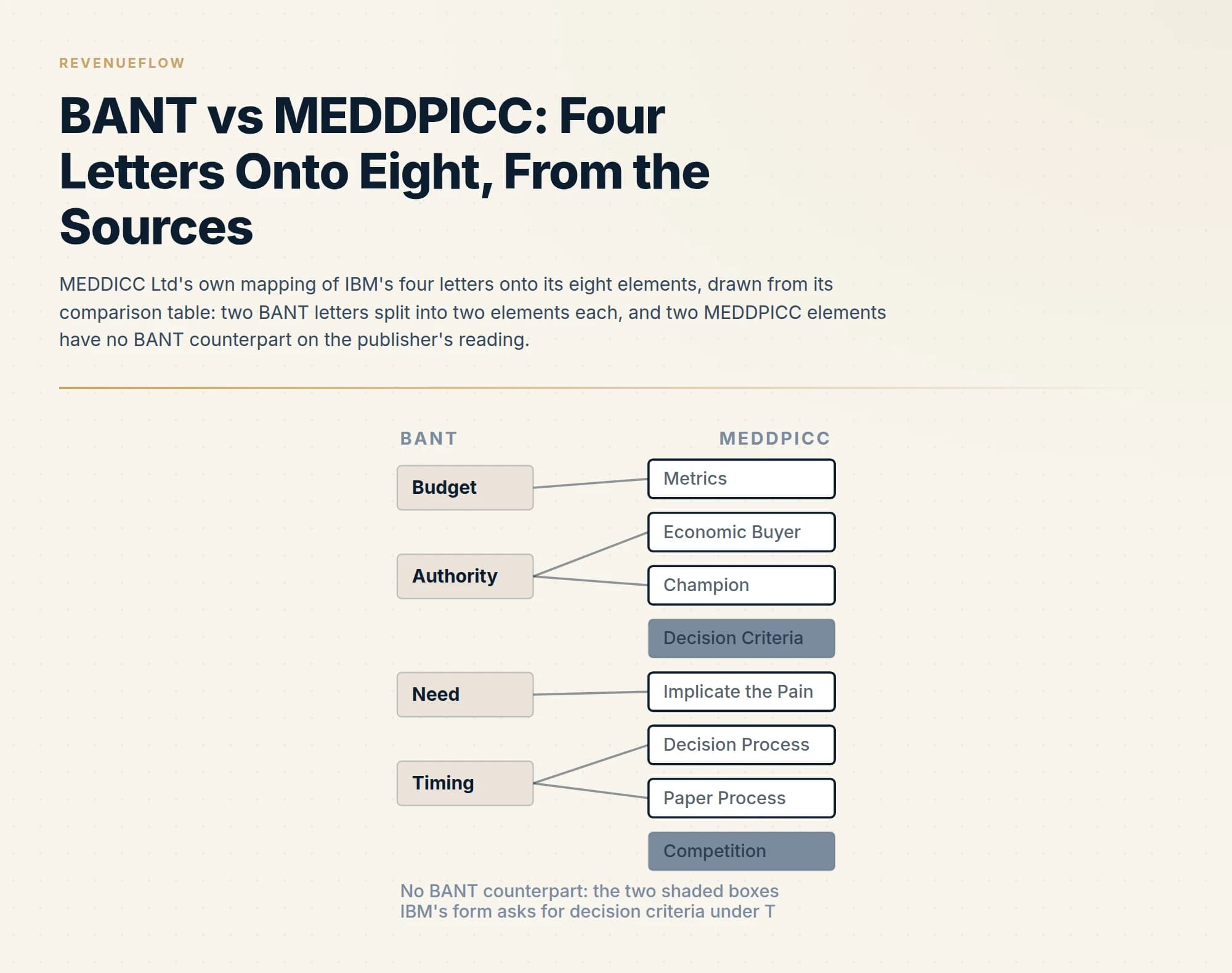
BANT is IBM's four-field registration form, a gate after one sales call. MEDDPICC is the MEDDPICC publisher's eight elements, reworked from discovery through the paper process. The publisher's own mapping sends Budget to Metrics, Authority to the Economic Buyer and Champion, Need to Implicate the Pain and Timing to the Decision and Paper Processes, leaving Decision Criteria and Competition unmatched.
Key takeaways
- IBM's own BANT form rejects an opportunity with a blank field after one sales call; MEDDICC Ltd's frameworks page says its method treats qualification as a continuous process across the whole deal.
- MEDDPICC adds Paper Process, Implicate the Pain and Competition to the six-letter version, each with its own page on the publisher's site, and none has a field on IBM's form.
- The publisher's mapping table splits Authority into Economic Buyer and Champion and Timing into Decision Process and Paper Process, and marks Decision Criteria and Competition as having no BANT equivalent; IBM's form in fact asks for decision criteria under T.
- The publisher recommends BANT for high-volume inbound and short-cycle deals and MEDDPICC for complex enterprise deals, and says teams use both in sequence; the four BANT answers become the first entries in four MEDDPICC fields.
Reviewed and updated September 21, 2026
BANT and MEDDPICC are usually compared by people who sell neither, which is why the comparisons read alike. This one has a better source: the publisher of MEDDPICC put its own comparison with BANT on the record, with a table mapping IBM's four letters onto its eight, and IBM's own BANT form is still served from the company's public host. This page sets those two artefacts side by side, takes the mapping from the MEDDPICC publisher's own text with every statement it makes about BANT labelled as a rival's description, says what deal shape each frame was published for, and sets out what a team keeps when it moves from one to the other. It ranks nothing. The six-letter comparison, MEDDIC against BANT from the PTC lineage that built MEDDIC, is on MEDDIC vs BANT; the two acronyms defined alone are the glossary entries for BANT and MEDDPICC, and neither is restated here.
Two artefacts, not two philosophies
BANT has a form. IBM's Budget Authority Need Timeframe Criteria Template, version 3.3, a PDF whose metadata dates its creation to 3 January 2013 and which was fetched from IBM's public download host on 21 September 2026, is the document a partner had to complete before IBM would accept an opportunity, and it states the consequence of a gap in one line: "Opportunity records lacking descriptions of a Customer's Budget, Authority, Need and Timeframe (BANT) will be rejected as incomplete." The 2012 European version of the form (dated June 2012 in its title) sets the threshold as at least one sales call made and four things known. The four letters, as IBM ran them, are a gate on the way into a pipeline, and the field-by-field walk through the form is on the six-letter comparison linked above.
MEDDPICC has a publisher. MEDDICC Ltd, founded by Andy Whyte, maintains a page for each of its eight elements, and its comparison page (published 22 August 2022, modified 11 August 2026) describes the family as one line of descent, MEDDIC, MEDDICC and MEDDPICC, "each a progression of the same methodology, with MEDDPICC being the most complete version for complex enterprise sales." The eight elements, in the publisher's own names, are Metrics, Economic Buyer, Decision Criteria, Decision Process, Paper Process, Implicate the Pain, Champion and Competition.
That difference in kind decides most of what follows. A form is filled in once and accepted or rejected. A set of elements with a publisher behind it is meant to be reworked for as long as the deal lasts, which is the claim the publisher makes on its frameworks page (published 5 September 2022, modified 13 August 2026): "MEDDICC treats qualification as a continuous process that runs throughout the entire deal lifecycle."
What MEDDPICC adds to the six-letter version
Against MEDDIC, MEDDPICC adds a P and a second C, and it renames the letter for pain. Each has its own page on the publisher's site, and each is what a BANT reader is least likely to have seen.
Paper Process. "The Paper Process is the series of steps that follow the Decision Process, detailing how you will go from decision to signature." The page names three parts, process, people and timing, and the reason for separating it from the decision: even after the champion and the economic buyer have agreed to buy, "the deal can stall in legal review, security sign-offs, vendor questionnaires, or Master Service Agreement (MSA) negotiations." The plan that carries a deal through that stretch with the buyer's own dates on it is the mutual action plan.
Implicate the Pain. The pain element in the publisher's rendering is three stages rather than one: identify, indicate, implicate. Its page states why identifying is not enough: "Once we identify a problem the customer is facing, AKA the pain, it isn't enough to simply point it out." A customer who does not feel the consequences of the problem has no urgency to solve it.
Competition. "Competition refers to any person, vendor, or initiative competing for the same funds or resources you are." The page lists four kinds, rivals, self-build, other initiatives and inertia, and names the one that decides most deals: "whether that be your usual rivals or your customer simply choosing to do nothing instead."
None of the three has a field on IBM's form, and one of them, the paper process, is a stretch of the deal a registration form cannot see because it happens after the form has done its job.
The publisher's own mapping of four letters onto eight
MEDDICC Ltd's comparison page opens by conceding BANT its purpose: "BANT is designed to answer one question quickly: is this worth pursuing past a first conversation?" Its position is stated in two sentences: "The problem isn't that BANT is wrong. It's that BANT is limited, and those limits show up fast in complex, enterprise B2B sales." Everything the page says about BANT from that point is the MEDDPICC publisher describing a rival, and the table below carries it as such.
The page then publishes a mapping table. Budget maps to Metrics, with the note that "MEDDPICC goes further. It ties value to quantified business outcomes, not just budget availability". Authority maps to two elements at once, because "MEDDPICC separates the person with budget authority from the internal advocate driving the deal". Need maps to the pain element, where "MEDDPICC treats pain as something to be developed and implicated, not just confirmed". Timing maps to two elements as well: "MEDDPICC breaks timing into two distinct tracks: the decision and the paperwork that follows". Two elements are left with a dash in the BANT column. Decision Criteria: "No BANT equivalent. How the deal gets evaluated is invisible in BANT". Competition: "No BANT equivalent. BANT doesn't account for alternatives or status quo".
One of those two dashes deserves a note from the other artefact. IBM's own form, under the letter T, asks: "What is the timeline of key decision milestones, and what decision criteria will be used?" So the form IBM actually ran did ask for decision criteria, inside its timeframe field. The publisher's dash is accurate about BANT as the four-word summary is usually taught, and inaccurate about BANT as IBM's own partner programme operated it. The competition dash stands on both readings: nothing on IBM's form asks what else the customer is considering.
The deal shape each was published for
The two artefacts were written for different sales and say so.
IBM's form was written for a partner registering an opportunity in a software programme: one call made, four fields filled, a forecast close date at least fifteen days out, and rejection if any field is blank. It is a threshold for entering a pipeline, and it was operated by a vendor whose partners sold to organisations it wanted registered accurately. Speed is the point. Salesforce's own comparison of BANT with MEDDIC (published 29 April 2024), a third party on both frames, reads the four letters the same way: "Speed and efficiency are the cornerstones of the BANT methodology."
MEDDPICC, in its publisher's words, is for the other end of the scale. The comparison page's recommendation: "Use BANT if you're qualifying high volumes of inbound leads or running short-cycle, transactional deals where speed matters more than depth." and use MEDDPICC for complex solutions sold to enterprise buyers, multi-threaded deals and a forecast leadership can trust. The same page names the point at which the four letters stop working, in the publisher's own terms: for a team running six-figure deals with long cycles and many decision-makers, "BANT stops being a qualification methodology and starts being a false sense of security."
Salesforce's checklist for choosing lists the variables a team weighs: the sales team's experience, the deal cycle, the customers, the product's complexity, and whether the CRM can track the extra fields. On the customers: "BANT is an ideal methodology if you primarily sell to small and mid-sized businesses." Its conclusion is that a team need not choose, and that one common design uses BANT for initial qualification and MEDDIC criteria on the segment that clears it.
BANT, as IBM's form ran it
- One sales call made before the form is filled
- Four fields described, or the record is rejected
- A forecast close date at least fifteen days out
- High-volume inbound and short-cycle deals, per the publisher
MEDDPICC, as its publisher recommends it
- Complex solutions sold to enterprise buyers
- Multi-threaded deals with many decision-makers
- A forecast leadership can trust
- Reworked from discovery through the paper process
What a team keeps when it moves from one to the other
The MEDDPICC publisher's own account of the transition is that the four answers are not thrown away. On its frameworks page: "SDRs use BANT to get an initial read on an opportunity before passing it to a seller, who then applies MEDDICC to work the deal." And on its comparison page: "Some teams use BANT at the top of the funnel and MEDDPICC to run deals from discovery through close."
Read against the mapping, what is kept is concrete. A budget answer becomes the first entry in a Metrics field, to be replaced by the buyer's quantified outcome. An authority answer becomes two candidate names, one for the economic buyer and one for the champion, each to be tested rather than assumed. A need answer becomes the first of the three pain stages, identified and not yet implicated. A timeframe answer, and on IBM's form its two milestone dates and its decision criteria, becomes the seed of the Decision Process and Decision Criteria fields, with the Paper Process still to be discovered. Three fields start empty: the criteria the buyer will score on if the BANT reader only had a date, the competition including doing nothing, and the paper process.
What changes more than the fields is the discipline. The frameworks page names the failure both frames share when they are run badly: "junior sellers treat them as checklists to interrogate customers with, rather than guides for having better conversations." A team moving from four fields to eight has doubled the number of things it can interrogate a buyer about, and the publisher's advice is that none of them is asked as a list. The questions that fill each field without reading as an interrogation are sorted by what they test on sales qualifying questions, and the wider map of frameworks and the blind spot each carries is on sales qualification frameworks.
A budget line is replaced over the deal by the quantified outcome the buyer expects, in the publisher's phrase value tied to business outcomes.
One candidate economic buyer and one candidate champion, separated because the publisher separates the person with budget authority from the internal advocate.
To indicate the impact and implicate the customer in the consequences is still to do.
The Paper Process, from decision to signature, is a separate field the form never asked for.
Decision Criteria where only a date was recorded, Competition including the customer doing nothing, and the Paper Process.
Where our own practice differs
Both artefacts begin after a conversation exists. IBM's form needs a sales call before a single field can be filled, and every MEDDPICC element is discovered from a buyer, so neither reaches the first message; the call where the four fields get asked and the eight elements start to fill is the discovery call.
Our work is that first conversation, and one position touches both frames. A meeting we book is qualified against criteria agreed in writing before a campaign launches: the company is in the agreed audience, the person has real responsibility for the area, they agreed to a relevant business conversation and they attended. Budget, timing and authority are never conditions of a meeting having counted, because at a first conversation they are rarely knowable and, on the publisher's own account of the economic buyer, rarely volunteered. A BANT field or a MEDDPICC element is something to learn on the call, never a gate on whether the call counted; a qualification frame turned into a billing condition stops being a qualification frame.
The second position is cadence. Our campaigns send one message per person, on one premise, with nothing scheduled behind it; a later approach is a separate campaign with a separate premise, and on LinkedIn no second message is sent at all. The reasoning, and the fifteen-touch design it declines, is on the Agoge sequence.
The short version
BANT is IBM's four-field registration form, a gate that rejects an opportunity with a blank field after one sales call. MEDDPICC is the MEDDPICC publisher's eight elements, reworked from discovery through the paper process to signature. The publisher's own mapping sends Budget to Metrics, Authority to the Economic Buyer and the Champion, Need to Implicate the Pain and Timing to the Decision Process and the Paper Process, and leaves Decision Criteria and Competition with no BANT counterpart; IBM's own form asks for decision criteria under its timeframe field, so the second of those dashes holds and the first does not. BANT was published for a one-call registration threshold and MEDDPICC for long, many-stakeholder deals, on the publisher's own recommendation, and a team that moves keeps its four answers as the first entries in four fields and starts three more from nothing. Neither reaches the first message. If the constraint is that too few first conversations are starting for any frame to qualify, a first campaign is where that is fixed.
Every quotation above is from the named document as fetched on 21 September 2026: IBM's BANT Criteria Template v3.3 (PDF metadata dated 3 January 2013) on public.dhe.ibm.com; MEDDICC Ltd's MEDDPICC vs BANT page (published 22 August 2022, modified 11 August 2026), its frameworks comparison page (published 5 September 2022, modified 13 August 2026) and its Paper Process, Implicate the Pain and Competition element pages (undated); Salesforce's BANT vs MEDDIC post (published 29 April 2024). Publishers revise these pages; confirm the current text before relying on it.
Frequently asked questions.
Frequently asked questions- What is the difference between BANT and MEDDPICC?
- BANT, as IBM's own partner form ran it, is a registration gate: after one sales call the partner describes the customer's budget, authority, need and timeframe or the opportunity is rejected as incomplete. MEDDPICC, as its publisher MEDDICC Ltd describes it, is eight elements reworked continuously from discovery through the paper process to signature. One is filled in once; the other is meant to be requalified for as long as the deal lasts.
- How do the BANT letters map onto MEDDPICC?
- MEDDICC Ltd's own comparison table sends Budget to Metrics, Authority to two elements, the Economic Buyer and the Champion, Need to Implicate the Pain, and Timing to the Decision Process and the Paper Process. It marks Decision Criteria and Competition as having no BANT equivalent. IBM's own form asks for decision criteria under its timeframe field, so on the form as IBM ran it only the competition gap fully holds.
- When should a team use BANT rather than MEDDPICC?
- On the MEDDPICC publisher's own recommendation, BANT fits high volumes of inbound leads and short-cycle, transactional deals where speed matters more than depth, and MEDDPICC fits complex solutions sold to enterprise buyers in multi-threaded deals. Salesforce's checklist adds team experience, product complexity and whether the CRM can track the extra fields, and both publishers say the two can be used in sequence.
- What does a team keep when it moves from BANT to MEDDPICC?
- Its four answers, as the first entries in four fields: a budget line becomes the first Metrics entry, an authority answer becomes a candidate economic buyer and a candidate champion to test, a need answer becomes identified pain with indicating and implicating still to do, and a timeframe with its milestone dates seeds the Decision Process. Decision Criteria, Competition and the Paper Process start empty, and the publisher warns against running either frame as a checklist.
About the author.

B2B cold email experts helping companies generate qualified leads through done-for-you outreach campaigns.
RevenueFlow Team
Explore more.
Ready to scale your outreach?
We build GTM engines that book real meetings. See the receipts.
Related articles.
Economic Buyer vs Champion: Which One You Actually Have
Economic buyer against champion, from MEDDICC Ltd's own pages and the publishers who write about confusing them: what each has, the four confusions, and the tests.
MEDDIC vs BANT: What Each Qualifies and When to Use Which
MEDDIC and BANT from the originators' own text: IBM's BANT form as a gate after the first call, PTC's six themes as an audit of a live deal, and when to run each.
MEDDIC vs SPICED: What Each Qualifies, From Both Publishers
MEDDIC and SPICED from their own publishers: six themes that audit an existing deal against five elements written to carry across a subscription customer's whole journey.
Command of the Sale: Force Management's Process Programme
Command of the Sale is Force Management's sales process and qualification programme, not its messaging one. What the vendor says it is, delivers and how it runs.
Discovery Call Frameworks: The Published Ones, Side by Side
The named discovery call frameworks from their publishers: Winning by Design's AxNOT and SP3V, 30MPC's four steps, SPIN, POWERFUL and PACT, side by side.
Sales Prospecting for Consulting Firms: Find the Event
Prospecting for a consulting firm: where triggers are published by practice, who inside the firm reads them, why alumni and referrals come first, when to skip it.