Cold Calling for Telecom Companies: A Carrier's Own Rules
What only a telecom company meets on the phone: the FTC exemption that stops at its contractor, the verified carrier change, and the CPNI limit on lists.
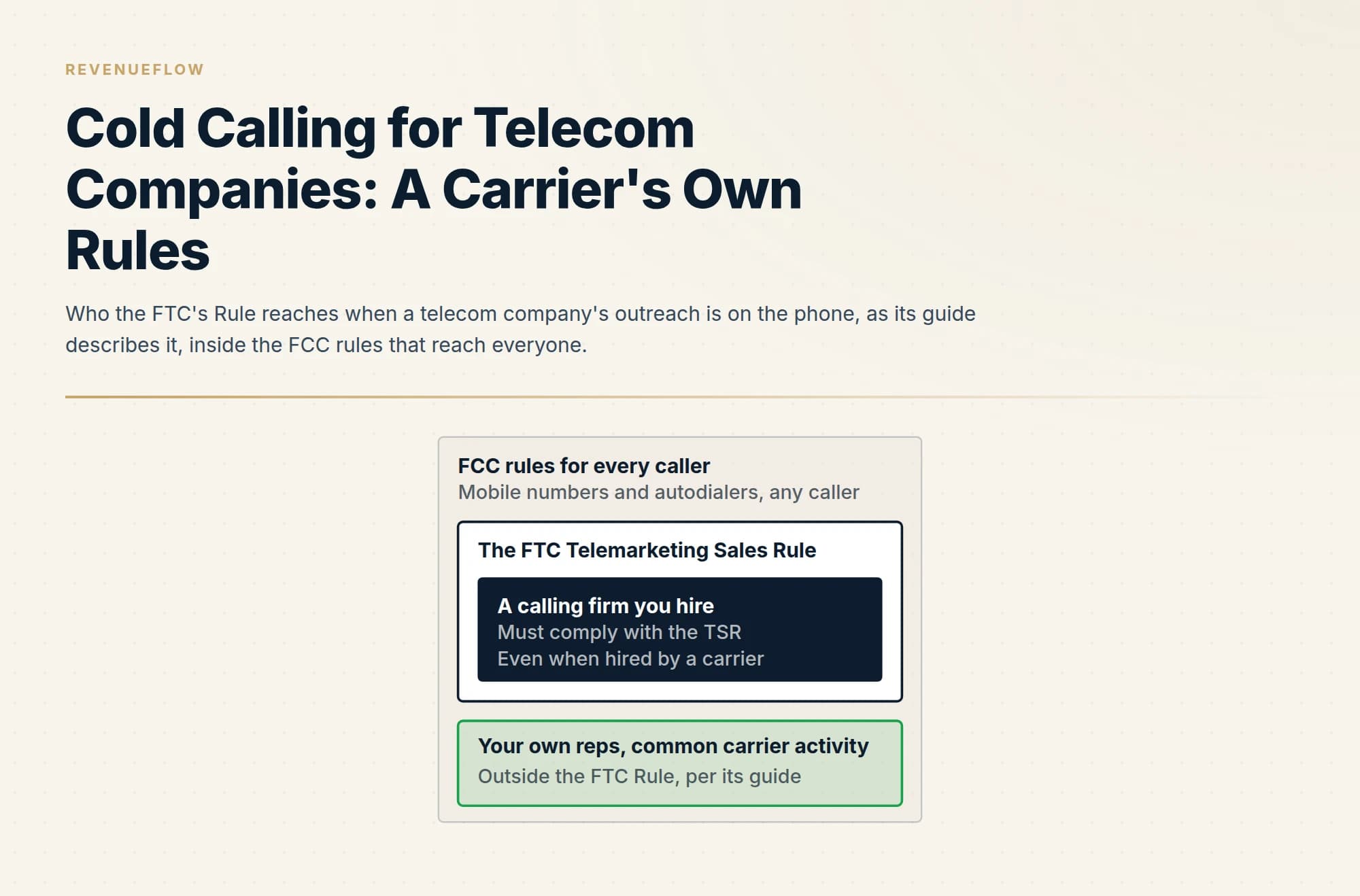
A telecom company's own reps calling businesses in common carrier activity are outside the FTC's Telemarketing Sales Rule while a hired calling firm is inside it. A call that changes a carrier must be verified by a written record, an electronic authorisation or an independent third party, and a list may not come from who called a competitor.
Key takeaways
- The FTC's guide says common carriers engaged in common carrier activity are not covered by the Telemarketing Sales Rule, and that any company contracted by one to provide telemarketing services must comply with it.
- 47 CFR 64.1120 prohibits material misrepresentation on the sales call, shifts the burden of proof to the carrier on a credible allegation, requires every carrier change to be verified, and makes the sales representative drop off a three-way verification call.
- 47 CFR 64.2005 lets a carrier use CPNI to market within a category the customer already buys, not across categories without approval, and never to identify or track customers who call competing providers.
- The FCC required voice service providers to implement STIR/SHAKEN by 30 June 2021, and its call blocking page lists the practices a legitimate caller follows to avoid being blocked or labelled.
Reviewed and updated September 21, 2026
The Federal Trade Commission's guide to its Telemarketing Sales Rule lists three kinds of business that the Rule does not reach, and a telephone company is one of them. "These three types of entities are not subject to the FTC's jurisdiction, and are not covered by the TSR: banks, federal credit unions, and federal savings and loans. common carriers", the guide continues, naming "long-distance telephone companies and airlines" as the examples, "when they are engaging in common carrier activity." The next sentence takes the exemption away from anyone the carrier hires: "Nevertheless, any individual or company that contracts with one of these three types of entities to provide telemarketing services must comply with the TSR." (FTC, Complying with the Telemarketing Sales Rule, read 21 September 2026.)
This guide is for a telecommunications company whose people phone businesses: a carrier, an internet service provider, a unified communications or hosted voice provider, a managed service provider with a telecom practice. Selling into telecom companies is the other direction and lives in cold email for telecom. Where a telecom seller's business leads come from, and why the month a contract ends is the most valuable field on the list, is in lead generation for telecommunications companies; what a booked telecom meeting has to carry is in appointment setting for telecom companies. Neither is repeated here. What follows is what only this industry has on the phone: a rule that binds the caller's contractor and not the caller, a sales call that is regulated sentence by sentence when it changes a carrier, a limit on what the caller may know about the number it dials, and a network that signs and labels the caller's own calls.
The rule that reaches your contractor and not you
Read the FTC's two sentences together. A carrier's own employees, calling businesses about the carrier's own service, are outside the FTC's Rule while engaged in common carrier activity. A calling firm the carrier hires to do the same thing is inside it. That is the first question a telecom sales leader answers before anyone dials: whose phones are these calls made from, and whose rules do they carry.
The exemption is narrower than it looks, because the Federal Communications Commission's rules apply to every caller and do not ask who the employer is. The federal position on business calls, with the separate statute on autodialers and mobile numbers quoted, is in what cold calling is and which rules apply and where the B2B exemption stops. A business owner's cell is a cell under those rules whether the caller is a carrier or a contractor.
The sales call that changes a carrier is regulated line by line
When a telecom sales call ends with a business agreeing to move its service, the call itself becomes a regulated event. The FCC's rules on verification of orders for telecommunications service, at 47 CFR 64.1120 and read on eCFR on 21 September 2026, open with the sentence a caller has to carry: "Material misrepresentation on the sales call is prohibited. Upon a consumer's credible allegation of a sales call misrepresentation, the burden of proof shifts to the carrier making the sales call to provide persuasive evidence to rebut the claim." (eCFR, 47 CFR 64.1120.) The FCC's consumer page on slamming says the same thing in plain words: "The rules also prohibit companies or their telemarketers from misrepresenting their service on a sales call." (FCC, Slamming.)
The rule then says a change cannot happen on the strength of the call alone: "No telecommunications carrier shall submit a preferred carrier change order unless and until the order has been confirmed in accordance with one of the following procedures", and the procedures are a written or electronically signed authorisation, an electronic authorisation placed from the number being changed, or an oral authorisation taken by an "appropriately qualified independent third party". That third party has to be independent of the seller: "The independent third party must not be owned, managed, controlled, or directed by the carrier or the carrier's marketing agent; must not have any financial incentive to confirm preferred carrier change orders for the carrier or the carrier's marketing agent; and must operate in a location physically separate from the carrier or the carrier's marketing agent."
Two sentences of the rule are about the rep personally. First, the rep leaves: "A carrier or a carrier's sales representative initiating a three-way conference call or a call through an automated verification system must drop off the call once the three-way connection has been established." Second, the verifier has to establish what the customer agreed to. Every verification method "shall elicit, at a minimum: The date of the verification; the identity of the subscriber; confirmation that the person on the call is authorized to make the carrier change", and then "confirmation that the person on the call understands that a carrier change, not an upgrade to existing service, bill consolidation, or any other misleading description of the transaction, is being authorized". A telecom cold call that describes a switch as an upgrade has, in the rule's own words, described it misleadingly, and the verification exists to catch it.
For a caller the consequence is that the close is not the call. The script ends at an agreement to be verified, and the description the rep gave will be tested by someone the rep does not employ.
What you may know about the number you are dialling
A telecom company holds more information about the businesses in its footprint than a cold caller in any other industry, and the FCC's rules on customer proprietary network information say what it may do with it. The FCC's page on customer privacy, updated 20 December 2022, summarises the statute: Section 222 restricts carriers' use and disclosure of their customers' proprietary information "and requires that telecommunications carriers protect the confidentiality of that information." (FCC, Customer Proprietary Network Information.) The rule itself, at 47 CFR 64.2005 and read on eCFR, draws the line by category of service: a carrier "may use, disclose, or permit access to CPNI for the purpose of providing or marketing service offerings among the categories of service", which the rule lists as local, interexchange and CMRS, "to which the customer already subscribes from the same carrier, without customer approval." And it may not cross categories without approval: "A telecommunications carrier may not use, disclose, or permit access to CPNI to market to a customer service offerings that are within a category of service to which the subscriber does not already subscribe from that carrier, unless that carrier has customer approval to do so". (eCFR, 47 CFR 64.2005.)
The sentence that matters most to a prospecting list is the one about competitors: "A telecommunications carrier may not use, disclose or permit access to CPNI to identify or track customers that call competing service providers. For example, a local exchange carrier may not use local service CPNI to track all customers that call local service competitors." A win-back list built from the fact that a customer's line has been calling a rival is exactly the list the rule names. The list a telecom cold caller may build is the one every other seller builds, from public signals: a new site, a lease, a hiring page, a term that is ending, as the telecom lead generation page linked above sets out.
| Use of CPNI | What the rule says |
|---|---|
| Market services in a category the customer already buys from you | Allowed without customer approval |
| Market a category the customer does not buy from you | Not without customer approval |
| Identify or track customers who call competing providers | Not allowed |
| Build a prospect list from public signals instead | Outside the rule; the ordinary route |
Your own network signs and labels the call
The third thing only a telecom caller lives with is that the industry's own defences against unwanted calls run on the caller's own network. The FCC's page on caller ID authentication says: "In 2020, the FCC adopted rules requiring voice service providers to implement STIR/SHAKEN in the IP portions of their voice networks by June 30, 2021." It describes what the framework does: "STIR/SHAKEN digitally validates the handoff of phone calls passing through the complex web of networks, allowing the phone company of the consumer receiving the call to verify that a call is in fact from the number displayed on caller ID." (FCC, Caller ID Authentication.) A telecom company's outbound calls are attested by the telecom company.
The receiving side labels. The FCC's call blocking page says labeling services "display categories for potentially unwanted or illegal calls" on a caller ID display, and it warns that the labels are not only for scammers: "False-positive blocking may occur if a legitimate caller uses a pattern similar to those associated with unwanted or illegal robocalls." Its advice to legitimate callers reads like a calling policy: "Always use a valid outgoing number." "Limit the number of calls placed per minute, particularly outside of normal business hours." "Limit the number of times you call numbers back within a short time frame." And: "You should periodically check with phone companies and third-party analytics companies about consumer complaints for the numbers you use to place calls." (FCC, Call Blocking Tools and Resources.) For a carrier those analytics companies are often its own vendors, which means a telecom sales floor can discover that its own network has labelled its own campaign.
Who does the calling, from the industry's own job postings
The desk at the small end of the market is described by the companies that staff it. Spectrum's posting for a Business Account Executive in Springfield, Virginia, dated 27 August 2026 and requisition number 2026-81469, says the role will "prospect for new small business customers within your sales territory" and is "responsible for door-to-door sales of Spectrum Business services (Internet, Phone, TV, and Mobile) to new customers in your assigned territory." The working conditions are "Daily field-based, outside selling with frequent driving and walking", and the required experience is "2+ years of sales experience or 2+ years of telecom or technical industry experience". (Spectrum, Business Account Executive, Springfield, read 21 September 2026.) At the small-business end of a cable and fibre carrier, the cold call is a territory call and often a doorstep; the phone is what a rep uses between visits.
At the mid-market and enterprise end the desk is reception, assistants and shared inboxes, and the appointment setting page linked above carries what the vertical's own vendors say about getting past them. The one practitioner voice among the search results for this phrase is a thread by a new business-to-business representative selling internet and phone service; it could not be fetched from this network and is not quoted here. Mitel, a communications vendor, publishes a general cold-calling guide that a search for this phrase returns; it is a vendor's own guide and is named as such.
When the call is placed
Telecom has no fiscal calendar of its own; the timing field is the term, and the telecom lead generation page linked above makes the case that the month the current agreement ends is the most valuable field on a telecom list. For a caller it is one line: a business two years into a three-year agreement is written down and called later, and a call placed in the quarter before the term ends is the one the verification rule above was written for.
Three openers, each tied to a rule above
Each opener rests on one source on this page, names no real person and claims no result.
Grounded in the carrier-change rule.
Good morning, this is {{name}} at {{company}}, a business internet and phone provider in {{area}}. This is a cold call and it isn't a switch: nothing changes on a call like this, because a change of carrier has to be confirmed by an independent verifier after the fact. The only question today is when your current agreement ends, so we know whether to talk this quarter or next year.
Grounded in the FCC's caller ID authentication page.
Hello, {{name}} at {{company}}. The number on your display is ours and our own network attests it, which is what the caller ID authentication rules ask of a provider. We provide connectivity to businesses in {{area}} and we're calling because you opened a second site on {{street}}. Is that site on its own circuit yet, or is it waiting on one?
Grounded in the CPNI rule.
This is {{name}} from {{company}}. A straight answer to the question people ask first: we're not calling because of anything on your account or your call records, which we can't use for this; we're calling because your hiring page lists {{count}} new roles at {{site}}. If the phone system there is growing with them, that's the conversation. If not, no call back.
When the phone is the wrong play for a telecom seller
When the number is a consumer's, where the FCC's consumer rules on the hub pages apply and this page does not. When the list came from the network, where the CPNI rule names the list. When the account is mid-term, where the call cannot end in an order and belongs on a dated list. And when the plan is to close the switch on the call, where the verification rule says the call cannot do that and the rep must drop off the line.
Where calling sits next to writing is a position, not a result. RevenueFlow runs email and LinkedIn for clients and does not run phone outreach: one message per campaign, no bumps, and a new campaign only when a new premise exists, which in telecom arrives on a date: the term end, the new site, the hire. If you want a list built on those dates and the first message written, see what a first campaign looks like.
The short version
A telecom company's own reps calling businesses about its own service are outside the FTC's Telemarketing Sales Rule; the firm it hires to make the same calls is inside it. A call that changes a carrier is regulated word by word: misrepresentation is prohibited with the burden on the carrier, the change must be verified by a written record, an electronic authorisation or an independent third party, and the rep drops off the line before the verifier asks whether the customer understands it is a carrier change and not an upgrade. The list may not come from who called a competitor. And the network that signs the call is the network that labels it, so the FCC's own list of practices for legitimate callers is the calling policy.
Every page quoted above was read on 21 September 2026 from stored snapshots. Rules and postings change; read the current text before relying on it. Nothing here is legal advice.
Frequently asked questions.
Frequently asked questions- Does the Telemarketing Sales Rule apply to a telecom company's own sales calls?
- The FTC's guide lists common carriers, with long-distance telephone companies as the example, among three kinds of entity not subject to the FTC's jurisdiction and not covered by the TSR when engaging in common carrier activity. It then says any individual or company that contracts with one of them to provide telemarketing services must comply with the TSR. The FCC's own rules on mobile numbers and autodialers apply to every caller regardless.
- Can a telecom rep switch a business's service on a cold call?
- Not on the call alone. 47 CFR 64.1120 says no carrier may submit a preferred carrier change order until it is confirmed by a written or electronically signed authorisation, an electronic authorisation from the number being changed, or an independent third party's verification. The rep must drop off a three-way verification call, and the verifier must confirm the customer understands it is a carrier change and not an upgrade or bill consolidation.
- Can a carrier use customer records to build a prospect or win-back list?
- Within limits the rule states. 47 CFR 64.2005 allows a carrier to use CPNI to market services in a category the customer already subscribes to from that carrier, forbids using it to market a category the customer does not buy without approval, and says a carrier may not use CPNI to identify or track customers that call competing service providers. A list built from public signals such as a new site or a hiring page is the ordinary route.
- Why do a telecom company's own calls get labelled as spam?
- Because the industry's defences run on its own networks. The FCC's page on caller ID authentication says providers were required to implement STIR/SHAKEN by 30 June 2021, and its call blocking page says labelling services display categories for potentially unwanted calls and that false-positive blocking can hit a legitimate caller whose pattern resembles a robocaller's. Its advice is a valid outgoing number, limited calls per minute, and checking complaints with analytics companies.
About the author.

B2B cold email experts helping companies generate qualified leads through done-for-you outreach campaigns.
RevenueFlow Team
Explore more.
Ready to scale your outreach?
We build GTM engines that book real meetings. See the receipts.
Related articles.
Cold Calling for Consulting Firms: The Partner's Hour
Cold calling for a consulting firm: who it dials and who picks up, why partner-led economics argue against the phone, the client's fiscal year, and when to skip it.
Cold Calling for Chemical Companies: Who Picks Up
A chemical cold call rarely arrives first. It reaches a formulator who has already been comparing suppliers on a screen, for one of three published reasons.
Cold Calling for Manufacturers: The Desk and the Floor
Cold calling for a manufacturer calling plants and OEMs: who answers the main line, the buyer's desk against the floor, the show calendar, the channel map, the limits.
Cold Calling for PPC Agencies: What You Can See First
A paid media prospect is partly readable before the call and has already been told by the platform what to do when a stranger rings about its ads.
Cold Calling for Higher Education Vendors: Who Picks Up
Who a published campus number really reaches, what university purchasing pages permit a sales call to do, the quiet period around a bid, and when a campus can talk.
Telemarketing Laws by State: 13 Statutes, Read
Thirteen states' own telemarketing statutes and agency pages, read first-hand: what each one keys on, and which of them reach a business to business call.