Cold Calling for Consulting Firms: The Partner's Hour
Cold calling for a consulting firm: who it dials and who picks up, why partner-led economics argue against the phone, the client's fiscal year, and when to skip it.
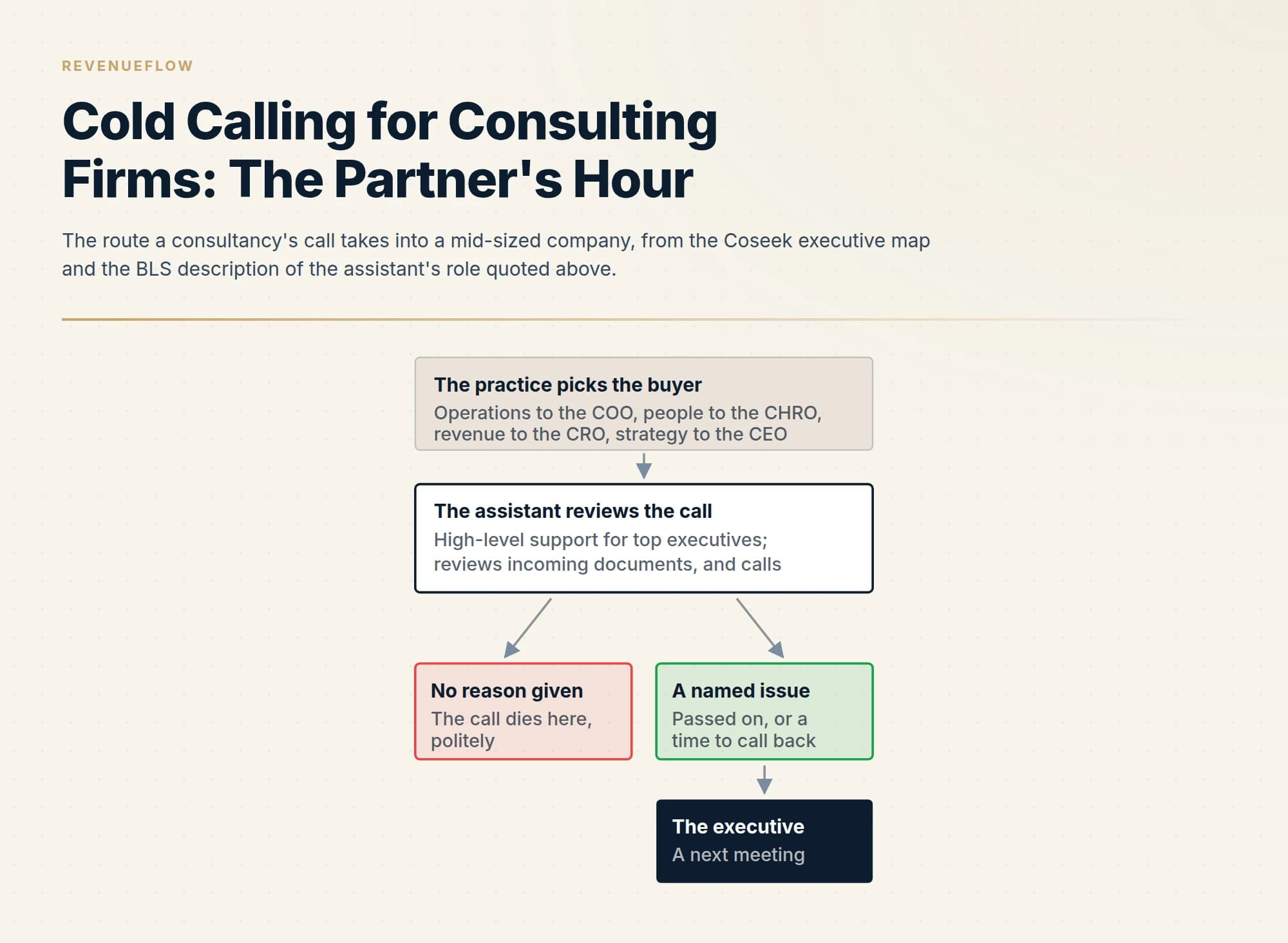
A consultancy dials the executive who owns the problem its practice solves and reaches that executive's assistant first. The economics argue against the phone: the partner who can answer the buyer's first question bills by the hour. The client's fiscal year and a visible change are the two clocks, and the call's only legitimate product is a next meeting.
Key takeaways
- The BLS says executive assistants provide high-level support for top executives and review incoming documents, which is the desk a consultancy's call reaches before the executive.
- The BLS entry for management analysts says self-employed analysts are paid by the hour or the project and that analysts divide their time between the office and the client's site, so every hour dialling is an hour not billed.
- Consulting Success tells consultants that sales do not get made over the phone on a first call and that the goal is the next meeting; Carol Sente writes that cold calls are dreaded even among those charged with rainmaking.
- The IRS defines a calendar year as January to December and a fiscal year as twelve months ending on any month but December, so the client's year-end, not the script, decides when a budget conversation can land.
Reviewed and updated September 21, 2026
A consulting firm's phone problem starts with arithmetic that no script fixes. The person best placed to explain what the firm does is a partner whose hours are the product, and the person cheapest to put on the phone is an analyst who cannot answer the first real question a buyer asks. Whoever dials, the call reaches an executive assistant before it reaches the executive, and it asks a busy person to describe a problem to a stranger who has not yet earned the right to hear it.
This page is cold calling for the consulting firm: the partner, the business developer or the analyst at a management, technology or specialist consultancy dialling its own prospects. It is written for the people inside the firm, not for vendors selling to consultancies. It covers who a consultancy dials and who picks up, why a partner-led firm's economics argue against the phone, when a buyer answers, what the call may say and when the phone is the wrong play. The method of a cold call, its rules and its objection handling live in the hubs and are linked; cold email for the same reader is the consulting cold email guide, whose positioning section applies to the phone unchanged. Every outside page below was fetched on 21 September 2026 and is dated where it publishes a date.
What a search for this returns
Six of the ten pages name consulting. Two are first-person accounts, an analyst on the consulting forum describing three hundred calls a day and a Medium writer who cold called consulting prospects daily for a month; both refused every fetch from here and are named as what the search serves, not as sources. Two are outsourcing vendors' how-to pages and one is a dialer vendor's; the sixth is Consulting Success, a publisher for consultants. The rest are generic cold-calling pages. The vertical pages are written by people who sell calling to consultancies, so the trade's own voice is thinner here than elsewhere.
Who a consultancy dials, and who picks up
A consultancy sells a solution to a business problem, so the person it dials is the one who owns the problem, which is rarely procurement and often not the top of the organisation. Coseek, an outsourced calling vendor that markets to consulting firms, sets out the map its callers use: for operations work the COO, for people work the CHRO, for revenue work the CRO, and for corporate priorities the CEO or a VP of strategy (Coseek, as fetched). That is a vendor's list, but the principle holds without it: the practice determines the executive route, and a firm with three practices makes three different calls.
Who picks up is not that person. The Bureau of Labor Statistics describes the role that answers an executive's line: "Executive secretaries and executive administrative assistants provide high-level support for an office and for top executives of an organization. They often handle complex responsibilities, such as reviewing incoming documents, conducting research, and preparing reports" (BLS, secretaries and administrative assistants, as fetched). An assistant who reviews incoming documents for a living reviews an incoming call the same way: a call with no named reason dies at that desk, politely, and a call with a named issue is passed on or given a time to call back. The live guide to cold calling business owners covers the opposite case, the owner-led business where the person answering is nobody's screener.
Why a partner-led firm's economics argue against dialling
The BLS describes the trade's economics in its entry for management analysts: "Management analysts usually divide their time between their offices and the client's site. Because they must spend a significant amount of time with clients, analysts travel frequently", and, for the independent end of the profession, "Self-employed analysts are paid directly by their clients, typically by either the hour or the project" (BLS, management analysts, as fetched). An hour on the phone is an hour not billed, and the person whose hour is worth most to a buyer is the person whose hour costs the firm most to spend dialling.
The trade's own writers say the same thing from the inside. Carol Sente, a business development coach who spent a decade as marketing manager of an architecture firm, opens her piece on the cold call with the trade's feeling about it: "Cold calls are one of the most dreaded activities, even among those charged with rainmaking", and her first of six elements is to find a connection, because "We are all more likely to take a call from a friend of a friend" (Carol Sente, page copyright 2021). Consulting Success, writing for consultants, puts the limit on what a call can do: "Sales don't get made over the phone on a first call. The goal of your call is to get a next meeting" (Consulting Success, updated 16 May 2025). The live page on sales strategy for professional services sets out the seller-doer model most firms run, in which the person making the sale does the work; that split mandate is why the phone is expensive here.
A firm whose partners sell can afford a call only where the list has already done the work, so that each dial reaches a company with a visible problem in the partner's practice; a firm that puts an analyst on the phone buys volume and loses the first substantive question. The referral base is cheaper on both counts, and the live page on referrals against cold outbound sets out where its ceiling is.
When a consulting buyer answers
A consulting engagement is bought against a budget, and budgets follow a fiscal year. The Internal Revenue Service defines the two conventions, a calendar year as "12 consecutive months beginning January 1 and ending December 31" and a fiscal year as "12 consecutive months ending on the last day of any month except December" (IRS, tax years, as fetched). A buyer on a calendar year is planning in the autumn and spending from January; a buyer on a June year-end is doing both six months later. The list, not the script, has to carry the client's year-end: a partner's call in the fourth quarter to a calendar-year company arrives while next year's budget is being written, and the same call in February arrives after it is spent.
The second clock is the timing evidence a call can name. Coseek's page lists the four kinds its callers look for, a leadership change, integration and growth, operating pressure, and market change, and its own framing of the first is the one worth keeping: a new owner of a mandate is worth calling as a new owner (Coseek, as fetched). Where those events are published is a prospecting question rather than a calling one, and is left out here.
What the call may say
The rules on a business-to-business call, the federal exemption and its two carve-outs, and the separate statute on autodialers and mobile numbers, are quoted in what cold calling is and which rules apply and its companion page on whether cold calling is against the law, and this page adds no legal reading of them. Two things are specific to a consultancy. The first is the executive assistant, who is an employee of the company and not the buyer; a call that solicits the assistant personally is the carve-out the hub describes, and a call that asks the assistant for the right person is not. The second is that no professional body's solicitation rule was found for management consulting in the way a bar or a board of accountancy publishes one; the management consultants' institute's code page did not render on the fetch date, so this page states no rule from it, and a firm whose practice touches a licensed profession reads that profession's own page.
What the call may say is therefore governed by what the buyer can verify, which is the consulting email guide's positioning argument carried to the phone: the practice named, the business issue named, and a next meeting as the only ask.
What the trade says against it
Three objections come from the sources above, and each is right about something. The first is dread: the people charged with rainmaking do not want to make the call, and a firm that assigns it to the person least able to answer a question has solved its own dread by exporting it. The second is the connection: Sente's advice to find a friend of a friend and ask for an introduction before dialling says the cold call is the worst version of a call the trade already makes warm. The third is the ask: if nothing is sold on a first call, the call's only product is a meeting, and a meeting with a partner is the most expensive thing the firm gives away.
The vendors answer the first two with their own product. Coseek's page frames its service as protecting partner time, "The rep qualifies the issue. The partner brings the judgment", and its FAQ asks the trade's question outright, whether cold calling suits a relationship-led consulting firm, and answers yes "when it creates context for partner judgment rather than trying to replace it" (Coseek, as fetched). That is a vendor's answer; the firm can accept the design without the vendor by writing down which practice, issue and executive a call is for before anyone dials.
Dread
Even those charged with rainmaking dread the call, so it gets handed to whoever cannot answer the first question.
Answer: decide the practice, the issue and the executive before anyone dials.
No connection
A friend of a friend gets the call taken; a stranger does not.
Answer: ask for the introduction first, and keep the cold list for the accounts nobody can introduce.
Nothing sells on a first call
The only product of the call is a next meeting, and the meeting costs a partner's hour.
Answer: the rep qualifies the issue; the partner brings the judgment.
When the phone is the wrong play
Four cases. The referral-led firm whose pipeline still refills: every partner hour on the phone is unbilled, and the referral page above sets out how far referrals carry. The firm without a defined practice: a call that cannot name the business issue it is for has nothing to say past the assistant. The buyer with no visible change: Coseek's own list of timing evidence is a list of reasons to call, and an account with none of them is a courtesy call. And the analyst-only programme: three hundred dials a day from someone who cannot take the first substantive question, which is the forum account's own title, buys volume and spends the firm's name.
RevenueFlow runs email and LinkedIn for clients and does not cold-call, so the phone described here is the trade's option and not our motion; how email and cold calling each fail compares the two. For a consultancy the written channel has one specific use: the named issue and the partner's one-page view make a better first contact in writing than in an assistant's notes. We send one message per campaign, with no bumps. If building that list and first message is the part you would rather hand over, see what a first campaign would target.
Three openers, each on a fetched fact
Each opener below is one message, sent once, to one person; each rests on a page quoted above, names no real recipient and makes no claim about results. The companies in them are invented.
The first rests on the IRS definition of a fiscal year and is for a COO at a calendar-year company in the fourth quarter.
{{first_name}}, your company closes its year in December, which means the operating budget for next year is being written now. We run a single operations practice for manufacturers your size, and the question we would ask before the budget is set is whether {{plant_or_process}} is inside it. If a twenty-minute conversation with the partner who leads that practice would help, name a day.
The second is built on Coseek's list of timing evidence and is for a newly appointed CHRO.
{{first_name}}, you took the people role at {{company}} this quarter. New owners of that mandate inherit an organisation designed by someone else. Our people practice works only on that transition, and the partner who leads it takes the call personally. Would twenty minutes in the next fortnight be useful, or is the first ninety days already spoken for?
The third rests on Consulting Success's rule that nothing is sold on a first call and is for an executive assistant, by name.
{{first_name}}, this is a sales call from a consulting firm and it is not urgent. We would like a twenty-minute meeting with {{executive}} about {{business_issue}}, nothing more on a first contact. If you handle that calendar, could you tell us whether a request should go to you, and whether any week this quarter is better than the rest?
The short version
A consultancy dials the executive who owns the problem its practice solves, and reaches that executive's assistant first. The economics argue against the phone: the person who can answer the buyer's first question bills by the hour, and the person who cannot is the one usually dialling. The client's fiscal year and a visible change are the two clocks, and the call's only legitimate product is a next meeting. Referrals and a named issue come first; the cold list is for the accounts nobody can introduce.
Frequently asked questions.
Frequently asked questions- Who should a consulting firm cold call?
- The executive who owns the business problem the practice solves, which a calling vendor that markets to consultancies maps as the COO for operations work, the CHRO for people work, the CRO for revenue work and the CEO or a VP of strategy for corporate priorities. The person who answers is usually that executive's assistant, whom the BLS describes as reviewing incoming documents and preparing reports, so the first sentence has to name the issue.
- Does cold calling work for consulting firms?
- The trade's own sources say it is dreaded, works best as a warm call through an introduction, and sells nothing on a first call. The economics explain why: the partner who can answer a buyer's first question bills by the hour, and an analyst who cannot buys volume and spends the firm's name. It fits where the list has found a visible problem inside a defined practice and the only ask is a next meeting.
- When is the best time to call a company about consulting?
- When its budget is being written, which depends on its fiscal year. The IRS defines a calendar year as January to December and a fiscal year as twelve consecutive months ending on the last day of any month except December. A calendar-year company plans in the autumn and spends from January; a June year-end company runs six months later. A visible change, such as a new leader or operating pressure, is the second clock.
- What can a consulting firm say on a cold call?
- The rules on a business-to-business call are quoted in the cold calling hubs, and no professional body's solicitation rule for management consulting was found on the fetch date, so this page states none. What the call may say is governed by what the buyer can verify: the practice named, the business issue named, and a next meeting as the only ask. Soliciting the assistant personally is the carve-out the hub describes; asking the assistant for the right person is not.
About the author.

B2B cold email experts helping companies generate qualified leads through done-for-you outreach campaigns.
RevenueFlow Team
Explore more.
Ready to scale your outreach?
We build GTM engines that book real meetings. See the receipts.
Related articles.
Sales Prospecting for Consulting Firms: Find the Event
Prospecting for a consulting firm: where triggers are published by practice, who inside the firm reads them, why alumni and referrals come first, when to skip it.
Cold Calling for PPC Agencies: What You Can See First
A paid media prospect is partly readable before the call and has already been told by the platform what to do when a stranger rings about its ads.
Cold Calling for Manufacturers: The Desk and the Floor
Cold calling for a manufacturer calling plants and OEMs: who answers the main line, the buyer's desk against the floor, the show calendar, the channel map, the limits.
Cold Calling for Food and Beverage Companies: Three Doors
Cold calling for a food or beverage company: who picks up at a chain, a distributor and an independent grocer, where each publishes its door, and when the phone is wrong.
Cold Calling for Chemical Companies: Who Picks Up
A chemical cold call rarely arrives first. It reaches a formulator who has already been comparing suppliers on a screen, for one of three published reasons.
Cold Calling for Legal Tech Companies: Who Answers at a Firm
What changes when a legal tech company cold calls a law firm: which desks answer, why the billable hour hurts the pitch, the 2027 show dates, and what not to ask.