Referrals Against Cold Outbound: The Ceiling You Hit
Referrals convert better and always will. The decision turns on a ceiling set by other people's attention, and on whether your network reaches your target accounts.
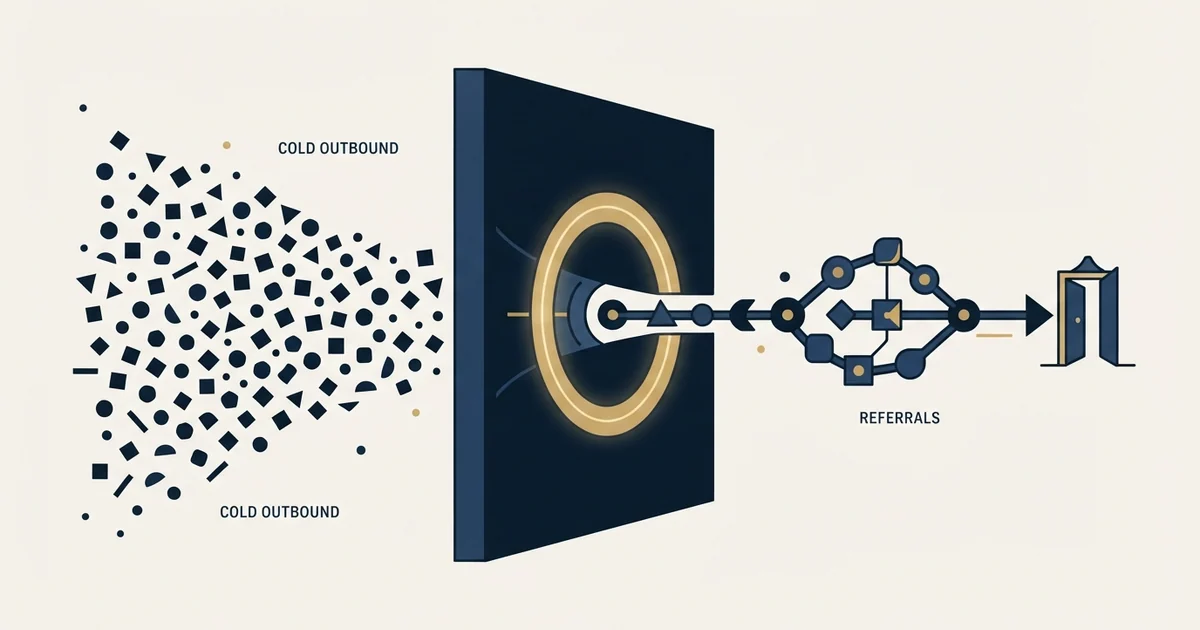
Referrals convert better because trust arrives with the introduction and the referrer filters the match. The decision between them turns on ceiling rather than conversion: referral volume is bounded by the number of people who owe you attention, while outbound is bounded by what you choose to resource, and only outbound can be aimed at named accounts.
Key takeaways
- The published referral multipliers compare two populations selected in completely different ways, so run the comparison on your own closed deals instead.
- A referral ceiling is arithmetic: willing referrers, times asks per year, times the share of introductions that become conversations.
- Referrals cannot be aimed, so they keep producing companies adjacent to the ones you already serve rather than the accounts on a target list.
- Customers, live opportunities and the relationship list belong in the exclusion file before a first cold send, not in a review afterwards.
Reviewed and updated September 1, 2026
A consultancy books eleven of its twelve deals last year through introductions, and the twelfth through an old client who changed employer. The founder is asked whether outbound would help and gives the honest answer, which is that referrals convert far better than anything cold ever has for them. Then the board sets a number that needs thirty deals, and the referral engine has no lever on it. Nothing about the first observation was wrong. It simply does not answer the second question.
That gap is where arguments about referrals against cold outbound usually go astray. The comparison is usually run on conversion rate, where referrals win by a wide margin and always will, and the decision actually turns on a different property entirely.
The same reasoning answers the objection in the form it usually arrives in, which is that prospects prefer warm introductions and a cold approach therefore will not land. That is true about preference and silent about volume. Nothing below argues that a stranger is as welcome as an introduction; the argument is about what happens when the number of introductions available is smaller than the number of conversations the plan requires.
What a referral supplies, and why the conversion gap is real
An introduction transfers trust that would otherwise have to be earned from scratch. The prospect starts from a position where somebody whose judgement they have already tested has said the conversation is worth having, so the opening moments of the call are about fit rather than about legitimacy. The referrer also filters: most people will not spend their own credibility introducing a bad match, so a referred prospect arrives partly qualified before anyone speaks.
Those mechanisms are not in dispute and they explain why the conversion difference is large. What is worth treating carefully is the published size of it. The pages ranking for this comparison quote precise multipliers, and almost none of them state a denominator, a period or a population, which is the reading problem lead generation statistics exists to describe. A figure comparing referral close rate against cold close rate is comparing two populations selected in completely different ways, and the selection is doing much of the work the number appears to be doing.
The safer version of the claim is the one you can check on your own numbers, and it takes an afternoon: take last year's closed deals, tag each one by how the conversation started, and compare close rate and cycle length across the two groups. That produces a figure about your business rather than about somebody's blog, and it is the input every decision below actually needs.
The property that decides the question is the ceiling
The question of whether to build the network or buy lead lists is the same trade read from the supply side, and the ceiling described above is what decides it: a network is finite and aimable only where it already reaches, while a built list is aimable anywhere and starts colder.
Referrals are bounded by the number of people who owe you attention, and that number is finite, slow to grow and outside your control. Cold outbound is bounded by how many accounts you can research and contact responsibly, which is a resourcing decision you make. Those are different kinds of limit, and the difference is the whole argument.
The six prospecting methods piece puts referral and introduction at the top on conversion and last on ceiling for exactly this reason: it demands a base of satisfied customers or a personal network, which new teams and new markets do not have, and it degrades if it is asked for too often.
Working out your own ceiling is arithmetic rather than judgement. Take the number of people who would plausibly introduce you, multiply by how often you can ask each without straining the relationship, and multiply by the share of introductions that become a real conversation. Here is the shape with invented figures, which describe no real company: forty willing referrers, asked twice a year, at one introduction in three producing a conversation, is roughly twenty-six conversations a year. Those numbers are made up to show the arithmetic. Run it with your own and the useful output is not the total but the comparison against the number of conversations your target needs.
- Trust arrives with the introduction
- Prospect is partly filtered before contact
- Ceiling is the size of the network that owes you attention
- Grows slowly and mostly as a by-product of delivery
- Degrades when asked too often
- Cannot be aimed at a specific account you choose
- Attention, timing and framing all have to be supplied
- Fit is checked by you rather than by a referrer
- Ceiling is what you can research and send responsibly
- Scales with a decision rather than with goodwill
- Degrades when volume replaces selection
- Can be aimed at any account in the market
Aiming is the capability referrals do not have
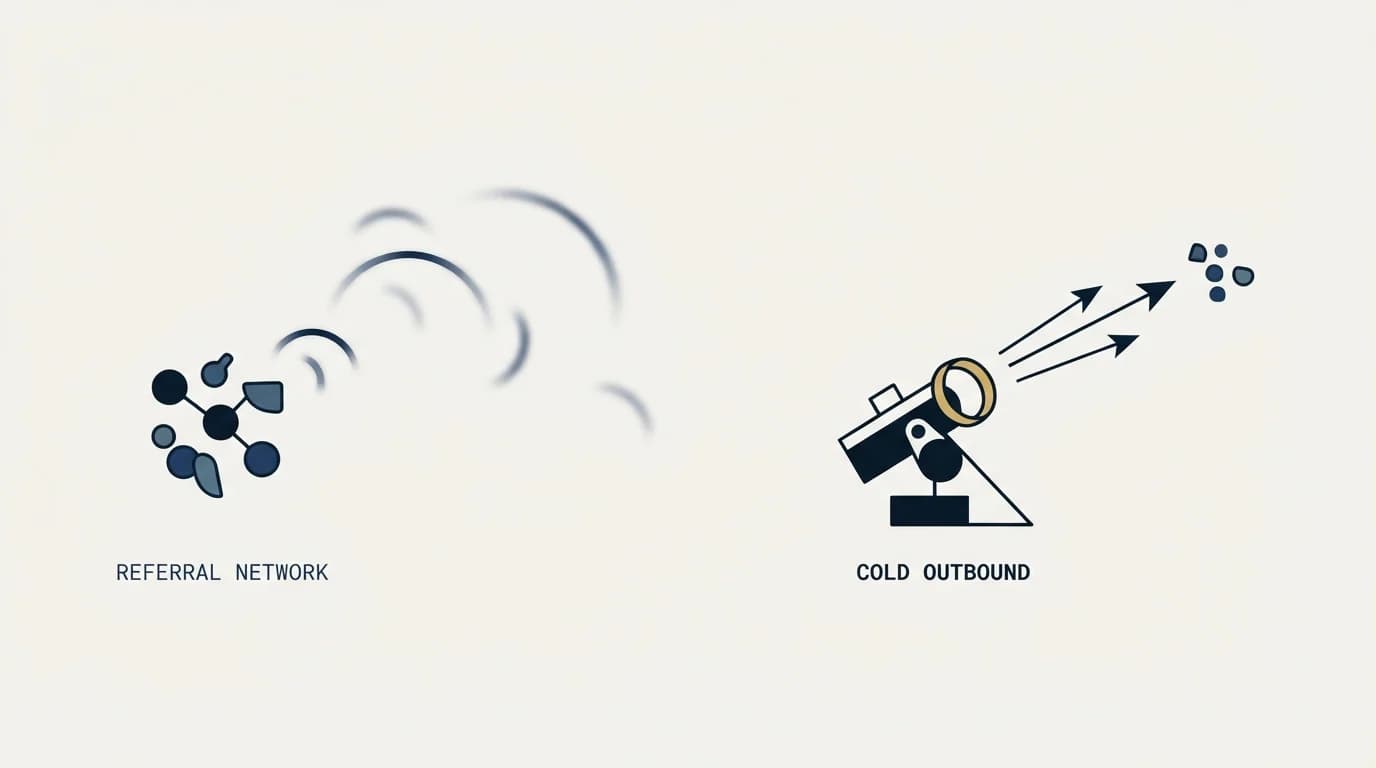
The ceiling is the familiar part of the argument. The half that decides more strategies is that a referral network cannot be pointed anywhere.
Introductions arrive from the accounts adjacent to the ones you already serve, which means the referral engine keeps producing companies that look like your existing customers. That is a strength while your best market is the one you are already in, and it becomes a constraint the moment the plan involves a new segment, a new region or a named list of accounts that would change the year. Nobody in your network can introduce you into a market they do not sit in.
Outbound's defining property is the opposite one. You choose the accounts. The cost of that choice is that everything a referral supplies for free has to be supplied deliberately, which is what outbound prospecting works through in full, and it is the reason outbound conversations start further back than referred ones.
So the two motions answer different questions. Which companies would you like to talk to, and which companies will your network produce. A business whose target list and whose network overlap almost completely has less to gain from outbound than one whose target list contains four hundred companies nobody it knows can reach.
The choosing is also the expensive half, and it is worth being clear that it is work rather than a setting. Deciding who is worth a message, finding a reason that message should exist this week, and locating the person that reason implicates is most of the job, which is the argument sales prospecting makes when it puts sending at the end of the process rather than at the centre of it.
- Step 1Count the addressable set
How many companies genuinely fit. A number, not a description, and it rules the question in or out immediately
- Step 2Compute the referral ceiling
Willing referrers, times asks per year, times the share that become conversations
- Step 3Compare against the conversations the target needs
Work backwards from the number through close rate and cycle length rather than forwards from activity
- Step 4Decide what covers the gap
If the ceiling clears the target, outbound is optional. If it does not, the gap is the part nothing currently produces
Running both without spending the network
The genuine risk in adding outbound to a referral business is not that it converts worse. It is that a badly aimed campaign reaches somebody who was about to be introduced to you, or an existing customer, or the partner whose introductions you depend on. That damage is real and it is entirely preventable at build time.
Three exclusions do most of the work, and all three belong in the file before the first send rather than in a review afterwards. Existing customers and their parent organisations. Live opportunities, refreshed on a schedule rather than collected once, because this is the set that changes weekly. And the relationship list: partners, advisors, referrers and anyone whose goodwill the programme depends on. The mechanics of holding those permanently and checking them automatically at build time are in suppression list, and the distinction it draws between an instruction you received and a decision you made matters here, because the relationship list is the second kind and gets revisited.
There is a smaller trap worth naming. A referral business often has a warm list of people who filled in a form, attended an event or were handed over by a partner, and that list arrives with an implicit claim that it has been checked. It has not, and the specific hazard is that a supplier's own staff, advisors and existing customers turn up in it because the same people attended the same event. That failure mode, and why a supplied list goes through the same verification as a sourced one, is set out in lead list.
When staying referral-only is the right call

Two situations make the honest answer no.
The first is a market small enough that your network already covers it. If the addressable set is a few hundred companies and you or your customers know people at most of them, outbound is buying reach you already have, and the effort is better spent on the introductions you are not currently asking for. The company count rather than the revenue figure is what decides this, and serviceable addressable market explains why the two lead to different plans.
The second is a business whose delivery capacity is the actual constraint. A pipeline problem and a capacity problem look identical from the outside and are fixed by opposite actions, and adding conversations to a business that cannot deliver the ones it has produces a worse quarter rather than a better one.
Where neither holds, the useful framing is that referrals and outbound are not competing for the same job. Referrals produce the highest-quality conversations available and produce them at a rate you do not control. Outbound produces conversations at a rate you do control, with the accounts chosen by you, at a lower conversion rate that the choosing partly offsets. A plan that depends on the first one scaling is a plan resting on other people's goodwill growing to meet a number, and goodwill does not work that way.
- Yes: Close rate and cycle length compared on your own deals, tagged by origin
- Yes: The referral ceiling computed from referrers, ask frequency and conversion
- Yes: The addressable company count established, not the revenue figure
- Yes: The share of your target list nobody in your network can reach
- Yes: Customers, live opportunities and the relationship list held as exclusions
- Yes: Whether the constraint is conversations or delivery capacity
- No: A published multiplier used as the basis for the decision
Where our own position sits
We run cold email and LinkedIn, we send one message per campaign with no bumps and no thread replies, and meetings are qualified against criteria agreed in writing before anything launches. That constraint is relevant to this comparison in one specific way. A single message cannot lean on persistence to compensate for a weak premise, so the selection and the reason carry the entire weight of the approach, which is the closest a cold motion gets to the property that makes a referral work: the recipient can see why this message reached them specifically.
It does not close the gap. A stranger with a good reason is still a stranger, and anybody claiming otherwise is selling something. What it does is make the two motions comparable on the thing that matters operationally, which is conversations per period against a target rather than conversion rate in isolation.
The short version
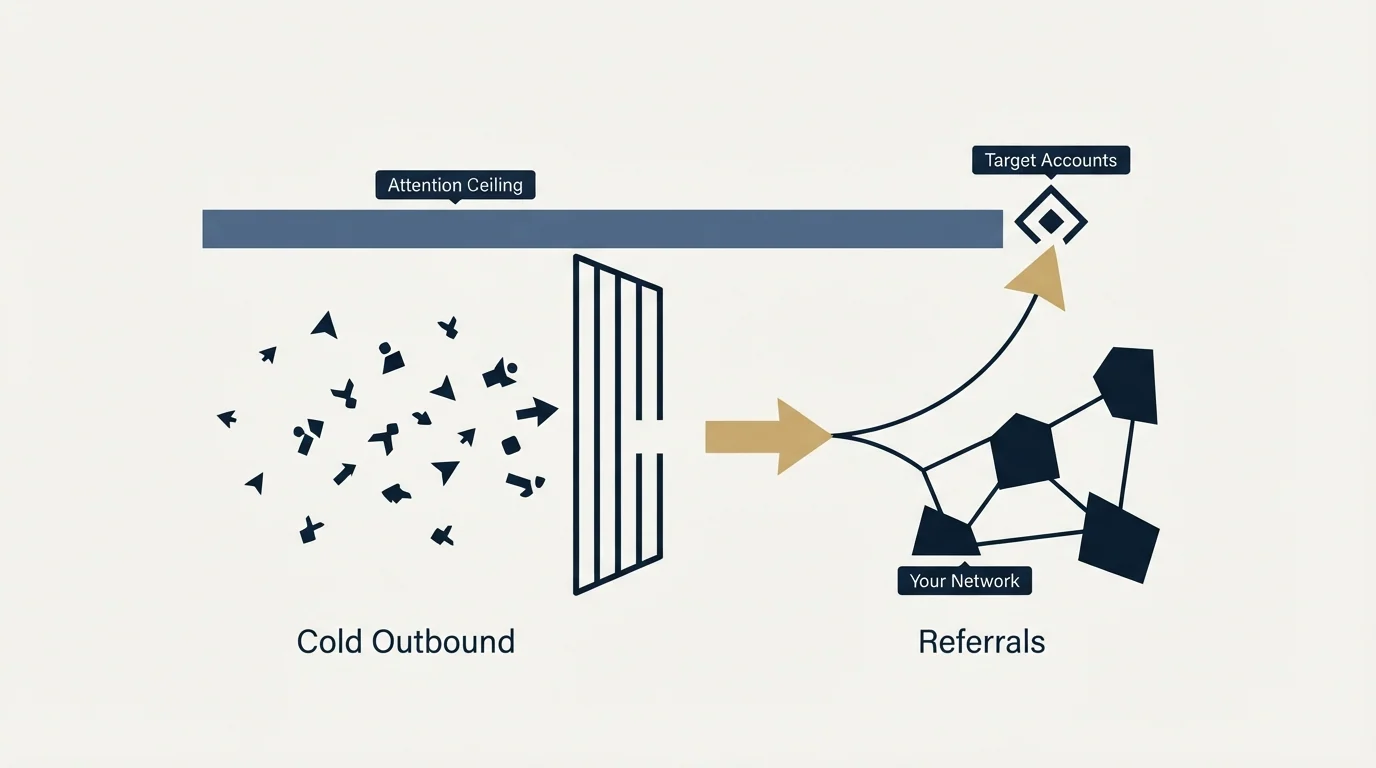
Referrals convert better and always will, because trust arrives with the introduction and the referrer has already filtered the match. The published multipliers are worth ignoring in favour of the same comparison run on your own closed deals. The decision is not about conversion rate at all: it is about a ceiling set by other people's attention against one set by your own resourcing, and about whether your network can reach the accounts on your target list. Compute both numbers, and if the referral ceiling clears the target, outbound is genuinely optional. If it does not, the gap is the part nothing currently produces, and the only thing left to decide is how carefully the cold half is aimed.
If the useful next step is seeing which of your target accounts nobody in your network can reach, we will build the campaign and show you what the population looks like.
Frequently asked questions.
Frequently asked questions- Do referrals really convert better than cold outreach?
- Yes, and the mechanism is straightforward. Trust transfers with the introduction, so the opening of the conversation is about fit rather than legitimacy, and the referrer filters the match because they are spending their own credibility. The size of the gap published online is far less reliable than the same comparison run on your own closed deals over the last year.
- How do I work out my referral ceiling?
- Count the people who would plausibly introduce you, decide how often you can ask each without straining the relationship, and estimate the share of introductions that become a real conversation. Multiply the three. Then compare that annual figure against the number of conversations your revenue target needs, working backwards through close rate and cycle length rather than forwards from activity.
- Will cold outbound damage our referral relationships?
- Only if the campaign is aimed carelessly, and the fix is a build-time exclusion rather than a policy. Hold existing customers and their parent organisations, live opportunities refreshed on a schedule, and the relationship list of partners, advisors and referrers. Checked automatically as each campaign is assembled, that removes the failure mode entirely.
- When is staying referral-only the right answer?
- When your addressable market is small enough that your network already covers most of it, or when delivery capacity rather than conversation supply is the real constraint. Both cases make outbound an expense that buys reach you already have or conversations you cannot serve. Count the companies rather than the revenue to tell which situation you are in.
About the author.

B2B cold email experts helping companies generate qualified leads through done-for-you outreach campaigns.
RevenueFlow Team
Explore more.
Ready to scale your outreach?
We build GTM engines that book real meetings. See the receipts.
Related articles.
Appointment Setting for Business Brokers: The Seller Meeting
What a bought meeting with a business owner has to be for a brokerage: the three-part qualification, the confidentiality rules, the licence line and the owner's reasons.
LinkedIn Outreach for Banks: A Regulated Message
How a bank's relationship managers use LinkedIn to reach business owners: what the FFIEC guidance, FINRA's notices and LinkedIn's own rules require, and where to stop.
SDR Outsourcing for Business Brokers: The Fee Timing
Whether a success-fee brokerage should rent sales development at all: the fee timing, the texts that limit what an outside person may say about value, and who signs.
SDR Outsourcing for Logistics Companies: The Brokerage Line
What an outside sales development team may do in a freight company's name, the calling and email rules it inherits, and which arrangement survives a bid-shaped market.
SDR Outsourcing for Financial Services: The Third Party
What a bank, broker-dealer, adviser or agency's regulators say about an outside team that speaks for it, the licensed line, and which arrangement survives due diligence.
B2B Lead Lists for Aviation Companies: Build or Buy
Aviation is one of the few industries whose accounts are published by its regulator, which changes what is worth buying and what is worth downloading yourself.