Sales Prospecting: Most of the Job Happens Before You Send
Prospecting is selection, not sending. The five decisions inside the motion, the one most teams never make, and what changes when you buy it as a service.
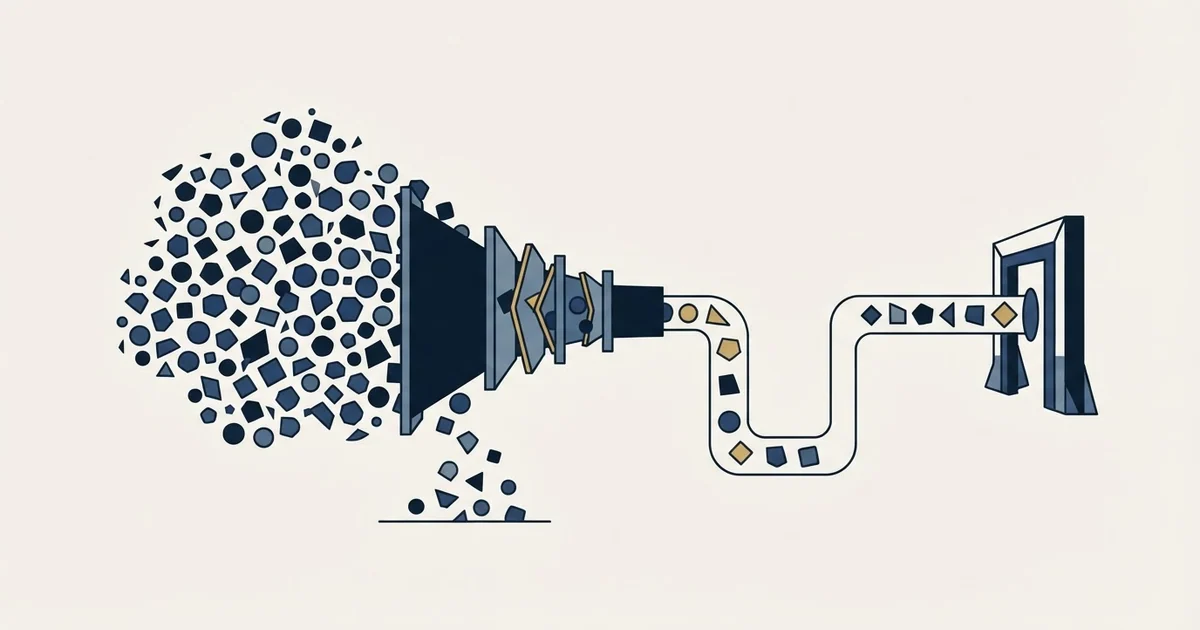
Sales prospecting is the work of deciding which accounts and people are worth contacting and finding a dated reason to contact them, up to the point a real conversation begins. Sending is the last part of it. The motion is five decisions, and the reason attached to each account is the one most often skipped.
Key takeaways
- Prospecting is selection and research; sending is the final step. Programmes measured by messages sent are measuring the cheapest part of the work, which is why send volume can rise for months without the meeting count moving.
- Five decisions make up the motion: who could buy, who should hear from you now, which person, what the message says, and what counts as a result. Skipping one does not remove it, it just applies the default answer.
- Prospecting clients and prospecting customers are the same five decisions with different tolerances for error. A small addressable market makes a wasted approach expensive; a large one makes selection the only real constraint.
- A prospecting service can sell the list, the sending, the whole motion or software wearing the word. The question that separates them is where the research, the reasons and the reply data live when the contract ends.
Reviewed and updated September 1, 2026
A rep opens a list of 400 accounts on Monday morning, works down it alphabetically, and by Friday has sent 400 messages and booked one meeting. A second rep spends Monday and Tuesday reading, writes to sixty of those accounts, and books four. The second rep did less sending and more prospecting, and the gap between those two words is where most outbound programmes are won or lost.
Sales prospecting is the work of deciding who is worth a message, finding a reason that message should exist this week, and locating the person that reason implicates. Sending is the last five percent of it.
The marketing definition of prospecting is narrower than the sales one: marketing means identifying accounts worth pursuing, while the selling motion below is about starting conversations with them. For examples of prospecting in sales, every method on this page carries one: a concrete first touch you can copy rather than a category label.
Prospecting in business generally, outside a named sales role, is the same discipline: finding the people a proposal is for before making one.
A sales prospecting template is either a message you will rewrite anyway or a tracker your CRM already has, which is why the work below sits upstream of both.
What prospecting means in sales
A version of this arrives as finding the right people without buying a list, and it is the same decision rather than a cheaper route around it: the criteria have to be settled first either way, and a purchased list simply applies somebody else's criteria to a population you did not choose.
The prospecting definition most teams operate on is "reaching out to potential customers", which is broad enough to cover almost any activity and therefore useless as an instruction. A tighter one: prospecting is the identification and qualification of accounts and people who might buy, up to the point where a real conversation starts. Everything after the first reply is selling. Everything before the first message is prospecting.
That boundary has a practical consequence. Prospecting is measured by the quality of the population you produce and the reasons attached to it, and selling is measured by what happens to the conversations. Teams that measure prospecting by messages sent are measuring the cheapest part of it, which is why sending volume rises for months in programmes whose meeting count does not move.
The word also carries a second, older sense that has nothing to do with sales. Prospecting for minerals is where the metaphor comes from, and the dictionary still leads with it. In a sales context the useful reading is closer to the mining one than the marketing one: you are surveying a large area to find the small part of it worth working, and the survey is the job.
- Success looks like messages sent
- The list is an input somebody else supplies
- Personalisation is a writing task
- Volume is the lever when results fall
- Nothing in the motion expires
- Success looks like reasons found
- Building the population is the job itself
- Personalisation is a research output
- Better selection is the lever when results fall
- Reasons have dates and go stale
The five decisions that make up the motion
Asked as how to approach prospect identification, the question is usually about the second and third decisions below rather than about tooling: who counts as a target, and what evidence has to be true of them before they enter a list.
Prospecting decomposes into five decisions, and every one of them is made whether or not anybody makes it deliberately.
- Step 1Who could buy
The filter set: size, sector, geography, stack, structure. Stable, and it defines a market rather than a week's work.
- Step 2Who should hear from us now
The dated reason. A role posted, a leader replaced, a location opened, a product launched, a technology added or dropped.
- Step 3Which person
The reason usually implicates a function. Write to the person who owns the problem, not to whichever title the filter returns.
- Step 4What the message says
One premise, drawn from the reason. If the message reads the same with the reason deleted, the reason contributed nothing.
- Step 5What counts as a result
Replies and attended conversations, agreed before launch. Sends and opens are activity, not outcome.
Decision two is the one most programmes never make. A list built only from filters returns nearly the same accounts every quarter, which means there is no answer to the question of why this week, and the copy has to manufacture urgency instead. The difference between a filter and a signal, and the test for whether a candidate signal is worth building on, is worked through properly in our guide to B2B prospecting.
A team where every seller prospects their own way is not short of effort: it is missing this second decision, so five people each invent a different answer to why this account this week and none of the answers transfers.
Decision three is quietly expensive to get wrong. A reason that names a function tells you which chair the problem sits in, and writing to a title one level up because that title is easier to find converts a specific message into a generic one. A posted role for a demand generation manager implicates the person who would own that hire and probably reports to whoever signed off the budget for it. A funding announcement implicates nobody in particular, which is why funding rounds produce so much undifferentiated mail. The test is whether the reason survives being read aloud next to the recipient's job title.
Decision four is where the constraint of a single message becomes visible. A premise that needs three paragraphs of setup is not a premise, it is a briefing, and it will be read by nobody who did not already want to hear from you. What survives contact with a real inbox is one verifiable fact, one implication drawn from it, and one small ask. The mechanics of writing that message, including what to do when the specific fact is thin, are in how to write a cold email.
Decision five is the one that gets agreed too late. Qualification criteria settled after a campaign has run become an argument about whose fault the meetings were. We agree them in writing before launch, which is a policy rather than a preference, and it makes the rest of the motion measurable.
Prospecting for clients and prospecting for customers
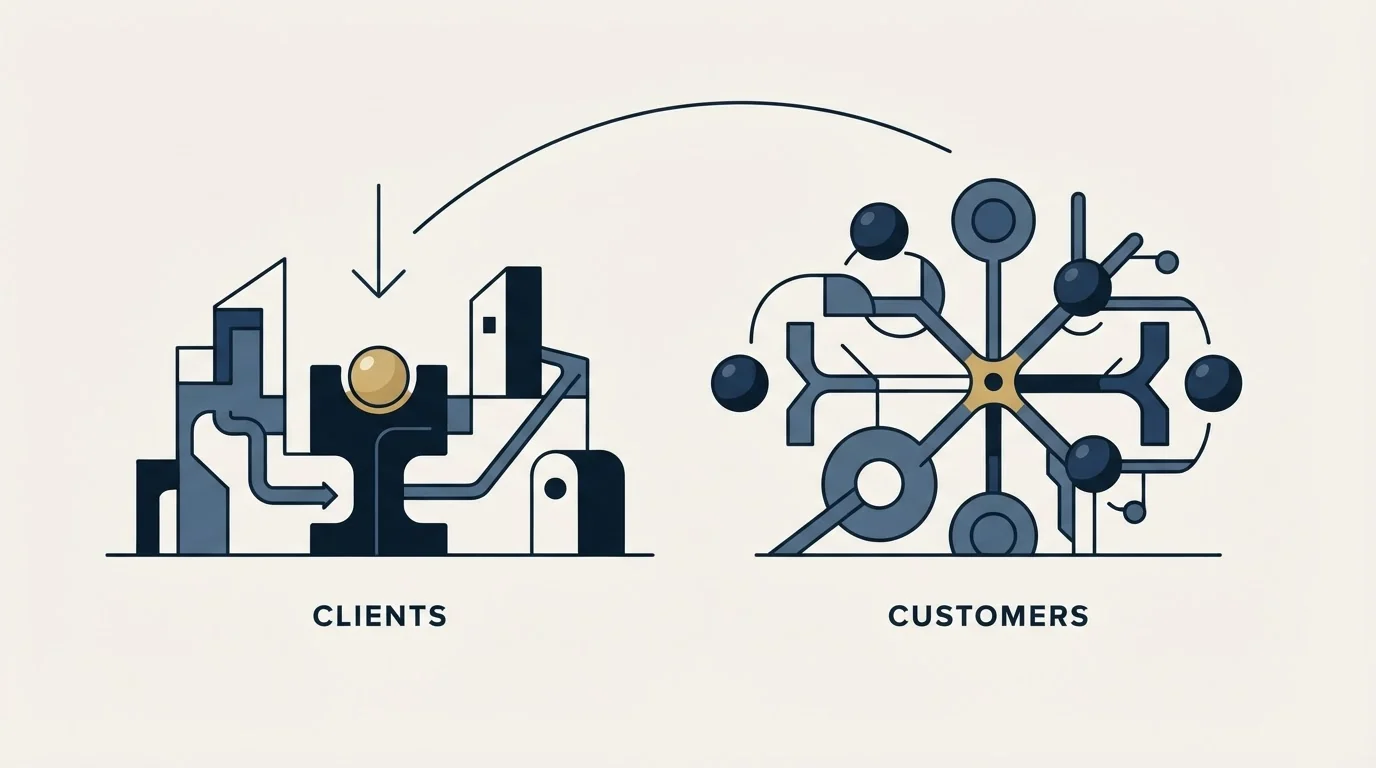
Agencies, consultancies and service firms tend to call it prospecting clients, and product companies tend to call it customer prospecting, and the underlying job is the same one with a different noun on it. The mechanics that change are narrow and worth naming.
A service business usually sells to a smaller total market, so exhausting the addressable list is a real risk and the cost of a wasted approach is higher. That argues for fewer, better-researched approaches rather than volume, and it makes the reason attached to each approach more important rather than less. It also means the diagnosis, the thing you would normally charge for, is often what earns the reply. That trade is examined in consultant lead generation.
A product company selling into a market of tens of thousands of accounts has the opposite constraint. The list is effectively inexhaustible, so the question stops being whether you can reach everyone and becomes which slice deserves attention first. The failure mode there is treating an inexhaustible list as permission to skip selection entirely.
Neither case changes the five decisions. What changes is how expensive it is to get decision one wrong.
What prospecting is not
Prospecting is not the same thing as increasing send volume, and the two get confused because they look identical on an activity dashboard.
They are also not the same as lead generation, which produces people who came to you. Prospecting produces people who have not asked for anything yet, and the two motions need different messages, different measurement and usually different owners. Where they meet, and what breaks at the seam, is covered in inbound lead generation.
It is not a follow-up problem either. Our own position is that a campaign carries one message: no bumps, no thread replies, no second attempt underneath the first one. A prospecting motion built on that constraint has to put its effort into selection and premise, because there is no second message to rescue a weak first one. Re-approaching an account that did not reply happens as a new campaign with a new reason, not as a chase, and that is a different piece of work rather than the same one repeated. The full argument sits in the outbound sales playbook.
The part nobody schedules
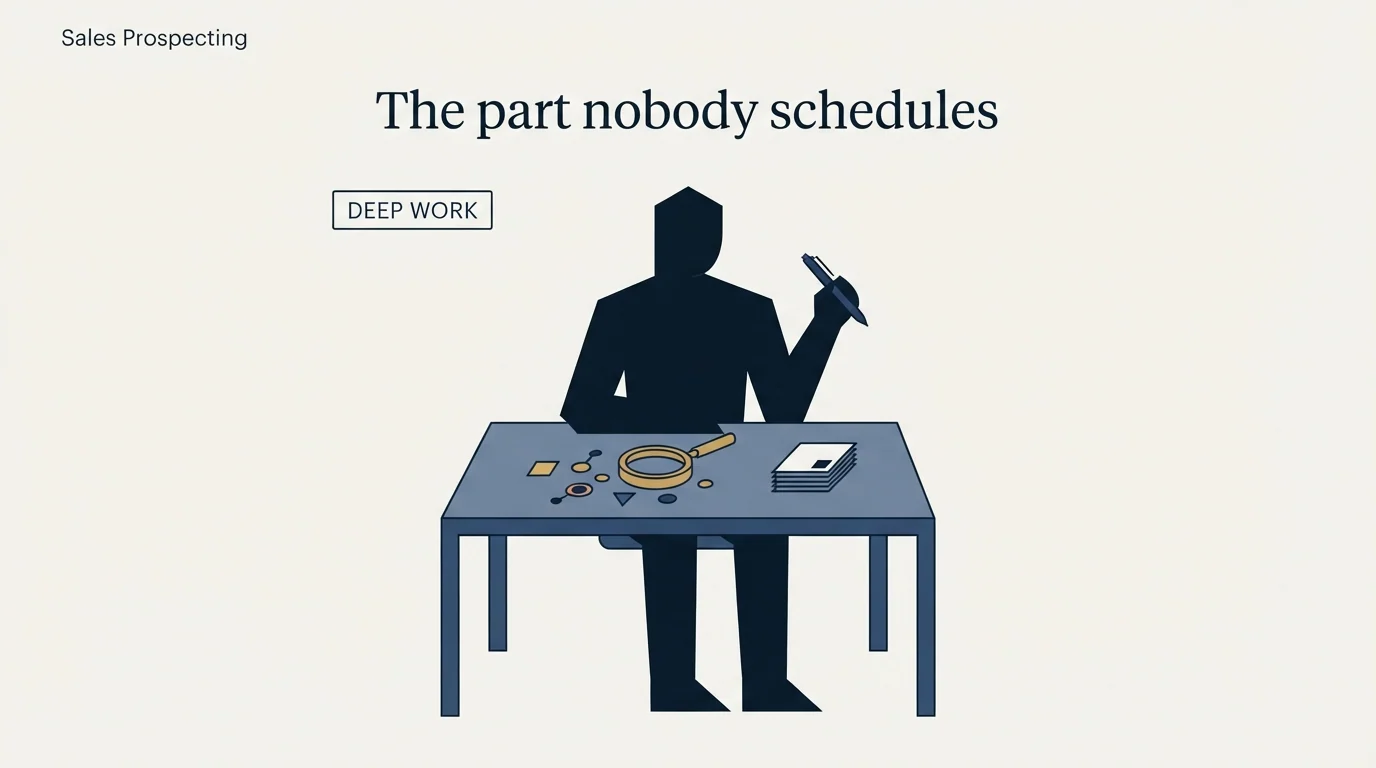
Prospecting decays for a reason that has nothing to do with skill: it is the only part of a seller's week with no external deadline. A demo has a calendar invite. A proposal has a client waiting. Reading twenty accounts to find four reasons has nobody waiting for it, so it loses every scheduling contest it enters.
That is why a team busy servicing clients stops prospecting first rather than last: delivery work carries somebody else's deadline and prospecting does not, so it loses the scheduling contest every week rather than occasionally.
To make the shape visible, take a purely illustrative set of numbers with no measurement behind them. Suppose reading an account properly takes twelve minutes and produces a usable reason four times out of ten. Twenty accounts is four hours and yields eight reasons. A seller with four hours of genuinely protected time a week can sustain that; a seller with fragmented time cannot, and will fall back on the filter-built list because it requires no reading at all. Those figures are invented to show the arithmetic, not measured.
- Yes: Can you state the reason each account is on this week's list, in one sentence per account
- No: Would the message still make sense if that reason were deleted
- Yes: Does the list expire, or does it get reused until it is exhausted
- Yes: Is research time protected in the calendar, or does it happen in gaps
- Yes: Were the qualification criteria agreed in writing before the campaign launched
- Yes: Is the primary metric replies and conversations rather than messages sent
Buying it rather than building it
A sales prospecting service sells some part of this motion as an outcome. The category name covers at least four different products, and the differences matter more than the price does.
Some vendors sell the list: a research team produces accounts and contacts to your specification, and your team writes and sends. Some sell the sending: infrastructure, deliverability and campaign operation on copy you approve. Some sell the whole motion including the reply handling, and are paid per meeting or per month. Some sell software and call it a service.
The question that separates them is where the learning ends up. If the vendor holds the research, the reasons and the reply data, then what the programme learns about your market leaves when the contract does. If the copy and criteria stay with you, it does not. That trade is examined by delivery model in B2B lead generation services, which is the right page to read before signing anything in this category.
Our own arrangement is narrow and worth stating plainly. Qualification criteria are agreed in writing before launch, we are paid on attended meetings that meet those criteria, and every campaign carries a single message.
The short version
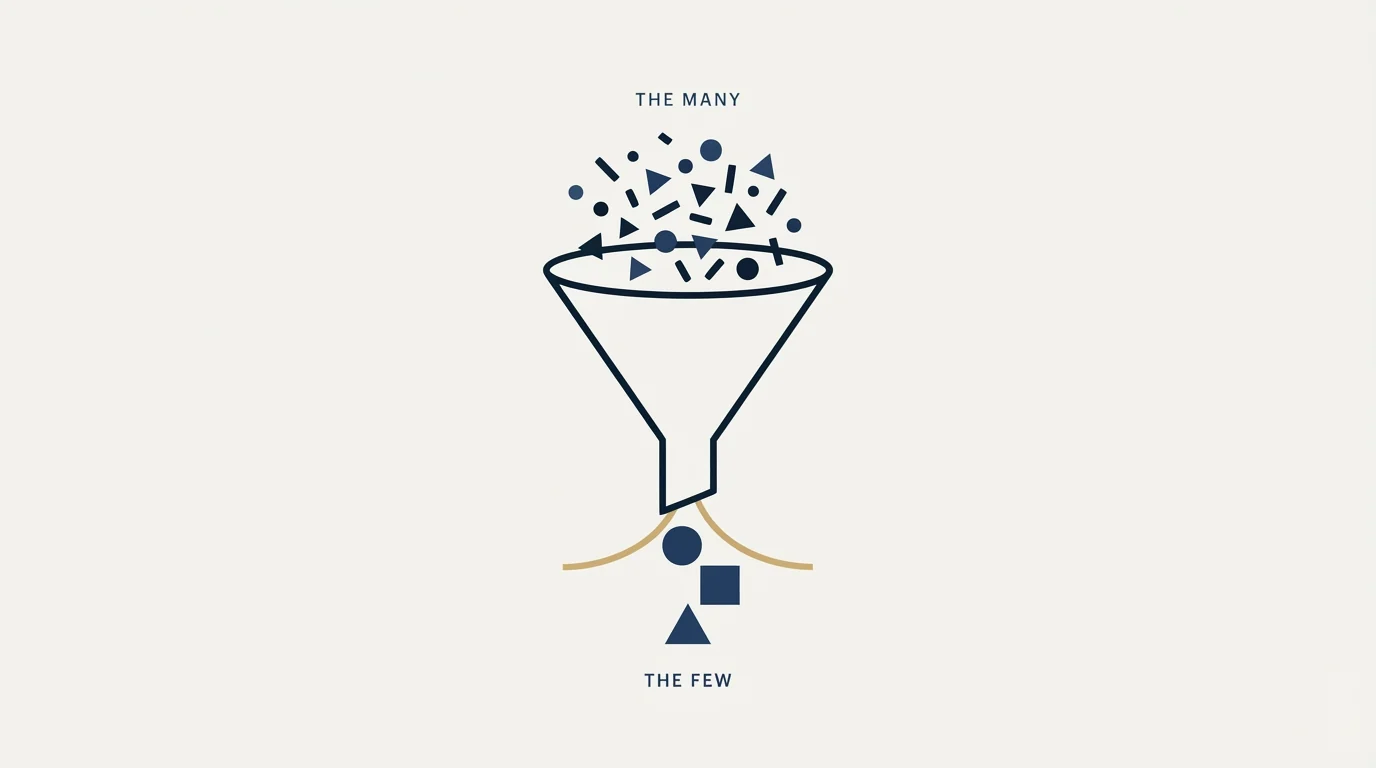
Prospecting is selection, not sending. Five decisions make up the motion, and the second one, the dated reason a specific account should hear from you this week, is the one most teams never make. Prospecting for clients and prospecting for customers are the same five decisions with different tolerances for error. It is not a follow-up problem and cannot be fixed with a second message, which is why the premise has to carry the weight. The research half of the work has no external deadline, so it needs protected time or it disappears. If you buy it as a service, the question worth asking is where the learning ends up when the contract ends.
If you want to see what a signal-led campaign would look like against your own market, we will build one.
Frequently asked questions.
Frequently asked questions- What is the difference between prospecting and lead generation?
- Lead generation produces names, usually from people who came to you or from bulk acquisition, and it scales with budget. Prospecting decides which names deserve attention and finds a reason to use it, and it scales with research time. They fail differently, so a lead generation fix applied to a prospecting problem produces more names and the same number of meetings.
- How many accounts should one person prospect at a time?
- Fewer than most territory plans assume. The binding constraint is how many live conversations a person can genuinely carry, and every account beyond that number receives no contact regardless of who owns it on paper. Start from the capacity figure, work outwards, and treat the gap between capacity and market size as work that needs a different motion.
- Does prospecting mean cold outreach?
- Not only. Referrals, community presence, partner introductions and following up on inbound activity are all prospecting, because each one is a way of turning a market into a working list with a reason attached. Cold outreach is the version that supplies its own attention and timing, which is what makes it the most demanding of the options.
- How do you prospect when a campaign sends only one message?
- By putting the effort into selection and premise instead. Our campaigns carry one message, so the reason for writing has to be real and the message has to be worth reading the first time. Re-approaching an account happens as a new campaign built on a new reason, which is a different piece of work rather than the same one repeated.
About the author.

B2B cold email experts helping companies generate qualified leads through done-for-you outreach campaigns.
RevenueFlow Team
Explore more.
Ready to scale your outreach?
We build GTM engines that book real meetings. See the receipts.
Related articles.
Prospecting Methods: Six Ways In, and What Each One Demands
Six prospecting methods, grouped by economics rather than preference: what each one needs before it works, where it stops scaling, and how to choose.
Lead Prospecting: Where Lead Generation Ends
The work between an acquired name and a person worth contacting is real, unglamorous and usually unowned. What it involves and where the handover breaks.
Virtual SDR: One Term Covering Two Different Purchases
One vendor sells a vetted remote person, another sells software from $250 a month. The term does not separate them, and they fail in opposite directions.
Outbound Prospecting: When Nobody Raised Their Hand
Going first means supplying the attention, timing, framing and permission that inbound gets free. Where outbound earns its cost, and what it really charges.
The Agoge Sequence: What Sam Nelson Actually Built
A documented 15-touch, 27-day cadence built by Sam Nelson at Outreach. What the primary sources say, which part transfers, and where our own practice differs.
Outbound for SDR Managers: Finding the Constraint
A short month is usually the list, the message or the infrastructure. Capacity is the least common cause and the only one more people actually fix.