Prospecting Methods: Six Ways In, and What Each One Demands
Six prospecting methods, grouped by economics rather than preference: what each one needs before it works, where it stops scaling, and how to choose.
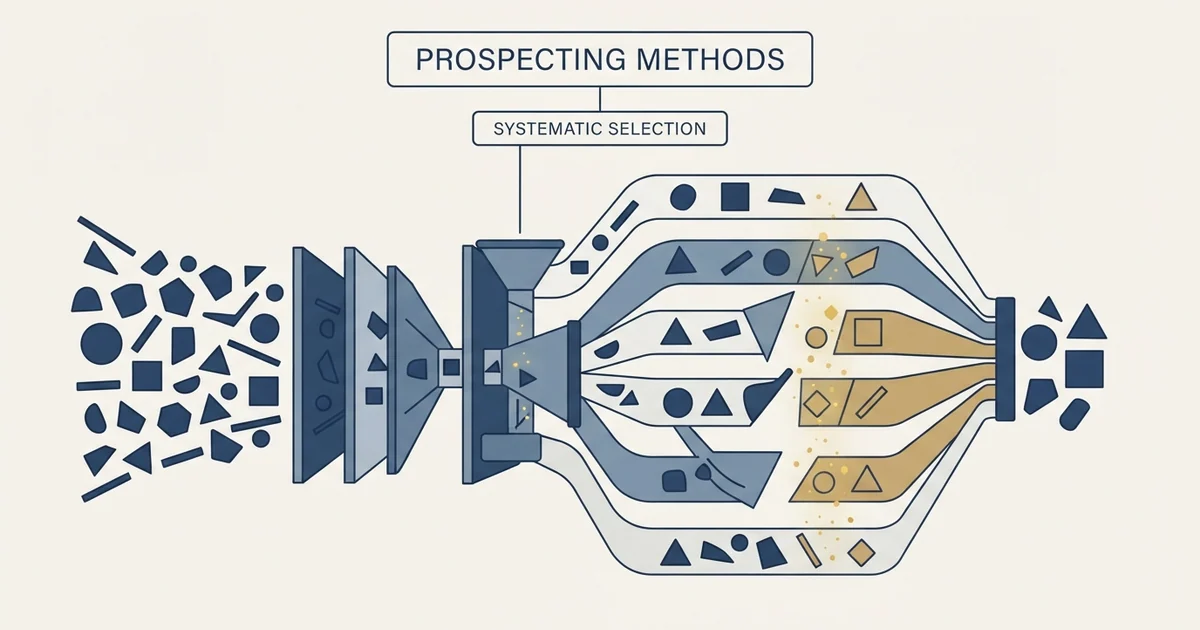
A prospecting method is a repeatable way of turning a market into a working list plus a reason to make contact. Six cover most practice: referral, signal-led outbound, warm-inbound follow-through, community and event, partner and channel, and list-led volume. They divide into relationship-led, signal-led and volume-led families.
Key takeaways
- The six methods group into relationship-led, signal-led and volume-led families, and the families have genuinely different economics. Relationship-led converts best and has the smallest ceiling; volume-led has the largest ceiling and the fastest-decaying returns.
- Which methods a team can run is decided by market size, deal value and how much uninterrupted time the week contains. Methods needing protected blocks lose to methods that fit in gaps unless the calendar is changed deliberately.
- Techniques that survive across methods: write the message before building the list, delete the reason and reread, work from the account own published surfaces, prospect the function rather than the title, and cap research time per account.
- Method and channel are separate choices. Running one message per campaign removes an entire category of technique advice, because much published prospecting guidance assumes a motion we never run rather than describing a method.
Reviewed and updated August 28, 2026
Ask six sellers how they prospect and you will get six answers that sound like preferences: one swears by referrals, one by LinkedIn, one by phone, one by events, one by research-heavy email, one by whatever the marketing team hands over. Every one of those answers is a method with different economics, and the reason the arguments never resolve is that each seller is describing the method that fits their market, their tenure and the amount of uninterrupted time their week contains.
A prospecting method is a repeatable way of turning a market into a working list plus a reason to make contact. Six of them cover almost everything teams actually run.
Where marketing hands over raw names, the handoff between generation and prospecting explains how that list becomes an accountable, contactable population.
The six methods, and what each one demands
Building pipeline through an existing network is the method most teams start with and the one they describe least precisely, because it is the only one whose supply is fixed in advance: referrals and partnerships produce whatever they produce, and no amount of effort widens the network faster than it decays.
Referral and introduction. An existing relationship vouches for you. It has the highest conversion of any method and the smallest possible ceiling, because it is bounded by the number of people who owe you attention. It demands a base of satisfied customers or a personal network, which new teams and new markets do not have, and it degrades if it is asked for too often.
Signal-led outbound. You watch for dated events, a role posted, a leader replaced, a location opened, a technology added or dropped, and write to the person the event implicates. It demands research time and a source of signals you can observe rather than buy from the same vendor as your competitors. Its ceiling is the frequency of the event across your market.
Signal-led outbound depends on tooling that can reliably surface a dated trigger, and the distinct jobs prospecting tools perform shows where teams end up paying twice for the same capability.
Warm-inbound follow-through. Somebody visited, downloaded, attended a webinar or replied to a newsletter, and a person reaches out on the back of it. It demands a marketing motion producing enough of these to matter, and it usually competes with the automated marketing programme that already owns those contacts.
Community and event. Conferences, industry groups, forums, private communities. The contact happens in a context where a stranger is expected, which removes the permission problem entirely. It demands travel, time and a tolerance for slow returns, and it produces relationships rather than a pipeline you can forecast next quarter.
Partner and channel. Somebody who already sells into your market introduces you into their accounts. It demands a genuinely complementary partner, an incentive that survives contact with their quota, and enough enablement that their reps can describe what you do without you in the room.
List-led volume. Filter a database, build the largest defensible list, send. It demands almost no research and almost no relationships, which is why it is the default when nothing else is in place. Its economics have moved sharply against the operator: the same filters are available to every competitor, so the list is not distinctive, and recipients see a great deal more of this mail than they used to.
- Needs an existing base or real presence
- Highest reply quality per approach
- Ceiling is other people's attention, not your effort
- Slow to start, slow to decay
- Hard to forecast quarter by quarter
- Needs observable events and research time
- Reason to write is the reason they are on the list
- Ceiling is how often the event occurs
- Expires, so the list rebuilds itself
- Forecastable once the event rate is known
- Needs data and sending infrastructure
- No reason attached beyond fit
- Ceiling is deliverability and audience patience
- Never expires, so it gets reused until exhausted
- Easy to forecast and easy to over-run
Choosing between them without a taste test

Three properties decide which methods a team can actually run, and none of them is about which method is best.
Market size. A market of 400 accounts cannot absorb a volume method; you would exhaust it in a quarter and have nothing left. A market of 40,000 cannot be covered by referrals no matter how good the relationships are.
Prospecting without boots on the ground is a question about which of these families a team can honestly run, since the relationship-led family is the one that depends on presence and the other two do not.
Deal value. Research-heavy methods cost seller hours per account. Below a certain contract value that arithmetic fails, and the honest answer is a cheaper method rather than a more diligent seller.
Time structure. Methods that need uninterrupted blocks lose to methods that fit in gaps, in any week that is not deliberately protected. This is why teams drift towards volume even when they know better.
A fourth property, how fast a method answers, decides which one to reach for when the problem is urgent rather than structural. That question has its own page: lead generation channels sorted by speed is the right read when the pipeline gap is this quarter's rather than next year's.
- Step 1Count the market
How many accounts genuinely fit. A number, not a description. It rules methods in and out immediately.
- Step 2Divide by capacity
How many accounts one person can carry at once. The gap between the two numbers is the part that needs a method other than personal attention.
- Step 3Look for a dated event
If the market produces observable events at a useful rate, signal-led is available. If it does not, it is not, whatever the tooling promises.
- Step 4Check the calendar, honestly
A method that needs four protected hours a week fails in a calendar that has none. Change the calendar or change the method.
The techniques inside a method
Method is the shape of the motion. Technique is what you do inside it, and this is where most sales prospecting strategies advice actually sits. A few techniques survive scrutiny across methods.
Asked to identify three prospecting techniques, most people name channels instead, which is why the answer never travels between teams. Three that do travel, and that work inside any of the methods above: research that yields one specific observation about the account rather than a general one, a trigger carrying a date so the timing is defensible, and a written premise short enough that whoever runs it next week produces the same message.
Write the message before you build the list. If the message only makes sense when a specific fact is true, the list is defined by that fact and builds itself. If the message works for anybody, the list has no boundary and the method has quietly become volume.
Delete the reason and reread. Take the sentence that references the event out of the draft. If the message still reads fine, the research contributed nothing to it, and you paid for research you did not use.
Read the account's own surfaces first. Careers pages, product pages, changelogs, newsroom posts and pricing pages are published deliberately, and they are current more often than an aggregator is. Referencing something a company chose to publish is ordinary attentiveness; referencing something they did not choose to publish reads as monitoring.
Prospect the function, not the title. Titles vary between companies for the same job. The reason you found usually points at a function, and the person who owns that function is findable even when the title is unfamiliar.
Give the research a deadline. The most common prospecting tips failure is unbounded research: forty minutes on an account that warranted eight. Cap the time per account and accept that some accounts will not yield a reason, because that is a finding rather than a failure.
Keep a record of what the research found, not just what you sent. A note saying which surface produced the reason, and whether it produced one at all, turns a quarter of prospecting into evidence about where to look next. Teams that log only sends and outcomes can tell you what worked without being able to reproduce it, which makes every new hire start the search from nothing.
Separate the account decision from the person decision. A great many wasted approaches come from a correct account judgement paired with a lazy contact choice, and they are usually recorded as the account being wrong.
How many methods a team can honestly run
A common shape is that repeat business and events are working and total volume is still flat, which is not a failure of either method: both have a ceiling set by something outside the team's control, existing customers and the event calendar, so growth past that ceiling has to come from a method with a supply the team sets itself.

Most teams run more methods than they can sustain, because adding one is a decision and dropping one never is. Each method carries a fixed cost that does not scale down: a source to watch, a list to maintain, a message shape to keep current, and somebody who notices when it stops working. Running four methods badly produces less than running two properly, and the four-method version is much harder to diagnose, because a flat quarter has four candidate explanations and no clean signal from any of them.
A practical rule is to run one method that produces volume and one that produces quality, and to add a third only when the first two are both stable enough that somebody could describe their current performance without opening a dashboard. New markets are the exception worth naming: when nothing is known about a market, running two methods briefly and deliberately is a cheap way to learn which one the market rewards, provided the comparison is set up before either starts rather than reconstructed afterwards.
The failure modes are specific to each family and worth recognising early.
- No: Relationship-led: the same twenty contacts are asked repeatedly and reply rates fall inside a warm network
- No: Signal-led: the window between event and contact stretches past the point where the event still matters
- No: Signal-led: the signal turns out to resolve to firmographics, so removing it leaves the same list
- No: Volume-led: send volume rises while replies stay flat, which is the audience answering
- No: Volume-led: the list is rebuilt from the same filters each quarter and returns the same accounts
- No: Any method: nobody can name who owns it, so nobody notices when it stops working
Where the channel sits inside the method
Method and channel are separate choices, and conflating them produces the argument about whether email or phone or LinkedIn is better, which has no answer at that level of abstraction.
We run email and LinkedIn. Phone and SMS are legitimate channels that a large part of the industry runs, with their own regulatory surface and their own economics, and this is a description of that practice rather than an account of ours. Where calling does fit alongside the rest of a motion, and the coverage arithmetic that governs it, is set out in cold calling prospecting. The equivalent for the LinkedIn side, including what the platform's limits do to a plan built on it, is in LinkedIn prospecting.
One constraint cuts across every method we run: a campaign carries one message. No bumps, no thread replies, no second attempt under the first. Applied to prospecting methods, that removes an entire category of technique advice, because a great deal of published prospecting guidance assumes something we never send, a second message under the same premise. Re-approaching an account that did not reply is a new campaign with a new reason, which means the reason has to exist before the campaign does. The list construction that makes this work, and the test for whether a signal deserves a place in it, is in B2B prospecting.
The short version

There are six prospecting methods worth naming, and they divide into relationship-led, signal-led and volume-led families with genuinely different economics. Which ones a team can run is decided by market size, deal value and how much uninterrupted time the week contains, not by preference. Techniques matter inside a method: write the message before the list, delete the reason and reread, work from the account's own published surfaces, prospect the function rather than the title, and cap research time per account. Channel is a separate choice from method, and running one message per campaign removes most of that advice from circulation.
To see which method the arithmetic of your own market supports, we will build a campaign against it and show you the population.
Frequently asked questions.
Frequently asked questions- Which prospecting method works best?
- The question does not resolve at that level, because the methods have different ceilings. A market of a few hundred accounts cannot absorb a volume method and a market of forty thousand cannot be covered by referrals. Count the addressable market, divide by what one person can carry, and the arithmetic rules most of the options in or out for you.
- How many prospecting methods should a team run at once?
- Usually two: one that produces volume and one that produces quality. Each method carries a fixed cost that does not scale down, including a source to watch, a list to maintain and somebody who notices when it breaks. Four methods run badly produce less than two run properly, and a flat quarter then has four candidate explanations.
- Is cold calling a prospecting method or a channel?
- A channel. The method is how you decide who to contact and why now; the channel is how the message travels. Calling can carry a signal-led method or a volume-led one, and the coverage arithmetic differs enormously between them. We run email and LinkedIn rather than phone, so our account of calling describes industry practice.
- What are the best sales prospecting strategies for a small team?
- Pick methods that match the hours you actually have. A two-person team with no protected research time cannot sustain signal-led outbound, and the honest options are relationship-led work, which is slow but cheap in attention, or a tightly bounded volume motion with a much smaller list than the tooling encourages.
About the author.

B2B cold email experts helping companies generate qualified leads through done-for-you outreach campaigns.
RevenueFlow Team
Explore more.
Ready to scale your outreach?
We build GTM engines that book real meetings. See the receipts.
Related articles.
Virtual SDR: One Term Covering Two Different Purchases
One vendor sells a vetted remote person, another sells software from $250 a month. The term does not separate them, and they fail in opposite directions.
Sales Prospecting: Most of the Job Happens Before You Send
Prospecting is selection, not sending. The five decisions inside the motion, the one most teams never make, and what changes when you buy it as a service.
Outbound Prospecting: When Nobody Raised Their Hand
Going first means supplying the attention, timing, framing and permission that inbound gets free. Where outbound earns its cost, and what it really charges.
The Agoge Sequence: What Sam Nelson Actually Built
A documented 15-touch, 27-day cadence built by Sam Nelson at Outreach. What the primary sources say, which part transfers, and where our own practice differs.
Fractional VP of Sales: Four Arrangements, One Title
Interim executive, shared leader, consultant and managed pod are sold under one title. Which one you are buying, and the conditions that decide it.
Prospect Meaning in Sales: A Name Is Not a Prospect
A prospect is a name that passed a fit check, not a name that replied. What lead, prospect and opportunity each assert, and what the boundary decides.