Fractional VP of Sales: Four Arrangements, One Title
Interim executive, shared leader, consultant and managed pod are sold under one title. Which one you are buying, and the conditions that decide it.

A fractional VP of sales is senior sales leadership bought as a share of someone's week rather than as an employee. The title covers four arrangements: interim executive, shared fractional leader, consultant and vendor supplied pod. It works when the motion is already proven and someone inside owns execution between sessions.
Key takeaways
- The title covers four different purchases, and the agreement rather than the label should say which one you are buying, because their costs and failure modes are not alike.
- Chief Outsiders states that fractional VP compensation is in line with United States executive sales salaries, so the saving sits in the fraction of time rather than in the rate.
- A shared senior seat works when the sales motion is already proven, when somebody inside owns execution between sessions, and when the scope is one problem rather than the whole function.
- Comparing a fractional fee against a base salary is not a comparison: build both sides fully loaded and budget ramp in calendar time, which is longer against fewer hours.
Reviewed and updated September 1, 2026
Jason Lemkin's answer to the question is one word long. Asked when a fractional VP of Sales works at an early stage startup, his SaaStr post replies "Just about Never," and lists four reasons: you need someone all in, they will not build the team you need, it is a band aid rather than a solution, and early stage companies need hands on leadership that closes deals personally (SaaStr).
That is a strong opinion about a real failure mode, and it is also an argument about one specific arrangement being sold under a title that covers at least four. The word fractional has become a label for any senior sales help that is not a full time employee, and the four things it labels have different costs, different failure modes, and different reasons to exist. Buying the wrong one is how the engagement ends up proving Lemkin right.
Four arrangements, one job title
The distinction that matters is not how many days a week somebody works. It is what they are accountable for producing, and whether anybody else can produce it if they leave.
The interim executive. A full time or near full time senior leader on a fixed term, usually covering a gap: a VP left, a founder is stepping back from sales, an acquisition needs a bridge. The engagement has an end date and a defined handover. Chief Outsiders separates this shape from the fractional one in its own navigation, listing Interim CMO alongside Fractional CMO as different offers (Chief Outsiders). That separation is worth copying into your own thinking, because an interim is a temporary employee and a fractional is a shared one, and those two things behave nothing alike.
The genuine fractional VP. A senior leader who gives you a defined share of their week, indefinitely, and carries several clients at once. Chief Outsiders' page states that compensation for the role is in line with executive sales salaries in the United States, and that the figure varies with the executive's experience, the specifics of the engagement, and whether the work is part time or full time. Notice what that sentence concedes: the rate is anchored to a full executive's market value, so the saving is in the fraction of time rather than in the hourly price of the person.
The consultant or advisor. Diagnosis, plan, coaching, review. No line management, no forecast ownership, no hiring. This is the shape most often sold as a fractional sales consultant, and it is a legitimate purchase, but it is advice rather than leadership. Lemkin's fifth point names the risk precisely: most fractional leaders in sales and marketing end up wanting to provide advice, and there is a limit to how much advice an early stage company can absorb and act on.
The managed pod. A vendor supplies a manager plus the people being managed, and the manager is the vendor's employee rather than a leader inside your company. This is often marketed as fractional sales management. It solves a different problem from the other three, because you are buying delivery capacity with supervision attached rather than buying leadership for a team you already have.
- Fixed term, near full time
- Owns the number and the team
- Has an end date and a handover
- Fails when the term ends before a successor exists
- A defined share of a senior week, or advice only
- May or may not manage anyone
- Rate anchored to executive market value
- Fails when nobody internally executes between sessions
- Vendor supplies manager and team
- Manager is the vendor's employee
- Priced as a service, not a salary
- Fails when it is bought to fix leadership rather than capacity
What the fractional consultant version actually delivers

The consultant shape deserves its own paragraph because it is the one most often bought by accident. A company decides it needs sales leadership, meets someone experienced who works with several clients, and signs a monthly agreement. Three months later the diagnosis was accurate, the plan was sensible, and nothing changed, because a plan is not the constraint.
The test that separates a useful consulting engagement from an expensive one is whether the deliverable is a document or a behaviour. A document is a territory plan, a compensation design, a stage definition, a call scorecard. Those are genuinely valuable and a good consultant produces them quickly. A behaviour is reps running the new stage discipline in week six without being reminded. Nobody who is in your business one day a fortnight can produce the second thing on their own. Somebody inside has to own it, and if that person does not exist, the consulting fee is buying paper.
So the honest framing is that a consultant is an accelerator on execution capacity you already have, not a substitute for it. Where that capacity exists, the engagement is efficient: you are renting judgement you cannot afford to employ. Where it does not, the same fee buys a plan that outlives its own relevance.
Which arrangement the conditions point at
What decides this is what is already true in the company rather than who you meet. The scoping question, meaning what a fractional leader is for, how an engagement is shaped, what the first ninety days should produce and how the exit gets written, is covered in full in fractional sales leadership, and it is worth reading alongside this page. The concern here is narrower: given those conditions, which of the four arrangements above is the one to buy.
Where the motion is proven and the problem is scaling it, a genuinely shared fractional leader has something to systematise, and the shared shape works. Where nobody yet knows why anything closes, the leader has to discover that first, which is the deepest work in sales and the least compatible with two days a week. That is the substance of Lemkin's objection, and it holds. In that situation the interim shape, at or near full time on a fixed term, is the honest version of the same purchase.
Where somebody inside owns execution between sessions, any of the shared shapes can work. Where nobody does, the consultant shape is the worst of the four, because it produces the most paper and the least implementation. The arrangement degrades into a fortnightly meeting about why last fortnight did not happen, which is the same failure that stalls a shared SDR seat for the same reason, laid out in fractional SDR.
Where the scope is one problem rather than the whole function, narrow scope suits shared time, because the context the leader has to carry is small enough to reload quickly. A brief to own sales does not fit into a shared week at any price, and a company writing that brief is describing an interim or a full time hire whatever the agreement is titled.
Where the constraint is delivery capacity rather than direction, none of the first three fit and the managed pod is the match. Buying leadership to solve a capacity problem is the most expensive version of this mistake, because it costs a quarter before anyone discovers the diagnosis was never the missing piece.
Where the cost comparison gets rigged
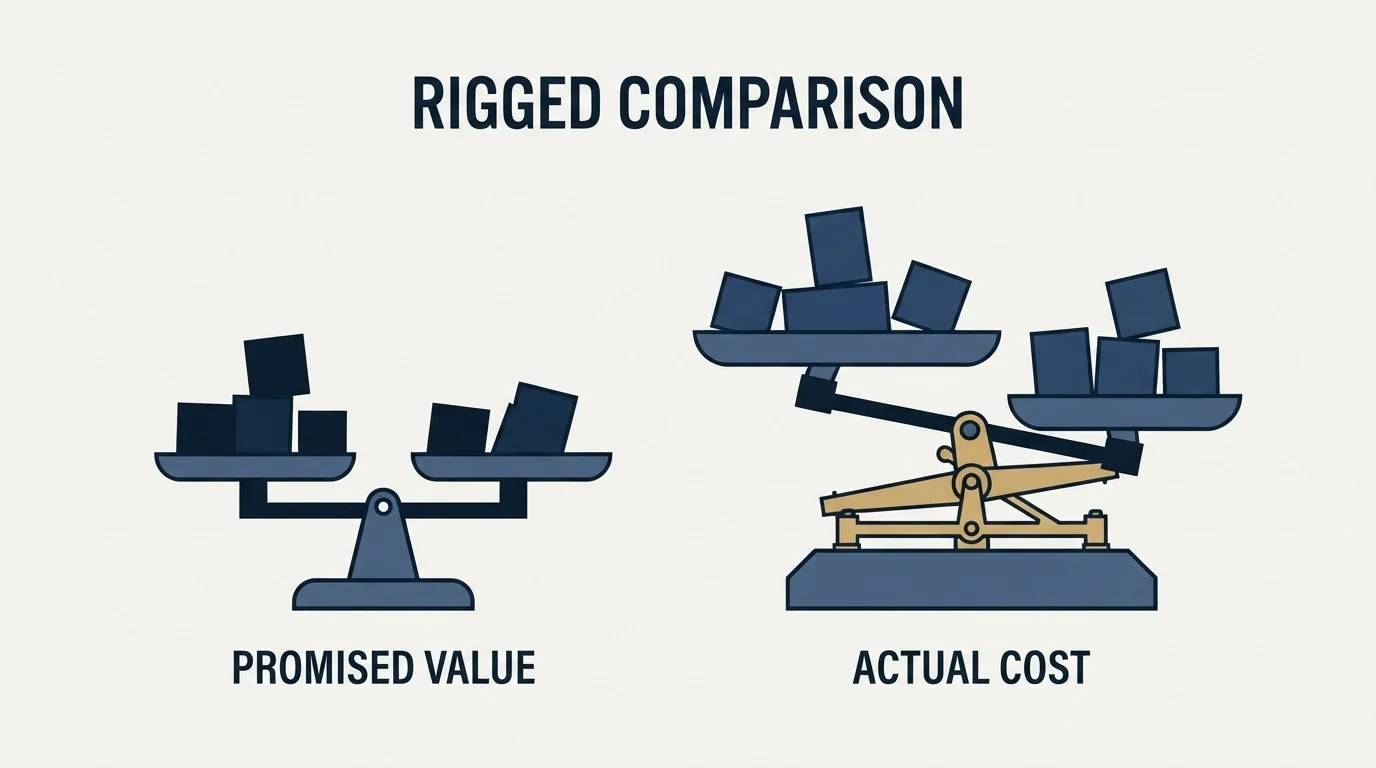
The comparison people run is a fractional monthly fee against a VP's base salary, and it is not a comparison. One of those numbers is an all in price for a share of a person, and the other is one line of a full employment cost that also carries variable compensation, employer taxes, benefits, recruiting, equipment and the management time of whoever the VP reports to. The method for building the second number honestly, line by line, is in SDR salary and the fully loaded cost, and it applies unchanged at executive level.
Two adjustments matter more than the headline rate.
The first is ramp. A new VP of Sales is not productive on day one at any level of seniority. They have to learn the product, the market, the team and the deals in flight before their judgement is worth more than the incumbent's. A fractional leader carries the same learning cost against fewer hours, so the ramp measured in calendar time is longer even though it is cheaper in cash. Budget the calendar, not just the invoice.
The second is what happens at the end. A full time hire who works out compounds: the second year is cheaper than the first because recruiting and onboarding fall away. A fractional arrangement does not compound in the same way, because the knowledge stays with someone who has other clients. Ask directly what is written down and where it lives, and treat any answer that depends on the individual's memory as a cost you will pay again.
Here is the shape of the arithmetic with invented inputs, chosen only to make the structure legible. These are not observed figures from any engagement, ours or a client's, and they are not benchmarks. Suppose a fractional arrangement costs a quarter of a loaded full time executive package and delivers one day a week. On paper that is a wash on cost per day. Now add that the fractional leader needs eight weeks to reach useful judgement against the full timer's four, and that the full timer also recruits two reps in the first quarter while the fractional one recruits none. The cost per unit of output diverges quickly, and it diverges in the direction of whichever arrangement matches the work that actually has to happen.
- Yes: Which of the four arrangements this is, written in the agreement rather than inferred from the title
- Yes: Whether the person line manages anyone, and who they can hire or exit
- Yes: How many other clients they carry, and whether the number is capped in writing
- Yes: Who inside your company owns execution between sessions, named
- Yes: What artefacts stay with you: comp plan, stage definitions, scorecards, playbook
- Yes: The result that would make you scale this, and the result that would make you stop
- No: Buying a fractional leader to discover why deals close when nobody knows yet
- No: Signing an open ended agreement with a scope described as owning sales
The alternative nobody prices against it
There is a third option that competes with both a fractional leader and a full time one, and it rarely gets compared because it sits in a different budget line. If the constraint is that the top of the funnel is empty, the sequence of hiring a leader, having that leader hire reps, and waiting for those reps to ramp is a long and expensive way to find out whether the market responds. Buying the meetings directly answers the market question first, and it does so without a leadership hire being the dependency.
That is a different purchase from leadership, and it does not solve a broken sales process or an undefined ICP. It solves exactly one thing: whether there are qualified conversations available in your market at a cost you can live with. The cost math for it against an internal build is in outsourced SDR versus in-house, and the question of when a management layer is the right hire at all is worked through in the SDR manager role and in sales hiring.
The order matters more than the choice. Proving the motion, then hiring into the constraint, is cheaper than hiring a leader to find the constraint, whatever the leader's employment status.
The short version

Fractional VP of Sales names four different purchases: an interim executive on a fixed term, a genuinely shared senior leader, a consultant delivering diagnosis and plans, and a vendor supplied pod with a manager attached. Write into the agreement which one you are buying, because the title does not say.
The shared and advisory shapes work when the motion is already proven, when somebody inside owns execution between sessions, and when the scope is one problem rather than the whole function. They stall when they are bought to discover why deals close, which is the deepest work in sales and the least compatible with a shared week. Compare fully loaded cost against fully loaded cost, budget ramp in calendar time rather than in cash, and ask what stays behind when the engagement ends.
RevenueFlow does not sell sales leadership. We are paid on attended meetings that meet criteria agreed in writing before launch, which is the market question rather than the leadership one, and you can see what a campaign would look like for your market.
Vendor page language verified as of mid-2026. Verify current terms with the vendor before relying on them.
Sources: A "Fractional" VP of Sales Almost Never Works, SaaStr, Fractional VP of Sales, Chief Outsiders
Frequently asked questions.
Frequently asked questions- What does a fractional VP of sales actually do?
- It depends which of four arrangements you signed. An interim executive owns the number on a fixed term. A fractional leader gives you a defined share of their week and usually manages people. A consultant diagnoses and plans without line management. A managed pod supplies delivery staff with a vendor employed manager attached.
- When does a fractional VP of sales not work?
- Mainly when nobody yet knows why deals close. Discovering the motion is the deepest work in sales and it fits badly into a shared week, which is the substance of Jason Lemkin's public objection to the model at early stage. It also stalls when no one inside owns execution between the leader's sessions.
- Is a fractional VP of sales cheaper than hiring one?
- Cheaper in cash for a share of the time, not necessarily cheaper per unit of output. The rate is anchored to executive market value, ramp takes longer in calendar time against fewer hours, and the knowledge leaves with someone who has other clients. Compare fully loaded cost against fully loaded cost.
- What is the difference between a fractional and an interim VP of sales?
- An interim is a temporary near full time employee covering a defined gap, with an end date and a handover. A fractional leader gives you part of their week indefinitely while carrying other clients. Some firms list the two as separate offers, and treating them as one purchase is where scope arguments start.
About the author.

B2B cold email experts helping companies generate qualified leads through done-for-you outreach campaigns.
RevenueFlow Team
Explore more.
Ready to scale your outreach?
We build GTM engines that book real meetings. See the receipts.
Related articles.
Prospecting Methods: Six Ways In, and What Each One Demands
Six prospecting methods, grouped by economics rather than preference: what each one needs before it works, where it stops scaling, and how to choose.
Sales Motivation Quotes: Seven Lines, and Who Said Them
Ford's most quoted line first appeared months after he died, with no source. Seven sales-floor staples, checked against the earliest printed record.
SDR Outsourcing: The Four Models and What Each Costs
Dedicated team, fractional SDR, offshore staffing or outcome-based agency. What you control in each, how ramp works, and what happens when the person leaves.
No Show Email Template: What to Send After a No Show
A no-show accepted the meeting, so writing to them is correspondence rather than a bump. The checks to run first, what to send, and the policy behind it.
Outsourced SDR Pricing by Seat, Meeting or Qualified Meeting
Three pricing units, three different distributions of risk. How to normalise quotes onto one number, and why per-qualified-meeting is not per-meeting.
Prospect Meaning in Sales: A Name Is Not a Prospect
A prospect is a name that passed a fit check, not a name that replied. What lead, prospect and opportunity each assert, and what the boundary decides.