Fractional Sales Leadership: Ninety Days and a Written Exit
A fractional sales leader works on the system rather than in it. What sits in scope, the shape of a first ninety days, and why a healthy engagement shrinks over time.
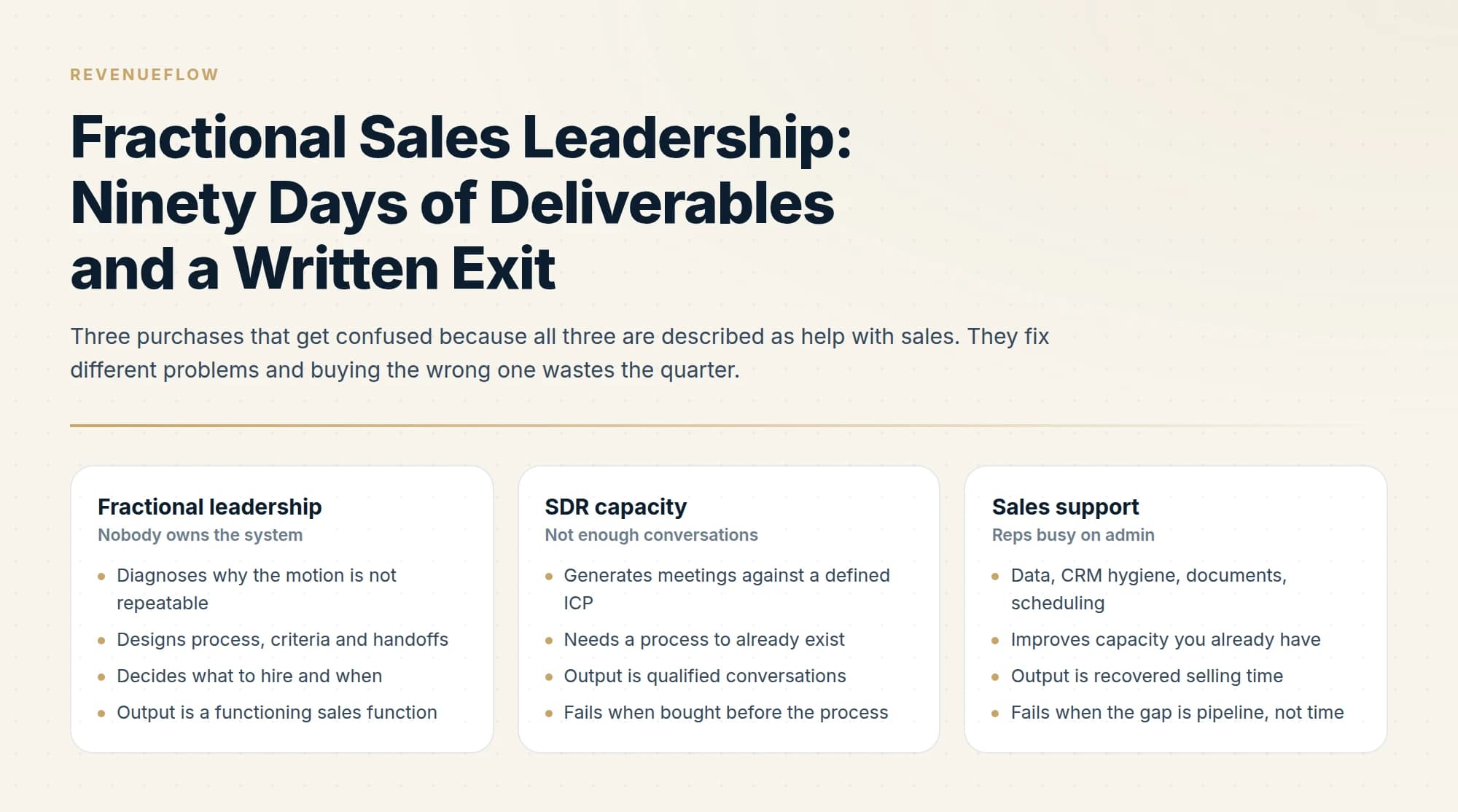
Fractional sales leadership buys ownership of the sales system rather than execution within it: diagnosing why the current motion is not repeatable, designing process and criteria, deciding what to hire and when, and setting compensation and forecasting. The output is a sales function that works without the person who built it.
Key takeaways
- Hiring an SDR before there is a process to run is the sequencing error a fractional leader exists to prevent.
- Below roughly two days a month the engagement is advisory rather than leadership, and it should be priced and described that way.
- The exit condition belongs in the agreement at the start, stated concretely as a documented process, a hired leader, a functioning forecast or a team hitting a defined standard.
- A leader with no authority over hiring or compensation is designing a system while watching somebody else decide the parts that cost money.
Reviewed and updated September 1, 2026
A founder with three reps and no sales leader has a specific problem, and it is not that nobody is selling. It is that nobody owns the question of why the selling is not repeatable, and the founder is too close to it to answer.
Fractional sales leadership buys that ownership for a few days a month. It is a genuinely different purchase from buying reps or meetings, aimed at a different failure, and it fails in its own characteristic ways.
Fractional sales management is the same purchase described one rung lower, and the distinction worth holding is whether the person is being bought to run the team week to week or to fix the system the team runs on.
If you are reading this as one of the VPs of sales it is written for, the persona-specific version of this playbook lives in our guide to outbound for VPs of sales.
What the role is for
A fractional VP Sales or sales director works on the system rather than in it. The output is not deals, it is a sales function that works without them.
Four things typically sit in scope.
Diagnosing why the current motion is not repeatable. Usually the first month, and usually the most valuable part. A founder-led motion that worked will not survive being handed to reps unless somebody articulates what actually made it work.
Designing the process. The stages, the qualification criteria, the handoffs, the definition of a good deal. This is what turns individual talent into something teachable.
Hiring and structuring the team. What roles, in what order, at what point. Hiring an SDR before there is a process to run is the single most expensive sequencing error in early sales, and this is precisely the mistake a fractional leader exists to prevent.
Once reps are hired, deciding how to rehearse their live conversations matters, and AI sales role play explains what a simulated buyer can and cannot prepare them for.
Comp design and forecasting. Both are technical, both are easy to get wrong permanently, and both are hard to change once people are hired against them.
- Diagnoses why the motion is not repeatable
- Designs process, criteria and handoffs
- Decides what to hire and when
- Output is a functioning sales function
- Generates meetings against a defined ICP
- Needs a process to already exist
- Output is qualified conversations
- Fails when bought before the process
- Data, CRM hygiene, documents, scheduling
- Improves capacity you already have
- Output is recovered selling time
- Fails when the gap is pipeline, not time
When it is the right call
The clean signal is that you can name a sales problem and nobody in the company is accountable for solving it.
A founder who is the entire sales function and needs the motion documented before it can be delegated. This is the most common and most successful use.
Reps hired without a process, now underperforming, with nobody senior able to say whether it is the people, the process or the market. A fractional leader can answer that in weeks, which is faster and cheaper than churning through reps to find out.
Hiring the reps themselves raises a separate question of contracts and guarantees, which the breakdown of sales hiring agency fee structures walks through in detail.
A full-time leader you cannot yet justify or attract. Good sales leaders are expensive and hard to hire into an unproven motion. Fractional bridges the gap and, done well, produces the scorecard you will hire the full-time person against.
A transition. A leader has left, and hiring under pressure produces bad hires.
When it is the wrong call

When the real gap is a product or market problem. No sales process fixes a product nobody wants, and a fractional leader who tells you that in month two has earned their fee while being extremely unwelcome.
When you want someone to sell. They are not there to close deals. Some will run a few to understand the motion, and an engagement structured around them personally carrying the number is a part-time AE with a senior title.
When nobody internally will implement. The leader designs; someone has to execute daily. If the founder wants the problem to leave their desk entirely, that expectation and the model are incompatible.
When the company changes direction every few weeks. Process design assumes some stability in what you sell and to whom.
- Yes: You can name a sales problem nobody currently owns
- Yes: Something is selling, even if only founder-led
- Yes: Someone internal will implement between sessions
- No: You want them to personally carry a number
- No: The underlying issue is that the product has no buyers yet
- Depends: Whether you are within a year of hiring a full-time leader
How the engagements are shaped
Two or three days a month is common at the light end and mostly buys diagnosis, design and a standing review. One or two days a week is the working end, where the leader is present enough to coach, sit in on calls and hold people to the process.
Below roughly two days a month it is advisory rather than leadership, which can be useful and should be priced and described as such.
Pricing is quoted rather than published almost universally, so the useful comparison is not rate but scope: how many days, what specifically is produced, and by when. Ask for the first ninety days as deliverables rather than as a retainer description.
- Weeks 1 to 3Diagnosis
Call recordings, CRM history, win-loss review, and time with the founder. Ends in a written statement of what is actually broken.
- Weeks 4 to 6Process and criteria
Stages, qualification criteria, handoffs and the definition of a good deal, written down and agreed.
- Weeks 6 to 9Team plan
What to hire, in what order, against what scorecard. Including the case for hiring nobody yet.
- Weeks 9 to 12Operating cadence
Pipeline review, coaching rhythm and forecasting that continue after they leave.
The exit is the whole point
A fractional engagement that never ends has failed at its stated purpose, and the drift into permanence is easy because the leader becomes useful in ways that have nothing to do with the mandate.
Agree the exit condition at the start, in concrete terms: a documented process, a hired and ramped leader, a functioning forecast, a team hitting a defined standard. Then review against it quarterly.
The healthy version of a long engagement is one that shrinks. Three days a month becomes one, then a quarterly review. If the day count is not falling after two or three quarters, either the mandate has quietly changed to execution, which should be renamed and repriced, or nobody internal is picking up what was designed.
What to ask a candidate

Three questions separate operators from advisors.
What did you decide not to do at your last engagement, and why? Sales leadership is mostly sequencing. Someone who wanted to do everything at once has not run the constraint before.
Walk me through a process you designed that outlived you. The test of the work is whether it survived the leader's departure. Vague answers here usually mean the process was them.
When would you tell a client not to hire reps? The right answer exists and it is common: when there is no repeatable motion to hire into. A candidate who cannot imagine recommending against headcount will recommend headcount.
Also ask what they will need from you weekly, because an engagement that assumes founder availability nobody has is designed to stall.
How the relationship works day to day
The practical mechanics decide more than the person's CV, and they are worth agreeing at the start.
Who they report to. Usually the founder or CEO, and it should be someone with authority to act on what the leader finds. A fractional leader reporting into a middle layer cannot change the things that need changing.
What access they get. CRM, call recordings, win-loss history and the ability to sit in on live calls. A leader working from summaries will produce advice rather than diagnosis, and the difference is visible in the first month's output.
How decisions get made between sessions. The engagement is part-time and the business is not. Agree which decisions wait for them, which the team makes and reports, and which the founder makes alone. Without this, either everything stalls between visits or the leader is repeatedly overruled by decisions made in their absence.
What the team is told. Reps who think a consultant is auditing them behave differently from reps who understand someone is fixing the process around them. The framing matters and it should come from the founder rather than from the leader on day one.
One structural warning. A fractional leader with no authority over hiring or comp is being asked to design a system and then watch someone else implement the parts that cost money. If those two levers are genuinely off the table, say so during scoping, because it substantially narrows what the engagement can achieve and a good candidate will tell you the same.
Where it sits among the alternatives

Fractional leadership is one of five distinct things sold as outsourced sales, and the category map is in outsourced sales companies.
The specific confusion to avoid is buying leadership when you need conversations, or conversations when you need leadership. If your process is sound and the gap is that too few people are hearing from you, that is outbound sales outsourcing or an SDR company. If the reps exist and nobody can say why they are not working, that is this.
Fractional sales companies sell across that whole span, from a shared leader to a shared rep to a marketplace that places either, so read which one a provider offers before comparing day rates.
The two are also sequential more often than they are alternatives. A fractional leader who concludes that the process is sound and the gap is volume has given you a clear brief for buying prospecting capacity, including the qualification criteria and the ICP definition that any vendor will ask for on the first call. Buying in that order costs one engagement more and tends to make the second one work.
The short version
Fractional sales leadership buys ownership of the system rather than execution within it: diagnosis, process, hiring sequence, comp and forecasting. It fits a founder-led motion that needs documenting before delegation, or a team hired without a process. It does not fit a product problem, and it is not a part-time closer. Buy it as ninety days of deliverables rather than as a retainer, insist the first month ends in a written diagnosis, and agree the exit condition before starting, because the healthy engagement shrinks over time.
If the diagnosis concludes that the gap is conversations rather than process, we book attended qualified meetings against criteria agreed in writing beforehand, and you can see what a campaign would look like for your market.
Frequently asked questions.
Frequently asked questions- What does a fractional sales leader do?
- Four things usually sit in scope. Diagnosing why the current motion is not repeatable, which is normally the first month and the most valuable part. Designing the stages, qualification criteria, handoffs and the definition of a good deal. Deciding what to hire, in what order and when. And compensation design and forecasting, both technical and both hard to change once people are hired against them.
- When is fractional leadership the wrong purchase?
- When the real gap is a product or market problem, since no sales process fixes something nobody wants. When you want somebody to personally carry a number, which is a part-time account executive with a senior title. When nobody internal will implement between sessions. And when the company changes direction every few weeks, because process design assumes some stability in what you sell.
- How should the engagement be structured?
- Buy the first ninety days as deliverables rather than as a retainer description. Weeks one to three produce a written diagnosis from call recordings, CRM history, win-loss review and time with the founder. Weeks four to six produce process and criteria. Weeks six to nine produce a team plan including the case for hiring nobody yet. Weeks nine to twelve establish the operating cadence.
- What should you ask a fractional leadership candidate?
- What they decided not to do at their last engagement and why, since sales leadership is mostly sequencing. To walk you through a process they designed that outlived them, because the test of the work is whether it survived their departure. And when they would tell a client not to hire reps, which has a right answer that a headcount-first candidate cannot reach.
About the author.

Ben Carden is CRO at RevenueFlow, which builds and operates outbound revenue engines for B2B companies. Previously at Gartner Enterprise. Studied at London School of Economics.
Ben Carden · CRO
Connect on LinkedIn →Explore more.
Ready to scale your outreach?
We build GTM engines that book real meetings. See the receipts.
Related articles.
Monthly Sales Meeting Agenda: What the Month Decides
The weekly meeting triages deals in flight. The monthly one closes a period and changes the list. Six blocks, ninety minutes, one output each.
Sales Kickoff Meeting: The Decisions It Has to Leave With
A kickoff is the one moment a whole sales organisation can change at once. The four decisions it has to publish, and the week-six check that tests them.
Sales Commission: A Plan That Survives a Bad Quarter
The headline rate is the last decision, not the first. How to derive a commission plan from contract value and margin, and the clauses that decide a bad quarter.
Sales Crediting: Who Gets Paid on a Four-Person Deal
Crediting decides who is recorded as earning a sale, and it is a separate decision from the rate. Settle the rule before the quarter, not after the close.
OTE in Sales: What Decides Whether the Number Arrives
On-target earnings is a forecast written in the grammar of a salary. Pay mix, quota and last year's attainment decide whether the number on the letter arrives.
Sales Hiring: Prove the Motion Before You Hire
Sales hiring goes wrong through sequencing rather than selection. The precondition almost nobody meets, the order that works, and what to test in the interview.