Choosing an SDR Company: The Questions That Reach the Rep
You are buying people doing a repetitive, skill-dependent job on your behalf, and almost none of the standard diligence questions get near them. Five that do.
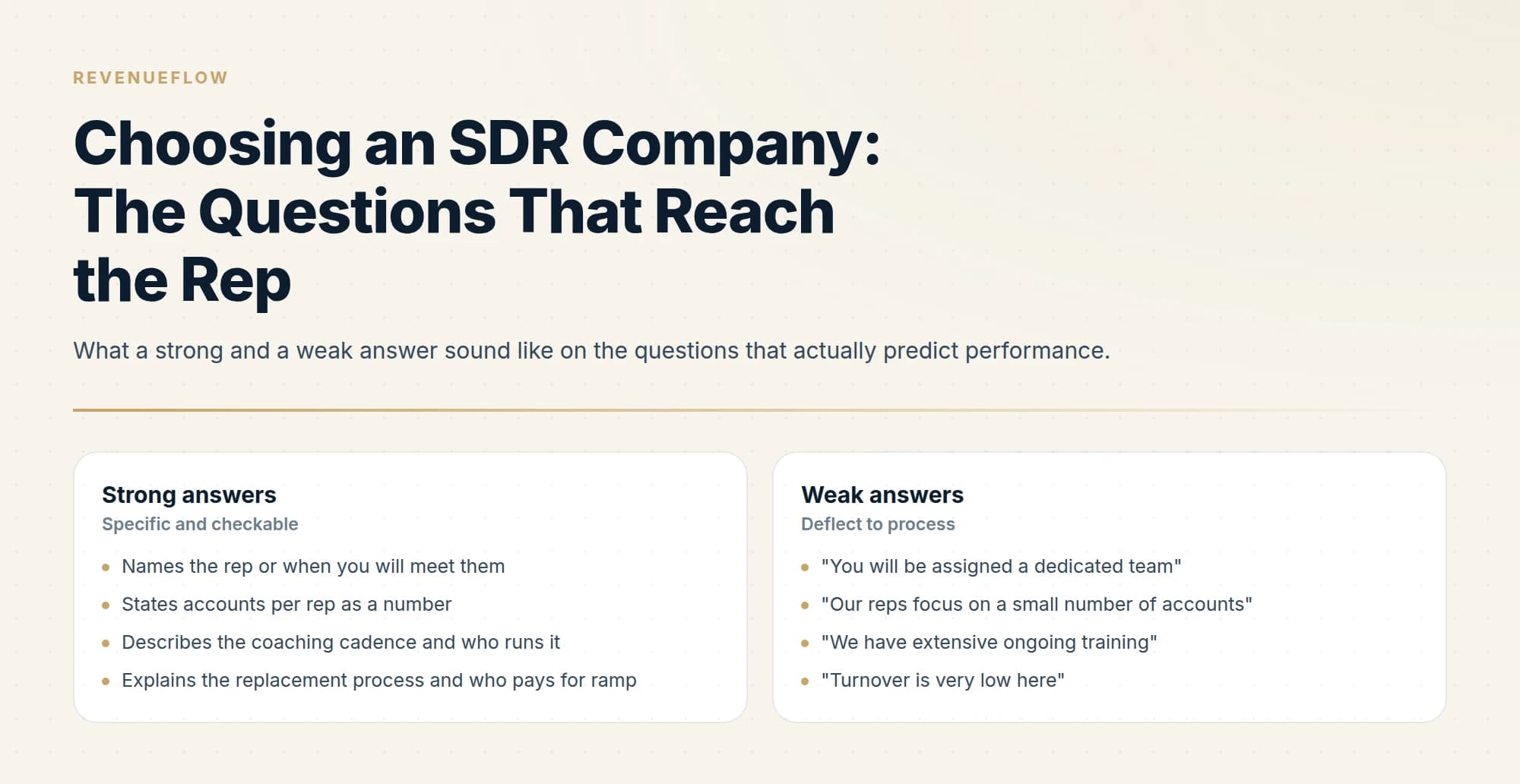
An SDR company sells people doing a repetitive, skill-dependent job on your behalf, so the evaluation is mostly about those people. Establish who the rep is, how many accounts they carry, what the vendor claims about their experience, what happens when they leave, and who coaches them and how often.
Key takeaways
- Accounts per rep is the single most predictive number in the evaluation and it is rarely volunteered, so ask for it as a number.
- Vendors contradict themselves across their own pages, so hold a published claim to the page it appears on rather than to the company.
- Dedicated carries at least three meanings, exclusive, named, or pooled with a coordinator, and vendors answer honestly when asked which one directly.
- On shared sending domains another client's bad list becomes your deliverability problem, so ask whether the domains are dedicated and who registers them.
Reviewed and updated September 2, 2026
Two SDR companies quote similar numbers for what sounds like the same service. One will assign a rep who has done this for years and carries three accounts. The other will assign someone six weeks out of training who carries nine. Nothing on either website tells you which is which, and the difference decides the outcome.
An SDR company sells people doing a repetitive, skill-dependent job on your behalf. So the evaluation is mostly about the people, and almost none of the standard diligence questions get near them.
Ask about the rep, specifically
Five questions, and they are more informative than any case study.
Who is the rep, and will I meet them before signing? A vendor confident in their staffing will introduce the person. One that resists is either not sure who it will be, which is normal at proposal stage, or is avoiding the question, which is not. Ask when you will meet them if not now.
How many accounts does one rep carry? This is the single most predictive number in the whole evaluation and it is rarely volunteered. A rep split across many clients context-switches constantly and cannot hold your market in their head. Three is attentive. Eight is a queue.
What is their experience, and what does the vendor claim about it? Some publish this, and it is worth noting exactly where, because vendors are not always consistent across their own site. SalesRoads' outsourced SDR services page states that its SDRs "average 7 years sales and appointment setting experience", while its appointment setting services page says 5-10 years. Both are live published claims on the same site, which is a useful reminder to hold a vendor to a page rather than to a company.
What happens when the rep leaves? Turnover in this function is high everywhere, including at good vendors. The question is not whether it happens but what the vendor does: how fast the replacement arrives, whether the new rep inherits documented account context, and whether the ramp is billed to you.
Who coaches them, and how often? A rep with no coaching plateaus. Ask who reviews their calls, at what cadence, and whether that person is billed separately.
- Names the rep or when you will meet them
- States accounts per rep as a number
- Describes the coaching cadence and who runs it
- Explains the replacement process and who pays for ramp
- Publishes an experience claim you can hold them to
- "You will be assigned a dedicated team"
- "Our reps focus on a small number of accounts"
- "We have extensive ongoing training"
- "Turnover is very low here"
- Case studies instead of staffing detail
Where the reps sit, and why the vendor should say so plainly
Onshore, offshore or hybrid changes the price substantially and the fit selectively.
Offshore reps are considerably cheaper and work well for research, list building and written outreach into markets where accent and time zone are not part of the buying experience. They are a harder fit for phone-led motions into markets where they are, and pretending otherwise is how engagements sour.
Some vendors make this an explicit pricing variable. SalesHive sets its quote by team model, listing US-based or offshore SDRs as one of three inputs alongside channel mix and daily volume, and publishes no figures because those three inputs determine the number. That is a reasonable way to sell it, and it lets you price the trade-off directly.
Opaque pricing is normal in adjacent categories, and shortlisting sales enablement vendors without published rates is the same evaluation problem one field over.
The answer that should worry you is vagueness. A vendor unwilling to say where the people sit is managing an objection rather than answering a question, and you will find out anyway in week two.
What "dedicated" means, and usually does not

Almost every vendor uses the word. It has at least three meanings.
Dedicated to you exclusively, working only your accounts. Rare and expensive, and worth confirming rather than assuming.
Dedicated as in named, meaning a specific person you can identify who also carries other clients. This is the common case and is fine, provided you know the account count.
Dedicated as in pooled, where a team touches your work and the named person is a coordinator. Sometimes appropriate for high-volume, low-complexity motions, and rarely what the buyer thought they were getting.
Ask which of the three, in those words. It is a question vendors answer honestly when asked directly and rarely volunteer.
How big the vendor's own team is matters far less than that ratio, and buyers routinely ask the first question instead of the second. A large vendor with a high account-per-rep count gives you less attention than a small one with a low count, and headcount on its own tells you nothing about which you are getting. Where total headcount is genuinely useful is as a resilience question: ask who covers your account when the named rep is ill or leaves, because the answer names the bench rather than the company.
The infrastructure question that decides deliverability
An SDR company sends on your behalf, and how they do it affects assets you own.
Confirm that outbound runs on domains separate from your primary company domain, so a reputation problem in prospecting cannot reach your invoices and contracts. Then ask whether those domains are dedicated to you or shared with other clients, because on shared infrastructure another client's bad list becomes your deliverability problem.
Ask who registers the domains. If the vendor does, establish upfront whether they transfer at the end, since warmed domains have real value and this is easier to agree before signature.
Deciding whether to warm those domains yourself or leave it to the vendor gets easier after you weigh dedicated tools that keep sender reputation healthy.
- Yes: You know how many accounts your rep will carry
- Yes: You have met the rep, or know when you will
- Yes: Coaching cadence and who runs it are stated
- Yes: The replacement process and who pays for ramp are agreed
- Yes: Sending runs on separate domains, and you know if they are shared
- Yes: "Dedicated" has been defined as exclusive, named or pooled
- No: The proposal guarantees meetings without defining a qualified meeting
- Depends: Whether domains transfer to you at the end
Judge the trial on inputs, not only on meetings

A first month rarely produces enough meetings to be statistically meaningful, so judging solely on the count means judging on noise.
Better early signals: the quality of the first list they build, whether they asked for your suppression list before sending anything, reply rate by segment rather than blended, and how quickly they escalate a problem they cannot solve. A vendor that comes back in week two saying contact coverage on one segment is poor and proposing a change is demonstrating exactly the behaviour you are buying.
The negative early signal worth watching for is silence combined with activity reports. Sends going out, dashboards updating, and no observation about what is or is not working means nobody senior is reading the results.
The contract terms specific to buying people
Three clauses matter more here than in a typical service agreement, because the thing being bought can walk out of the vendor's building.
Continuity of the named rep. If you were sold a specific person, say what happens if they are reassigned rather than resigning. A vendor moving your rep to a larger client mid-engagement is a real scenario and it is worth pricing into the agreement rather than discovering.
Who pays for replacement ramp. When a rep leaves and a new one takes two weeks to become effective, whether you are billed at full rate for those weeks should be settled in advance. Reasonable vendors will discuss it; the discussion itself tells you how often it happens.
Notice period against ramp length. A three-month notice period on an engagement that takes six weeks to reach productivity means a bad fit costs you nearly five months. Match the notice to the ramp, not to the vendor's preference.
Then one term that is not about people and is easy to miss: what happens to the target list and the enriched data at the end. You supplied the market knowledge that shaped it, and the enriched records were paid for by you within the fee. Both should come back to you in a usable format, and this is straightforward to agree at signature and awkward afterwards.
This is also the answer to where a finished list ends up: it is a deliverable with a format and an owner, and both belong in the agreement rather than in an email at the end of the engagement.
- At proposalThe rep and the account count
Who the rep is, or when you will meet them, and how many accounts they carry. Three is attentive. Eight is a queue.
- Before signatureThe terms specific to buying people
Which of the three meanings of dedicated applies, what happens if the named rep is reassigned, who pays for replacement ramp, and a notice period matched to the ramp rather than to the vendor's preference.
- Week twoWhere the reps actually sit
You find this out whether or not the vendor answered plainly, which is why vagueness at proposal stage is itself an answer.
- First monthJudge the inputs, not the meeting count
List quality, whether they asked for your suppression list before sending, reply rate by segment, and how fast they escalate a problem they cannot solve.
- Mid-engagementThe rep leaves or is reassigned
Turnover is high everywhere, including at good vendors. The replacement process and the ramp billing were settled at signature, or they get settled now under pressure.
- At the endThe list and the enriched data
You supplied the market knowledge that shaped it and paid for the enrichment inside the fee. Both should return to you in a usable format.
None of these are adversarial requests. A vendor who has run this model for a while has answers ready, and the quality of those answers is itself part of the evaluation.
What no SDR company can supply

Worth being explicit, because these cause most failed engagements and none are the vendor's fault.
They cannot decide who you sell to, beyond challenging your definition. They cannot invent an offer. They cannot answer a booked meeting on your behalf, so if your team takes four days to confirm, the no-show rate is yours. And they cannot make a market want your product.
Unlike SDR staffing questions, SaaS motions often route prospects straight to a product login, which changes what demand generation for product-led signups must optimise for.
Being explicit about that list at kickoff is worth the slightly awkward conversation, because each item is a shared failure mode with an obvious owner. Agreeing in the first week that reply speed is yours, the ICP is jointly owned and the offer is yours removes most of the argument that otherwise arrives in month three, when performance is being discussed and nobody wrote down who was responsible for what.
For the wider category and which type of firm you actually need, see outsourced sales companies. For the delivery models and how each is priced, SDR outsourcing and outsourced SDR pricing cover ground this article deliberately does not repeat.
The short version
Buying an SDR company is buying people, so evaluate the people. Establish accounts per rep, who the rep is, their experience, who coaches them and how often, and what happens when they leave. Pin down which of the three meanings of "dedicated" applies. Confirm sending runs on separate domains and find out whether they are shared. Then judge the first month on list quality, segment-level reply rates and escalation behaviour rather than on a meeting count that is mostly noise, because one month rarely produces enough meetings to tell a good vendor from an unlucky one.
If you would rather the vendor carried the delivery risk outright, we work on a pay-per-qualified-meeting basis with the criteria agreed in writing before anything sends, and you can see what a campaign would look like for your market.
Vendor claims verified against each company's own site as of mid-2026. Verify current terms with the vendor before relying on them.
Sources: SalesRoads outsourced SDR services, SalesRoads appointment setting services, SalesHive pricing
Frequently asked questions.
Frequently asked questions- What should you ask an SDR company before signing?
- Who the rep is and whether you will meet them before signing. How many accounts one rep carries, as a number. What the vendor publishes about rep experience. What happens when a rep leaves, including how fast a replacement arrives, whether they inherit documented context, and whether the ramp is billed to you. And who coaches them, at what cadence, and whether that person is billed separately.
- Do vendors publish consistent claims about their reps?
- Not always, and it is worth noting exactly where a claim appears. SalesRoads' outsourced SDR services page states its SDRs average 7 years of sales and appointment setting experience, while its appointment setting services page says 5 to 10 years. Both are live published claims on the same site, which is a reminder to hold a vendor to a page rather than to a company.
- What does dedicated mean in an SDR proposal?
- At least three things. Dedicated to you exclusively, working only your accounts, which is rare and expensive. Dedicated as in named, meaning a specific identifiable person who also carries other clients, which is the common case and fine once you know the account count. Or dedicated as in pooled, where a team touches the work and the named person coordinates.
- How should you judge the first month?
- Not on meeting count, which is rarely statistically meaningful that early. Look at the quality of the first list they build, whether they asked for your suppression list before sending anything, reply rate by segment rather than blended, and how quickly they escalate a problem they cannot solve. Silence combined with steady activity reports is the negative signal.
About the author.

B2B cold email experts helping companies generate qualified leads through done-for-you outreach campaigns.
RevenueFlow Team
Explore more.
Ready to scale your outreach?
We build GTM engines that book real meetings. See the receipts.
Related articles.
B2B Lead Lists for Aviation Companies: Build or Buy
Aviation is one of the few industries whose accounts are published by its regulator, which changes what is worth buying and what is worth downloading yourself.
Cold Calling for Food and Beverage Companies: Three Doors
Cold calling for a food or beverage company: who picks up at a chain, a distributor and an independent grocer, where each publishes its door, and when the phone is wrong.
Win Rate Benchmarks: Which Figures State a Population
A catalogue of the published average sales win rates, sorted by whether the page names the population behind its own number. Most do not.
LinkedIn Outreach for Banks: A Regulated Message
How a bank's relationship managers use LinkedIn to reach business owners: what the FFIEC guidance, FINRA's notices and LinkedIn's own rules require, and where to stop.
Cold Calling for PPC Agencies: What You Can See First
A paid media prospect is partly readable before the call and has already been told by the platform what to do when a stranger rings about its ads.
Cold Calling for Consulting Firms: The Partner's Hour
Cold calling for a consulting firm: who it dials and who picks up, why partner-led economics argue against the phone, the client's fiscal year, and when to skip it.