Outsourced Sales Companies: The Five Types
Prospecting, full-cycle, staffing, support and fractional leadership are sold with close enough pitches that buyers routinely sign with one while needing another.
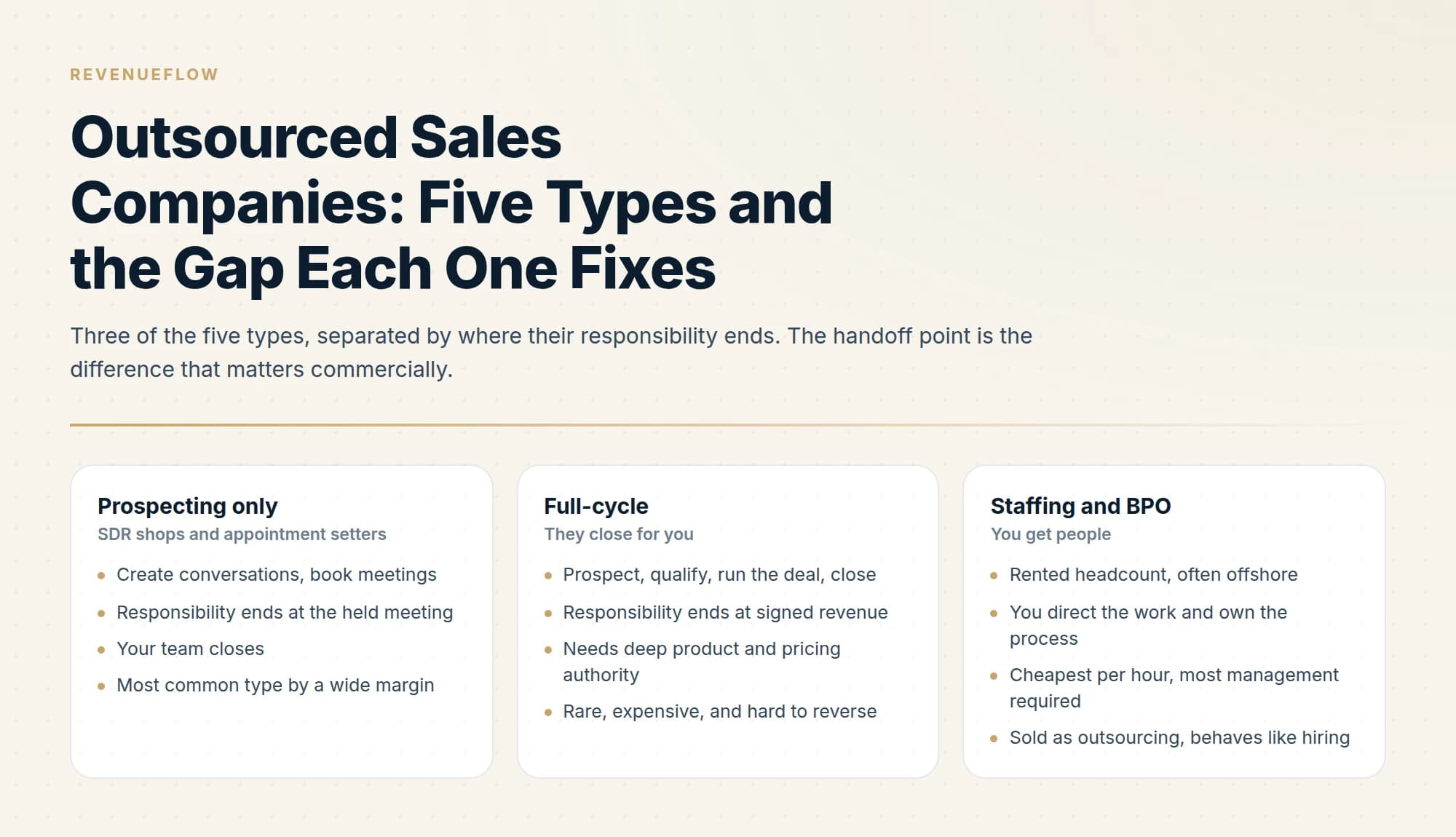
Outsourced sales companies fall into five types by which part of the selling job they perform: prospecting, full-cycle, staffing and business process outsourcing, sales support, and fractional leadership. Work backwards from the single output you are missing, because each type fixes exactly one thing and cross-type comparison is where buyers choose wrongly.
Key takeaways
- Three questions place any vendor within minutes: where their responsibility ends, who talks to your customer and under whose name, and what happens to the relationship if you part ways.
- Switching cost separates the types more sharply than price does, with prospecting the easiest to leave and full-cycle the hardest because the vendor holds the customer relationships.
- Staffing sold in outcome language is the most common mismatch, and the pricing structure resolves it: a number that moves with headcount is a seat.
- Three of the five characteristic failures sit on the buyer's side, and each becomes visible in the first month if somebody is watching for it.
Reviewed and updated September 1, 2026
"Outsourced sales company" describes five businesses that do genuinely different work, and the pitches are close enough that buyers routinely sign with one type while needing another. A company that needed meetings booked ends up with a staffing contract. A company that needed someone to close deals ends up with appointment setters.
The distinction that matters is not price or delivery model. It is which part of the selling job the company actually performs.
The five types, by what they do
- Create conversations, book meetings
- Responsibility ends at the held meeting
- Your team closes
- Most common type by a wide margin
- Prospect, qualify, run the deal, close
- Responsibility ends at signed revenue
- Needs deep product and pricing authority
- Rare, expensive, and hard to reverse
- Rented headcount, often offshore
- You direct the work and own the process
- Cheapest per hour, most management required
- Sold as outsourcing, behaves like hiring
1. SDR shops and appointment setters. They generate conversations and hand over meetings. This is what most buyers mean and what most vendors sell. The two labels differ mainly in emphasis: appointment setters tend to be volume-oriented and meeting-count led, SDR shops tend to sell a named rep and a process.
2. Full-cycle sales outsourcing. They run deals to close, usually for a commission plus a retainer. Legitimate in specific circumstances, mainly entering a new geography where you have no presence and no intention of building one soon. It requires giving an outside party pricing authority and direct customer relationships, which is a much larger commitment than it appears on a proposal.
3. Staffing and BPO. You rent people, frequently offshore, and direct them yourself. Cheapest per hour and most demanding of your management time. It is outsourcing in the contractual sense and hiring in every practical sense, and buyers who do not notice the difference end up with unmanaged reps.
4. Sales support. Everything around selling that is not the conversation: data, CRM hygiene, list building, proposal production, scheduling. A different purchase entirely, covered in outsourced sales support.
CRM hygiene and process tooling often lead buyers toward platform features, and Salesforce's own bundling is unpacked in Salesforce's sales performance tools.
5. Fractional leadership. A part-time sales leader who builds the process rather than working it. Different buyer, different problem, covered in outsourced sales leadership.
Matching the type to the gap
Work backwards from what is missing, because each type fixes exactly one thing.
No conversations happening. Type 1. This is the most common gap and the one the market is built to serve.
Conversations happening, nobody to run them. Type 2, or hire an AE. Buying full-cycle outsourcing to solve a temporary capacity problem tends to create a permanent dependency on someone else owning your customer relationships.
Reps exist but spend their time on admin. Type 4. Adding more selling capacity when the existing capacity is doing data entry is a expensive way to avoid fixing the data entry.
Nobody knows what the process should be. Type 5. Hiring reps into an undefined process produces expensive churn, and this is the mistake that most reliably wastes a year.
You need cheap hands and have the management capacity. Type 3, with clear eyes about the management load.
- Step 1Name the missing output
Conversations, closed deals, rep selling time, or a defined process. One of these, not several.
- Step 2Check whether the input above it exists
Meetings are useless without someone to run them. Reps are useless without a process.
- Step 3Decide who must own the customer relationship
If the answer is you, full-cycle outsourcing is out regardless of its economics.
- Step 4Then compare vendors within one type only
Cross-type comparison is where buyers talk themselves into the wrong purchase.
Step two catches the most expensive mistakes. Buying meetings when nobody can attend them promptly, or renting reps when there is no process to run, both produce a failed engagement that gets attributed to the vendor.
What the types share, and where they differ commercially

All five are sold on some combination of retainer, per seat and per outcome, and those commercial shapes cut across the functional types rather than tracking them. A prospecting shop can be a retainer or a per-meeting deal; a staffing provider is almost always per seat. Because the axes are independent, compare the function first and the commercial model second, using B2B lead generation services for the model side.
Where the types genuinely differ commercially is in switching cost.
Prospecting is the easiest to leave, provided you retained your list and reply data. Support is similarly easy, since the work is procedural. Staffing is moderate, because you have trained people who then leave. Fractional leadership is moderate and depends on whether the process was documented. Full-cycle is the hardest by far, because the outsourced party holds the customer relationships, and unwinding that means introducing your own team to accounts that know someone else.
Reading a proposal for type confusion
Vendors do not always sit cleanly in one category, and some deliberately blur.
Three questions resolve it quickly. Where does your responsibility end? A held meeting, a qualified opportunity, or signed revenue. Who talks to my customer, and under whose name? Yours, theirs, or a persona. What happens to the relationship if we stop working together? The answers place any vendor in one of the five types within a few minutes, whatever the deck says.
A fourth question is worth asking of anyone claiming to do more than one type: which one do you actually staff for? A firm whose team is entirely SDRs and offers full-cycle closing as an add-on is selling type 1 with an option nobody exercises well.
- Yes: You can name the one missing output in a single sentence
- Yes: The input feeding that output already exists internally
- Yes: You have decided who must own the customer relationship
- Yes: You are comparing vendors within one type, not across types
- No: The shortlist mixes appointment setters with full-cycle firms
- Depends: Whether the real gap is process rather than capacity
How each type fails, which is how you recognise it early

Every type has a characteristic failure, and knowing them lets you spot the wrong purchase in month one rather than month six.
Prospecting fails as a quality argument, and it is the most common failure of the five. Meetings arrive, your team says they are not qualified, the vendor says they meet the criteria, and both are right because the criteria were never written down properly. Prevent it by agreeing the definition in writing before launch and by naming who adjudicates a disputed meeting.
Full-cycle fails as a control problem. The outsourced team is closing deals in ways you would not, discounting to hit their own targets, or making commitments you have to honour. It surfaces when the first awkward customer conversation reaches you and you realise you do not know what was promised.
Staffing fails as an unmanaged-team problem. Nobody was supervising, output drifts, and the client concludes the people were poor when nobody ever directed them. It shows up as a gradual decline rather than a bad month.
Support fails silently, which makes it the hardest of the five to catch early. Lists are built slightly wrong for weeks, and by the time bounce rates rise the bad data has propagated into campaigns and reports.
Fractional leadership fails as an implementation gap. Good diagnosis, good process design, nobody internal doing anything with it between sessions. The leader looks effective in the room and nothing changes on the floor.
Notice that three of the five failures are on the buyer's side, and that each becomes visible within the first month if somebody is watching for it. That is not a defence of vendors; it is the practical point that choosing the right type is only half the job, and each type carries an obligation you have to staff.
The type that gets bought by mistake most often
Staffing sold as outsourcing. The proposal reads like a managed service, the price is attractive relative to the alternatives, and the reality is that you receive people who need direction, coaching and a process from your side.
It is also the type most likely to be described in the language of another. Staffing providers have learned that buyers respond to outcome language, so proposals arrive talking about pipeline and meetings while the underlying commercial unit is a seat and an hourly rate. Reading the pricing structure rather than the narrative resolves it immediately: if the number moves with headcount rather than with output, you are buying people regardless of what the first page says.
The tell is in what the vendor asks for during scoping. A managed provider asks about your ICP, your offer and your qualification criteria, because they need those to run the motion. A staffing provider asks about headcount, hours and shift coverage, because those are what they are selling. Neither is dishonest; they are answering different questions, and the buyer who does not notice ends up managing a remote team they thought they had outsourced.
For evaluating a specific SDR vendor once you know the type you need, see choosing an SDR company. For whether to outsource the outbound function at all, outbound sales outsourcing covers that decision.
The short version

Outsourced sales companies come in five types: prospecting, full-cycle, staffing, support and fractional leadership. Identify the one output you are missing, confirm the input feeding it already exists, decide who must own the customer relationship, and only then compare vendors within a single type. Ask where responsibility ends, who talks to your customers, and what happens to the relationship if you part ways. Watch for staffing sold as managed service, which is the most common mismatch and shows up in what the vendor asks about during scoping.
Picking a type is easier once the layers are named, and the outsourced sales definition sets out which one a contract is actually buying.
If the gap is conversations with the right people and you want the risk on the vendor, we work on a pay-per-qualified-meeting basis with the criteria agreed in writing first, and you can see what a campaign would look like for your market.
Frequently asked questions.
Frequently asked questions- What are the five types of outsourced sales company?
- SDR shops and appointment setters, who create conversations and hand over meetings. Full-cycle firms, who run deals to close for a retainer plus commission. Staffing and business process outsourcing, where you rent people and direct them yourself. Sales support, covering data, CRM hygiene, documents and scheduling. And fractional leadership, a part-time leader who builds the process rather than working it.
- How do you pick the right type?
- Name the single missing output in one sentence: conversations, closed deals, rep selling time or a defined process. Check the input above it exists, since meetings are useless without somebody to run them. Decide who must own the customer relationship, which rules full-cycle in or out regardless of economics. Then compare vendors within one type only.
- How does each type characteristically fail?
- Prospecting fails as a quality argument when the qualified definition was never written down. Full-cycle fails as a control problem, surfacing at the first awkward customer conversation. Staffing fails as an unmanaged team, declining gradually. Support fails silently, with bad lists propagating for weeks. Fractional leadership fails as an implementation gap, with good design and nobody executing between sessions.
- How do you spot staffing sold as a managed service?
- Read the pricing structure rather than the narrative: if the number moves with headcount rather than with output, you are buying people. The other tell is what the vendor asks during scoping. A managed provider asks about your ideal customer profile, offer and qualification criteria. A staffing provider asks about headcount, hours and shift coverage, because those are what it sells.
About the author.

B2B cold email experts helping companies generate qualified leads through done-for-you outreach campaigns.
RevenueFlow Team
Explore more.
Ready to scale your outreach?
We build GTM engines that book real meetings. See the receipts.
Related articles.
B2B Lead Lists for Aviation Companies: Build or Buy
Aviation is one of the few industries whose accounts are published by its regulator, which changes what is worth buying and what is worth downloading yourself.
Cold Calling for Food and Beverage Companies: Three Doors
Cold calling for a food or beverage company: who picks up at a chain, a distributor and an independent grocer, where each publishes its door, and when the phone is wrong.
Win Rate Benchmarks: Which Figures State a Population
A catalogue of the published average sales win rates, sorted by whether the page names the population behind its own number. Most do not.
LinkedIn Outreach for Banks: A Regulated Message
How a bank's relationship managers use LinkedIn to reach business owners: what the FFIEC guidance, FINRA's notices and LinkedIn's own rules require, and where to stop.
Cold Calling for PPC Agencies: What You Can See First
A paid media prospect is partly readable before the call and has already been told by the platform what to do when a stranger rings about its ads.
Cold Calling for Consulting Firms: The Partner's Hour
Cold calling for a consulting firm: who it dials and who picks up, why partner-led economics argue against the phone, the client's fiscal year, and when to skip it.