Outbound Sales Outsourcing: Where the Learning Should Live
Outbound produces meetings and an understanding of which segments respond to which argument. Where that understanding accumulates is the real decision.
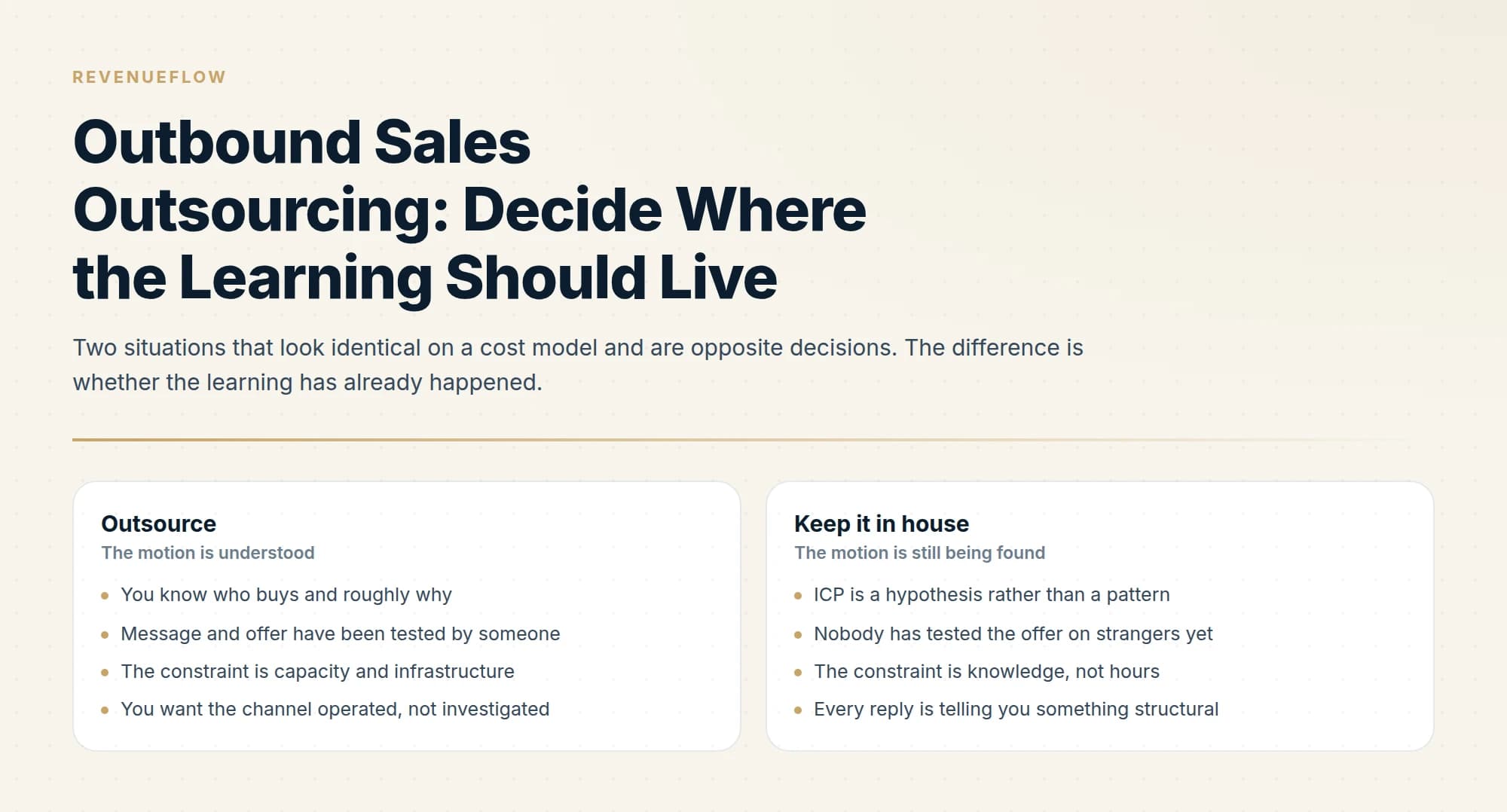
Outsourcing outbound transfers a capability, and the party doing the work gets better at it. That suits a company whose motion is understood and whose constraint is capacity. It works against a company still discovering its market through outbound, because handing the function over exports the feedback loop.
Key takeaways
- Three things should never leave whoever executes: the definition of who you sell to, the offer, and the raw reply data including the negative replies.
- Reversibility is high when you own the target list, hold the reply history and the sending runs on domains you control.
- Four obligations stay with the buyer: answering meetings quickly, approving copy without a fortnight cycle, owning the suppression list and reading the actual replies.
- A hybrid where you own the ideal customer profile, offer and criteria while the vendor runs infrastructure and sending preserves the feedback loop and is rarely offered unprompted.
Reviewed and updated September 21, 2026
The question "should we outsource outbound" is almost never answered on cost, even though cost is what gets modelled. It is answered on whether the knowledge the function produces is knowledge you need to own.
Outbound generates two things: meetings, and an understanding of which segments respond to which argument. The meetings are transferable. The understanding is the asset, and where it accumulates is the decision most companies never consciously make.
Teams that want to sharpen which segments respond to which argument will find notes on trigger-based targeting useful for separating real buying signals from category noise.
The decision, stated properly
Companies that have not used external lead generation before tend to ask whether it works, when the question that decides the outcome is this one: is the motion understood well enough that you want it operated, or is outbound still how you are finding out who buys.
Outsourcing outbound is not the same purchase as hiring capacity. You are transferring a capability, and capabilities have a direction of travel: the party doing the work gets better at it.
That is fine when outbound is a channel you want operated. It is a problem when outbound is the primary way you learn about your market and you are early enough that the learning matters more than the meetings.
- You know who buys and roughly why
- Message and offer have been tested by someone
- The constraint is capacity and infrastructure
- You want the channel operated, not investigated
- Learning is incremental rather than foundational
- ICP is a hypothesis rather than a pattern
- Nobody has tested the offer on strangers yet
- The constraint is knowledge, not hours
- Every reply is telling you something structural
- Handing it over exports the feedback loop
The failure this prevents is common and expensive: a pre-product-market-fit company buys outbound, receives a report saying the market did not respond, and cannot tell whether the market is wrong, the message is wrong, or the targeting is wrong, because nobody internal was close enough to the replies to know.
What you keep, whatever you decide
Establishing control over lead generation is not a matter of doing the work yourself, it is a matter of which three things stay on your side of the wall whoever executes, and the third one is the one usually left out of the contract.
Three things should never leave, regardless of who executes.
The definition of who you sell to. A vendor can challenge and refine it. Originating it requires knowledge of your won deals, which lives in your CRM and your team's heads.
Companies with a self-serve product hold another source of targeting, since usage signals deciding which accounts earn a seller come out of the product rather than a list.
The offer. What you ask for and what they get is a commercial decision with pricing and delivery consequences.
The reply data. Not summaries. The actual replies, including the negative ones, in a system you own. This is the learning, and if it lives only in the vendor's inbox you have rented your market feedback along with the sending.
Reply data only becomes useful once it feeds analysis inside the CRM you already run, which is the terrain covered in Salesforce's Einstein sales tools.
Insist on that third point in the contract. It is usually agreed without friction if you ask at the start, and it is the thing most likely to be missing when an engagement ends.
The reversibility question
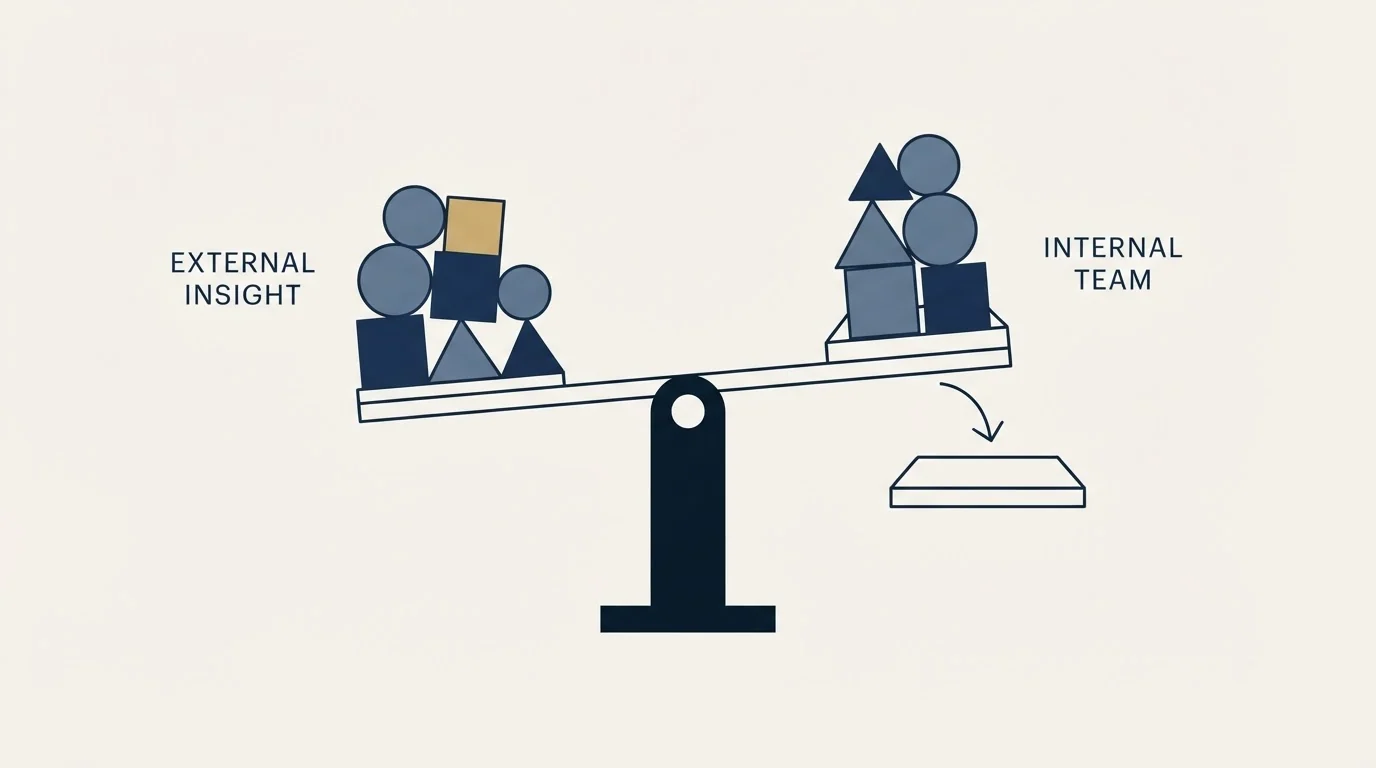
Ask how hard it would be to bring the function back in twelve months, because that determines how much of a bet the decision is.
Reversibility is high when you own the target list and criteria, hold the reply history, and the sending runs on domains you control. It is low when the vendor owns the domains, the data lives in their platform, and the only artefact you receive is a monthly report of meetings booked.
The cheap protection is to specify at the outset: domains registered to you where practical, list and enriched data delivered on request, reply history exportable, and the qualification criteria documented in a shared place rather than in the vendor's process. None of these are unreasonable and all of them are easier to agree before signature than after.
- Yes: You can describe who buys, based on deals you have actually won
- Yes: Someone has tested the offer on strangers and it landed
- Yes: The binding constraint is hours and infrastructure rather than knowledge
- Yes: You will receive raw replies, not just a meetings report
- No: Outbound is currently your main source of market learning
- No: You need it working this month
- Depends: Whether you can answer booked meetings fast enough to justify them
The last row catches more engagements than any other. A vendor delivering meetings into a team that cannot take them promptly produces no-shows and wasted spend, and the vendor will be blamed for both.
Pressure to hit a meeting count changes how a booking gets made, and urgency manufactured in outbound messages sets out what those tactics cost with a buying committee.
What outsourcing genuinely buys
Being fair to the case for it, three advantages are real and hard to replicate internally.
Infrastructure that already exists. Warmed domains, verified data pipelines and deliverability practice take weeks to months to build and are easy to get wrong in ways that are invisible until mail stops landing.
Speed to first contact. SalesHive, for example, publishes a launch window of two to three weeks against three to six months to hire, which is roughly the right shape of the comparison even where the specific numbers vary by vendor.
Removing the management problem. Recruiting, ramping, coaching and replacing reps is a real job. Buying the outcome removes an entire management layer you would otherwise have to staff and supervise.
What it does not buy is a market that wants your product, a clear offer, or fast internal follow-up. Every engagement that fails on those fails regardless of vendor quality.
Cost, briefly, and where the real comparison lives

Published figures give a rough anchor. SalesRoads lists one SDR at $11,950 per four weeks and two at $16,750, and the FAQ on its appointment-setting page says high-quality services start around $12,000 per month and scale with team size, with cheaper options at roughly half that. SalesHive publishes no figures and sets the quote by team model, channel mix and daily touch volume.
Two cautions on reading any of that. Four-week billing is thirteen periods a year rather than twelve, which understates the annual figure if you read it as monthly; the arithmetic is worked through in outsourced SDR pricing. And the rate is not the cost, because internal time answering meetings, approving copy and handling handoffs is real and unbudgeted.
The full in-house comparison, including how to build a fully loaded internal cost from your own numbers, is in outsourced SDR versus in-house. The delivery models available are covered in SDR outsourcing, and this article deliberately does not re-tread either.
What has to be true on your side
Outsourcing shifts execution and it does not remove obligations. Four of them land on you regardless of vendor, and an engagement missing any one underperforms in a way that gets blamed on the vendor.
Someone answers meetings quickly. A booked meeting confirmed four days later frequently does not happen. If your calendar cannot absorb meetings within a couple of days, fix that before buying more of them.
Someone approves copy without a two-week cycle. Vendors need sign-off to send. A client whose approval takes a fortnight per iteration converts a three-month engagement into one round of learning.
Someone owns the suppression list. Current customers, live opportunities, partners and anyone a rep is protecting. Only you have this, and the damage from getting it wrong lands on your relationships rather than the vendor's.
Someone reads the replies. Not the summary report. The actual replies, weekly. This is the learning the engagement produces, and it evaporates if nobody internal looks at it.
Each of these is a named person and an hour or two a week, and together they are the difference between a vendor who can work and one who cannot. It is worth agreeing them at kickoff in writing, in the same conversation as the commercial terms, because they are easier to assign before anyone is disappointed.
The uncomfortable implication is that outsourcing outbound does not reduce your involvement to zero, and any vendor promising that it does is describing an engagement that will fail quietly. What it removes is the recruiting, the ramping, the coaching, the infrastructure and the daily execution, which is most of the work and none of the judgement.
The middle option most companies skip
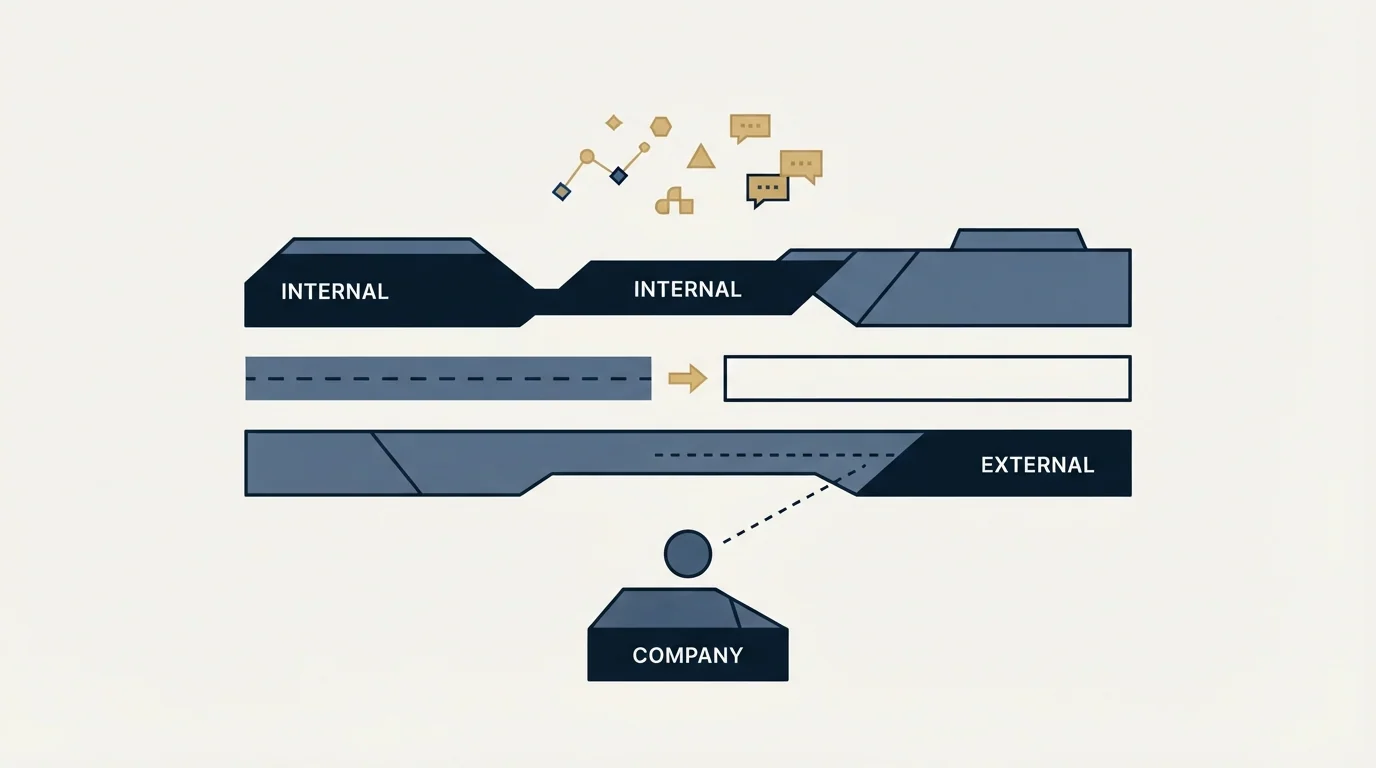
The framing is rarely binary in practice. A common and underused arrangement keeps strategy and learning inside while buying execution: you own the ICP, the offer and the criteria, the vendor runs infrastructure, data and sending, and the replies come to a shared inbox both sides read.
That structure preserves the feedback loop, which is the main risk of outsourcing, while removing the infrastructure and management burden, which is the main cost of doing it yourself. It requires more of your attention than a fully managed engagement and considerably less than building a team.
It also gives you a real answer to the reversibility question, because the knowledge accumulates on your side by construction.
- Step 1You own the ICP, the offer and the criteria
The three things that should never leave, whoever executes the sending.
- Step 2The vendor runs infrastructure, data and sending
Warmed domains, verified data pipelines and deliverability practice, which take weeks to months to build and are easy to get wrong invisibly.
- Step 3Replies come to a shared inbox both sides read
The actual replies including the negative ones, rather than a monthly report of meetings booked.
- Step 4The learning accumulates on your side
By construction rather than by goodwill, which is what makes the function reversible in twelve months.
- Step 5Ask for it at proposal stage
It has to be negotiated rather than bought off a template. Most vendors will accommodate it, and a refusal tells you how much of the engagement they intend to keep visible.
The reason it is skipped is that it is harder to buy. Fully managed engagements are a defined product with a proposal template, while the hybrid has to be negotiated, and vendors quote it less readily because it involves your team in their process. It is worth asking for anyway. Most vendors will accommodate a shared reply inbox and client-owned criteria if the request comes at proposal stage, and the ones that refuse have told you something useful about how much of the engagement they intend to keep visible.
The short version
Decide on where the learning needs to live rather than on cost. Outsource when the motion is understood and the constraint is capacity, keep it in house while outbound is still how you discover your market. Whatever you choose, retain the ICP, the offer and the raw reply data, and specify domain and data ownership before signing so the decision stays reversible. Then check the unglamorous precondition: whether anyone internally can answer a booked meeting quickly.
We run outbound on a pay-per-qualified-meeting basis with the criteria agreed in writing before anything sends, and you can see what a campaign would look like for your market.
Frequently asked questions.
Frequently asked questions- Should you outsource outbound sales?
- Outsource when the motion is understood, someone has tested the offer on strangers, and the binding constraint is hours and infrastructure rather than knowledge. Keep it in house while outbound is still the main way you learn about your market, because a report saying the market did not respond cannot tell you whether the market, the message or the targeting was wrong.
- What does outsourcing outbound genuinely buy?
- Infrastructure that already exists, meaning warmed domains, verified data pipelines and deliverability practice that take weeks to months to build and are easy to get wrong invisibly. Speed to first contact against a hiring process. And removal of the recruiting, ramping, coaching and replacement problem, which is an entire management layer you would otherwise staff and supervise.
- What do outsourced outbound engagements cost?
- Published anchors are thin and vary by vendor. SalesRoads' pricing page lists one SDR at $11,950 per four weeks, with two SDRs shown at $16,750 per four-week engagement. SalesHive publishes no figures at all and sets its quote by team model, channel mix and daily touch volume. Note that four-week billing is thirteen periods a year rather than twelve.
- What has to be true on your side for it to work?
- Somebody answers booked meetings within a couple of days, because a meeting confirmed four days later frequently does not happen. Somebody approves copy without a two-week cycle. Somebody owns the suppression list, which only you can supply. And somebody reads the actual replies weekly rather than the summary report, since that is the learning the engagement produces.
About the author.

B2B cold email experts helping companies generate qualified leads through done-for-you outreach campaigns.
RevenueFlow Team
Explore more.
Ready to scale your outreach?
We build GTM engines that book real meetings. See the receipts.
Related articles.
B2B Lead Lists for Aviation Companies: Build or Buy
Aviation is one of the few industries whose accounts are published by its regulator, which changes what is worth buying and what is worth downloading yourself.
Cold Calling for Food and Beverage Companies: Three Doors
Cold calling for a food or beverage company: who picks up at a chain, a distributor and an independent grocer, where each publishes its door, and when the phone is wrong.
Win Rate Benchmarks: Which Figures State a Population
A catalogue of the published average sales win rates, sorted by whether the page names the population behind its own number. Most do not.
LinkedIn Outreach for Banks: A Regulated Message
How a bank's relationship managers use LinkedIn to reach business owners: what the FFIEC guidance, FINRA's notices and LinkedIn's own rules require, and where to stop.
Cold Calling for PPC Agencies: What You Can See First
A paid media prospect is partly readable before the call and has already been told by the platform what to do when a stranger rings about its ads.
Cold Calling for Consulting Firms: The Partner's Hour
Cold calling for a consulting firm: who it dials and who picks up, why partner-led economics argue against the phone, the client's fiscal year, and when to skip it.