Product-Led Sales: The Signal That Buys a Human
Product-led sales is a go-to-market motion in which people use the product first, on their own, and a seller enters afterwards on the strength of what that usage shows. The signal starts in the product rather than on a list, which changes who is contacted, when, and what the first message can assume.
Key takeaways
- Product-led sales is the sales half of a product-led company, and a narrower idea than product-led growth, which is the acquisition model it sits inside.
- The design problem is the threshold: a self-serve funnel costs the same at any volume while a person costs the same per conversation, so which accounts earn a human has to be written down.
- Declared intent converts best, account shape is usually most worth a human, and trajectory catches the accounts going quiet; a raw activity score is not a signal.
- Compensating the team only on personally closed revenue converts it back into a sales-led team, because the fastest route to that number is to ignore accounts that were going to convert anyway.
Product-led sales is a go-to-market motion in which people use the product first, on their own, and a seller enters afterwards on the strength of what that usage shows. The signal that starts the sales conversation comes out of the product rather than out of a list, which changes who is contacted, when, and what the first message can already assume.
It is the selling side of a product-led company, and it is a narrower idea than the growth model it sits inside. Product-led growth is a claim about how customers are acquired. Product-led sales is a claim about what a seller does once some of them are already there.
What separates it from the two things it is confused with
Three motions get one name in ordinary conversation, and separating them is the whole operating question.
Against product-led growth. PLG is the model: discovery without a seller, value before payment, expansion by usage. Product-led sales is the fourth step of that model taken seriously as a job, with a threshold, a queue and somebody accountable for it. A company can run PLG with no sales seat at all, and many small ones do.
Against sales-led growth. In a sales-led motion the seller arrives before any usage exists, and the first conversation has to establish the problem, the fit and the value from nothing. In product-led sales the buyer has already established the first two on their own. What the seller adds is the part the product cannot do alone: the purchase mechanics, the second and third stakeholders, and the deployment decision that a single user cannot make.
Against a free trial and an automated nudge. A trial that ends in a scheduled reminder is a lifecycle programme, not a sales motion. The distinguishing feature of product-led sales is that a person looks at the account, decides it is worth a human, and arrives knowing what that account already does with the product.
- Establish that the problem exists
- Establish that the product solves it
- Establish that this account fits
- Negotiate the purchase
- Timing is unknown at first contact
- The problem and the fit are already demonstrated
- Establish who else in the account is affected
- Establish who can authorise a company purchase
- Remove the obstacle in the way of paying properly
- Timing is legible from the usage curve
Why it matters: the economics only work above a threshold
The reason to name the motion is that it is expensive in a way self-serve is not, and the expense is somebody's week.
A self-serve funnel costs the same whether a hundred people or a hundred thousand go through it. A person costs the same per conversation regardless of what the conversation is worth. So the entire design problem is the threshold: which accounts are worth a human, stated in a way somebody can apply on a Monday morning without asking.
Set the threshold at signup and the sales team becomes a support queue with a quota. Set it at a genuine account-level signal and the same headcount works a much smaller number of much better conversations. The account executive working usage signals is doing a materially different job from one working a cold list, and the difference is that the qualification evidence arrived before the call rather than during it.
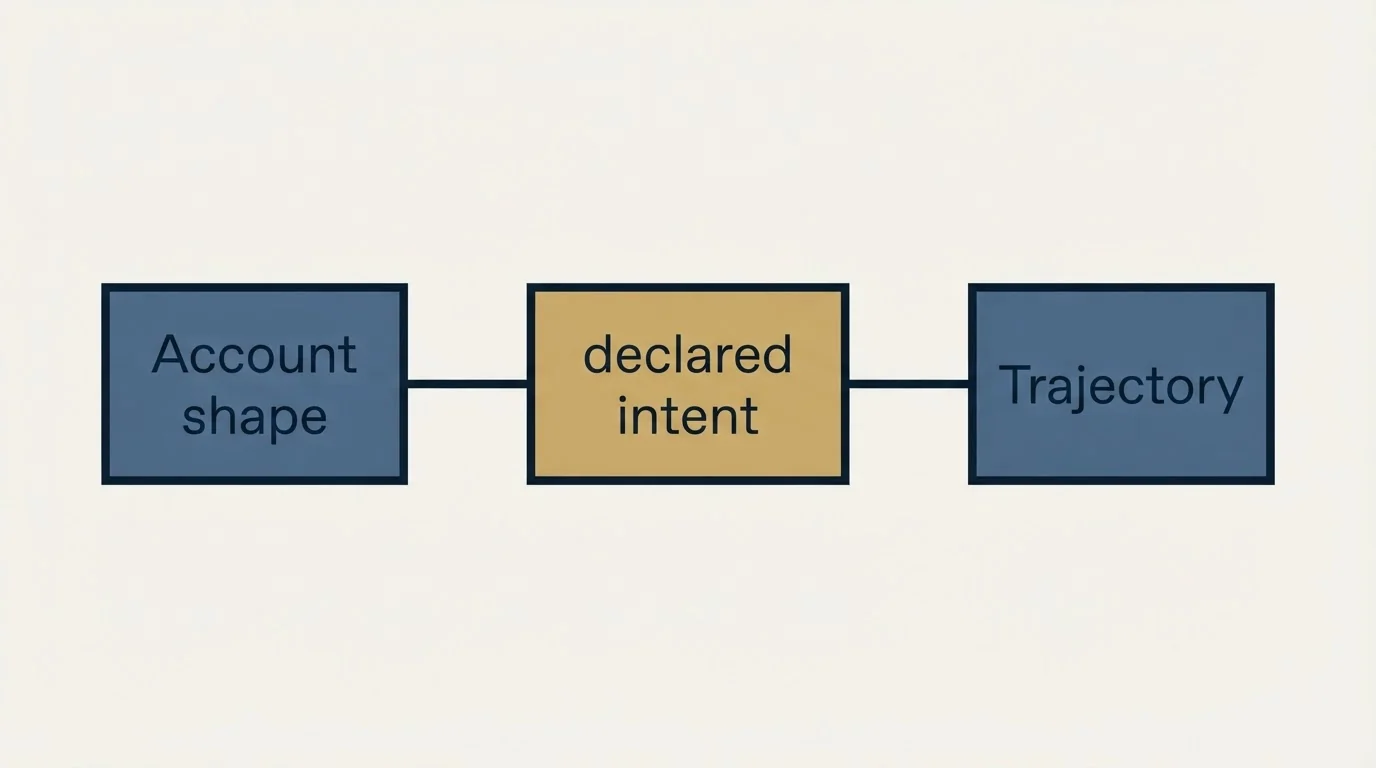
Three signal classes behave differently, and they are worth separating before any of them is wired to a person.
A declared intent. Somebody asked about plans, invoicing, procurement, seats or a paid-only capability. This is the cheapest signal to detect and the highest-converting, because the buyer has already told you what they want. The work is usually removing an obstacle rather than selling anything.
Account shape. Several people from one company using the product independently, none of them aware of the others. A support team cannot see this, because a ticket arrives from a person while the opportunity belongs to an account. It is usually the signal most worth a human, since the substance of the conversation is introducing colleagues to each other.
Trajectory. Usage crossing a boundary that predicts a plan limit, or falling away after a strong start. The second is under-used and genuinely valuable, because an account going quiet is recoverable for a short window and then is not.
What does not belong on the list is a raw activity score with no shape behind it. Somebody who has clicked a great deal has told you they are busy.
- Yes: The threshold is written down, and somebody can say what does NOT qualify
- Yes: The seller can see account-level usage before the first message
- Yes: There is a response commitment measured in hours, not days
- Yes: The handoff to enterprise sales has a named threshold rather than a judgement call
- Depends: Somebody owns the loop back into product when the same obstacle recurs
- No: Every self-serve signup receives a sales contact
- No: The team is compensated only on revenue it personally closed
Where the definition breaks in practice
The seller is measured as though the product did nothing. A large share of product-led sales conversations end with the user upgrading through the same checkout they would have used anyway. Attributing that to the seller overstates the motion; attributing none of it understates the motion; and a compensation plan built on personally closed revenue quietly converts the team back into a sales-led one, because the fastest way to hit that number is to stop working the accounts that were going to convert on their own.
It is treated as free pipeline. Usage signals are demand capture. They exist only inside accounts that already found the product, which is a genuinely privileged position and a bounded one. A company that has staffed the motion well tends to assume it has covered the ground, and two populations sit permanently outside it: the segment where nobody can start alone because the product needs permission or configuration to be useful, and the accounts where the product is already in use and the person who could buy it properly has never heard of it.
The threshold decays. A signal that predicted a purchase last year predicts it less well after a pricing change, a packaging change or a shift in who the product is marketed to. Nothing announces this, and the first symptom is a slow decline in conversion that gets attributed to the sellers.
It is confused with the role that runs it. The function has a dozen names, almost none of which say sales, and the naming is a deliberate choice about how a first message reads to somebody who did not ask to be sold to. What the function is, where its two boundaries sit, and how to keep it from becoming a second support queue are set out in sales assist.
How it is used in outbound
Product-led sales and outbound look like opposites and they meet at one specific, valuable place.
The second population above, accounts where the product is already in use and the budget holder has never heard of it, is an outbound motion with an unusually strong premise. Something checkable about the account's own organisation is already true, and the first message can say so without claiming anything about the product's merits. That is a better premise than most outbound programmes ever get.
Three boundaries make it work rather than backfire.
The trigger has to travel with the row. The reason an account is on the list, which team is using the product and roughly how much, is the entire content of the message. Where that fact stops at the person who built the list, the message reverts to a generic pitch and the advantage is thrown away. That artefact discipline is the subject of go-to-market enablement.
Qualification has to be decided in advance. For this motion specifically, the question is whether an internal champion who already uses the product counts as a qualified conversation or whether the named budget holder is required. Agreeing that in writing before anything sends is much cheaper than arguing about it with results on the table.
The privacy of the observation matters. Naming individual colleagues and their usage in a cold message to their manager reads as surveillance rather than as helpfulness, whatever the intent. The honest form names the situation at the level of the organisation and lets the recipient ask for the detail.
Our own practice narrows the shape further. We run one message per campaign, with no bumps and no thread replies. The reasoning is in why we stopped using follow-ups. For a product-led company that is a good fit, because usage supplies exactly the kind of change that justifies a fresh approach: a new team started using the product, a limit was hit, an evaluation restarted.
The sequencing question underneath all of it, when a human should enter a technical evaluation at all, is worked through in proof of concept sales, and the channel arithmetic by deal size for the population that will never appear in a self-serve funnel is in outbound lead generation for B2B SaaS.
The short version
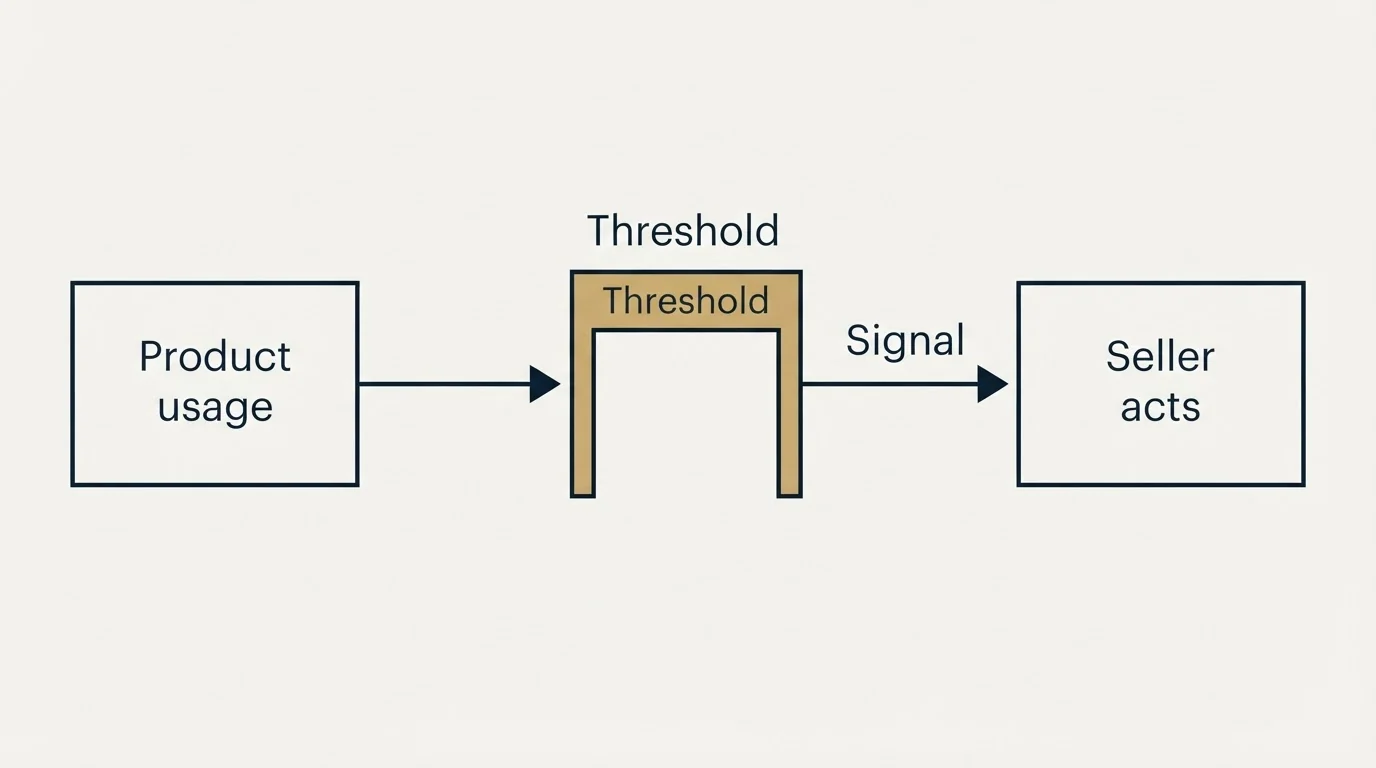
Product-led sales is the motion where usage produces the signal and a seller acts on it, which makes it the selling side of a product-led company rather than a synonym for the growth model. The whole design problem is the threshold: which accounts are worth a person, written down clearly enough that somebody can apply it without asking.
Point it at declared intent first, account shape second and trajectory third, and keep it away from raw activity scores. Measure influenced pipeline and response time rather than personally closed revenue, because a plan built on personally closed revenue rewards a seller for ignoring the accounts that were converting anyway.
Treat it as demand capture, because that is what it is. The accounts where nobody can start alone, and the ones where the product is in use and the buyer has never heard of it, are a separate motion. We will build one campaign against that list so you can read the replies.
Neighbouring definitions: product-led growth for the model this sits inside, founder-led sales for the motion it usually follows, and lead qualification for what a signal has to demonstrate before it earns a person's time.
Frequently asked questions.
Frequently asked questions- What is the difference between product-led sales and product-led growth?
- Product-led growth is a claim about how customers are acquired: discovery without a seller, value before payment, expansion by usage. Product-led sales is a claim about what a seller does once some of those users exist. A company can run product-led growth with no sales seat at all, and many small ones do until an account appears that cannot buy without one.
- What signals should trigger a product-led sales conversation?
- Three classes, in order of reliability. A declared intent, meaning somebody asked about plans, invoicing, procurement or a paid-only capability. Account shape, meaning several people from one company using the product independently. And trajectory, meaning usage crossing a boundary or falling away after a strong start. A raw activity score with no shape behind it is not a signal.
- How should a product-led sales team be measured?
- With influenced pipeline, opportunities referred, response time against the stated commitment, and the conversion of touched accounts against comparable untouched ones. Personally closed revenue is the tempting number and the damaging one, because many of these conversations correctly end with the user upgrading through the same checkout they would have used anyway.
- Does outbound have a role in a product-led company?
- Two populations sit permanently outside the self-serve funnel. The segment where nobody can start alone because the product needs permission or configuration first, and the accounts where the product is already in use and the person who could buy it properly has never heard of it. The second is outbound with an unusually strong premise, because something checkable about the account is already true.