Proof of Concept Sales: The Criteria Decide Everything
A proof of concept with no stated result is an expense. Three or four observable criteria, agreed in writing before anything is built, are the whole mechanism.
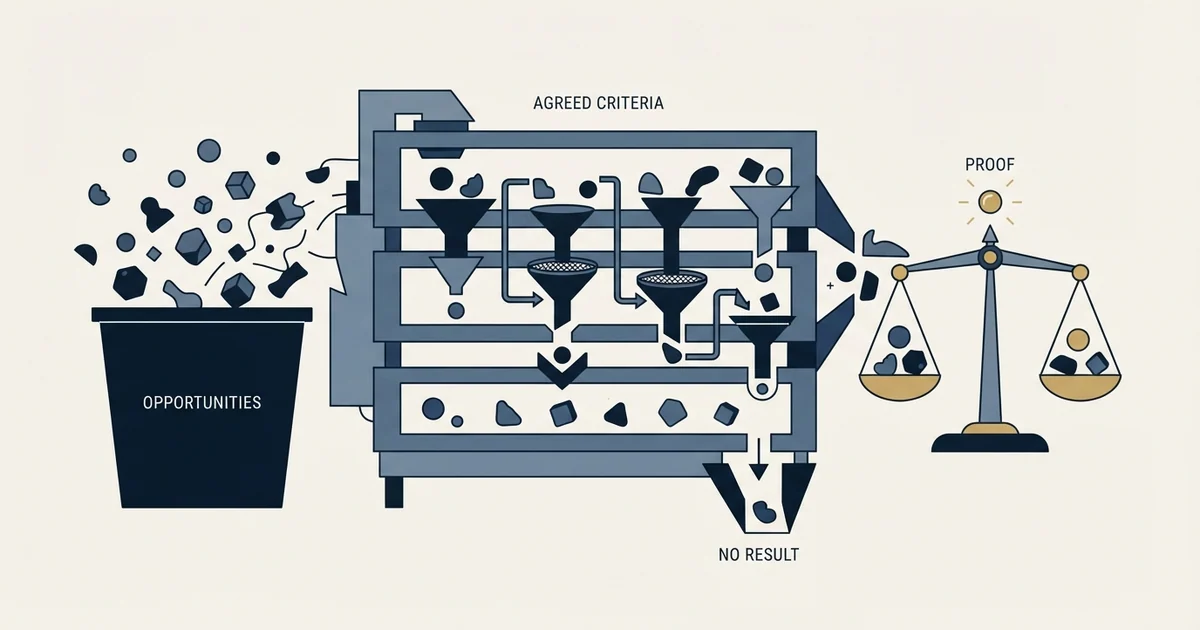
A proof of concept in sales is a time-boxed evaluation in which the buyer tests a specific claim against their own data. Its value comes from three or four observable success criteria agreed in writing before anything is built, an end date with the decision meeting booked, and a stated outcome for a pass.
Key takeaways
- A proof of concept tests one named claim against the buyer's own data; a demo proves the product exists and a trial proves it is usable.
- Dock's guide advises defining 3-4 SMART success metrics together with the prospect, and presenting findings against them at the end.
- Refuse a POC where nothing is in dispute, the economic buyer is unaware, the buyer will not commit people, or no one says what a pass triggers.
- Review against the written criteria and nothing else; a clean failure ends a deal in weeks with a reason both sides accept.
Reviewed and updated October 1, 2026
A prospect asks whether they can try it before committing. The seller says yes, because saying yes feels like progress, and a proof of concept starts the following week with no written definition of what it is proving. Six weeks later two solutions engineers have spent most of a month on it, the buyer's team has used the product on and off, and the review meeting opens with somebody saying it went well. Nobody in the room can say whether it passed, because nothing was ever agreed that it could pass.
That is the ordinary failure, and it is a scoping failure rather than a product one. A proof of concept is an experiment, and an experiment with no stated result is an expense.
What a proof of concept in sales is for, and what it is not
A sales proof of concept is a time-boxed evaluation in which the buyer uses the product against their own data and their own use case, to establish whether a specific claim holds. It exists because some claims cannot be established any other way.
A sales POC and a sales proof of concept name the same instrument, and the acronym is simply the shorter form of the phrase.
Three things get called a POC and only one of them is one.
| Instrument | Proves | Driven by | Runs on |
|---|---|---|---|
| Demo | The product exists | The seller | The seller's data |
| Free trial | It is usable | The buyer, alone | Whatever is loaded |
| Proof of concept | A named claim holds here | Both, to a written question | The buyer's real data |
The distinction matters commercially because the three cost wildly different amounts to run and are frequently sold to each other's situations. A buyer who wanted reassurance gets handed a POC and disengages from the work. A buyer who genuinely needed to test an integration against forty thousand of their own records gets handed a trial and learns nothing.
Demo automation is the variant that breaks the left-hand column of that table. The buyer drives a pre-built interactive replica of the product on their own time, asynchronously, with no seller in the room, which changes who is present and when but leaves the underlying limit intact: an automated demo still runs on the seller's data and a scripted path, so it can prove what the product does and cannot prove that a named claim holds against the buyer's own records. It is a substitute for the demonstration, never for the proof of concept.
Success criteria, agreed in writing, before anything is built
This is the whole mechanism, and it is the step teams skip because it feels like paperwork on top of momentum.
Dock's guide to running sales proof of concepts puts it near the top of its own list. Under the heading "Success criteria" that page says: "If you do nothing else, do this. Together with your prospect, define 3-4 specific, measurable, achievable, relevant, and time-bound (SMART) metrics." Its phase list ends the same way, defining the closing phase as "Evaluation and decision : Present your findings against those agreed-upon success criteria."
The reason to insist on it is not rigour for its own sake. It is that the criteria are the only thing standing between a completed POC and an argument about whether it worked. A criterion reading "the team finds it intuitive" cannot be met or missed. A criterion reading "carrier confirmations from the three highest-volume partners are parsed and written to the system with no manual correction" can, and both sides know the answer on the day.
The question that produces good criteria is short, and it is asked before the POC is agreed rather than after: what would you need to see to be confident enough to move forward. The answer is the criteria. If the answer is vague after two attempts, that is information about the deal rather than about the buyer's communication skills.
Agree before it starts
- Three or four criteria, each observably met or missed
- An end date, with the decision meeting in both calendars
- A named owner of the buyer's half of the work
- An economic buyer who knows what it decides
- What a pass triggers, written down
Do not accept
- Criteria about how the team feels about the product
- Scope that grows after the start date because a new stakeholder asked
The fifth item is the one sellers most often leave out and most often regret. A POC that passes and is followed by a fresh round of procurement discovery was never a decision gate; it was a free deployment. Agreeing in advance what a pass triggers, and getting that in the same document as the criteria, is what turns the exercise into a step in a purchase. The same instrument that carries the rest of a late-stage deal works here: a mutual action plan with the POC phase and its decision meeting written into it, roughly half of whose rows belong to the buyer.
When to refuse one

Most published advice on this subject is about running a POC well. The more valuable decision is usually whether to run it at all, because the cost sits almost entirely on the seller's side and it is paid in the scarcest resource a technical sales team has.
Four situations where the answer is no, or not yet.
Nothing is in dispute. If the buyer already believes the product does what it does, a POC proves something nobody doubted and adds weeks. The tell is that the criteria are hard to write because there is no open question.
Where reassurance rather than proof is what the buyer wants, the cheaper instrument is material that reads without a seller present, built to survive being forwarded to someone who met nobody.
The economic buyer is not aware of it. A POC agreed between a seller and an enthusiastic technical user, with no visibility above, produces a passing result delivered to somebody who never asked for it. The technical win is real and it decides nothing.
Because whether one person holds the problem, budget and signing authority often depends on company size, understanding the SMB segment boundary helps explain why some POCs stall for lack of an economic buyer.
The buyer will not commit resource. A POC needs the buyer's data, the buyer's environment and the buyer's people. A buyer unwilling to name a person and a number of hours has told you what the priority is, and running it anyway converts that signal into six weeks of your own team's time.
It is being used to delay a decision. A POC is an acceptable-looking way to postpone, and it will be proposed by a buyer who does not want to say no yet. Asking what happens if it passes surfaces this immediately, because a buyer using it as a delay has no answer to that question.
Refusing well is a skill and it is not the same as refusing bluntly. The useful version offers the smaller instrument that answers the actual open question: a scoped technical session on the one integration in doubt, a reference call with somebody who ran the same configuration, a sandbox with their sample file loaded. Each of those costs days rather than weeks. The test-drive close and what it assumes about the buyer covers the wider family of let-them-try-it moves this belongs to.
Running it so it ends
Two operational habits separate a POC that concludes from one that dissolves.
Set the end date at the start and defend it. POCs do not fail at the end; they stop having an end. A date agreed in advance, with the decision meeting already in calendars, is what makes a slipped criterion visible as a slipped criterion rather than as a natural extension. Where an extension is genuinely warranted, granting it explicitly, once, with a new date and the reason recorded, keeps the frame intact.
Review against the criteria and nothing else. The review meeting is where a well-scoped POC gets quietly rescored, usually generously, because everybody involved has now spent weeks together. Reading the criteria out as written, in order, and marking each one met or missed, is a two-minute discipline that protects the entire exercise. A missed criterion is not a lost deal, and treating it as one is what teaches everyone to fudge the scoring. It is a finding, and the honest response is to say what would have to change.
A POC that fails cleanly is worth more than one that passes vaguely. The clean failure ends a deal in six weeks that would otherwise have consumed six months, and it does it with a written reason both sides accept, which is the only kind of loss you can learn from.
Once a clean pass or fail is on record, the same discipline about stated terms carries into negotiating commercial trade-offs once the deal moves toward close.
The evidence problem underneath all of it
The reason POCs are contentious is that they are expensive to run and their result is easy to dispute afterwards, and both of those are consequences of the same thing: the claim under test was never written down precisely enough. Every other problem in this article is downstream of that. Scope creep happens because scope was described rather than defined. Extensions happen because there was no criterion to have missed. Generous rescoring happens because the score was never a score.
The same discipline appears earlier in the funnel in a different costume. A diagnostic conversation that establishes what the current process costs, in the buyer's own units, is where the claim worth testing usually comes from, and a POC scoped against a cost the buyer named is much harder to argue about later than one scoped against a feature list.
Where we differ from standard practice
We run outbound rather than technical pre-sales, so our version of this is the same instinct applied one stage earlier and it is a matter of our own commercial conduct.
For every campaign, the criteria that make a meeting qualified are agreed with the client in writing before anything sends, and budget, timing and authority are never billing conditions. That is a POC's success criteria in a different setting: the definition is settled before the work starts, precisely because a definition argued afterwards is argued while somebody has an invoice in front of them. Every disagreement about whether a piece of work counted comes from the same place, which is that the ruler was written after the measurement.
On the outbound side our doctrine is one message per campaign, with no bumps or thread replies. The full argument is in why we stopped using follow-ups.
The short version
A proof of concept tests a specific claim against the buyer's own data, and it is a different instrument from a demo or a trial. Its value comes entirely from having a stated result, which means three or four observable criteria agreed in writing, an end date with a decision meeting already booked, a named owner on the buyer's side, an economic buyer who knows it is running, and an agreed statement of what a pass triggers.
Refuse one where nothing is in dispute, where the economic buyer is unaware, where the buyer will not commit resource, or where it is being used to postpone a decision, and offer the smaller instrument instead. Review against the criteria as written rather than against how the weeks felt.
If the constraint is that there are not enough late-stage evaluations for any of this to be the limit, that is a supply problem. See what a first campaign produces for your market.
Criteria and phase detail are quoted from Dock's sales proof of concept guide. Publishers revise these pages; confirm the current text before relying on it.
Frequently asked questions.
Frequently asked questions- What is a proof of concept in sales?
- A time-boxed evaluation in which the buyer uses the product against their own data and use case to establish whether a specific claim holds. It differs from a demo, where the seller drives on the seller's data, and from a free trial, where the buyer explores alone with no written question to answer.
- What should sales POC success criteria look like?
- Three or four criteria, each one observably met or missed, agreed in writing with the buyer before anything is built. Dock's guide describes them as specific, measurable, achievable, relevant and time-bound metrics. A criterion about how the team feels about the product cannot be met or missed, so it decides nothing.
- When should a seller refuse a proof of concept?
- When nothing is in dispute, when the economic buyer does not know it is running, when the buyer will not commit people and data, or when nobody can say what a pass would trigger. In each case offer something smaller, such as a scoped technical session, a reference call or a sandbox with their sample file.
- How long should a sales proof of concept run?
- As long as the criteria need and no longer, with the end date and the decision meeting agreed at the start. Where an extension is genuinely warranted, grant it once, explicitly, with a new date and the reason recorded, so a slipped criterion stays visible instead of becoming a natural extension.
About the author.

B2B cold email experts helping companies generate qualified leads through done-for-you outreach campaigns.
RevenueFlow Team
Explore more.
Ready to scale your outreach?
We build GTM engines that book real meetings. See the receipts.
Related articles.
Win Rate Benchmarks: Which Figures State a Population
A catalogue of the published average sales win rates, sorted by whether the page names the population behind its own number. Most do not.
Sales Enablement Charters: What the Published Ones Ask For
Six publishers set out what a sales enablement charter should contain. Five describe a document nobody can check, and one writes a definition with inspection in it.
Sales Kickoff Agendas: Five Published, Session by Session
Five publishers print a sales kickoff agenda. They agree on four blocks and disagree on session length, rehearsal and where the agenda comes from.
Sales Cycle Length Benchmarks: What Each Figure Counts
The published B2B sales cycle benchmarks, sorted by what each page says it counted. The same number means two different things in two of them.
Sales Comp Plan Design: What the Publishers Prescribe
Four publishers set out how to design a sales compensation plan. Here are their procedures, their components, and which of their ratios carry a population.
Sales Prospecting for Utilities: Read the Filings First
Prospecting utilities from the proceedings that announce their spend: rate cases, resource plans and procurement decisions, who owns each, and the supplier gate.