SMB Sales: What the Term Means and Where the Boundary Sits
Two people in one pipeline review can say SMB and mean companies ten times apart in size. The official definitions, and the boundary that decides how a company buys.

SMB means small and medium-sized business. The EU defines an SME as under 250 staff with up to €50 million turnover, while the US SBA's size standards vary by industry. In sales, the useful boundary is behavioural: an SMB is a company where the person with the problem also signs.
Key takeaways
- SMB stands for small and medium-sized business; in sales it is a segment name, not a legal category.
- The EU's SME definition fixes ceilings of under 10, 50 and 250 staff with turnover or balance-sheet tests, and a firm in a larger group may have to count the group.
- The US SBA's size standards vary by industry and are based on employees or annual receipts; most manufacturers with 500 employees or fewer qualify as small.
- Draw the sales segment where the buyer stops being the signer, approximate it with bands your data can filter on, and check the bands against the behaviour.
Reviewed and updated September 19, 2026
SMB meaning in business: small and medium-sized business. In sales it names a segment rather than a legal category, and the official definitions disagree. The EU caps a medium-sized firm at under 250 staff and €50 million turnover, while the US Small Business Administration sets size standards that vary by industry. The boundary a sales team needs is who signs, not how many people work there.
Two people in the same pipeline review can use the word SMB and mean companies that differ by a factor of ten in headcount. One is thinking of a twelve-person agency. The other is thinking of a two-hundred-person manufacturer. Both are using the term correctly, because there is no single definition, and the official ones disagree with each other on purpose.
SMB stands for small and medium-sized business. In sales it is a segment name rather than a legal category, and the useful question is not what the acronym expands to. It is where you draw the boundary and what changes when a company crosses it.
That ordering is what SMB segmentation actually consists of, and it is why two teams cutting the same market at the same headcount band can still be selling to different companies.
SMB Meaning in Business: The Official Definitions, and Why They Do Not Settle It
The European Union publishes fixed ceilings. Under the EU's SME definition, a company is micro below ten staff, small below fifty, and medium-sized below two hundred and fifty, with a turnover test alongside the headcount test: turnover at or below two million euro for micro, ten million for small and fifty million for medium-sized, or a balance sheet total at or below two million, ten million and forty-three million respectively.
The definition also carries a rule that catches people out. Those ceilings apply to individual firms, and a firm that is part of a larger group may need to include the group's headcount, turnover and balance sheet in the assessment. A fifteen-person subsidiary of a large parent is not an SME by that test, which is exactly the case where a targeting filter built on headcount alone gets it wrong.
The United States takes a different approach entirely. The Small Business Administration publishes a table of size standards, and its own explanation states that they "vary by industry and are generally based on the number of employees or the amount of annual receipts the business has", defining the maximum size a business and its affiliates can be to qualify as small for a particular contract. Its rule of thumb is that most manufacturing companies with 500 employees or fewer, and most non-manufacturing businesses with average annual receipts under $7.5 million, will qualify, with exceptions by industry.
So one regime sets fixed numbers across the economy, and the other sets different numbers per sector. Both are correct for their purpose, which is deciding eligibility for programmes and contracts. Neither is a segmentation scheme for a sales team, because neither is built around the thing a sales team actually needs the segment to predict.
The boundary that actually matters

The reason SMB is a useful segment in sales has nothing to do with headcount and everything to do with how a purchase happens.
In a genuinely small company, the person with the problem is usually the person with the budget and the person who signs. One conversation can go from problem to decision. The cycle is short because there is no internal case to build, no committee to convene and no procurement process to survive. Deal sizes are smaller, and the sensitivity to price is real rather than performed.
Move up and something changes discretely rather than gradually. At some point the buyer stops being the decision-maker and starts being the champion. From then on, your message is not addressed to the person who decides, it is addressed to the person who has to persuade whoever does. That is a different piece of writing entirely, and it is the boundary worth putting your segment line on.
That shift in who must be persuaded also reshapes what happens once commercial terms are discussed, a dynamic covered in the seller's side of negotiation.
Move up again and procurement, security review and legal appear as stages in their own right, and the cycle lengthens for reasons unrelated to whether the buyer wants the product.
Those three states are what SMB, mid-market and enterprise are pointing at when sales teams use them. The headcount numbers people attach are proxies for the states, and they are poor proxies in both directions. A forty-person financial services firm may run a security review. A three-hundred-person agency may have a founder who signs on the spot.
Defining the segment so it survives contact
The practical form of this is to write down the boundary in terms of the behaviour, then pick headcount or revenue bands that approximate it for your market, and treat the bands as a filter rather than as the definition.
That ordering matters because it is reversible in the wrong direction. A team that starts from bands ends up with a segment defined by whatever its data provider happens to store, which is headcount, because headcount is the field every provider has. A team that starts from behaviour can notice when the band is wrong and adjust it, because it has a definition to check the band against.
The same logic applies to what you do with the segment once you have it. Segmentation earns its keep by changing something downstream. If the message, the offer, the qualification criteria and the follow-through are identical either side of the line, the line is decoration.
Beyond segmentation, deciding which numbers actually deserve a team's attention is a related question, covered in choosing metrics that drive decisions.
What changes in outbound when the segment is small companies
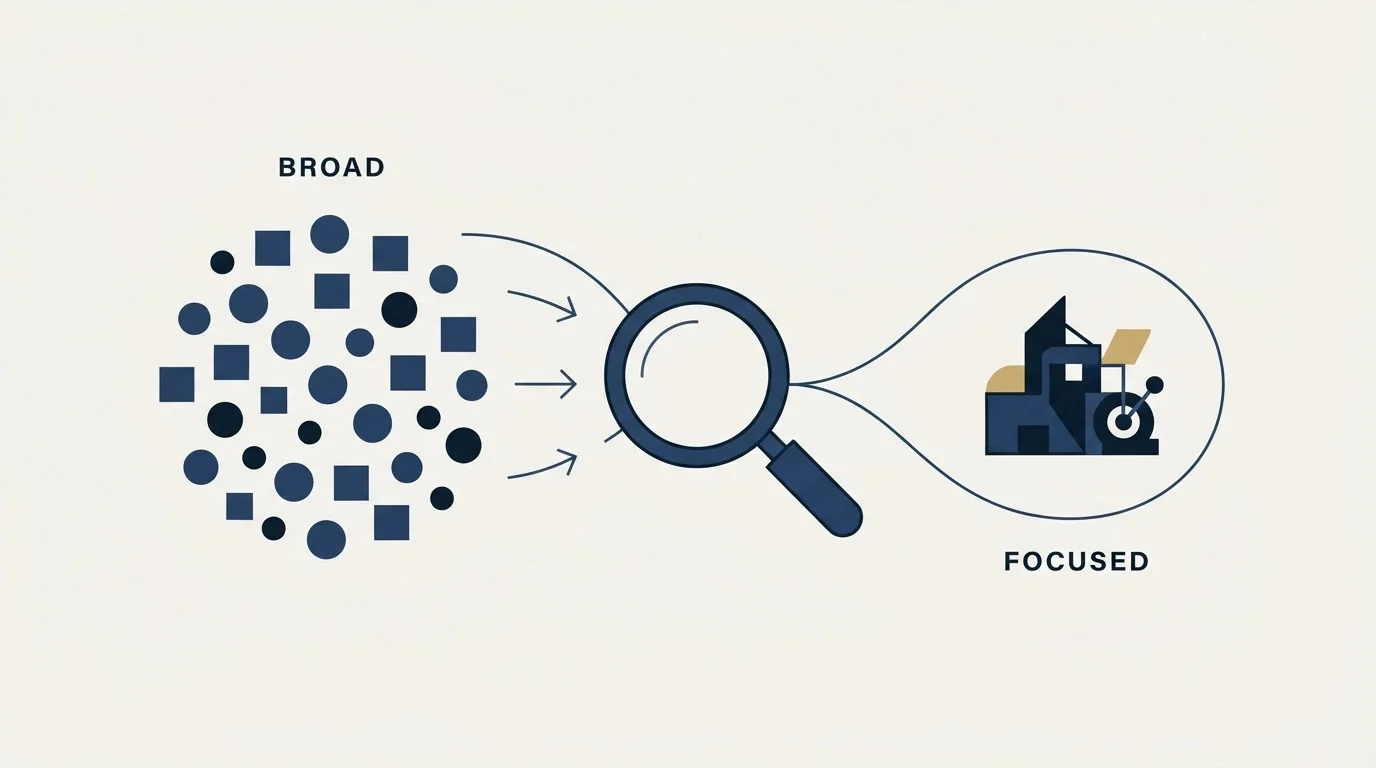
Selling to smaller companies changes several things at once, and most of them are unintuitive if you have come from enterprise.
The reachable population is far larger, and the individual value of each contact is far smaller. That combination pushes toward volume and against deep per-account research, which is the right instinct arithmetically and the wrong one if it is taken to mean generic messaging. What it actually means is that personalisation has to come from something you can obtain at scale rather than from an hour of manual work per account.
Titles are unreliable. In a company of twenty, job titles describe aspiration as often as responsibility, and the person who owns your problem may hold a title that says nothing about it. Targeting by title alone, which works acceptably at enterprise scale, degrades badly here. Company-level signals tend to be more predictive than person-level ones.
The decision-maker is reachable, which is the segment's real advantage. You are usually one email away from the person who can say yes. That makes the quality of a single message unusually decisive, because there is no committee to be routed through and no internal champion who needs equipping.
And the cost of getting the targeting wrong is lower per contact but higher in aggregate, because volume multiplies it. Building the segment definition before scaling the sending is the cheap version of learning this.
The data problem the segment creates
Deciding to sell to smaller companies makes the list harder to build, and the reason is structural rather than a matter of picking a better provider.
Contact databases are assembled from public traces. A company generates those traces by publishing: a website with named staff, press coverage, conference appearances, job postings, filings. Larger companies generate more of all of it. Smaller ones generate less, and the smallest generate almost none, which means coverage falls off exactly where the segment you have chosen begins.
Thin public traces also cap what a model can say about an account, and where machine learning sits in a sales motion treats the available data as the binding constraint.
The consequences are practical. Match rates on company lists will be lower than the rates a provider quotes, because quoted rates average across a customer base that includes people targeting large enterprises. Contact-level coverage falls faster than company-level coverage, so you will find the company and not the person more often than you expect. And the records you do find will be staler on average, because a small company updates its public footprint infrequently.
Quoted rates and your own rates are different numbers, and the match rate definition explains why it decides cost per usable record rather than per credit.
None of that argues against the segment. It argues for two adjustments. Test coverage on a sample of your own targets before committing to a volume plan, rather than sizing the campaign off a provider's headline figure. And expect to need more than one source, since providers differ most from each other precisely in the long tail. The method for both is in our writing on waterfall enrichment.
There is one compensating advantage. Firmographic signals that are weak at enterprise scale are strong here, because a small company's public footprint, thin as it is, describes the whole business rather than one division. What the website says the company does is usually what the company does, which is not reliably true above a certain size.
Holds up
- The boundary is written as who signs and how long it takes
- Headcount or revenue bands are recorded as an approximation
- Something concrete changes when a company crosses the line
- Group ownership is checked, so a subsidiary is not treated as small
- Qualification criteria are agreed in writing before launch
Breaks it
- Using an official SME definition as a sales segment without translating it
- Relying on job titles as the primary targeting signal in very small companies
The short answer
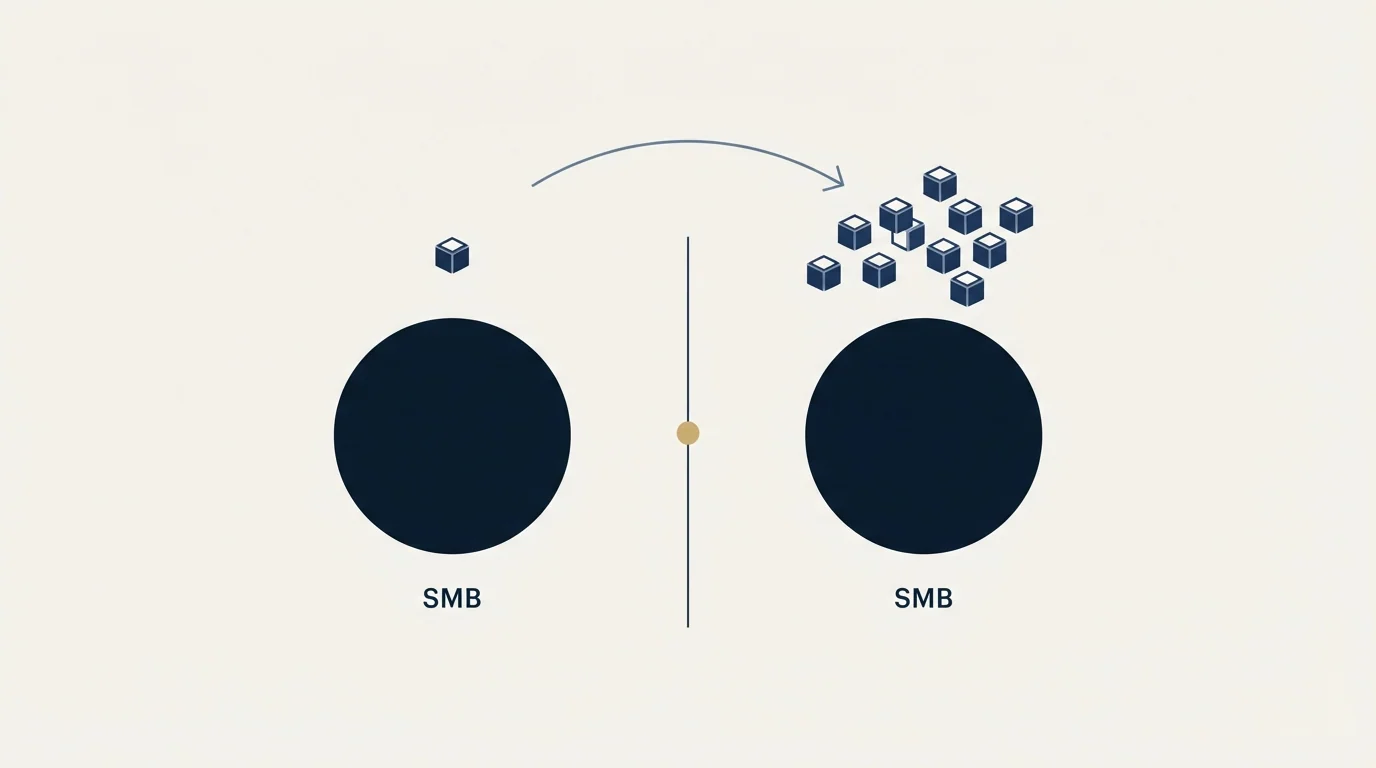
SMB means small and medium-sized business, and the official definitions are real but built for a different job: the EU sets fixed staff and turnover ceilings across the economy, and the SBA sets thresholds that vary by industry. Either can tell you whether a company qualifies for a programme. Neither tells you how the company buys.
In sales the term is worth keeping only if it names a buying behaviour: one person with the problem, the budget and the authority, deciding quickly without procurement in the way. Draw the line there, approximate it with bands your data can actually filter on, and check the bands against the behaviour rather than the other way round.
The related decision, which segment to point outbound at in the first place, is a different question and a bigger one. Our writing on the ideal customer profile covers how to derive it from closed business rather than from ambition, and the vendor-shopping half of the small-business market is covered in lead generation for small business.
If you want the segment defined and the campaign built against it, see what a first campaign looks like.
Definitions cited here were verified against raw page bytes from the European Commission's SME definition page and the US Small Business Administration's size standards pages in mid-2026, and re-read for this update. Both are revised periodically; check the current text before relying on a threshold.
Frequently asked questions.
Frequently asked questions- What does SMB mean in business?
- SMB stands for small and medium-sized business. Official definitions differ: the EU counts a firm as small or medium-sized below 250 staff with turnover up to €50 million, and the US Small Business Administration sets size standards that vary by industry. In sales the term names a segment, usually companies where one person can decide.
- What is SMB sales?
- Selling to small and medium-sized businesses, where the person with the problem is usually the person with the budget and the one who signs. Cycles are shorter, deal sizes smaller and price sensitivity real. The reachable population is large and each contact is worth less, so personalisation has to come from signals available at scale.
- How does the SBA define a small business?
- Its size standards vary by industry and are generally based on the number of employees or the amount of annual receipts, and they cover a business together with its affiliates. As a rule of thumb, most manufacturers with 500 employees or fewer and most other businesses with average annual receipts under $7.5 million qualify, with exceptions by industry.
- Where should the SMB segment line sit?
- Where the buyer stops being the decision-maker and becomes a champion who has to persuade someone else. Write that behaviour down first, then choose headcount or revenue bands that approximate it in your market, and review which companies the bands admit and exclude, because headcount alone is a poor proxy in both directions.
About the author.

B2B cold email experts helping companies generate qualified leads through done-for-you outreach campaigns.
RevenueFlow Team
Explore more.
Ready to scale your outreach?
We build GTM engines that book real meetings. See the receipts.
Related articles.
Win Rate Benchmarks: Which Figures State a Population
A catalogue of the published average sales win rates, sorted by whether the page names the population behind its own number. Most do not.
Sales Kickoff Agendas: Five Published, Session by Session
Five publishers print a sales kickoff agenda. They agree on four blocks and disagree on session length, rehearsal and where the agenda comes from.
Sales Cycle Length Benchmarks: What Each Figure Counts
The published B2B sales cycle benchmarks, sorted by what each page says it counted. The same number means two different things in two of them.
Sales Enablement Charters: What the Published Ones Ask For
Six publishers set out what a sales enablement charter should contain. Five describe a document nobody can check, and one writes a definition with inspection in it.
Sales Comp Plan Design: What the Publishers Prescribe
Four publishers set out how to design a sales compensation plan. Here are their procedures, their components, and which of their ratios carry a population.
B2B Lead Lists for Aviation Companies: Build or Buy
Aviation is one of the few industries whose accounts are published by its regulator, which changes what is worth buying and what is worth downloading yourself.