Sales Enablement Charters: What the Published Ones Ask For
Six publishers set out what a sales enablement charter should contain. Five describe a document nobody can check, and one writes a definition with inspection in it.
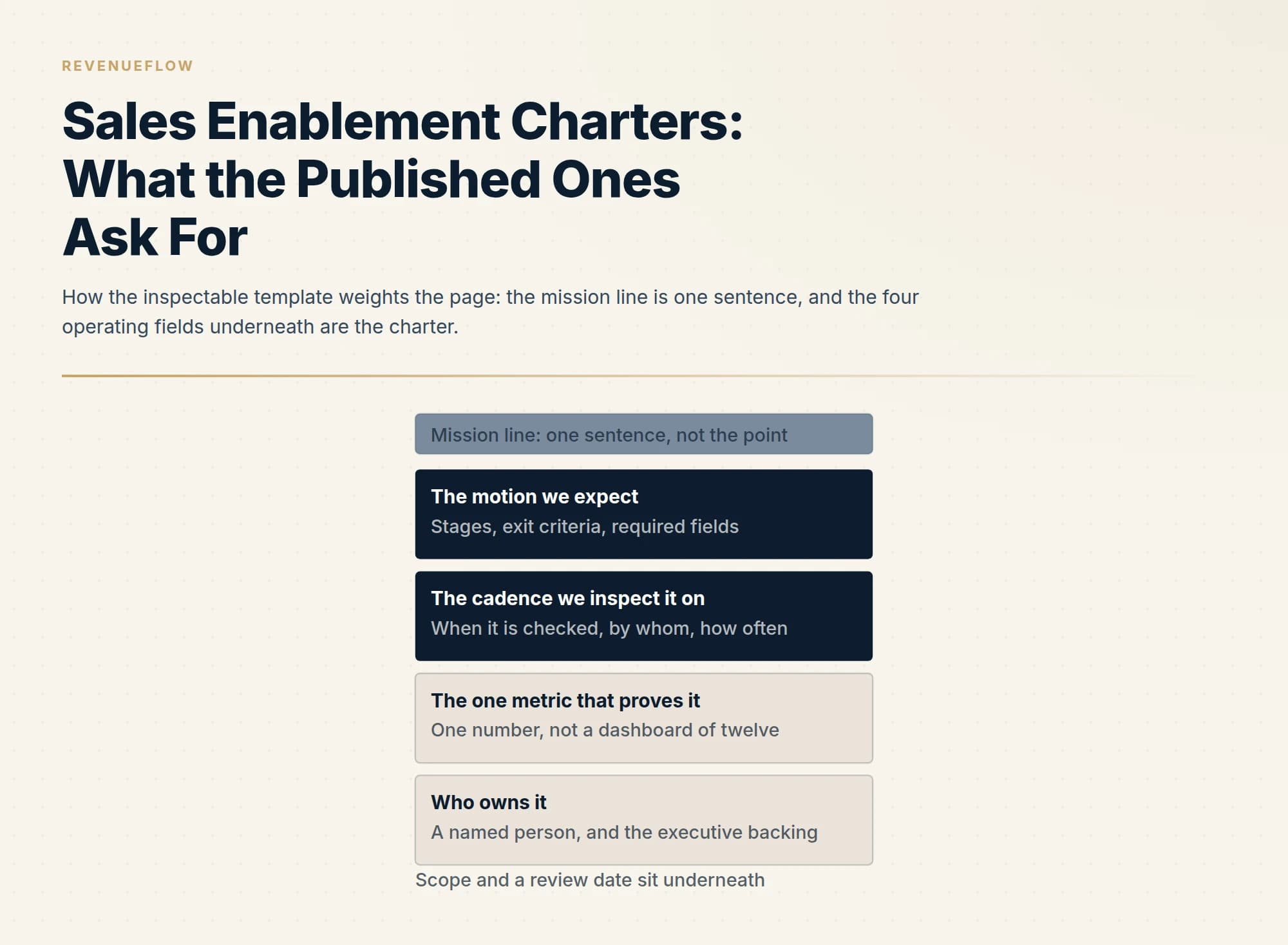
Published sales enablement charters agree on a mission, a scope that says what is out, an audience, objectives and metrics. One publisher adds the fields that make the document checkable: the motion reps are expected to run, the cadence it is inspected on, one metric, and a named owner.
Key takeaways
- Most published charter templates ask for a vision, a mission, pillars and metrics, none of which a manager can check against a live deal.
- One publisher defines the charter as a written set of expectations naming the motion, the inspection cadence and the one metric that proves it.
- Seismic builds adoption from three standing groups: an executive board meeting quarterly, an advocate team refreshed twice a year, and a monthly cross-functional council.
- A practitioner publishes the rollout in full: draft, two review layers, leaders, front-line managers, then the floor, budgeted at three to four weeks.
Reviewed and updated September 21, 2026
Six organisations publish an answer to the question of what a sales enablement charter should contain, and five of them describe a document that cannot be checked. They ask for a vision, a mission, a set of pillars and a list of metrics, all of which can be written, approved and filed without anybody ever finding out whether the function did what the document said. One publisher defines the charter the other way round, as a set of expectations somebody inspects, and that difference decides whether the exercise is worth the fortnight it takes.
This page sets the published charters beside each other: what each publisher says the document is, the sections each one asks for, the two figures that circulate about how many teams have one, and the rollout sequence one practitioner publishes in full. What sales enablement is, and the four distinct jobs bundled under the name, is the subject of the sales enablement guide and is not restated here.
What the publishers say a charter is
Four definitions, in their own words, and they are not the same document.
Seismic calls it a plan. Its charter post opens with "Think of a charter as your North Star" and then makes the business-plan claim directly: "A charter transforms random efforts into a strategic and value-adding sales enablement strategy that positively impacts business objectives." Among the seven things it says a charter helps a team do, one is operational rather than aspirational: "Define which responsibilities are in and out of scope". The post is bylined to Sarah Raines and dated 23 August 2022 on the page.
Mindtickle, in a post dated 12 June 2026, uses almost the same framing, describing how "a sales enablement charter is a roadmap or business plan for your sales enablement plan", and then splits the document into a vision and a mission, where "Typically, vision statements are aspirational and provide a high-level view of the potential impact of sales enablement on the organization" and the mission says how you will get there.
The Sales Enablement Collective, in a piece published on 26 April 2023 and modified on 21 November 2025, defines it by the job it does inside the company: "a document that provides direction and focus to your enablement team", and also the thing you can point any other department at when they ask what enablement actually does.
Supered, in a post dated 24 June 2026, refuses all three of those and writes a definition with a verb in it: "A sales enablement charter is a written, agreed set of expectations for the enablement function that names the motion you expect reps to run, the cadence you will inspect it on, and the one metric that proves it is working." Its argument for that wording is a general one about process, that "A process exists only to the degree adherence to it is inspected."
The sections the published templates ask for
Line the templates up and a common core appears, with one publisher adding fields nobody else has.
| Publisher | Calls the charter | Sections it asks for |
|---|---|---|
| Seismic | A North Star and a business plan | Scope in and out, an org chart, executive buy-in, impact measurement, plus three governance bodies |
| Mindtickle | A roadmap or business plan | Vision, mission, goals set with SMART, target audience, KPIs |
| Showpad | A blueprint | Mission, objectives, enablement pillars, success metrics, stakeholder management |
| Sales Enablement Collective | Direction and focus for the team | Company priorities and the alignment to them, team mission and delivery model, a roadmap with a measurement framework |
| Supered | Expectations you inspect against | The motion, the cadence, one metric, a named owner, scope, a review date |
Showpad's guide, dated 14 November 2024, is the clearest statement of the conventional version. It lays three foundations first, one of which is to define the scope of enablement with stakeholders so that the remit is explicit, and then names the core components: a mission, because "Every enablement team needs a clear mission that explains why they exist and what they're here to accomplish", a set of time-bound objectives, the enablement pillars, success metrics where "Success metrics should include both leading and lagging indicators to give a full picture of how well your initiatives are working", and stakeholder management.
Mindtickle adds one thing the others leave implicit, which is the audience. Some enablement teams support only sellers; others support solution engineers and customer success managers too, and the charter is where that is settled. It also asks for goals written with a named discipline, since you should "Use the SMART acronym to avoid vague goals", and it closes the document with the KPIs the team will track to measure impact. Showpad, which calls the same document a blueprint, ends its own list the same way.
The one template that can be checked
Supered's version is structured the other way around. The mission line sits at the top and is explicitly not the point; four operating fields carry the weight.
The first is the motion, described as "The named standard a rep runs on a deal: the stages, the exit criteria, the required fields, the qualification questions you decided matter." The second is the cadence, which is simply "When adherence gets checked, by whom, on what rhythm", and which the page says is what converts the document from a description into a contract. The third is one metric, with the reasoning stated flatly: "A charter that claims responsibility for everything is accountable for nothing." The fourth is a named owner, plus the executive who backs the cadence when a manager would rather skip a review. Scope and a review date sit underneath as short context fields.
The page also publishes a test, and it is the most portable thing in the whole set: "The test for whether your charter is the real kind is mechanical." Take any field and ask whether a manager could check it against a live deal next week. A line about empowering reps to win fails that. A line saying every stage-two deal has a confirmed economic buyer and a documented next step passes it.
The same post offers the image that explains why the conventional template fails so often: "A thermometer reads the room. A thermostat sets a target and acts on the gap." An aspiration charter describes a desired state and stops there.
Who signs it, and how it reaches the sales floor
Two publishers treat adoption as part of the document rather than as an afterthought, and they solve it differently.
Seismic builds three standing groups. The enablement board is the executive layer, and the instruction is direct: "The enablement board should include your executive team, so it's important to establish this relationship early", with the rhythm set as "Meet with this team quarterly to gain buy-in from executive sponsors for your enablement strategy, establish a consistent feedback loop, and ensure that your strategy aligns with the organization's overall vision, mission, and goals." The advocate team is the champion layer across the roles enablement supports, refreshed on a schedule, since the page advises to "Ideally, nominate new members every six months to welcome fresh perspectives, ideas, and continuous feedback as you prioritize and scale your enablement strategy." The enablement council is the cross-functional layer outside enablement, where "The council's focus is to exchange important information and transfer critical knowledge monthly."
The Sales Enablement Collective publishes the other half, which is the launch sequence, from Lisa Duncan, Senior Director of Global Revenue Enablement at Meltwater. She describes working backwards from the date the charter is presented, and states the size of the artifact plainly: "The final product is maybe a 5-6 slide charter with the following items", those items being an "Overview of company priorities and alignment of enablement priorities with them", the "Enablement team mission/purpose, structure, stakeholder alignment and delivery model", and an "Enablement roadmap for the upcoming quarter/year including learning objectives and desired outcomes (and a measurement framework)". The rollout runs from an almost-final draft through a sales leader review, a second-line leader review, finalisation, presentation to leaders and then to front-line managers, then to the wider sales organisation, and last to the partners across other departments who need to be informed. Her stated duration for that sequence is specific: "With a large global team and lots of timezones to contend with, this process takes me about 3-4 weeks."
The figures published about charters, and what stands behind them
Three numbers circulate in this literature, and they are worth separating by what each page actually says.
The Sales Enablement Collective attributes its figure to a named report of its own: "According to our Sales Enablement Landscape Report 2024, 38% of sales enablement professionals have a charter, which leaves a significant percentage without one." The report is named; the page states no sample size and no respondent profile. Mindtickle prints the same share with no source named on the page, writing that "recent research found that only 38% of sales enablement professionals have one in place", so a reader who meets the number there cannot trace it without already knowing where it came from.
The Sales Management Association's 2017 write-up of a HubSpot practitioner session quotes a different survey in its abstract: "According to new research from CSO Insights, 59% of organizations surveyed now have a dedicated sales enablement function, a YOY increase of more than 26%." That is a figure about the existence of a function rather than of a charter, and the session itself cannot be read: the page ends with "You must be a member to access to this resource." Nothing else from it is quoted here.
Supered cites a win-rate gap between organisations with a charter and organisations without one, sourced to a Korn Ferry CSO Insights study, and the population behind that comparison is not stated on the page where it appears. It is reported here as what that page reports, not as a measured benchmark, which is also how this site treats every third-party figure in sales enablement metrics.
Where we differ from standard practice
If the charter names a motion, then for any team doing outbound the motion field is where our own policy diverges from the market's. The named standard in most published enablement material is a multi-touch prospecting sequence: several messages to the same person over a set number of days, later ones landing in the same thread, with adherence measured as touch completion.
Our documented policy is one message per campaign, with no bumps and no thread replies. Where an audience does not answer, the next approach is a separate campaign built on a genuinely different premise rather than a reminder. The reasoning is mechanical: a repeat message is delivered to the people who already saw the first and chose not to reply, which is the population most likely to complain, and the cost of that lands on the sending domain across every campaign running on it. Meetings are qualified against criteria agreed in writing before launch, which is the same instinct a charter expresses, applied to a supplier relationship.
The practical consequence for a charter is that the motion field for prospecting has to describe the single message and the targeting behind it, and the cadence field has to inspect something that exists: the premise, the list and the result, rather than a touch count. The order in which those decisions get made is the subject of the four enablement decisions.
- A named motion with stages and exit criteria
- A cadence naming when adherence is checked and by whom
- One metric the function is accountable for
- A named owner and the executive who backs the cadence
- Scope stated as what is in and what is out
- A vision statement about the potential impact of enablement
- A list of pillars with no adherence check attached
- A mission line that says enablement empowers reps
What to take from the published charters
Take the common core, because it is cheap and every publisher asks for it: a mission, a scope that says what is out as well as what is in, an audience, objectives and the measures. Write it on five or six slides rather than twenty.
Then spend the effort on the fields only one publisher asks for. A named motion, a named inspection cadence, one metric and one owner are the parts that turn the document into something a manager can be held to, and a template that gives three paragraphs to vision and one bullet to scope has the weighting backwards.
Plan the rollout as part of the work. The published sequence runs draft, sales leader review, second-line review, finalise, leaders, front-line managers, then the sales organisation, and the practitioner who publishes it budgets three to four weeks for a global team.
And put a review date on it. A charter with no date to be re-read becomes a description of a function that has since changed, which is the same accumulation problem that afflicts every enablement library and which the enablement tools guide runs into from the tooling side.
The short version
The published sales enablement charters agree on a mission, a scope, an audience, objectives and metrics, and they disagree about whether the document is a vision artifact or an operating agreement. Only one publisher writes a definition with inspection in it, naming four operating fields: the motion you expect, the cadence you inspect it on, the one metric that proves it, and the person who owns that metric.
Two publishers print the same share of enablement professionals who have a charter, one naming its own report and neither stating a sample size. A third figure, about how many organisations have an enablement function at all, sits in the abstract of a members-only session.
Apply the mechanical test to every line you write: could a manager check this against a live deal next week. If the answer is no, the line belongs in the one-sentence mission at the top, or nowhere. If the constraint the charter uncovers is that too few qualified conversations are starting at all, see what a first campaign produces against your market.
Frequently asked questions.
Frequently asked questions- What should a sales enablement charter include?
- Across the published templates the common core is a mission, a scope that states what falls outside enablement as well as inside, the audience the function supports, time-bound objectives and the measures. One publisher adds four operating fields on top of that: the motion reps are expected to run, the cadence adherence is checked on, a single metric, and the person accountable for it.
- How long is a sales enablement charter?
- The one practitioner in this set who states a size describes the final product as roughly five or six slides, carrying an overview of company priorities with the enablement priorities aligned to them, the team mission, structure, stakeholder alignment and delivery model, and a roadmap for the quarter or year with a measurement framework attached.
- How do you get a sales enablement charter adopted?
- Two published answers exist. One builds standing groups: an executive board that meets quarterly, an advocate team of champions across the supported roles with new members nominated every six months, and a monthly cross-functional council. The other publishes a launch order that runs from draft through two review layers to leaders, managers and then the wider organisation.
- How many enablement teams actually have a charter?
- Two publishers print the same share of enablement professionals who have one, and neither page states a sample size; one names its own annual landscape report as the source and the other calls it recent research. A separate and older survey figure, about how many organisations have an enablement function at all, sits inside the abstract of a members-only session.
About the author.

B2B cold email experts helping companies generate qualified leads through done-for-you outreach campaigns.
RevenueFlow Team
Explore more.
Ready to scale your outreach?
We build GTM engines that book real meetings. See the receipts.
Related articles.
Sales Kickoff Agendas: Five Published, Session by Session
Five publishers print a sales kickoff agenda. They agree on four blocks and disagree on session length, rehearsal and where the agenda comes from.
Win Rate Benchmarks: Which Figures State a Population
A catalogue of the published average sales win rates, sorted by whether the page names the population behind its own number. Most do not.
Sales Cycle Length Benchmarks: What Each Figure Counts
The published B2B sales cycle benchmarks, sorted by what each page says it counted. The same number means two different things in two of them.
Sales Comp Plan Design: What the Publishers Prescribe
Four publishers set out how to design a sales compensation plan. Here are their procedures, their components, and which of their ratios carry a population.
Physician Email Lists: The Row, Its Sources and Its Gaps
The anatomy of a physician email list: the six field groups, which CMS, AMA and state board records hold each, what vendors claim, the rules, and the order to verify.
B2B Lead Lists for Aviation Companies: Build or Buy
Aviation is one of the few industries whose accounts are published by its regulator, which changes what is worth buying and what is worth downloading yourself.