Sales Enablement: The Four Jobs Hiding Under One Name
Readiness, messaging, materials and process support are four different jobs with four different failure modes, usually resourced in reverse order of impact.

Sales enablement bundles four separable jobs: readiness, messaging, materials and process support. Materials usually take most of the budget because they produce visible artefacts, while process support produces the most durable change and consistently gets the least attention and the least resource of the four.
Key takeaways
- Measure enablement with ramp consistency, behavioural consistency in recorded conversations and time to answer a buyer question, rather than with downloads and completions.
- Content libraries degrade because nothing announces when an asset stops being accurate, so put an owner and a date on everything and retire on a schedule.
- Making the process easier to follow correctly than incorrectly teaches more reliably than a course does, because it is enforced at the moment of the behaviour.
- Reading produces recognition and conversations require production, which is why practice with feedback is the mechanism content cannot replace.
Reviewed and updated August 28, 2026
Sales enablement is the discipline of making sure a seller has what they need to have a useful conversation, at the moment they need it. That definition is uncontroversial and almost useless, because everything a company does could be described that way, which is how enablement functions end up owning onboarding, content, tooling, training, messaging, competitive intelligence and the CRM's field descriptions all at once.
The version that changes outcomes is narrower. This page is about which parts of the remit actually move numbers, which parts are content production wearing a different name, and how to tell them apart in your own organisation.
What is sales enablement, stated plainly: the discipline of making sure a seller has what they need to have a useful conversation, at the moment they need it, which in practice resolves into the four jobs below.
Sales enablement examples, concretely: call recordings with commentary, one-page objection responses, competitive framing, proposal skeletons, and the stage guidance that lives in the CRM.
A talk track is the written form of that scripted material, a short framing for a complex concept or a recurring objection, and it obeys the same rule as an objection library: the value sits in the rehearsal rather than in the document, so a talk track nobody has said aloud is messaging that has been published rather than delivered. Sales readiness is the category name the tooling market gives that first job, and the useful part of the label is its insistence that the question is continuous: whether a seller can do the job is answered by repeated demonstration rather than assumed once onboarding has finished.
Teams wrestling with whether their talk tracks reflect real differentiation can examine Force Management's pricing-power messaging test for a concrete standard.
The four things enablement does
Strip the category back and there are four distinct jobs, with different owners, different evidence and different failure modes.
Pointing those same four jobs at every customer-facing role rather than at the seller is what revenue enablement claims to be, and the claim is only real when the authority widens with the scope.
- Onboarding, certification, practice
- Measured by time to first closed deal and by ramp consistency
- Fails as: a content library nobody completes
- Positioning, objection responses, competitive framing
- Measured by consistency across recorded conversations
- Fails as: a deck nobody opens after the launch meeting
- Case material, proposals, one-pagers, technical answers
- Measured by whether sellers can find and use them
- Fails as: a repository with six versions of everything
- CRM fields, stage guidance, templates, handover standards
- Measured by whether the process gets followed
- Fails as: required fields sellers fill in with placeholder text
The four are usually resourced in reverse order of impact. Materials get the most attention because they are visible and produce artefacts. Process support gets the least, because it is unglamorous and requires arguing with whoever owns the CRM.
Sales development enablement is these same four jobs pointed at a prospecting seat, where readiness and messaging carry nearly all of the weight, because what a development rep needs to hand is a short set of objection responses they have said aloud rather than a library they can search.
Pointed at the technical seat instead, the same four change weight again and materials stops being a findability problem, which is worked through in presales enablement.
The measurement problem, stated honestly
Enablement is hard to evaluate for a structural reason, and pretending otherwise produces the metrics that make the function look decorative.
Everything it does is upstream of the result and mediated by other people. A better onboarding programme shows up in a closed-won number one full sales cycle later, filtered through the quality of the pipeline, the market, and how much the manager reinforced it. No attribution model separates those cleanly, which is why enablement teams end up reporting content downloads and course completions: those are measurable and they are measurements of activity rather than of effect.
Three proxies are more honest, and all three are obtainable.
Ramp consistency, meaning the spread between the fastest and slowest new sellers reaching a defined competence bar, rather than the average. Enablement's realistic promise is narrowing the spread, and the average is dominated by hiring.
Behavioural consistency, meaning whether recorded conversations show sellers doing the thing the programme taught. This is the only measurement that distinguishes a programme that landed from one that was delivered.
Beyond behavioural consistency, a further limitation is that activity counts and outcome numbers can look healthy while hiding whether anything actually changed, a distinction drawn out in separating what happened from what changed.
Time to answer, meaning how long it takes a seller to get a reliable answer to a buyer question they cannot answer themselves. This is the metric that most directly tracks whether the materials half is working, and it is almost never instrumented.
Content is the part that consumes the budget and moves least

Most enablement functions produce far more material than gets used, and the imbalance is structural rather than a failure of judgement.
Material gets commissioned when somebody feels a gap, produced against that feeling, published, and then never retired. Nothing announces when a piece stops being accurate. So the library grows, search across it degrades, and the practical consequence is that sellers stop looking and rebuild what they need from memory, which is the exact outcome the library existed to prevent.
Two habits fix most of it and neither requires a platform. Put an owner and a date on every asset, so a reader can tell whether they are looking at something current. And retire aggressively on a schedule: anything unopened for two quarters is either obsolete or undiscoverable, and both cases want the same action.
The deeper point is that a seller in a live conversation needs one right answer quickly, not eleven documents. A library optimised for coverage and one optimised for retrieval look completely different, and most are built for coverage because coverage is what gets reviewed.
There is a cheap diagnostic for which kind you have. Pick five questions buyers actually asked last month, hand them to a seller who joined recently, and time how long it takes them to produce an answer they would be willing to send. Under two minutes each means the library is working. Anything longer, or an answer assembled from memory rather than from the library, means the material exists and is not reachable, which is functionally the same as not existing.
The other half of the same problem is that the request queue sets the roadmap. Enablement functions are usually reactive by structure: a seller asks for a one-pager, a product launch needs a deck, a competitor releases something. Each request is legitimate and none of them are prioritised against each other, so the function's output ends up shaped by whoever asks most often rather than by where the sales motion is weakest. A standing rule that no new asset is commissioned without naming the conversation it is meant to change, and the moment in that conversation where it gets used, filters a surprising share of requests before any work happens.
Where enablement and the process meet
The highest-leverage enablement work is usually the least visible: making the process itself easier to follow correctly than incorrectly.
A stage that requires an evidence field before it advances teaches discovery more reliably than a discovery course does, because it is enforced at the moment of the behaviour rather than in a room three months earlier. A handover standard that names exactly what a receiving account executive needs prevents the buyer being asked to repeat a conversation they already had. A written definition of what a qualified opportunity requires settles more arguments than any amount of alignment work between two teams.
That is why process support belongs in the enablement remit rather than being left to operations alone. Pipeline stages that earn their place covers the criteria side of it, and what the acceptance boundary has to settle covers the definition that sits underneath.
Practice is the mechanism content cannot replace
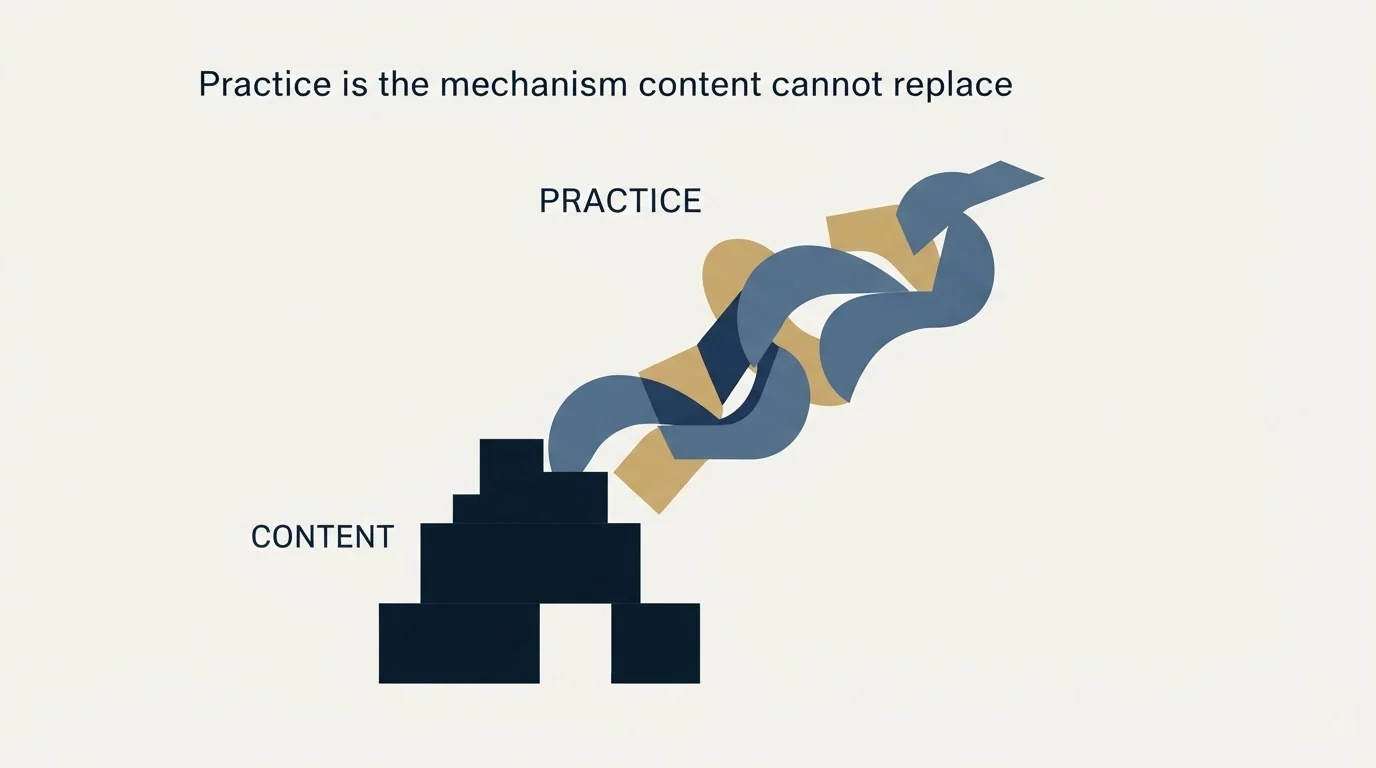
Reading and watching produce recognition. Conversations require production, and the gap between the two is where most training goes to die.
The mechanism that closes it is practice with feedback, which historically meant peer roleplay and a manager's time. Both are expensive, and both are the first thing cut in a busy quarter, which is precisely when a new message is being rolled out.
This is the gap the current generation of simulation tooling addresses. Vendors in the category offer AI-driven roleplay with automated scoring so that practice does not depend on a manager's calendar, and the evaluation question for any of it stays the same: does the practice look like the conversation the seller will actually have, and does somebody see the output and act on it.
The same principle applies to the parts of the job that are already scripted. Objection responses are the clearest case, because they are the piece of messaging most often published as a document and least often rehearsed aloud, and an objection library is mostly worth auditing rather than extending.
When enablement is the wrong investment
A function this broad absorbs whatever it is given, so the honest fit test matters.
- Yes: Several sellers are having materially different conversations about the same product
- Yes: New sellers reach competence at wildly different speeds
- Yes: Sellers routinely cannot answer a common buyer question without escalating
- Yes: There is enough headcount for consistency to be worth engineering
- No: The actual constraint is that too few qualified conversations happen at all
- No: Buying it to postpone a decision about who the buyer is
The fifth item is the one that decides whether the money is well spent. Enablement improves what happens to conversations once they exist and creates none of them. A team with excellent messaging and an empty calendar has an excellent version of a problem it does not have, and no amount of readiness work changes the number of meetings held.
The sixth is the failure that looks most like success. Where positioning is genuinely unresolved, an enablement programme produces beautifully consistent delivery of a message that has not been validated, and the consistency makes the underlying problem harder to see rather than easier.
Where we differ from standard practice

Much of the material in this category reflects how outbound is commonly run, and since this page sits on our site it is worth saying where our practice diverges and what it costs us.
Enablement content about prospecting almost always assumes a cadence: a sequence of touches per prospect over several weeks, with later messages landing in the same thread, and a certification exercise built around writing the sequence. We do not run that. One message per campaign, no bumps, no thread replies, and where an audience does not respond the next approach is a separate campaign with a genuinely different premise rather than a reminder. The reasoning is mechanical: a repeat message is delivered to the population that already saw the first and chose not to answer, which is the population most likely to complain, and the reputation cost lands on the sending domain across every campaign running on it. our write-up on why we stopped using follow-ups has the whole trade. The cost we accept is fewer contacts per prospect, which moves the work into targeting and into the single message.
The commercial standard we hold ourselves to is the same instrument this page recommends. Meetings are qualified against criteria agreed in writing before launch, which is a definition written before anyone can read the result off it. The full argument, including what it costs us, is in why we stopped using follow-ups.
The short version
Sales enablement is four jobs bundled under one name: readiness, messaging, materials and process support. They are usually resourced in reverse order of impact, with materials taking the budget and process support producing the durable change.
Measure it with ramp consistency, behavioural consistency in recorded conversations, and time to answer a buyer question, rather than with downloads and completions. Retire content on a schedule and put an owner and a date on everything, because an unretired library becomes undiscoverable and sellers stop using it. Invest in practice with feedback, because reading produces recognition and conversations require production.
And check the constraint first. If the shortage is qualified conversations rather than their quality, that is a different problem, and it is the half we run: see what a first campaign produces.
Frequently asked questions.
Frequently asked questions- What does sales enablement actually do?
- Four separable jobs. Readiness covers onboarding, certification and practice. Messaging covers positioning and how the team talks about competitors. Materials covers the assets sellers hand to buyers. Process support covers the CRM fields, stage guidance and handover standards that make the process easier to follow correctly than incorrectly.
- How should sales enablement be measured?
- Not by downloads or course completions, which measure activity. Three honest proxies are the spread between fastest and slowest new sellers reaching a competence bar, whether recorded conversations show sellers doing what the programme taught, and how long it takes a seller to get a reliable answer to a buyer question.
- Why does enablement content go unused?
- Because assets get commissioned against a felt gap, published, and never retired. Nothing announces when a piece stops being accurate, so the library grows, search across it degrades, and sellers rebuild what they need from memory. Owners, dates and scheduled retirement of anything unopened for two quarters fix most of it.
- When is enablement the wrong investment?
- When the constraint is the number of qualified conversations rather than their quality, because enablement improves what happens to conversations and creates none of them. It is also the wrong move where positioning is genuinely unresolved, since it produces consistent delivery of an unvalidated message.
About the author.

Ben Carden is CRO at RevenueFlow, which builds and operates outbound revenue engines for B2B companies. Previously at Gartner Enterprise. Studied at London School of Economics.
Ben Carden · CRO
Connect on LinkedIn →Explore more.
Ready to scale your outreach?
We build GTM engines that book real meetings. See the receipts.
Related articles.
Sales Kickoff Meeting: The Decisions It Has to Leave With
A kickoff is the one moment a whole sales organisation can change at once. The four decisions it has to publish, and the week-six check that tests them.
AI Sales Role Play: What a Simulation Cannot Rehearse
Peer roleplay fails because two colleagues cannot make each other genuinely uncomfortable, and the discomfort is the training. What a bot changes, and what it does not.
The Sales Onboarding Process: What a New Seller Demonstrates
Most onboarding programmes are content schedules that can be completed without anyone learning the job. The demonstration list that replaces them, and the order to teach.
A Repeatable Sales Process: What Transfers
Repeatable means somebody else can run it and get a similar result. What a written process carries, what it quietly leaves behind, and how to measure it at ramp.
Sales Call Planning: The Plan a Booked Call Needs
A call cannot produce a commitment nobody named in advance. The four fields a call plan carries, and why the ask has to be decided before the meeting opens.
Value-Based Selling: The Arithmetic Step After the Diagnosis
Diagnosis establishes that a problem hurts. Value-based selling is the step that turns it into a figure the buyer's own finance function will defend for you.