Command of the Message: Production Work, Not Sales Training
Force Management defines it as being audible-ready and able to charge a premium. The four clauses, and why deployment fails when nobody owns the words.

Command of the Message is a sales messaging methodology from Force Management, defined by them as being audible-ready to define your solutions to customer problems in a way that differentiates you from competitors and allows you to charge a premium. Pricing power is the test of whether the message works.
Key takeaways
- The premium clause is unusual among messaging frameworks, because it names pricing power as the test rather than stopping at clarity.
- The methodology assumes the words exist before any seller needs them, which makes it a production question with a named owner rather than a curriculum.
- Force Management is explicit that differentiating does not mean characterising competitors badly, which they describe as creating tension and distrust.
- Differentiation decays as competitors converge on the same claims, so the message needs a review interval rather than a launch.
Reviewed and updated September 1, 2026
Ask four sellers at the same company what it does and why anyone should pay more for it, and count how many answers you get. Four is normal. The answers will all be sincere, most will be roughly true, and none of them will be the one the pricing was built on. That spread is the specific problem this methodology names, and the name it gives the fix is Command of the Message.
Command of the Message is a sales messaging methodology from Force Management, who hold it as a registered mark and license it as a consulting and training engagement. Its subject is narrower than most named methodologies. Where the qualification frameworks govern which deals an organisation may believe, and the call frameworks govern how a conversation is run, this one governs what a seller says about the value of what they sell, and where those words come from.
The definition, and the four claims inside it
Force Management publishes its own definition, and it is worth reading closely because each clause is doing work. The company defines Command of the Message as being audible-ready to define your solutions to customer problems in a way that differentiates you from your competitors and allows you to charge a premium for your products and services.
Four claims sit in that sentence.
Audible-ready. Force Management borrows the term from American football, where a quarterback changes the play at the line, and glosses it in business terms as situational fluency. Their own writing is careful about what it excludes: being audible-ready describes a team that has rehearsed enough scenarios to adapt on the spot, rather than sellers improvising off message. The distinction matters because "flexible" is the easiest part of the idea to adopt and the least useful on its own.
Solutions to customer problems. The methodology anchors the message to the buyer's problem before it reaches the product, and their writing puts the reason for it in one line: the person who owns the problem owns the customer. A team that spends its preparation on the demo has usually skipped this and will find out at the price conversation.
Differentiates you from your competitors. Force Management is explicit that this means articulating how your specific capabilities align to the customer's problem, and that it does not mean characterising competitors badly, which they describe as creating unpleasant tension and distrust.
Allows you to charge a premium. This is the unusual clause. Most messaging frameworks stop at clarity; this one names pricing power as the test of whether the message works, on the grounds that a buyer who can defend the spend internally is a buyer who understood the value well enough to repeat it.
- Step 1Customer problem
A specific, recognisable failure in how the buyer's work runs today
- Step 2Required capability
What would have to be true for that failure to stop, described without a product name
- Step 3How we deliver it
The specific part of the offering that supplies that capability
- Step 4Proof
Evidence the capability produced the outcome elsewhere, in the same failure mode
- Step 5Premium defended
The buyer can restate the value internally to someone who was not in the room
The part that is not a training problem
The methodology is usually bought as enablement, which is a reasonable way to deploy it and a misleading way to understand it. What it actually asks for is that the words exist before any seller needs them, which makes it a production question with an owner rather than a skills question with a curriculum.
Somebody has to decide which customer problems the company sells against, which capabilities answer them, what genuinely separates the offering from the alternatives, and what proof exists for each claim. That work is research and argument. It is slow, it is contested internally, and it is nobody's job by default.
The observable symptom of skipping it is a team that has been trained in the vocabulary and has nothing to put in it. Sellers recite value statements they cannot defend under a second question, which is worse than the four-different-answers problem it replaced, because the answers are now uniform and still unsupported. A buyer finds the floor in one more question.
Where sellers already recite the vocabulary without support, rehearsing that language under pressure exposes the gap before a buyer's second question does.
- A workshop, a template and a deadline
- Value statements written by the people who will deliver them, in the session
- Differentiation asserted from internal belief
- Proof points chosen for being impressive
- Reinforced by asking reps to use the language
- A named owner for the message with a review interval
- Problems and capabilities derived from won and lost deals
- Differentiation tested against what competitors actually claim
- Proof points chosen for matching the failure mechanism
- Reinforced by managers asking for the buyer's words back
Where the differentiation claim usually breaks
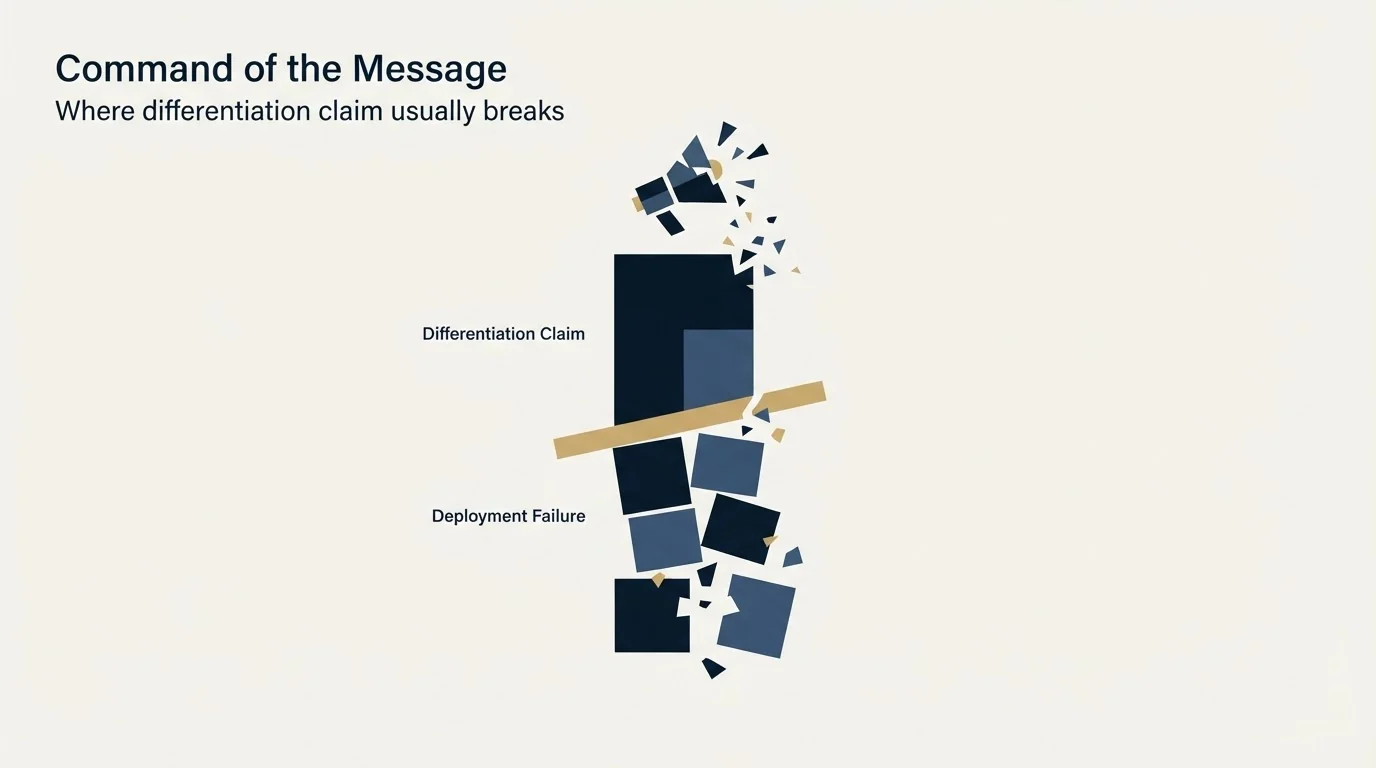
Differentiation is the clause most likely to be filled in from internal belief, and it is the one a buyer is best placed to check.
Three failures recur. The first is a claim that every vendor in the category also makes, which reads as noise however confidently it is delivered. The second is a claim that is true and irrelevant to the problem just described, which reads as a change of subject. The third is a claim the buyer has already heard from someone cheaper.
The discipline that addresses all three is unglamorous: read what your competitors actually say on their own pages, and keep only the claims that survive that reading. A differentiator that a competitor asserts word for word is a category description.
Differentiation also decays. A genuine separation becomes the standard pitch in a category within a year or two, because competitors read the same market and hire the same people. That is the argument for a review interval rather than a launch, and it is the same decay the Challenger approach runs into with commercial insight.
A message is only as sharp as the audience it was written for
The clause about differentiation carries a hidden dependency. A capability separates you from alternatives only for buyers with a particular problem, and the same statement applied to companies with different economics turns into a generalisation within a quarter.
That makes audience definition part of the messaging work rather than an input to it. A team writing one value story for everyone will produce something true of nobody in particular, and the usual response is to add qualifiers until the statement is defensible and inert. Narrowing the population is the cheaper repair, and building an ICP with the arithmetic attached is where that narrowing gets done with numbers rather than by preference.
The sharper version of the same idea is the difference between a filter and a signal. A message aimed at an industry and a headcount band has to survive every situation inside that band. A message aimed at companies in a specific, checkable situation can name that situation in its first sentence, which is what makes a value statement land before anyone has agreed to a meeting. The difference between a filter and a signal is the same distinction applied to list building.
Delivery then gets tested somewhere specific. A value statement survives or fails in the first real conversation, and the honest place to check it is against what the buyer says back rather than against how the call felt. Disqualifying well on a discovery call covers the conversation where that check happens.
How it fits with the frameworks around it

Command of the Message answers a different question from the qualification frameworks it is often deployed alongside, and the two are complementary rather than competing.
MEDDIC and its longer variants tell a sales organisation which deals it is allowed to believe. Force Management, who also teach the qualification family, note that MEDDIC originated in the 1990s at Parametric Technology Corporation. Those frameworks say nothing about what a seller should say; they say what a deal has to prove.
Unlike the messaging discipline described here, SPICED sequences discovery questions so situation and pain surface before anyone asks what solving the problem is worth.
The relationship runs in one direction that is worth naming. A qualification framework asks for the metrics a buyer will improve and for the person whose budget is affected. A message built the way this methodology describes is what makes those answers obtainable, because a seller who can name the problem precisely gets a precise answer, and a seller asking generally gets a general one. Where the two are deployed together, the qualification fields tend to fill with the buyer's own words rather than with the seller's summary, and that difference is visible in a pipeline review from across the room.
Testing whether you have it
The methodology's own test is the premium clause: whether buyers can defend the spend. That is a lagging measure and there are earlier ones.
- Yes: Four sellers, asked separately, name the same customer problem first
- Yes: Each can state the required capability without naming the product
- Yes: Each names the same differentiator, and it survives reading a competitor's page
- Yes: Each has a proof point that shares the failure mechanism, not just the industry
- Yes: Somebody owns the message and has revised it in the last two quarters
- No: The value statements were written in the same session they were taught
- No: Discounting is the usual response when the price is questioned
The single cheapest version of this test is to ask a seller what the buyer said, in the buyer's words, and see whether the vocabulary in the answer is the buyer's or the company's. A record full of the company's own value language usually means the message was delivered and never checked.
Where we differ from standard practice
Much of the advice in this area reflects how outbound is commonly run, and since this page sits on our site the divergence is worth stating.
A message this carefully built is normally distributed through a contact cadence: a sequence of touches per prospect over several weeks, each carrying another angle of the value story, with later messages landing in the same thread. We run one message per campaign, with no bumps and no thread replies, and where an audience does not respond we build a separate campaign on a genuinely different premise. The reasoning is mechanical: a follow-up reaches the population that already saw the message and chose not to answer, which is the population most likely to complain, and the reputation cost lands on the sending domain across everything else it sends. The constraint that creates agrees with this methodology more than it conflicts with it, because a single message has to carry one problem stated well enough to be worth a stranger's attention, and a value story that needs five touches to land has not been reduced to its load-bearing sentence yet. The full argument, including what it costs us, is in why we stopped using follow-ups.
Meetings we are paid for are qualified against criteria agreed in writing before launch, which is the same instrument this methodology applies to a value statement: a standard written before the result is known.
The short version
Command of the Message is Force Management's messaging methodology, defined by them as being audible-ready to define your solutions to customer problems in a way that differentiates you from competitors and lets you charge a premium. The four clauses are a specification, and the premium clause is the test.
Treat it as production rather than training. Name an owner for the message, derive the problems and capabilities from your own won and lost deals, check every differentiator against what competitors actually publish, choose proof points that share the failure mechanism, and set a review interval because differentiation decays. Then test it by asking four sellers separately and comparing the answers.
Getting the conversation where that message gets delivered is the half we run, on criteria agreed in writing before anything sends. See what a first campaign produces.
Methodology definitions verified as of mid-2026 against Force Management's own published pages. Verify current terms with the vendor before relying on them.
Frequently asked questions.
Frequently asked questions- What is Command of the Message?
- A sales messaging methodology from Force Management, held as a registered mark and sold as a consulting and training engagement. Its subject is what a seller says about value and where those words come from, rather than how to qualify a deal or run a call. Force Management publish their own definition of it.
- What does audible-ready mean?
- Force Management take the term from American football, where a quarterback changes the play at the line, and gloss it in business terms as situational fluency. Their writing is careful that it describes a team that has rehearsed enough scenarios to adapt on the spot, rather than sellers improvising away from the message.
- Why do rollouts of it fail?
- Because the underlying content was never produced. Somebody has to decide which customer problems the company sells against, which capabilities answer them, what genuinely separates the offering and what proof exists. Skipping that gives a team trained in the vocabulary with nothing to put in it, and a buyer finds the floor in one follow-up question.
- How does it relate to MEDDIC?
- They answer different questions and work together. MEDDIC tells an organisation which deals it may believe; a message built this way is what makes those answers obtainable, because a seller who names the problem precisely gets a precise answer. Force Management, who teach both, note MEDDIC originated in the 1990s at Parametric Technology Corporation.
About the author.

Ben Carden is CRO at RevenueFlow, which builds and operates outbound revenue engines for B2B companies. Previously at Gartner Enterprise. Studied at London School of Economics.
Ben Carden · CRO
Connect on LinkedIn →Explore more.
Ready to scale your outreach?
We build GTM engines that book real meetings. See the receipts.
Related articles.
The JOLT Effect: Selling to a Buyer Who Cannot Decide
The loss that shows no competitor and no rejection. What the JOLT research names, why the standard urgency playbook makes it worse, and the four moves that answer it.
CHAMP: Qualification That Starts With the Problem
CHAMP is BANT with the letters moved, and the order is the argument. What each of the four checks should produce, and which one predicts a deal ending in nothing.
Solution Selling: The Generic Term and the Licensed Method
One name covers a generic problem-led posture and a specific licensed methodology. The lineage, the three moves that matter, and the assumption that aged badly.
The Customer-Centric Sales Process: The Edit That Matters
Renaming the pitch achieves nothing. Writing every step as buyer evidence changes the forecast within a quarter, and three other things nobody warns you about.
B2B Sales Methodologies: Four Arguments, Sixteen Names
Sixteen named frameworks collapse into four arguments about what sellers get wrong. Which family fits where your deals die, and why adoption fails more often than choice.
Cross-Sell vs Upsell: Different Trigger, Different Owner
An upsell has a trigger that arrives on its own. A cross-sell has none and needs a diagnosis somebody funds. That is the difference that decides the work.