AI Sales Role Play: What a Simulation Cannot Rehearse
Peer roleplay fails because two colleagues cannot make each other genuinely uncomfortable, and the discomfort is the training. What a bot changes, and what it does not.
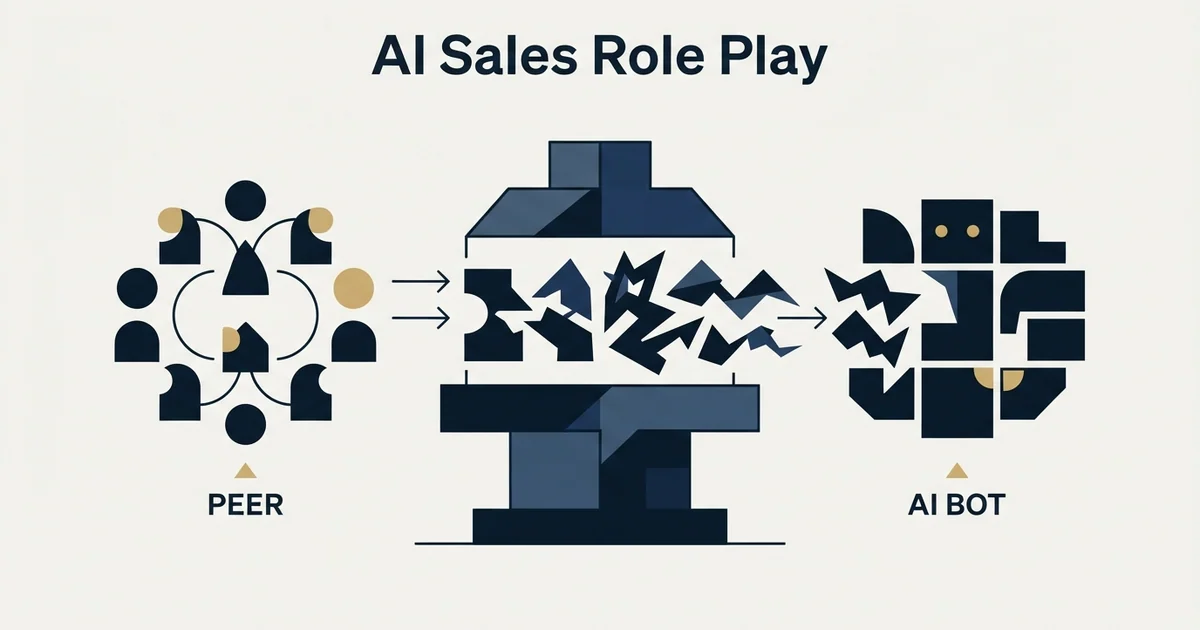
AI sales role play generates a simulated buyer for a seller to practise against, with automated scoring. It rehearses the production of language under pressure, which reading cannot do, and it cannot rehearse judgement about a real person with a real history.
Key takeaways
- The value is that a bot has no social obligation to be helpful, holds a position, and is available when a manager is not.
- Scenarios built from the messaging deck train sellers against the objections the company wishes it received; scenarios built from recorded calls train against the market.
- A score can carry countable criteria such as whether a question was asked, and cannot carry whether the conversation was any good.
- Keep practice private and separate from certification, because a leaderboard stops people practising the things they are worst at.
Reviewed and updated September 1, 2026
Peer roleplay fails for a reason that has nothing to do with the exercise. Two colleagues who like each other cannot make one of them genuinely uncomfortable, and the discomfort is the training. The person playing the buyer knows what the seller is trying to do, wants them to succeed, and gives ground at the moment a real buyer would go quiet. Everybody leaves having rehearsed a conversation that does not occur.
AI roleplay exists because that failure is structural, not because simulation is inherently better than a person. A bot has no social obligation to be helpful, will hold a position for as long as the scenario says, and is available at eight in the morning when a manager is not. Those three properties are the whole value proposition, and they are worth separating from the marketing around them.
Sales training software in this category is mostly roleplay and scoring, so evaluate it on whether the simulation resembles the conversation your reps actually have.
What a simulation actually rehearses
The mechanism is narrower than the category name suggests, and knowing the boundary decides whether it works for you.
A simulation rehearses the production of language under mild pressure. A seller has to say something out loud, in real time, without a script in front of them, and hear a response that may not cooperate. That is genuinely the hard part of a first conversation, and reading a document does not rehearse it, because reading produces recognition while conversations require production.
What a simulation does not rehearse is judgement about a real person. The bot has no history with your company, no internal politics, no colleague who was burned by a similar purchase two years ago, and no reason to be evasive that you did not write into the scenario. Practising against it builds fluency and does not build read.
- Saying the opening out loud without reading it
- Holding a structure when the answer arrives out of order
- Asking an uncomfortable question in a neutral tone
- Recovering after an interruption
- Repetition at a volume no manager can supply
- Reading hesitation that means something other than disagreement
- Deciding this account is not worth pursuing
- Navigating a person with an internal reason to block
- Choosing when to abandon the plan entirely
- Anything requiring knowledge of a real relationship
The scenario is the product
The single largest determinant of whether roleplay training works is where the scenarios came from, and it gets the least attention in most evaluations.
Scenarios built from the messaging deck produce a buyer who raises the objections the company has prepared answers for. Reps practise against those, get good at them, and meet a real market that objects to something else entirely. The exercise has trained confidence without transferring anything.
Deciding whether to trust deck-built scenarios often comes down to the messaging framework behind them, and the methodology that ties messaging to pricing power explains what that framework is actually optimizing for.
Scenarios built from recorded real conversations produce a buyer who behaves like your buyers. That is harder to author, requires call recordings you are allowed to use, and is the difference between the format working and the format producing a nice completion rate.
Practical test for any vendor: ask whether a scenario can be authored from a transcript of one of your own calls, and how long that takes. Some products in the category advertise self-authoring from approved content in days. Whether that means days of your effort or days of theirs is worth pinning down before signing.
Scoring, and what a score can honestly carry

Every product in this space scores the attempt, and the scores are more useful for some things than others.
A score can reliably carry the mechanical criteria: whether a defined question was asked, whether a named framework element was covered, whether the seller talked for eighty percent of the call, whether the opening ran over the intended length. These are countable and a machine counts them better than a busy manager does.
A score cannot carry whether the conversation was any good. Rapport, timing and the decision to abandon a prepared line because something more interesting appeared are not visible to a transcript scorer, and a rubric that pretends otherwise will reward the rep who hits every box in a conversation a human would have found stilted.
The practical consequence is about what you certify on. Certifying on a machine score alone produces sellers optimised for the rubric. The version that works uses the score to decide who needs a human review, and keeps the human review as the thing that passes or fails somebody.
Where it fits in a training programme
- Step 1Content
What we sell, to whom, and why it matters. Reading and instruction, which produce recognition
- Step 2Simulated practice
Production under mild pressure, repeated as many times as the seller needs, with mechanical scoring
- Step 3Human review
A manager reads or watches one attempt and passes judgement on the parts a rubric cannot see
- Step 4Real conversations
Where the judgement half is actually learned, now that the mechanical half is not consuming attention
- Step 5Review of real calls
Coaching from what buyers actually said, which is also where next quarter's scenarios come from
The loop at the end is the part most programmes leave open. Scenarios written once at rollout decay as the market and the product move, and the cheapest source of current ones is the recordings of conversations that happened last month. A programme that closes that loop stays accurate; one that does not is training against a snapshot of a market that has moved.
The cases where it clearly earns its cost

Three situations make the arithmetic obvious, and outside them it is a judgement call.
Onboarding at volume. Where several sellers start at once, manager practice time is the binding constraint and simulation removes it. This is the strongest case in the category and the one every vendor leads with, correctly.
A message change across a large team. When positioning changes, every seller has to produce new language and the rollout window is short. Practice is the only mechanism that gets new wording into someone's mouth rather than into their reading list, and why a message needs rehearsal rather than distribution is the same argument applied to objection responses.
Regulated conversations. Where what a seller may and may not say is constrained by law, simulation with compliance scoring and retained records answers a real audit requirement, which is why parts of this category specialise in life sciences and financial services.
Outside those, the honest question is whether a manager currently spends any time on practice at all. If the answer is none, buying a tool rarely creates the habit; it produces a dashboard showing that nobody has completed the exercises.
Running it so people use it
Adoption is where these programmes fail, and the failure modes are predictable.
Make it short. Three focused attempts at one moment in a conversation beat one long simulated meeting, and they fit into a day that has real calls in it.
Make somebody look. A score nobody reads is a score that changes nothing, and the fastest way to kill the habit is to require attempts that vanish into a system. A weekly ten minutes where a manager watches one attempt per rep is enough.
Make it safe. The value of the format is that a rep can be genuinely bad at something in private. Publishing a leaderboard of scores converts the practice environment into an assessment environment, and people stop practising the things they are worst at, which are the things practice was for.
And keep it distinct from certification. A tool used both for practice and for pass-fail assessment will be treated as assessment, because that is the higher-stakes use, and the practice half quietly stops happening.
Where we differ from standard practice
Much of the material in this category reflects how outbound is commonly run, and since this page sits on our site the divergence is worth naming.
Scenario libraries for prospecting usually assume a cadence, with modules for the second and third touch and rubrics that score whether the seller referenced the earlier message. We do not run that. One message per campaign, no bumps and no thread replies, and where an audience does not respond the next approach is a separate campaign with a genuinely different premise. The reasoning is mechanical: a repeat message reaches the population that already saw the first and chose not to answer, which is the population most likely to complain, and the reputation cost lands on the sending domain across everything else it sends. our write-up on why we stopped using follow-ups sets out the whole trade.
We also do not sell calling, calling training or scripts. We build and run cold email and LinkedIn outbound, so this page describes the category rather than reselling it. The conversation we do care about is the meeting at the end, which is qualified against criteria agreed in writing before launch, and running that meeting so it disqualifies well is the skill worth rehearsing whichever tool you rehearse it in. The full argument, including what it costs us, is in why we stopped using follow-ups.
The short version
AI roleplay exists because peer roleplay cannot make a colleague genuinely uncomfortable, and the discomfort is the training. It rehearses the production of language under pressure, which is the hard mechanical half of a first conversation, and it cannot rehearse judgement about a real person.
The scenarios decide everything: built from the deck, they train sellers against objections the company wishes it received; built from recorded conversations, they train against the market. Use scores for the countable criteria and keep a human review as the thing that passes somebody. Keep sessions short, make somebody watch the output, keep it private, and separate practice from certification.
It earns its cost clearly on volume onboarding, on message changes across large teams, and in regulated conversations. Where the constraint is the number of conversations rather than their quality, see what a first campaign produces.
The four clauses behind hiring agency fees explains why an agency's fee structure predicts its behavior better than its pitch when a team is scaling onboarding.
Product capabilities described in this category were verified against vendor pages as of mid-2026, with dated snapshots retained. Vendor outcome figures are self-reported and unaudited. Verify current terms with the vendor before relying on them.
Frequently asked questions.
Frequently asked questions- Does AI sales role play actually work?
- For the mechanical half of a conversation, yes. It rehearses saying something out loud in real time without a script and hearing a response that may not cooperate, which reading cannot do. It does not build judgement about a real person, because the simulated buyer has no history, no internal politics and no reason to be evasive you did not write in.
- What makes a good roleplay scenario?
- That it came from a recorded real conversation rather than from the messaging deck. Deck-derived scenarios produce a buyer who raises the objections the company already has answers for, so reps get good at those and meet a market that objects to something else. Ask any vendor how a scenario is authored from your own transcript.
- Should we certify sellers on the simulation score?
- Not on the score alone. A rubric rewards the rep who hits every box in a conversation a human would have found stilted. Use the score to decide who needs a human review, and keep the human review as the thing that passes or fails somebody.
- When is it clearly worth the cost?
- Onboarding several sellers at once, where manager practice time is the binding constraint. Rolling a message change across a large team in a short window, where practice is the only mechanism that gets new wording into someone mouth. And regulated conversations, where compliance scoring and retained records answer a real audit requirement.
About the author.

Ben Carden is CRO at RevenueFlow, which builds and operates outbound revenue engines for B2B companies. Previously at Gartner Enterprise. Studied at London School of Economics.
Ben Carden · CRO
Connect on LinkedIn →Explore more.
Ready to scale your outreach?
We build GTM engines that book real meetings. See the receipts.
Related articles.
Sales Enablement: The Four Jobs Hiding Under One Name
Readiness, messaging, materials and process support are four different jobs with four different failure modes, usually resourced in reverse order of impact.
The Sales Onboarding Process: What a New Seller Demonstrates
Most onboarding programmes are content schedules that can be completed without anyone learning the job. The demonstration list that replaces them, and the order to teach.
Sales Kickoff Meeting: The Decisions It Has to Leave With
A kickoff is the one moment a whole sales organisation can change at once. The four decisions it has to publish, and the week-six check that tests them.
Command of the Message: Production Work, Not Sales Training
Force Management defines it as being audible-ready and able to charge a premium. The four clauses, and why deployment fails when nobody owns the words.
A Repeatable Sales Process: What Transfers
Repeatable means somebody else can run it and get a similar result. What a written process carries, what it quietly leaves behind, and how to measure it at ramp.
Cross-Sell vs Upsell: Different Trigger, Different Owner
An upsell has a trigger that arrives on its own. A cross-sell has none and needs a diagnosis somebody funds. That is the difference that decides the work.