The Complete B2B Sales Tool Stack: How 47 Tools Connect
A visual guide to the B2B sales tool ecosystem. See how email sending, data enrichment, warmup, CRM, and sales engagement tools fit together in an outbound workflow.
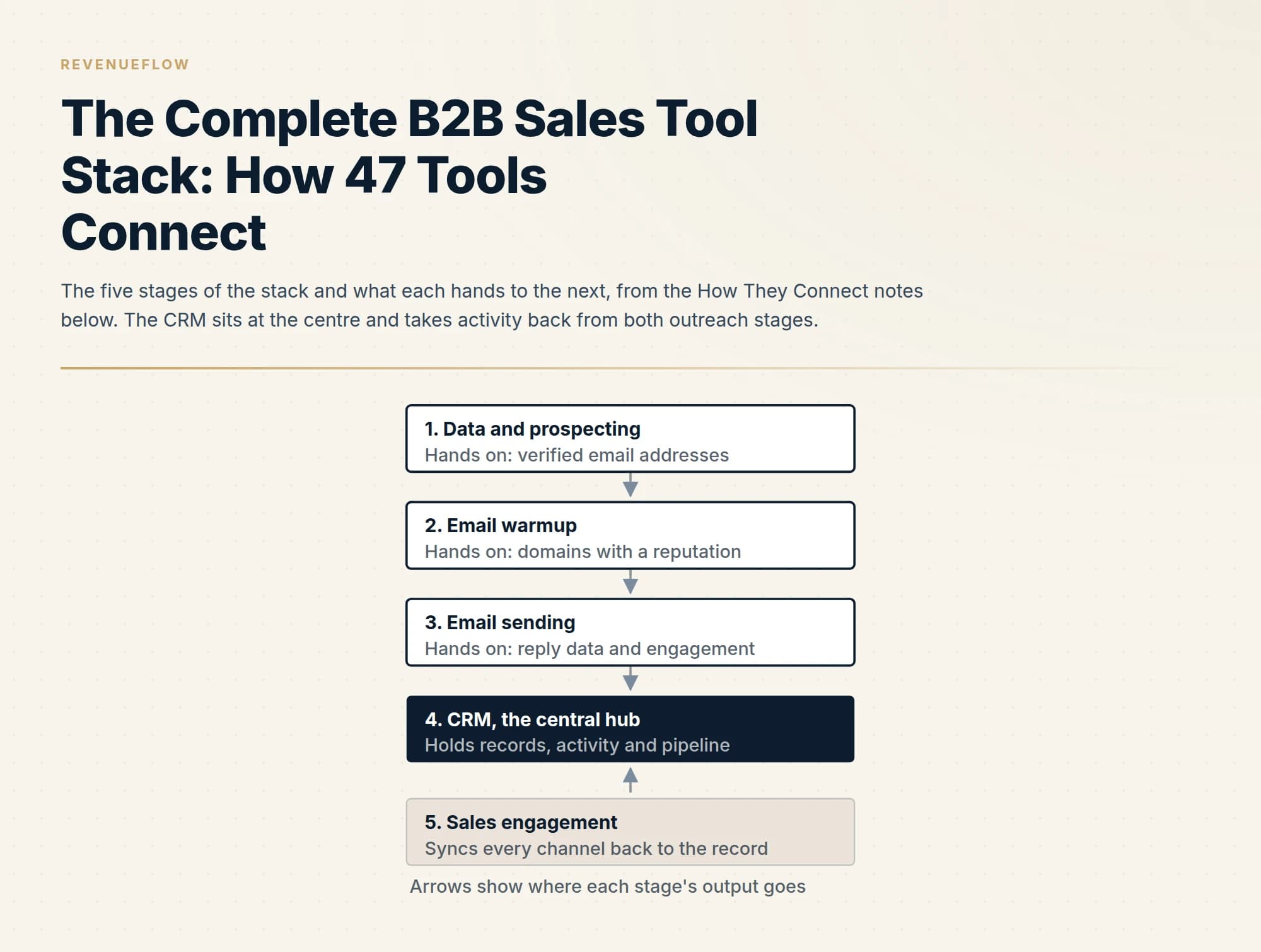
A B2B sales stack is the set of connected tools a team runs from prospect to close: data and prospecting, email warmup, campaign sending, a CRM, and sales engagement. The stack works when each stage hands the next clean data, and a starter version runs on published prices from $47 a month.
Key takeaways
- A B2B sales stack has five stages, data, warmup, sending, CRM and engagement, and the CRM is the hub every other stage writes back to.
- Every warmup, sending and CRM tool in this map publishes an entry price or a free plan; in data 11 of 15 do, and in sales engagement only Apollo.io does.
- A starter stack of Apollo.io Free, Instantly Growth with its included warmup, and HubSpot's free CRM costs $47 a month at published prices.
- At enterprise scale the data and engagement layers are quote-only, so a budget built from published pages covers the CRM and warmup lines and little else.
Reviewed and updated September 21, 2026
A B2B sales tool stack earns its keep in the connections between tools rather than in any single choice: data flows from prospecting through warmup and sending, into the CRM, and back out to every channel. This guide maps 47 tools across 5 stages of a B2B sales stack (Apollo.io appears in two of them), shows how they connect, and prices each one from its own page.
Sellers asking which sales tools for sales reps are worth a seat are asking the same question from the other end, and the answer depends on which of the five stages below is short rather than on any ranking.
What Is a B2B Sales Stack?
A B2B sales stack is the set of tools a sales team runs from finding a prospect to closing the deal, connected so data moves between them: data and prospecting, email warmup, campaign sending, a CRM, and sales engagement across channels. It works when each stage hands the next clean data, and it leaks wherever a person has to carry data across by hand.
The Sales Workflow: 5 Stages
Every outbound sales operation follows the same fundamental workflow:
- Data and Prospecting: find and verify target contacts
- Deliverability Preparation: warm email domains and infrastructure
- Campaign Execution: send personalized outreach at scale
- Pipeline Management: track deals from first touch to close
- Outreach Orchestration: coordinate across email, phone, and social
Each stage has dedicated tools, and some platforms span several stages. Every warmup, sending and CRM tool in this map publishes an entry price or a free plan on its own page; in data, 11 of the 15 do, and in sales engagement only Apollo.io does.
Stage 1: Data Enrichment (15 tools)
Data quality determines everything downstream. Bad data means bounced emails, wasted warmup capacity, and irrelevant outreach.
The Tools
| Tool | Entry price, as its page shows it | What that buys |
|---|---|---|
| Apollo.io | Free; Basic $49 a seat billed annually | Free: 900 credits per seat per year |
| ZoomInfo | Not readable here | Its pricing page refused both a plain and a rendered request |
| Clay | Free; Launch $167 a month | Free: 500 actions a month |
| Lusha | Free; Starter $37.45 a month billed yearly | Free: 40 credits a month, 1 seat |
| Clearbit | Joined HubSpot | Its homepage reads Clearbit has joined HubSpot |
| Seamless.AI | Free | 1 user, 50 credits |
| Cognism | No published price | Standard and Pro packages, priced by its team |
| Lead411 | $49 a month | Spark: 1,000 exports a month |
| UpLead | $99 a month, $74 billed annually | Essentials: 170 credits a month |
| RocketReach | Free account | 5 free lookups; larger plans start at $6K a year |
| ContactOut | Free; Email plan $49 a month billed annually | Free: 5 emails a day |
| SignalHire | Free | 5 or 10 credits |
| Datanyze | Not readable here | Its pricing page refused both a plain and a rendered request |
| Adapt.io | Free; Starter $49 a month | Free: 25 email credits |
| LeadIQ | Free | 1 user, 50 credits |
How They Connect
Data enrichment tools feed contact data into every other stage:
- To Email Sending: Verified email addresses for campaign lists
- To CRM: Enriched contact and company records
- To Sales Engagement: Prospect data for multi-channel sequences
Key Comparisons
Head-to-head comparisons in this stage: Apollo.io vs ZoomInfo, Clay vs ZoomInfo, Clay vs Lusha, Clearbit vs Lusha, Clearbit vs Seamless.AI and Cognism vs Seamless.AI.
For team-specific recommendations: Best data enrichment for SDR teams | Best data enrichment for startups
Stage 2: Email Warmup (5 tools)
Before sending campaigns, new email domains need warmup to build sender reputation. Skipping this step means landing in spam.
The Tools
| Tool | Entry price, as its page shows it | What that buys |
|---|---|---|
| Warmbox | $15 a month billed yearly, $19 monthly | Solo: 1 inbox, 50 emails a day |
| Mailreach | $19.5 per mailbox a month | Priced per mailbox warmed |
| InboxAlly | $149 a month | Starter: sends to 100 of its seed mailboxes |
| Lemwarm | $29 per email a month, $24 billed yearly | Essential plan |
| TrulyInbox | Free for 1 account; Starter $22 a month billed annually | Free: 10 warmup emails a day |
Is there a warm-up tool built for outbound at scale?
Three here price for volume rather than per inbox. TrulyInbox charges for warmup emails sent rather than accounts connected, Instantly's Growth plan includes unlimited email warmup across unlimited email accounts, and InboxAlly's Premium plan is described as building reputation for high volume senders, at $1,190 a month.
How They Connect
- From Data Enrichment: Warmup uses verified email addresses
- To Email Sending: Warmed domains are ready for campaign execution
- Some email sending platforms (like Instantly) include warmup built-in
Key Comparisons
Head-to-head comparisons in this stage: Mailreach vs Warmbox, InboxAlly vs Mailreach, InboxAlly vs Lemwarm and Lemwarm vs TrulyInbox.
For detailed guidance: Best email warmup tools for cold email teams | Best email warmup tools for agencies
Stage 3: Email Sending (15 tools)
This is where campaigns get executed. Email sending platforms manage sending, testing and reply tracking; we send one message per campaign, so the reply tracking matters more to us than the sequencing.
The Tools
| Tool | Entry price, as its page shows it | What that buys |
|---|---|---|
| Instantly | $47 a month | Growth: unlimited email accounts and warmup |
| Smartlead | $39 a month | Base: 2,000 contacts, 6,000 email sends |
| Lemlist | $69 a month, $55 billed annually | Email plan |
| Mailshake | $29 a month, $25 billed yearly | Starter plan |
| Reply.io | From $49 a user a month billed annually | Email Volume, by active contacts |
| Woodpecker | Usage-based | Priced by contacted prospects; warm-up free |
| Saleshandy | $34 a month billed annually, $41 monthly | Starter plan |
| Snov.io | Free Trial plan; Starter $39 | Trial: 50 credits, 100 recipients |
| GMass | £15 a month billed annually, £23 monthly | Standard, works inside Gmail |
| Mixmax | Free; Inbox Copilot $29 a user billed annually | Free plan at $0 |
| Klenty | $50 a month billed annually | Starter plan |
| Outplay | Free; Starter $39 a month billed annually | Free: 2,000 active prospects a month, 2 mailboxes |
| Mailmeteor | Free; Starter $5.99 a user a month | Free: 500 emails a month |
| Yesware | Free | Basic email open and attachment tracking |
| QuickMail | $49 a month | Starter plan |
How They Connect
- From Data Enrichment: Prospect lists with verified emails
- From Email Warmup: Domains with established reputation
- To CRM: Reply data and engagement signals
- To Sales Engagement: Campaign results for multi-channel follow-up
Key Comparisons
Head-to-head comparisons in this stage: Instantly vs Smartlead, Instantly vs Lemlist, Lemlist vs Smartlead and Instantly vs Mailshake.
For team-specific recommendations: Best email sending for startups | Best email sending for agencies | Best email sending for enterprise
Stage 4: CRM (8 tools)
CRMs are where every customer interaction gets tracked. They sit at the center of the sales stack, connecting to every other tool category.
The Tools
| Tool | Entry price, as its page shows it | What that buys |
|---|---|---|
| Salesforce | Free Suite $0; Starter Suite $25 | Per user a month |
| HubSpot CRM | Free | Contact management and deal pipelines |
| Pipedrive | From $14 billed annually | Lite, per Pipedrive's comparison page; its pricing page was not readable here |
| Close | $9 billed annually, $19 monthly | Solo plan |
| Copper | $29 a seat, $23 billed annually | Basic plan |
| Zoho CRM | Free | For 3 users |
| Freshsales | $9 billed annually | Growth plan |
| Monday CRM | £10 a seat | Served in pounds here |
How They Connect
CRMs are the central hub:
- From Data Enrichment: Auto-populated contact records
- From Email Sending: Activity logging and reply data
- From Sales Engagement: Multi-channel activity tracking
- To Reporting: Pipeline visibility and forecasting
Key Comparisons
Head-to-head comparisons in this stage: HubSpot CRM vs Salesforce, HubSpot CRM vs Pipedrive and Pipedrive vs Salesforce. Team-specific recommendations cover the best CRM for startups and for SDR teams.
Stage 5: Sales Engagement (5 tools)
Sales engagement platforms orchestrate outreach across multiple channels: email, phone, LinkedIn, and more.
The Tools
| Tool | Entry price, as its page shows it | What that buys |
|---|---|---|
| Outreach | No published price | Its pricing and packaging page lists no figures |
| Salesloft | No published price | Its pricing address opens Talk to Sales |
| Gong | No published price | Licences priced per user, plus a platform fee |
| Groove | Now part of Salesloft | The Groove page serves Salesloft's site, with Groove as a login |
| Apollo.io | Free; Basic $49 a seat billed annually | Free: 900 credits per seat per year |
How They Connect
- From Data Enrichment: Contact data and intent signals
- From Email Sending: Campaign data for sequence triggers
- To CRM: All engagement activity synced to contact records
Key Comparisons
Head-to-head comparisons in this stage: Outreach vs Salesloft and Gong vs Salesloft. Team-specific recommendations cover sales engagement for SDR teams and for enterprise.
Sample Tool Stacks by Budget
The Starter stack uses published prices as they stand. The Growth and Enterprise stacks are illustrative arithmetic at an invented team size, and quote-only tools are named rather than priced.
Starter
- Apollo.io Free: $0
- Warmup included in Instantly Growth: $0
- Instantly Growth: $47
- HubSpot CRM Free: $0
$47 a month
Growth, three SDRs
- Apollo.io Basic, 3 × $49: $147
- Warmbox Start-up, 3 inboxes: $69
- Smartlead Base: $39
- HubSpot Starter, 3 × $15: $45
$300 a month, illustrative
Enterprise, ten users
- Salesforce Core, 10 × $195: $1,950
- InboxAlly Plus: $645
- ZoomInfo or Cognism: quote only
- Outreach or Salesloft: quote only
$2,595 a month before the quoted tools, illustrative
Starter Stack
For solopreneurs and small teams just getting started:
| Stage | Recommended Tool | Monthly Cost |
|---|---|---|
| Data | Apollo.io (free tier) | $0 |
| Warmup | Included with Instantly | $0 |
| Email Sending | Instantly (Growth) | $47/mo |
| CRM | HubSpot CRM (free) | $0 |
| Total | $47/mo |
Growth Stack
For an invented team of three SDRs scaling outbound: Apollo.io Basic at 3 × $49 is $147 a month billed annually, Warmbox Start-up is $69 a month billed yearly for 3 inboxes, Smartlead Base is $39, and HubSpot's Starter CRM seats at 3 × $15 are $45, for $300 a month. Swap Apollo.io for Lusha Starter at $37.45 a month billed yearly, or Smartlead for Instantly Growth at $47, and the total moves by less than the cost of one seat.
Enterprise Stack
For an invented ten-user organisation: Salesforce Core at 10 × $195 is $1,950 a month, and InboxAlly Plus is $645, so the published lines alone come to $2,595 a month. The data and engagement layers at this size are quote-only: ZoomInfo's pricing page was not readable here, Cognism's pricing page sends buyers to its team for pricing, and Outreach, Salesloft and Gong price through their sales teams.
Integration Map: What Connects to What
The integration paths this map relies on:
- Apollo.io to HubSpot CRM: contact enrichment to pipeline tracking
- Instantly to HubSpot or Pipedrive: campaign data to CRM
- ZoomInfo to Salesforce: enterprise data to enterprise CRM
- Warmbox to any email provider: deliverability preparation
- Outreach or Salesloft to Salesforce: full engagement to pipeline sync
How to Build Your Stack

- Start with your CRM. Everything else connects to it. Pick this first.
- Add email sending. This is where revenue-generating activity happens.
- Layer in data enrichment. Better data means better targeting.
- Include warmup. Protect your deliverability from day one.
- Consider sales engagement last. Only add if you are doing true multi-channel outreach.
Explore All 47 Tools
Browse every tool comparison in our complete comparison library. With 47 tools across 5 categories, you can find the exact comparison you need.
If you would rather have this run for you, RevenueFlow books qualified meetings on a pay-per-meeting basis and publishes client results.
Pricing and features are taken from the vendors' own pages. Verify current terms with the vendor before relying on them.
Frequently asked questions.
Frequently asked questions- What is a B2B sales stack?
- It is the set of tools a B2B sales team runs from finding a prospect to closing the deal, connected so data moves between them. The five stages are data and prospecting, email warmup, campaign sending, a CRM, and sales engagement across channels. The CRM sits at the centre, and every other stage writes its activity back to it.
- What does a starter B2B sales stack cost?
- At published prices, $47 a month: Apollo.io's free plan for data, Instantly's Growth plan at $47 for sending with unlimited email warmup included, and HubSpot's free CRM. An illustrative three-SDR stack with Apollo.io Basic, Warmbox, Smartlead and HubSpot Starter seats comes to about $300 a month.
- Is there a warm-up tool built for outbound at scale?
- Three in this map price for volume rather than per inbox. TrulyInbox charges for warmup emails sent rather than accounts connected, Instantly's Growth plan includes unlimited email warmup across unlimited email accounts, and InboxAlly's Premium plan, at $1,190 a month, is described as building reputation for high volume senders.
- Which tools in a B2B sales stack do not publish prices?
- In this map, Cognism's pricing page sends buyers to its team for pricing, Outreach and Salesloft send buyers to their sales teams, and Gong prices licences per user plus a platform fee through a proposal. ZoomInfo's and Datanyze's pricing pages could not be read, and Clearbit now reads as part of HubSpot.
About the author.

Ben Carden is CRO at RevenueFlow, which builds and operates outbound revenue engines for B2B companies. Previously at Gartner Enterprise. Studied at London School of Economics.
Ben Carden · CRO
Connect on LinkedIn →Explore more.
Ready to scale your outreach?
We build GTM engines that book real meetings. See the receipts.
Related articles.
The ROI of Cold Email: Revenue Per Dollar Spent by Industry
Cold email delivers 36-44x ROI on average. This analysis breaks down revenue per dollar spent across 10 industries, with cost models and ROI calculators for different team sizes.
Cold Email Pricing Guide 2026: What Every Tool Costs
Side-by-side pricing for all 48 B2B sales tools. Total cost of ownership calculations by team size and budget recommendations by company stage.
Cross-Sell vs Upsell: Different Trigger, Different Owner
An upsell has a trigger that arrives on its own. A cross-sell has none and needs a diagnosis somebody funds. That is the difference that decides the work.
Monthly Sales Meeting Agenda: What the Month Decides
The weekly meeting triages deals in flight. The monthly one closes a period and changes the list. Six blocks, ninety minutes, one output each.
Sales Activity Tracking: What the Record Has to Say
Most activity tracking fails at capture rather than analysis. The unit you count decides what every later number can mean, and no tool fixes a wrong choice.
Sales Call Planning: The Plan a Booked Call Needs
A call cannot produce a commitment nobody named in advance. The four fields a call plan carries, and why the ask has to be decided before the meeting opens.