Monthly Sales Meeting Agenda: What the Month Decides
The weekly meeting triages deals in flight. The monthly one closes a period and changes the list. Six blocks, ninety minutes, one output each.
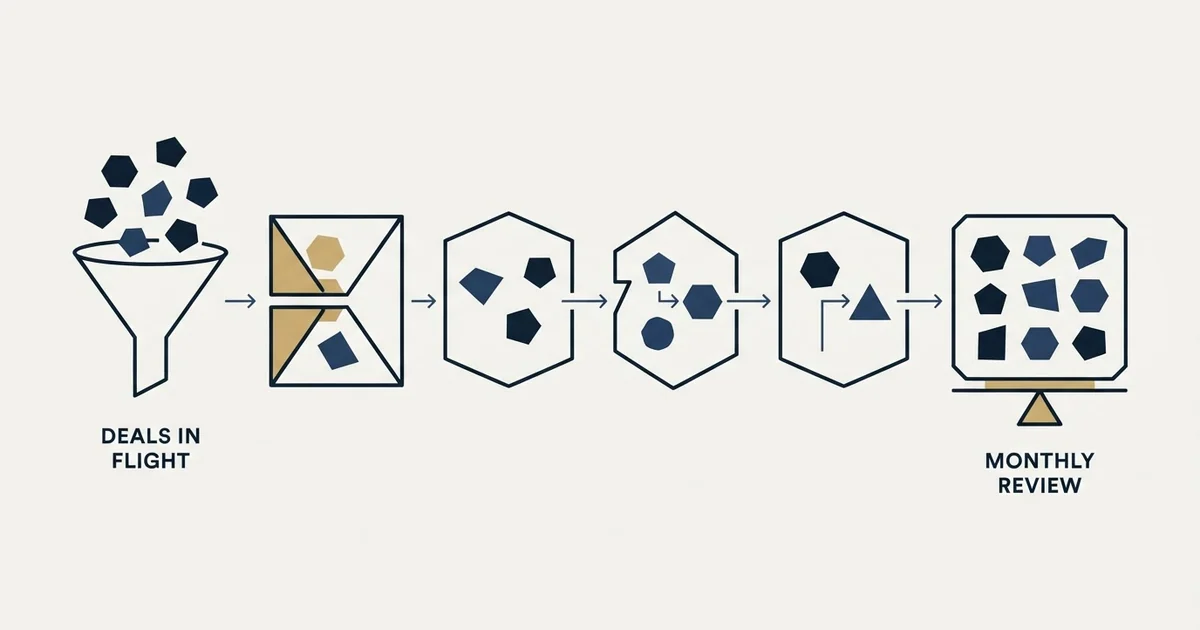
A monthly sales meeting closes a period and re-aims the motion, which weekly triage cannot do. Six blocks in ninety minutes: attainment against pace, created value against the volume the target requires, segment and source performance, one change to the list and one to the offer, coaching themes, and written decisions.
Key takeaways
- A weekly review moves deals already in flight, and a monthly review changes the list, the offer and the coverage model, which the committed week cannot.
- Attainment against pace rather than against target is what says whether the number is still reachable, and it turns a push into a forecast correction.
- Created value read against the volume the funnel arithmetic requires explains the month after next, which is the number no weekly triage meeting can supply.
- The pre-read goes out two working days ahead as numbers, and the meeting starts from them rather than establishing them.
Reviewed and updated September 2, 2026
A monthly sales meeting that runs as the weekly one with a longer deck is a recognisable shape. Same room, the same pipeline list read aloud, one extra slide carrying a month-to-date number, and ninety minutes instead of sixty. Nothing gets decided that the weekly meeting could not have decided, and the extra half hour is spent confirming figures everyone already read.
A month is a unit of account rather than a unit of triage. The weekly meeting exists to move the deals that can still be moved this week. The monthly meeting exists to close a period, read what the period says about the motion that produced it, and change something before the next one starts. Those are different questions, and running both on one agenda produces a meeting that answers the smaller one at length.
The agenda below is the monthly half. It assumes a weekly pipeline review already exists and runs on six blocks with six required outputs. The version for a team with no weekly review is at the end.
What the month owns
Three decisions belong to the month and to nothing shorter.
Whether the period is still recoverable. Weekly coverage says where attention goes this week. Monthly attainment against pace says whether the number is reachable at the rate the team is converting now, which is a different arithmetic and a different response. A team sitting well short of target early in the period is fine. The same team sitting equally short with a week left has a decision to make, and the decision is not effort.
Whether enough entered. Open pipeline value moves slowly, because deals leaving and deals arriving cancel each other out for most of a cycle. Created value does not. A month is the shortest window in which created value against the volume the target actually requires is worth reading, and it is the first number to fall when something upstream has broken.
What changes next month. The weekly meeting cannot change the list, the offer or the coverage model, because the week is already committed. The month can. That block is the one an agenda inherited from the weekly meeting has no room for, and it is the only one that makes the extra half hour worth spending.
- Reads coverage, ageing and what entered this week
- Decides which few accounts get attention now
- Output is a named account, an owner and a next step
- Changes nothing about the list or the offer
- Runs sixty minutes with the whole team
- Reads attainment against pace and created against required
- Decides whether the number is still reachable and what to change
- Output is a written change with an owner and a start date
- Can move the segment, the offer and the coverage model
- Runs ninety minutes, with a circulated pre-read
The agenda
Ninety minutes, six blocks, one question and one required output each. The numbers arrive two working days before the meeting and nobody reads them aloud in it.
MONTHLY SALES REVIEW                 Month: ........   Owner: ........
Pre-read circulated: ........ (two working days before, numbers only)

MIN  BLOCK                  THE ONLY QUESTION            OUTPUT REQUIRED
--------------------------------------------------------------------------------
15   The month that closed  Was the number reachable at  "On pace" or a named
                            the rate we actually convert  gap with a cause
15   Created against        Did enough new value enter    A created figure and
     required               to support next month         the volume it implies
15   Where it came from     Which segments and sources    A ranked list, and one
                            produced deals that survived  segment to stop
20   What changes next      What are we doing differently One change to the list,
     month                  and who starts it when        one to the offer, dated
15   Coaching themes        What did the lost deals have  Two themes, taken to
                            in common, not who lost them  one-to-ones by name
10   Decisions and owners   What did we just decide       Written before anyone
                                                          leaves the room
--------------------------------------------------------------------------------
CARRIED FORWARD FROM LAST MONTH: ........ (read first, closed or re-committed)
The carried-forward line does the same work here as in the weekly agenda and does it harder, because a month is long enough for everybody to have forgotten the commitment. Reading last month's two changes aloud before anything new is discussed is the difference between a review that accumulates decisions and one that re-makes them.
- Step 1Close the month
Attainment against pace, so everyone is arguing about the same figure
- Step 2Read what entered
Created value against the volume the target requires, which is the leading half
- Step 3Locate it
Segment and source, so the change has somewhere to land
- Step 4Decide the change
One change to the list, one to the offer, both with a start date
- Step 5Name the themes
Patterns across lost deals, carried into one-to-ones rather than settled here
- Step 6Write it down
Decisions, owners and dates recorded before the room empties
What each block is actually reading

The month that closed. Attainment against pace rather than against target. A target is a destination and pace is a rate, and only the rate tells you whether the destination is still available. Read it beside win rate, because a team short on attainment with a stable win rate has a volume problem and a team short on attainment with a falling win rate has a different one entirely. The six pipeline metrics and the companion each one needs covers which figure to hold beside which.
Created against required. The required figure is not a target set by ambition. It is the arithmetic the sales funnel template works backwards: closed-won target, then the proposals, qualified deals, meetings and contacted volume each stage rate implies. Once that chain exists, created value has a denominator, and the monthly question becomes whether the month put in enough to supply the month after next.
Where it came from. Segment and source, ranked by deals that survived qualification rather than by meetings booked. A source producing volume that dies at the first stage is worse than a source producing nothing, because it consumes selling time and flatters the count. The output of this block is a ranked list and one segment to stop, and the second half is what makes it a decision.
What changes next month. This is the block the meeting exists for. One change to the list, one change to the offer, each with an owner and a start date. Reaching an audience again means a new campaign with a new angle rather than another message under the one they passed over, so a change to the offer is a real decision with a real cost, and deciding it once a month is the right cadence for it. Holding both changes to one each is deliberate: two changes launched together cannot be read apart afterwards.
Coaching themes. Patterns across the deals, named without naming the seller. A month usually produces two: a stage where deals consistently stall, and an objection nobody has a good answer to. Both belong in one-to-ones afterwards. Coaching a specific call in front of the team is the fastest way to stop people bringing real problems to the meeting.
Decisions and owners. Ten minutes, written into whatever the team already reads, before the room empties. A decision that leaves the meeting only in people's memory is a suggestion with a nice tone.
The pre-read, and why it is not a slide deck
Every figure the meeting depends on goes out two working days before it, as numbers rather than as narration. Attainment and pace. Created value and the required figure beside it. Stage conversion and median cycle length. Deals lost, with their stage and reason code. Segment and source, ranked.
Two working days is the interval that works. A pre-read sent the night before gets skimmed in the first ten minutes of the meeting, which is the reporting exercise the pre-read exists to remove. A pre-read sent a week before is stale by the meeting.
The figures have to be readable, which is a pipeline design question rather than a meeting one. A reason code drawn from a fixed list can be counted. Free text cannot. A stage with an exit criterion someone else could check produces a conversion rate that means something, and a stage without one produces a number that moves when opinion moves. That groundwork sits in the six stages that earn their place, and a monthly review built on stages that mean different things to different sellers spends its ninety minutes translating.
A worked month, invented throughout

Every figure in this section is invented to show the shape of the arithmetic. None of it is measured, and none of it describes a real team.
Take an invented team of six sellers with a target of twelve closed-won deals in the month, sitting at five with a week to go. Attainment against target reads forty-two percent, which sounds like a bad month. Attainment against pace is the useful version: at five deals with one week of four left, the run rate implies about seven, so the gap is five deals rather than seven, and no amount of activity in the last week closes five deals in a motion whose median cycle is longer than a week. That reframes the block from a push to a forecast correction, which is the honest output.
The created number is where the same invented month gets interesting. Suppose the funnel arithmetic says twelve closed-won deals a month requires roughly thirty-six qualified opportunities entering, and the month produced nineteen. The month that just missed was not the problem. The month after next is, because the deals that would have closed in it were never created, and nothing decided in a weekly triage meeting can put them there.
That is the whole argument for the monthly cadence. The number that explains a bad month was set two months earlier, and the number that explains the bad month two months from now is on the pre-read in front of the room right now.
Monthly item or weekly item
- Yes: Attainment against pace, with the forecast correction that follows
- Yes: Created value against the volume the target requires
- Yes: Segment and source performance, ranked by deals that survived qualification
- Yes: One change to the list and one to the offer, each with a start date
- Yes: Themes across lost deals, carried into one-to-ones by name
- No: Individual deals narrated one rep at a time
- No: Next steps on deals that a weekly meeting already owns
- No: Wins, announcements and product news
Two variants
The month that is also a quarter end. Add one block and lengthen nothing else. The quarter closes the commit, so the extra fifteen minutes go on the number being committed for the next quarter and the assumption it rests on, which is usually a conversion rate the last three months have already disagreed with. Keep it separate from the monthly blocks rather than merging it, because a quarterly commit discussion absorbs any meeting it is allowed into.
No weekly review at all. Small teams often run one meeting a month and nothing else, and the honest version of that is two meetings on one day rather than one long agenda. Run the six blocks above, take a break, then run the weekly pipeline review as its own session on the deals that need a decision this fortnight. Merging them produces the failure this page opened on, in the other direction: the deal narration expands until the change block is five minutes at the end and nothing changes.
The annual version of all of this is a different object again, and what a kickoff has to publish rather than discuss is in the sales kickoff meeting.
The short version
A monthly sales meeting is a period being closed and a motion being re-aimed. Six blocks in ninety minutes: the month that closed read as attainment against pace, created value against the volume the target requires, where the deals came from ranked by what survived qualification, one change to the list and one to the offer with owners and start dates, two coaching themes taken to one-to-ones, and ten minutes writing the decisions down.
Numbers go out two working days ahead as numbers, and nobody reads them aloud. Last month's committed changes are read back before anything new is opened. Individual deal narration, next steps and announcements stay in the weekly meeting or in writing, because the month is the only meeting that can change the list and the offer, and that block is the one the deal narration eats.
The hardest block to run is created against required, because it needs a top-of-funnel number that has to exist in writing before the meeting can read anything against it. When the honest answer is that too few conversations are reaching the team for any agenda to matter, see what a campaign against your own market produces and read the replies.
Frequently asked questions.
Frequently asked questions- How is a monthly sales meeting different from a weekly one?
- The weekly meeting triages deals that can still move this week, so its output is a named account, an owner and a next step. The monthly meeting closes a period and decides what changes, so its output is a written change to the list or the offer with a start date. Running both on one agenda means the deal narration eats the change block.
- How long should a monthly sales meeting be?
- Ninety minutes, split across six blocks with a circulated pre-read. Anything longer usually means the figures are being established in the room rather than beforehand, and anything shorter tends to drop the block that decides what changes next month. A month that is also a quarter end takes one extra block for the commit.
- What should go in a monthly sales meeting agenda?
- Attainment against pace, created value against the volume the target requires, segment and source performance ranked by deals that survived qualification, one change to the list and one to the offer with owners and dates, two coaching themes for one-to-ones, and ten minutes writing the decisions down before anyone leaves.
- Who should attend the monthly sales review?
- Everyone the changes will land on, which is usually the sellers plus whoever owns the list and the messaging. Deal inspection needs only a manager and one rep, so it belongs in a separate session. Keep coaching on individual calls out of the room, because it stops people bringing real problems to a meeting their peers are in.
About the author.

Ben Carden is CRO at RevenueFlow, which builds and operates outbound revenue engines for B2B companies. Previously at Gartner Enterprise. Studied at London School of Economics.
Ben Carden · CRO
Connect on LinkedIn →Explore more.
Ready to scale your outreach?
We build GTM engines that book real meetings. See the receipts.
Related articles.
The Five-Step Sales Process: What You Stop Checking
Cutting a process to five steps is a decision about which checks you drop. Which deals the short version fits, and the two loss patterns that say it does not.
Sales Kickoff Meeting: The Decisions It Has to Leave With
A kickoff is the one moment a whole sales organisation can change at once. The four decisions it has to publish, and the week-six check that tests them.
Sales Call Planning: The Plan a Booked Call Needs
A call cannot produce a commitment nobody named in advance. The four fields a call plan carries, and why the ask has to be decided before the meeting opens.
The Seven-Step Sales Process: What Each Step Assumes
Prospecting through follow-up, walked one box at a time. Each of the seven steps carries an assumption about the buyer, and most of them have quietly stopped holding.
Solution Selling: The Generic Term and the Licensed Method
One name covers a generic problem-led posture and a specific licensed methodology. The lineage, the three moves that matter, and the assumption that aged badly.
The Customer-Centric Sales Process: The Edit That Matters
Renaming the pitch achieves nothing. Writing every step as buyer evidence changes the forecast within a quarter, and three other things nobody warns you about.