The Five-Step Sales Process: What You Stop Checking
Cutting a process to five steps is a decision about which checks you drop. Which deals the short version fits, and the two loss patterns that say it does not.
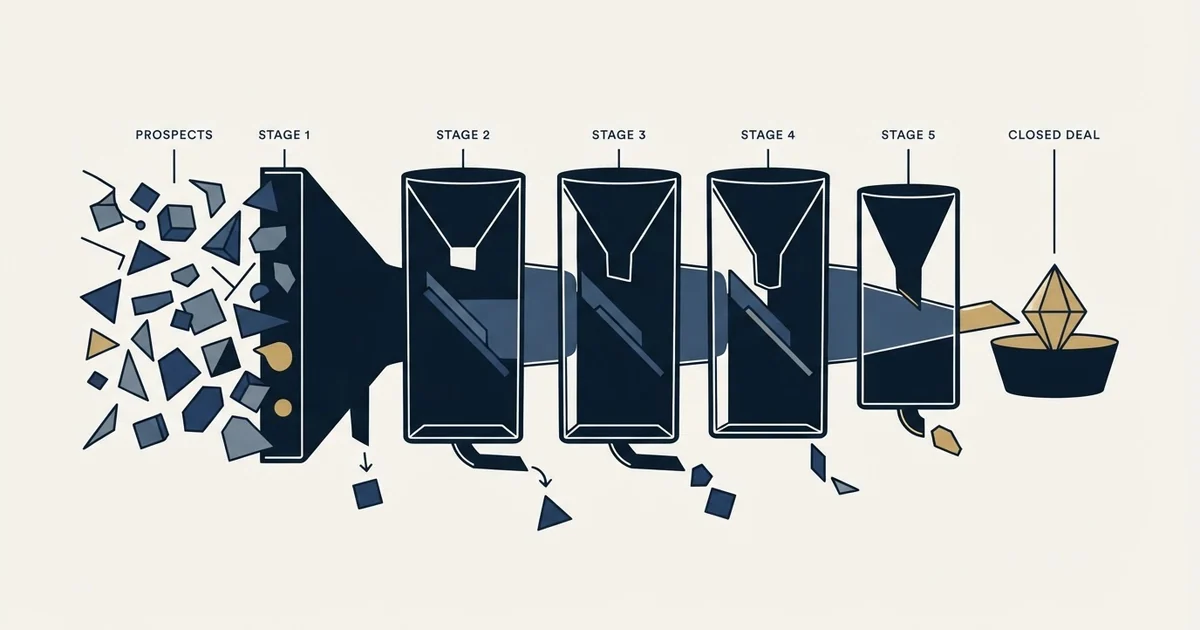
A five-step sales process runs from approach through discovery, solution, close and completion. The compression assumes one person can decide, the cycle is short and somebody upstream already filtered the list, so it fits transactional deals and hides missing checks on committee purchases.
Key takeaways
- The five-step version starts at contact, so finding the buyer and deciding they are worth a meeting sit outside the process and arrive as whatever quality of input somebody else supplies.
- Each merge is a bet: that qualification can happen inside discovery, that one conversation stands in for a committee, and that the commercial close and the paperwork are one act.
- Two loss patterns say the bet failed. Deals dying after the proposal point at a discovery box carrying too much, and deals stalling after a verbal yes point at an unmapped paper process.
- If you do compress, give every deleted check a new home in an entry criterion or a field, and attach a duration to each surviving box so a wider step cannot hide a stalled deal.
Reviewed and updated September 2, 2026
Somebody looking at a bloated eleven-stage pipeline usually reaches for the same fix, which is to cut the process down to five steps and start again. It is a good instinct and it works often enough to be worth taking seriously. What gets lost in the cutting is that a five-step process is not the long version with the boring parts removed. It is a set of decisions about which checks you are willing to stop making, and those decisions are only safe for some kinds of deal.
What the five-step version actually contains
Lucidchart's blog holds the top organic position for this query, and its page is the clearest statement of the common version. It calls the five-step process "a simple, linear approach to selling" and names the stages as Approach the client, Discover client needs, Provide a solution, Close the sale, and Complete the sale and follow up.
Read that list beside the longer template and the interesting thing is not what got merged. It is what disappeared.
- Approach the client
- Discover client needs
- Provide a solution
- Close the sale
- Complete the sale and follow up
- Prospecting: finding who is worth contacting at all
- Preparation: deciding what about this account changes the conversation
- Objection handling as its own named box
- The separation of the commercial close from the administrative one
The shape gives away where the short version came from. It describes a seller who has been handed somebody to call, opens with a handshake or an introduction, works through the need, presents, closes and then completes the paperwork, which is field selling and retail selling rather than a considered purchase decided by several people over months. That origin is not a criticism. It explains which parts of the frame are load-bearing and which were never designed to carry a committee.
The process begins at contact. Finding the buyer and deciding they are worth the meeting sits outside the frame entirely, which is defensible for a seller who is handed a list and indefensible as a description of how the revenue actually gets made. Any team using a five-step process needs to know where the first box gets its input, because the quality of that input decides most of the outcome before step one runs.
The compression is a bet about the buyer
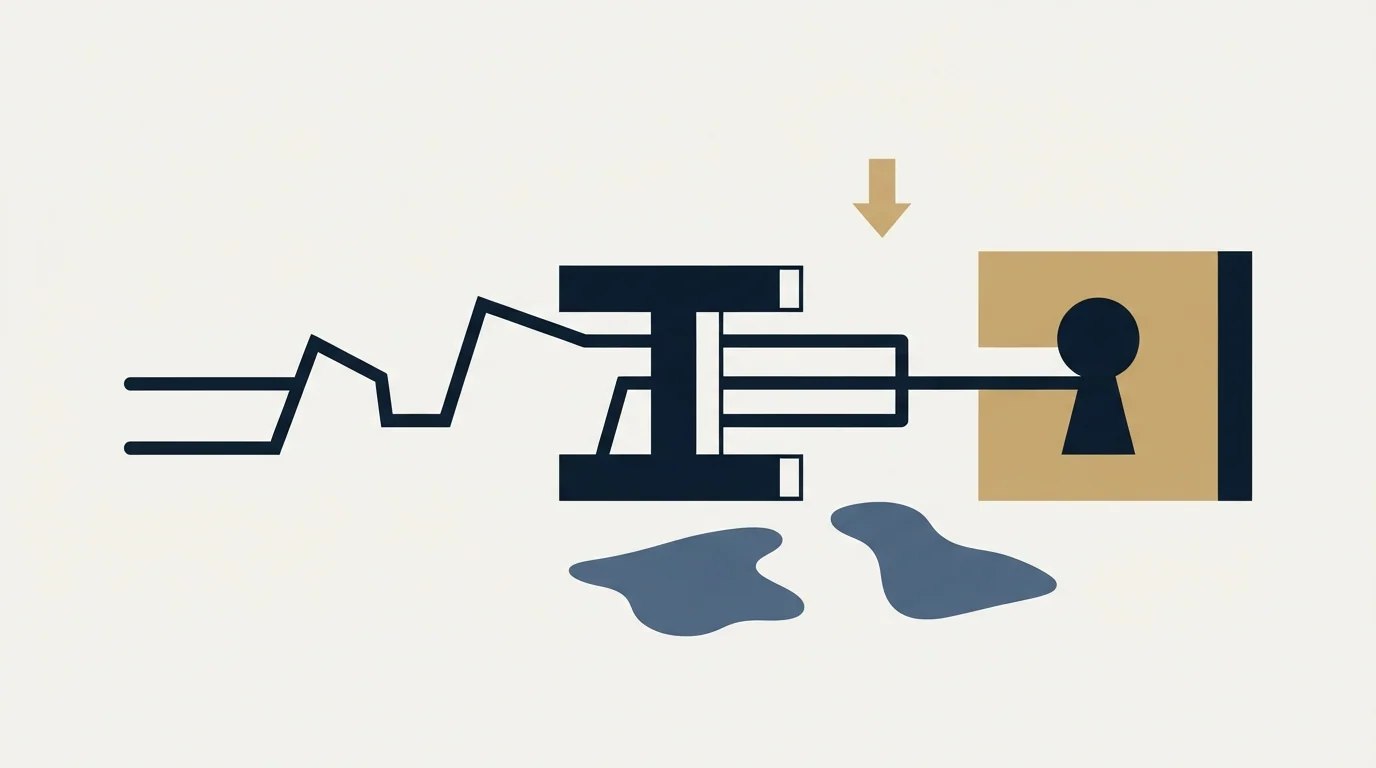
Each merge in the short version assumes something specific about the purchase. When those assumptions hold, five steps is faster to run and easier to keep honest than seven. When they do not, the missing checks show up as deals that die late for reasons that were knowable early.
Discovery and qualification merged. The five-step version asks the seller to discover client needs and to decide the client is real inside the same conversation. That works where the population was pre-filtered upstream. Where it was not, the process has no box whose job is to say no, and a process with no disqualifying step accumulates deals rather than progressing them. Lead qualification is the separate instrument that does that job.
One conversation stands in for the buying committee. The short version describes a seller and a client, singular. A purchase requiring four people to agree moves at the speed of the slowest calendar, and the people who were not in the room shape the criteria anyway. The buying committee is the term for what the compression assumes away.
The commercial close and the administrative one are treated as one act. Merging them hides the paperwork route: security review, procurement, legal redlines, signature routing. That route is knowable in week two by asking, and invisible to a process whose last two boxes are closing and completion.
Objections become part of the conversation rather than a stage. This particular merge is an improvement. Objections do not arrive at a predictable point, and giving them a box teaches sellers to expect them there.
The last box carries the handover as well as the paperwork. "Complete the sale and follow up" is doing two jobs that separate cleanly in a considered purchase: getting the agreement signed, and getting the customer to the point where the thing they bought is working. In a transactional motion those genuinely are one act. Where implementation involves other people at the buyer, folding them together means nobody owns the moment the account stops being a deal and starts being a customer, and the first renewal conversation is where that omission surfaces.
When five steps is the right shape
The fit test is about the purchase rather than about the team's preference for simplicity.
- Yes: One person can approve the spend without a committee
- Yes: The median deal closes inside a quarter
- Yes: There is no security, procurement or legal review on the path
- Yes: Somebody upstream already filtered who gets contacted
- No: The buyer is replacing something embedded, with migration risk
- No: Deals routinely die after the proposal for reasons nobody saw coming
- No: Your losses cluster at the paperwork rather than at the decision
The last two items are the diagnostic ones, and both are answerable from records you already have. A cluster of late deaths after a proposal usually means the discovery box absorbed a check it cannot carry, since nobody established what the problem costs and the price therefore had nothing to be measured against. A cluster of deals stuck after a verbal agreement means the completion box is hiding a procurement process.
Even so, no software layer can substitute for the missing check itself, and what optimization tools can and cannot fix explains why incomplete discovery stays a process problem.
Three properties of the purchase explain most of the variation here, and none of them is how good the seller is: how many people must agree, whether the money crosses an approval threshold, and what breaks if the buyer switches. Sales cycle covers how those three set the length, and the length is what decides whether five boxes can carry a deal.
Cutting to five without losing the checks
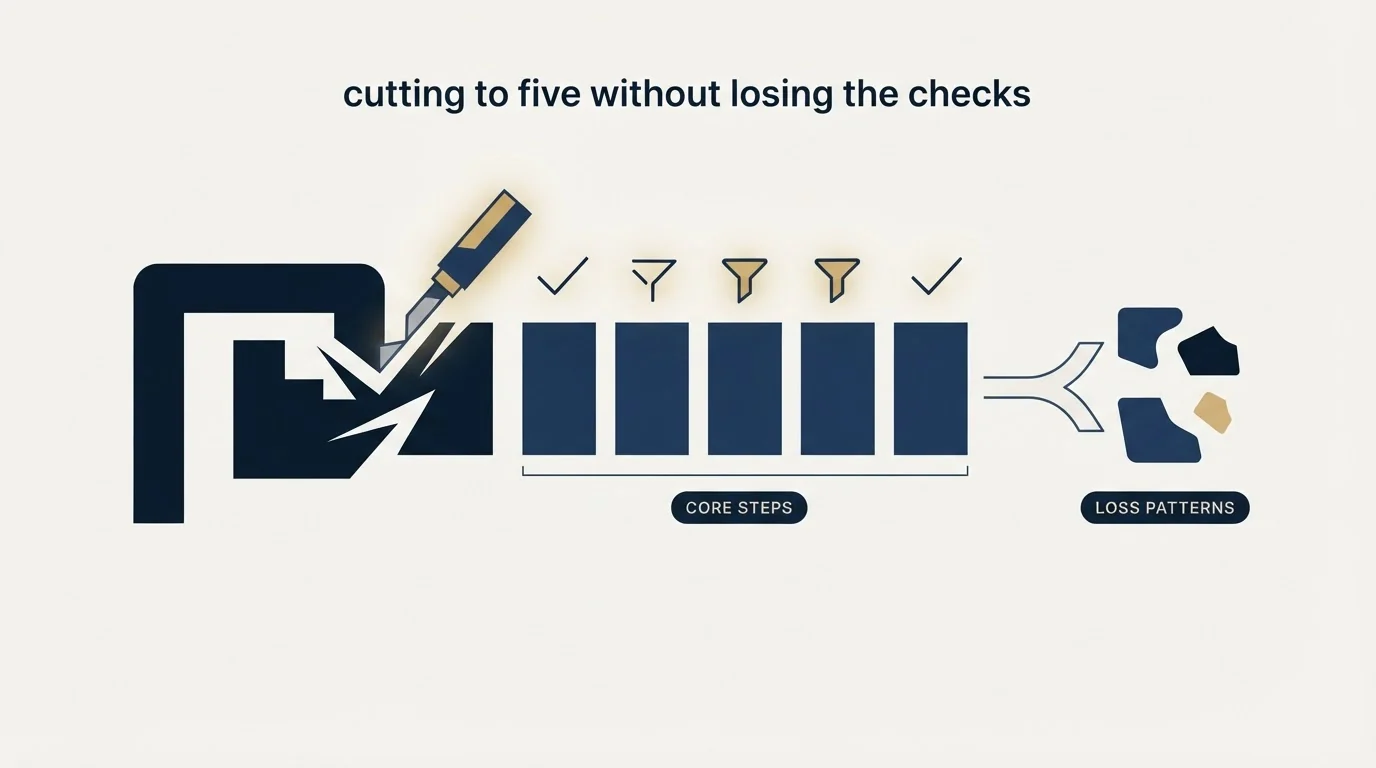
Teams that compress successfully tend to do the same three things, and none of them is a naming exercise.
Move the deleted checks somewhere they still happen. A check that leaves the process should land in a field, an entry criterion or an upstream filter, rather than evaporating. Qualification that no longer has its own box has to become the acceptance test at the front, applied against criteria written down before anyone was contacted.
A dropped check can also land in a periodic review, and what a monthly meeting closes and changes separates that cadence from the weekly deal triage.
Write each of the five as something the buyer did. "Provide a solution" is seller activity and is always achievable. "They confirmed the solution addresses the problem they described" requires the other party, which means it can be wrong about a deal, which is the property that makes a step useful. Pipeline stages that earn their place works through the same translation for the CRM stages the process feeds.
Give each box a typical duration from your own closed deals. With five boxes covering the same ground seven used to, each one is wider, so a deal can sit inside one for a long time without appearing stuck. Duration is what makes a stall announce itself.
Teams that still can't tell which box is stalling deals will find a measurement-first optimisation approach that starts with conversion, time in step and loss reason before anything gets deleted.
The discovery box deserves particular attention when it is carrying the weight of two. Its exit test is a knowledge test rather than an activity count: you can state what they do today, what it costs them, who else has a say, and what happens if they do nothing. Running a discovery call that disqualifies well is the mechanics of getting those four answers in one conversation.
- Step 1Read the losses first
Take two quarters of lost deals and record the step at which each one died and what was missing
- Step 2Name the checks worth keeping
Each becomes an exit criterion phrased as something the buyer did
- Step 3Assign every check a home
A box of the five, an entry criterion, or a field. Nothing is allowed to have no home
- Step 4Set durations and change at a period boundary
Each box gets a typical age from closed deals, and the switch happens at a quarter boundary so comparisons survive
The five steps of the sales process are worth adopting when the shorter frame matches how your buyers actually decide. They are worth resisting when they are adopted because seven boxes felt like admin, which is the usual reason and the expensive one.
Where we differ from standard practice
Much of the advice around the short version reflects how outbound is commonly run, and since this page sits on our site the difference is worth stating.
The compressed template puts contact at step one and treats the finding of the buyer as somebody else's problem, and the standard answer to that problem is a series of messages to each prospect over several weeks, later ones landing under the first. We run one message per campaign, with no bumps and no thread replies, and where an audience does not respond we build a separate campaign on a genuinely different premise rather than a reminder. The reasoning is mechanical: a repeat contact is delivered to the people who already saw the message and chose not to answer, which is the population most likely to complain, and that cost lands on the sending domain across everything else it sends. What we give up is reaching each contact more than once, which moves the work into targeting and into the single message. The full argument, including what it costs us, is in why we stopped using follow-ups.
The short version
A five-step sales process runs from approach through discovery, solution, close and completion, and the boxes it leaves out matter as much as the ones it keeps. Prospecting and preparation sit outside the frame, so the process inherits whatever quality of input arrives at the first box.
Compressing is a bet that one person can decide, that the cycle is short, that no procurement route stands between agreement and money, and that somebody upstream already filtered the list. Check that bet against two quarters of your own lost deals before making it, since late deaths after a proposal and stalls after a verbal yes are the two signatures of a check that went missing.
If you do cut, give every deleted check a new home, write each remaining box as a thing the buyer did rather than a thing the seller performed, and attach a typical duration to each so that a wider box does not hide a stalled deal.
Where the constraint turns out to be the supply of qualified conversations arriving at step one rather than the shape of the process, that is the half we run, and what a first campaign produces is the cheapest way to find out what it is worth.
Frequently asked questions.
Frequently asked questions- What are the five steps of the sales process?
- Lucidchart publishes them as approach the client, discover client needs, provide a solution, close the sale, and complete the sale and follow up. Other publishers vary the wording. The common feature is that the process begins at contact rather than at deciding who was worth contacting.
- Is a five-step process better than a seven-step one?
- It is better for some purchases and worse for others. Where one person can approve the spend and no procurement route stands between agreement and payment, five boxes are easier to keep honest. Where four people have to agree, the merged boxes hide the checks that would have caught the delay.
- How do I know whether my deals fit five steps?
- Read two quarters of losses. If deals die after the proposal for reasons that were knowable at discovery, the discovery box is carrying a check it cannot hold. If deals stall after a verbal agreement, the completion box is hiding a security or procurement queue that needed its own step.
- What should replace the steps I delete?
- An entry criterion or a field, never nothing. Qualification that loses its own box has to become the acceptance test at the front, applied against criteria written before anyone was contacted. A check with no home is a check that stops happening, and the evidence of that arrives a quarter later.
About the author.

Ben Carden is CRO at RevenueFlow, which builds and operates outbound revenue engines for B2B companies. Previously at Gartner Enterprise. Studied at London School of Economics.
Ben Carden · CRO
Connect on LinkedIn →Explore more.
Ready to scale your outreach?
We build GTM engines that book real meetings. See the receipts.
Related articles.
The Seven-Step Sales Process: What Each Step Assumes
Prospecting through follow-up, walked one box at a time. Each of the seven steps carries an assumption about the buyer, and most of them have quietly stopped holding.
The Customer-Centric Sales Process: The Edit That Matters
Renaming the pitch achieves nothing. Writing every step as buyer evidence changes the forecast within a quarter, and three other things nobody warns you about.
The Sales Process: Writing Steps a Buyer Has to Complete
The seven-step template names things the seller does, so a process built on it advances in quarters where nothing is bought. What to write instead, and how.
The Managed Services Sales Process: Qualifying on the Estate
Selling an ongoing obligation at a fixed price changes what the process has to establish. The assessment step, the four signals that predict margin, and payback.
The Consultative Sales Process: What Diagnosis Costs
Diagnosis before prescription is easy to say and expensive to run. What the approach actually requires, and why proposal volume falls before close rate rises.
The B2B Sales Process: When Nobody Can Decide Alone
A process that works for one signer falls over when four people have to agree. What changes, which checks the committee forces, and where the process starts.