The Managed Services Sales Process: Qualifying on the Estate
Selling an ongoing obligation at a fixed price changes what the process has to establish. The assessment step, the four signals that predict margin, and payback.
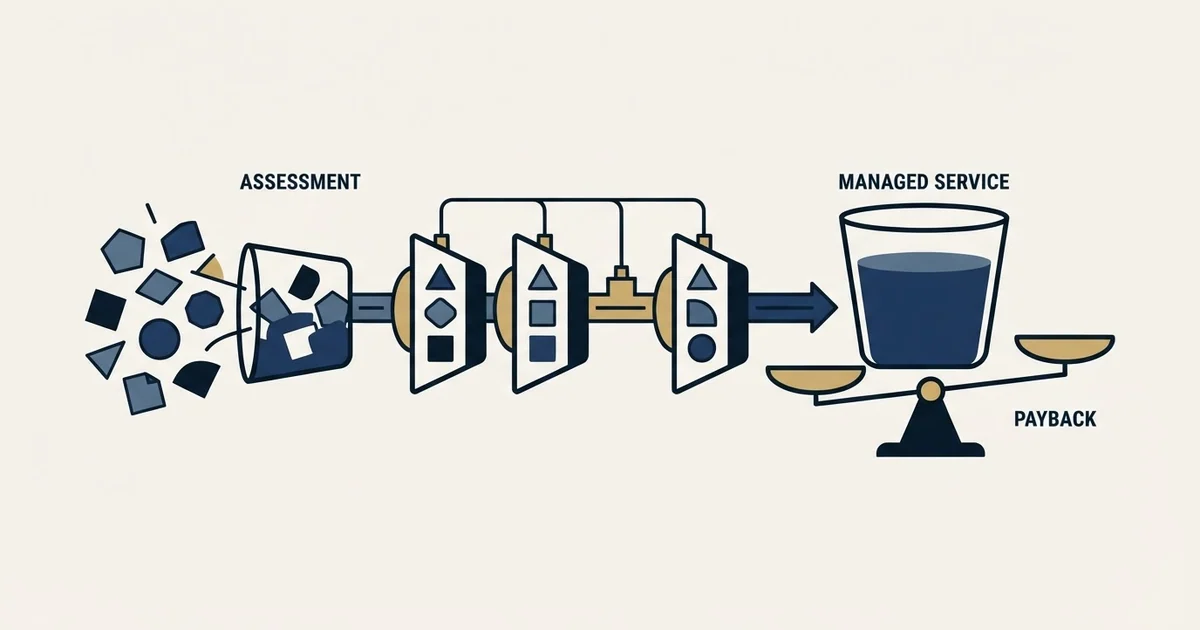
A managed services sales process has to establish what the provider would be taking on, because the deliverable is an ongoing obligation at a fixed monthly price. A structured assessment of the estate is the load-bearing step, and remediation belongs priced separately from the monthly agreement rather than absorbed into it.
Key takeaways
- A bad-fit managed services client costs money every month until somebody has an uncomfortable conversation, which makes qualification an economic question rather than an interest one.
- Folding remediation silently into the monthly fee is the common margin failure, because the work happens in the first quarter and the fee is spread across the term.
- Standardisation, support posture, what the buyer thinks they are buying and willingness to adopt your baseline predict profitability better than how keen the buyer sounds.
- The incumbent is usually an internal administrator or an existing provider, so the conversation is about risk and transition rather than about features.
Reviewed and updated September 1, 2026
There is a shape of managed services deal that closes cleanly and loses money for the whole of its first year. Nothing goes wrong in the sale. The estate turns out to hold unsupported servers, a firewall nobody has the password for, and a director who treats the helpdesk as a personal concierge. All of it was visible before signature, and none of it was in the sales process, because the sales process was built to establish interest.
Selling managed services is selling an ongoing obligation at a fixed monthly price. That single property changes what the process has to establish, and most of the differences from a normal B2B sale follow from it.
In contrast, the generic seven-step sales process treats every stage as seller activity achievable regardless of buyer intent, a limitation examined in the seven-step sales process explained.
What the obligation changes
A product sale ends at the transaction, and a bad-fit customer costs you the deal. A managed services sale begins an operational relationship with a cost curve, and a bad-fit client costs you money every month until somebody has an uncomfortable conversation.
- Qualify on interest and budget
- Demonstrate the capability
- Scope the work to be delivered
- Price against the deliverable
- Success is measured at handover
- Qualify on the estate you would inherit and how it behaves
- Demonstrate the operating model, including what happens at 2am
- Assess what you are taking on, in writing, before pricing
- Price against the cost to serve over the term
- Success is measured across the term, and onboarding is a loss
The right-hand column is more work and it is not optional. An MSP that skips the assessment is quoting a fixed price for an unknown quantity of labour, which is a bet rather than a proposal.
The assessment is the sales process
The load-bearing step in a managed services sale is a structured look at what the prospect actually runs: devices, ages, operating systems and their support status, backup that has been tested rather than configured, the identity setup, licensing, who currently has administrative access, and the outstanding work nobody has funded.
Where the estate and the contract dates are recorded decides whether a seller can qualify on them at all, and our guide to choosing a CRM for IT service providers covers the boundary between a standalone CRM and the module inside a PSA suite.
Two things make this different from ordinary discovery. It produces an artefact the buyer keeps and can act on whether or not they sign, which is the strongest reason for them to grant the access it needs. And it converts the prospect's vague dissatisfaction into a specific list, which is the only foundation a fixed price can rest on.
- Step 1Establish the trigger
What changed: an outage, an audit, a departing internal admin, an insurance requirement, a growth step
- Step 2Map the responsibility
Who currently owns the work, who feels the failure, and who signs the contract
- Step 3Assess the estate
Devices, ages, support status, backups tested, identity, access, and the unfunded remediation
- Step 4Separate remediation from service
What has to be fixed to make the estate supportable, priced apart from the monthly agreement
- Step 5Propose the operating model
Scope, response commitments, exclusions, onboarding plan and the term
Step four is the one that saves the deal from itself. An estate that needs work before it can be supported at the quoted level presents a choice: fix it as a separately priced project, or price the monthly service to absorb the risk. Folding remediation silently into the monthly fee is the most common margin failure in the sector, because the work happens in the first quarter and the fee is spread across the term.
Qualifying on the estate rather than on enthusiasm

Interest is the weakest qualification signal in this sale, because a prospect whose current arrangement is failing is highly motivated and may be the worst client available.
Four things predict whether an account will be profitable to serve, and none of them is how keen the buyer sounds.
Standardisation. An estate with consistent hardware, one identity provider and a common operating system baseline is cheap to support. A collection of exceptions accumulated over a decade is expensive forever, and the exceptions are usually attached to the people with the most influence.
Support posture. Whether unsupported operating systems, out-of-warranty hardware and unpatched infrastructure are treated as problems to schedule or as normal. This predicts the argument you will have in month four.
Who they think you are. A buyer who expects a supplier of infrastructure outcomes is different from a buyer who expects unlimited personal assistance. Both exist and only one is priced into the agreement.
Willingness to be standardised. A client who will not adopt your baseline, your tooling or your process is buying your labour at a fixed price with none of the efficiency that makes the price work.
- Yes: The estate was assessed rather than described
- Yes: Remediation is scoped and priced separately from the monthly agreement
- Yes: The buyer has agreed in principle to adopt your baseline and tooling
- Yes: Someone named owns the relationship on their side, with time for it
- Yes: Exclusions are written down and were read aloud before signature
- Depends: The urgency comes from an outage last week and nothing else
- No: The main attraction is that your price undercuts the incumbent
The last item is a no for a reason worth stating. An account won on price alone will be lost on price, and in the meantime it sets the expectation that the relationship is a commodity. The maybe on urgency is genuine: an outage is a real trigger and it is also the moment a buyer will agree to anything, including terms they will resent once the panic passes.
The incumbent is usually a person
In most managed services deals the thing being displaced is either an internal administrator or an existing provider with a relationship. Both cases are about risk and neither is about features.
Where the incumbent is internal, the person most affected is frequently in the room and is not the buyer. Selling around them produces a signed contract and an onboarding that fails, because the knowledge you need is in their head and there is no version of the transition that works without their cooperation. The productive framing gives that person a role in the new arrangement, and if there is genuinely no role, that fact belongs on the table before signature rather than after.
Where the incumbent is another provider, the buyer has already made this decision once and does not enjoy having been wrong. Attacking the incumbent puts them in the position of defending their own judgement, and people defend their own decisions better than anything else. Establishing what the current arrangement does not cover, with no characterisation of the provider at all, leaves the comparison to the person entitled to make it.
The paperwork is a stage, not an afterthought
A managed services agreement carries an SLA, a term, exclusions, an onboarding plan, data processing terms and frequently an insurance or compliance requirement the buyer's own policy imposes. Each of those has an owner on the buyer's side, and several of them have queues.
Qualification frameworks built for complex sales make this an explicit check for exactly this reason. MEDDPICC separates the paper process from the decision process on the argument that a deal can be won in October and signed in February with nothing having gone wrong in the selling. Managed services agreements are a clean example, because the security review and the legal read are triggered by the nature of the contract rather than by its size.
The cheap discipline is to ask, at the point a buyer says yes in principle, what has to happen between that yes and a countersignature, who owns each step and how long each one usually takes. The answers are a schedule, and a schedule can be worked.
The arithmetic that decides the qualification bar
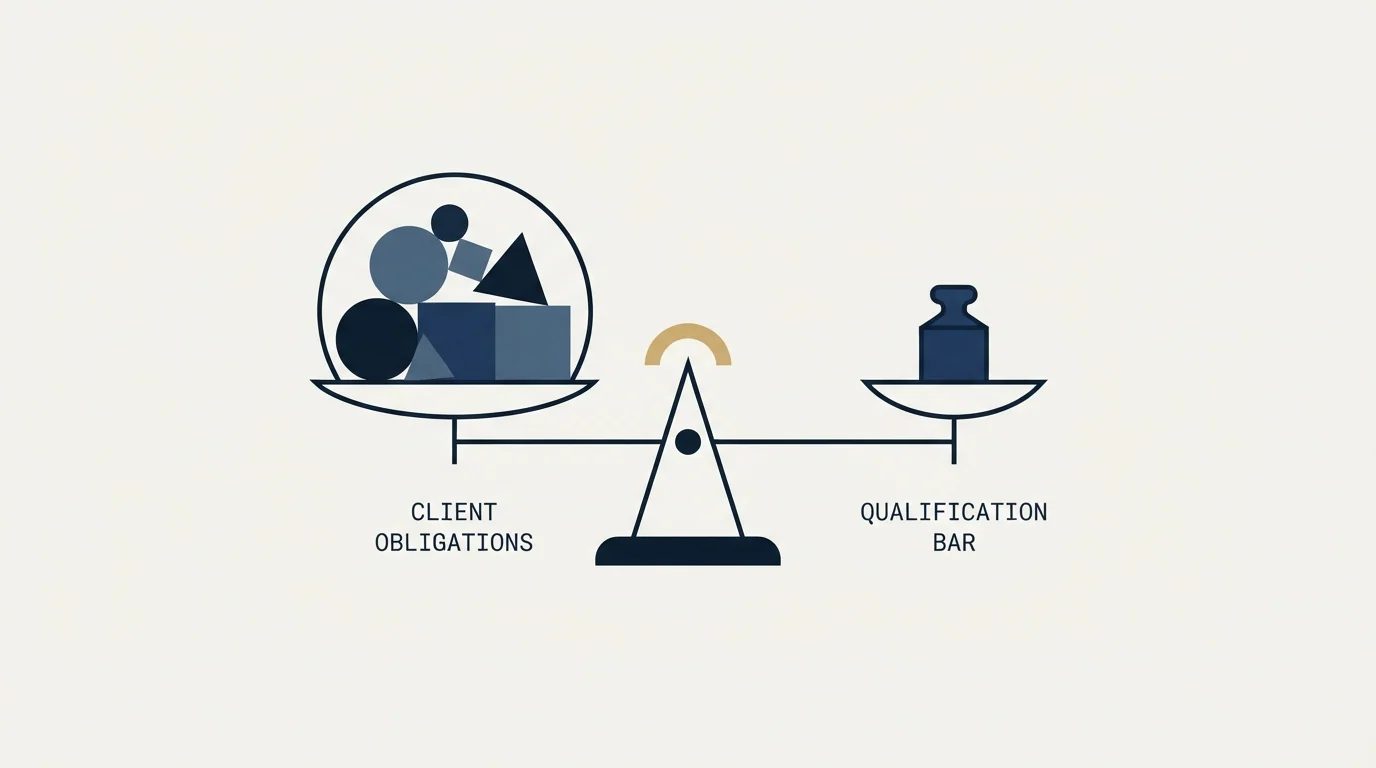
Onboarding is a cost paid up front against revenue that arrives monthly, so every managed services sale carries a payback period before the account contributes anything.
The following figures are invented for the illustration and describe no real engagement. Suppose onboarding an account costs four days of engineering time plus tooling and documentation, and suppose the monthly agreement contributes a margin equal to roughly one of those days. The account reaches payback somewhere around the fourth or fifth month and contributes for the rest of the term. Now suppose the estate needed remediation that was absorbed rather than priced, adding three more days. Payback moves past the half-year mark, and a client who leaves at twelve months has consumed most of what they paid.
Run that arithmetic with your own numbers once, and it settles arguments the sales process cannot. It tells you the minimum term worth signing, the minimum seat count worth serving, and how much assessment work is justified before quoting. Most MSPs that have done it discover their qualification bar was set by instinct and was too low.
Where the process starts, and who agrees it
Everything above describes a sales process that begins once a conversation exists. Getting that conversation is a separate problem with its own failure modes, and the two are frequently confused because both get filed under sales.
What is being bought at that stage is a meeting with somebody who owns the consequences of the current arrangement. How to tell a real MSP lead from a contact record covers the four different things sold under that one word and what each is worth, and what MSP lead generation services actually deliver covers how to test a supplier without committing to volume.
Our own position on the boundary is contractual. A meeting counts when the company matches the audience agreed in writing before launch, the person has genuine responsibility for the area, they agreed to a relevant business conversation, and they attended. Budget, timing and authority sit deliberately outside that definition, because a real conversation with the right person should not be voidable afterwards on a fact that changes every quarter. What a qualified meeting has to mean sets out the argument, and the diagnosis that follows the meeting is worked through in disqualifying well on a discovery call.
Where we differ from standard practice

Much of the advice on selling managed services reflects how outbound is commonly run, and since this page sits on our site the divergence is worth stating.
The standard recommendation for filling the top of this process is a contact cadence: several messages to each prospect over a number of weeks, later ones landing in the same thread, on the reasoning that decision makers in this market are hard to reach. We run one message per campaign, with no bumps and no thread replies, and where an audience does not respond we build a separate campaign on a genuinely different premise rather than a reminder of the old one. The reasoning is mechanical: a follow-up reaches the population that already saw the message and chose not to answer, which is the population most likely to complain, and the reputation cost lands on the sending domain across everything else it sends. The cost we accept is reaching each contact less often, which pushes the work into targeting and into the single message. The full argument, including what it costs us, is in why we stopped using follow-ups.
The short version
A managed services sales process has to establish what you would be taking on, because the deliverable is an ongoing obligation at a fixed price. The assessment of the estate is the load-bearing step, and remediation belongs priced separately from the monthly agreement rather than absorbed into it.
Qualify on standardisation, support posture, what the buyer thinks they are buying and their willingness to adopt your baseline, rather than on enthusiasm. Treat the incumbent as a person rather than a competitor. Schedule the paperwork explicitly, because contract review is where won deals go to wait. And run the onboarding payback arithmetic with your own figures once, because it sets the qualification bar that every other decision in the process depends on.
Getting in front of the person who owns the consequences is the half we run, on criteria agreed in writing before anything sends. See what a first campaign produces.
Frequently asked questions.
Frequently asked questions- How is selling managed services different?
- The deliverable is an ongoing obligation at a fixed price rather than a transaction, so the process has to establish what you would inherit. A product sale ends at handover and a bad fit costs you the deal. A managed services sale starts a cost curve, and a bad fit costs you margin every month of the term.
- Why assess the estate before quoting?
- Because a fixed monthly price for an unknown quantity of labour is a bet. The assessment converts vague dissatisfaction into a specific list of devices, support statuses, tested backups, identity setup and unfunded remediation. It also produces an artefact the prospect keeps whether or not they sign, which is the strongest reason for them to grant the access it needs.
- What should disqualify a managed services prospect?
- An estate the buyer will not standardise, a support posture that treats unsupported systems as normal, an expectation of unlimited personal assistance rather than infrastructure outcomes, and interest driven only by undercutting the incumbent on price. An account won on price alone is lost on price, and sets the expectation that the relationship is a commodity.
- How do I set the minimum account size worth serving?
- Run the onboarding payback arithmetic with your own figures. Onboarding is paid up front against revenue arriving monthly, so every account has a payback period before it contributes. That calculation gives you the minimum term, the minimum seat count and how much assessment work is justified before quoting, and it usually raises a bar that was set by instinct.
About the author.

Ben Carden is CRO at RevenueFlow, which builds and operates outbound revenue engines for B2B companies. Previously at Gartner Enterprise. Studied at London School of Economics.
Ben Carden · CRO
Connect on LinkedIn →Explore more.
Ready to scale your outreach?
We build GTM engines that book real meetings. See the receipts.
Related articles.
The Seven-Step Sales Process: What Each Step Assumes
Prospecting through follow-up, walked one box at a time. Each of the seven steps carries an assumption about the buyer, and most of them have quietly stopped holding.
The Five-Step Sales Process: What You Stop Checking
Cutting a process to five steps is a decision about which checks you drop. Which deals the short version fits, and the two loss patterns that say it does not.
The Customer-Centric Sales Process: The Edit That Matters
Renaming the pitch achieves nothing. Writing every step as buyer evidence changes the forecast within a quarter, and three other things nobody warns you about.
The Sales Process: Writing Steps a Buyer Has to Complete
The seven-step template names things the seller does, so a process built on it advances in quarters where nothing is bought. What to write instead, and how.
The Consultative Sales Process: What Diagnosis Costs
Diagnosis before prescription is easy to say and expensive to run. What the approach actually requires, and why proposal volume falls before close rate rises.
The B2B Sales Process: When Nobody Can Decide Alone
A process that works for one signer falls over when four people have to agree. What changes, which checks the committee forces, and where the process starts.