MSP Lead Generation Services: Why Selling Managed IT Differs
Managed IT is a switching sale into a saturated inbox, aimed at a buyer with no IT title. Which triggers are sourceable, and the compliance ones nobody uses.
Managed services lead generation services are outside firms that find and contact prospective clients for a managed service provider. They sell three different products under one phrase: a list, a warm reply, or an attended meeting. For MSPs the list is the product, because selling managed IT is a switching sale that depends on an observable trigger.
Key takeaways
- MSP lead generation services sell three different products under one phrase, a list, a warm reply or an attended meeting, so settle which one the rate is for.
- The buyer at twenty to two hundred seats is usually an owner, finance lead or operations manager, so targeting IT titles finds the wrong person or nobody.
- Selling managed IT is a switching sale, which makes trigger data the substrate of the campaign, and several useful triggers such as renewal dates cannot be observed at scale.
- Compliance is the most documented trigger: the FTC Safeguards Rule requires covered firms to oversee service providers, and UK buyers increasingly require Cyber Essentials from suppliers.
Reviewed and updated September 18, 2026
A twelve-person tax preparation firm is legally required to designate a Qualified Individual to implement and supervise a written information security programme, and the FTC's own guidance says that person can work for a service provider. That single sentence is a better MSP prospecting brief than most of the campaigns running in the category, because it names a buyer, a dated obligation and a role only an outside provider is likely to fill.
Managed services lead generation is not a generic B2B outbound problem with different words in the subject line. Four things about the vertical change how a campaign has to be built, and a vendor who has not thought about all four will produce activity rather than meetings.
The same four things decide whether outbound sales for MSPs produces meetings when the owner runs it in-house.
Because managed IT is only one of several seller types facing this problem, selling to buyers who run outbound themselves covers the wider pattern across integration, software and security vendors.
What are managed services lead generation services?
Managed services lead generation services are outside firms that find and contact prospective clients on behalf of a managed service provider. They build a list of companies likely to need managed IT, send the outreach, and hand back one of three things: a list, a warm reply, or a booked meeting with a decision maker. Those are three different products at three different prices, so the first question to settle with any provider is which one you are buying.
The buyer is rarely a technology function
At twenty to two hundred seats there is usually no CIO and often no IT director. The decision sits with an owner, a finance lead or an operations manager, and it gets made against a budget line that competes with hiring rather than against a technology roadmap.
That has two practical consequences for a list. Targeting by IT titles at this company size finds the wrong people or nobody at all, because the title either does not exist or belongs to somebody without spending authority. And where a technical person does exist, they are frequently the one whose job a managed services proposal appears to threaten, so the person closest to the subject matter is a risk to the deal rather than a route into it.
The message has to work for a reader who is not technical and is not shopping. That rules out most of what the category actually sends, which is written by technicians for an imagined technician.
SaaS digital marketing agency explains how diagnosing which growth bottleneck you actually face determines which marketing discipline and agency type will fix it.
Switching is the whole sale

Almost every company you would want as a client already has somebody doing this, usually under contract, and often with a relationship that predates whoever now signs the invoice. You are not creating demand. You are trying to arrive in the narrow window where an existing arrangement is genuinely in question.
That window is what your targeting has to find, which makes trigger data the substrate of an MSP campaign rather than a nice enhancement to it. The triggers worth building around are the contract anniversary and renewal notice period, a security incident or a disclosed breach, an acquisition or merger on either side, a compliance obligation landing, growth past the point where the incumbent was sized, and the incumbent itself being acquired in the consolidation running through the sector.
The uncomfortable part is that these differ enormously in how sourceable they are. A funding round or an acquisition is public. A contract renewal date is private and essentially unobtainable at scale. Anybody selling you an MSP lead generation service should be asked directly which of these they can actually observe, and the honest answer for several of them is that they cannot.
Observable
- Acquisition, merger or funding event at the prospect
- Hiring signals suggesting growth past the incumbent's sizing
- Publicly disclosed breach or regulatory notification
- The incumbent provider being acquired or consolidated
Partly
- A compliance regime the prospect's sector or customers impose
- Technology footprint changes visible from outside
Not observable
- Contract anniversary or renewal notice date
- Internal dissatisfaction with the current provider
The compliance trigger is the most underused, and it is documented
Compliance is the one trigger class that is written down publicly, dated, and specific about the role an outside provider plays. Most MSP campaigns gesture at it vaguely. The regulations are more useful than the gesture.
The FTC Safeguards Rule applies to non-bank financial institutions, and the definition is far broader than the phrase suggests. The FTC's guidance points to Section 314.2(h), which lists thirteen examples including mortgage brokers, collection agencies, tax preparation firms, credit counsellors and other financial advisors, and investment advisors not required to register with the SEC, with finders added by the 2021 amendments. A great many small businesses that would never describe themselves as financial institutions are covered.
Covered firms must maintain a written information security programme appropriate to their size and complexity, containing the nine elements set out in Section 314.4. Three of those elements are effectively a job description for a managed provider. The Qualified Individual who implements and supervises the programme can be an employee or can work for an affiliate or service provider, though the guidance is explicit that the buck still stops with the client. Multi-factor authentication is required for anyone accessing customer information on the system, using at least two of a knowledge factor, a possession factor and an inherence factor, and the only exception is an equivalent control the Qualified Individual has approved in writing. And covered firms must monitor their service providers, with contracts that spell out security expectations, build in ways to monitor the provider's work, and provide for periodic reassessments of their suitability.
Read that last one again from a prospecting point of view. The regulation requires the prospect to periodically reassess whoever currently holds the work, in writing. It manufactures the review moment that an MSP campaign is otherwise waiting for, and it applies to every covered firm regardless of size.
Size does change the picture in one important way, and it is worth getting right rather than glossing. Section 314.6 of the Rule states that Sections 314.4(b)(1), (d)(2), (h) and (i) do not apply to financial institutions maintaining customer information concerning fewer than five thousand consumers, which removes the written risk assessment, the continuous monitoring and testing requirement, the incident response plan and the annual written report to the board for the smallest covered firms. The Qualified Individual, the multi-factor requirement and the service provider oversight obligation are not on that list, so they hold at every size. For a list build, the five thousand consumer line separates prospects who owe a formal annual review from prospects who owe ongoing provider oversight without the paperwork cycle around it, and those two groups want different messages.
Breach obligations sharpen it further: the Rule requires notification to the FTC as soon as possible and no later than thirty days after discovering a notification event, defined as a security breach involving unauthorised acquisition of at least 500 consumers' unencrypted information.
In the UK the equivalent lever is supplier certification. The NCSC describes Cyber Essentials as the minimum standard of cyber security it recommends for organisations of all sizes, built on five technical controls: firewalls, secure configuration, security update management, user access control and malware protection. Crucially for targeting, the NCSC states that a growing number of organisations require suppliers to be certified in order to bid for work, so the obligation arrives from a prospect's own customers rather than from a regulator. Certification is priced by organisation size starting at £320 plus VAT, with Cyber Essentials Plus adding independent technical testing and priced by the size and complexity of the network.
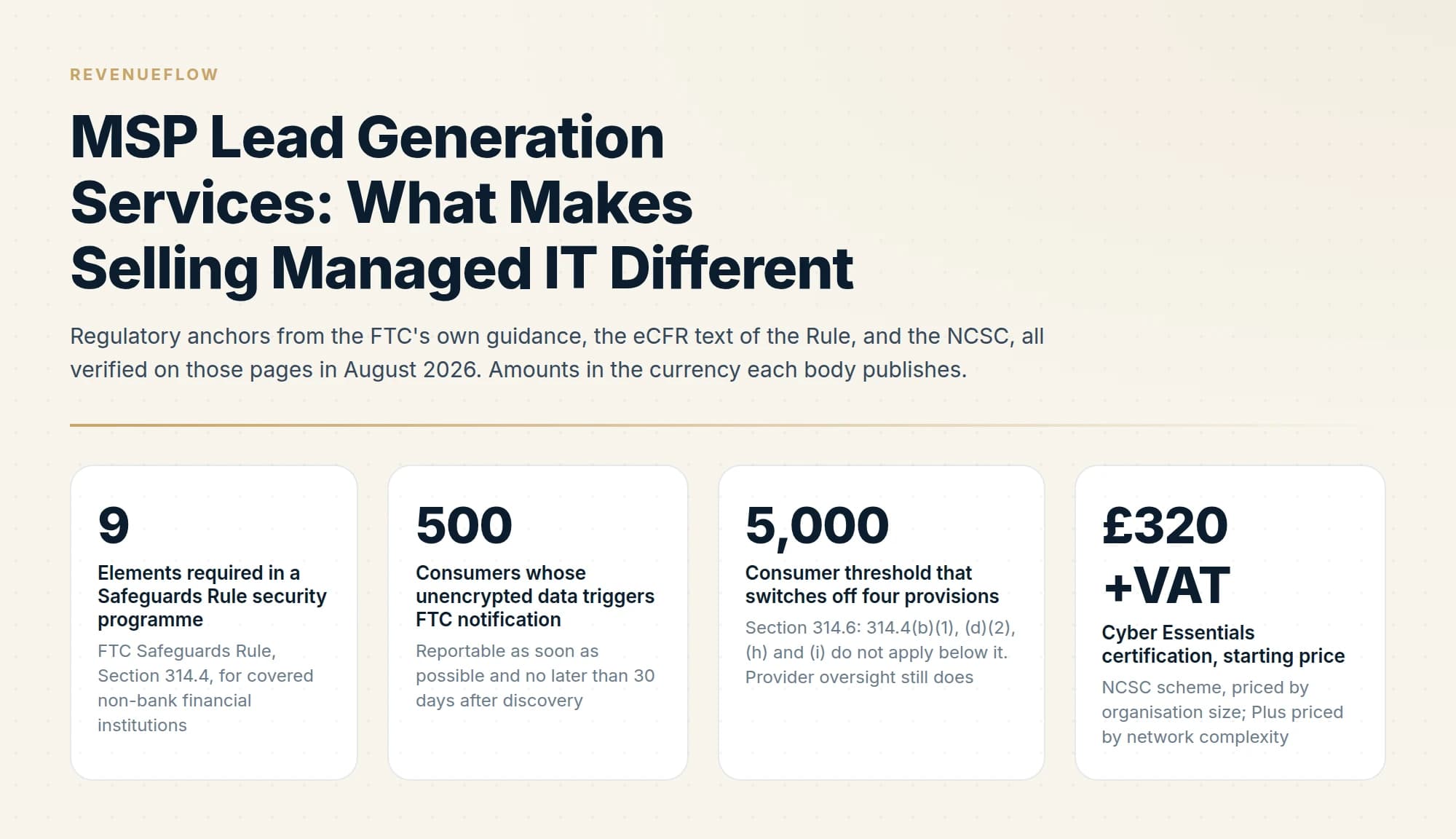
| Anchor | Figure | Where it comes from |
|---|---|---|
| Elements required in a Safeguards Rule security programme | 9 | FTC Safeguards Rule, Section 314.4, for covered non-bank financial institutions |
| Consumers whose unencrypted data triggers FTC notification | 500 | Reportable as soon as possible and no later than 30 days after discovery |
| Consumer threshold that switches off four provisions | 5,000 | Section 314.6: 314.4(b)(1), (d)(2), (h) and (i) do not apply below it. Provider oversight still does |
| Cyber Essentials certification, starting price | £320 +VAT | NCSC scheme, priced by organisation size. Plus is priced by network complexity |
None of this is a script. It is a way of building a list where the reason for the email is a fact about the prospect's obligations rather than a claim about your service.
Message density is the constraint nobody prices in

Every MSP in a metropolitan area is emailing broadly the same small business list, and a large share of them are offering the same free network assessment. Your campaign is not competing against silence. It is competing against a dozen near-identical messages that arrived in the same quarter and taught the recipient a pattern.
Two things follow, and both cost money rather than saving it. The list has to be narrower, because a specific reason to write only exists for a subset of companies. And the claim has to be specific enough that it could not have been sent to everybody, which means it has to be grounded in something observable about that company rather than in an adjective about your service desk.
We send one message per campaign and never follow it with a bump in the same campaign. That discipline matters more in a saturated vertical than anywhere else, because the marginal effect of a second unanswered message in a crowded inbox is to confirm the pattern the recipient already learned. Approaching a non-responder again means a new campaign built on a genuinely different reason, at a later date. Replying to someone who answered, or confirming with someone who booked, is ordinary correspondence rather than a bump, and the two should never be conflated when a vendor describes their process.
What most of the category sends
The undifferentiated campaign
Targets every SMB in the metro above a headcount floor, offers a free network assessment, names no fact about the recipient, and aims at IT titles that often do not exist at this size.
result indistinguishable from the last several received
What the vertical requires
The trigger-anchored campaign
Targets a segment defined by an observable event or obligation, offers something that only makes sense given that event, names why the message arrived now, and aims at the owner, finance or operations decision maker.
result could only have been written to those companies
Co-managed IT is the wedge that does not require a firing

Full displacement asks a prospect to end a relationship, absorb a migration and admit a prior decision was wrong. Co-managed arrangements ask for none of that. You supplement the existing arrangement on a specific gap: after-hours coverage, a security function the incumbent does not offer, a compliance workstream, or capacity during a project.
As a commercial motion it lowers the size of the first yes considerably, and it puts you inside the account when the renewal question eventually gets asked. As an outbound angle it is easier to write, because the message does not have to argue that the incumbent is bad. It only has to name something specific they are not doing.
What to ask whoever you hire
The single question that separates MSP lead generation services is where the trigger data comes from. Contact data is a commodity and everybody has it. Ask what observable signal defines each campaign's list, how it is refreshed, and what happens to targeting when the signal is unavailable for a segment. Vagueness here means the answer is a headcount and industry filter with a generic offer, which is the campaign the section above describes.
If your question is SDR outsourcing for MSPs specifically, the answer is the same test applied to the four models in SDR outsourcing: a vendor that can name the switching trigger and the compliance obligation for your metro is the only one worth a seat, and one that offers a headcount filter and a generic offer is not.
Pricing transparency in this niche is limited, and it is worth knowing that going in. Tech Pro Marketing, an MSP-specialist marketing agency that states its model is "actively facilitating the growth of over 100 MSPs", publishes no rates and has no pricing page at all, describing scope as tailored to each client through a road mapping process and its outbound work as outreach campaigns, prospect list building, personalised cold emails and LinkedIn messaging. That is a normal shape for the segment rather than a red flag, and it means comparison has to happen through the diligence questions instead of through published numbers. The general version of that comparison is in B2B lead generation companies, and the delivery models the quotes attach to are in B2B lead generation services.
Then settle what you are buying before the rate: a list, a warm reply, or an attended meeting with a named decision maker. Those are different products and they get sold under the same phrase, which is the subject of appointment setting vs lead generation. Adjacent verticals with the same trigger-led structure are worth reading across: the mechanics for booking meetings with cybersecurity buyers and for cloud services share most of this article's logic.
The short version

MSP outbound is a switching sale into a saturated inbox, aimed at a buyer who does not work in technology. That combination means the list is the product: a segment defined by an observable trigger, worked with a message that could only have been sent to those companies. Compliance is the most documented trigger available and the least used, and the regulations name the review moments for you. The FTC Safeguards Rule requires covered firms to monitor and periodically reassess their service providers, and the NCSC notes that supplier certification is increasingly a condition of bidding for work. Co-managed IT is the wedge that gets a first meeting without asking anyone to fire anyone.
If you want to see what a trigger-anchored list looks like for your metro and your target segment, you can see what a campaign would look like for your market.
Vendor pricing and terms verified against the vendors' own pages in mid-2026. All are subject to change; confirm current terms directly before contracting. Regulatory details are taken from the FTC's and the NCSC's own published guidance and are summarised here rather than reproduced in full; take advice on any obligation that applies to you.
Sources: FTC Safeguards Rule guidance, 16 CFR 314.6, NCSC Cyber Essentials, Tech Pro Marketing
Frequently asked questions.
Frequently asked questions- What are managed services lead generation services?
- They are outside firms that find and contact prospective clients on behalf of a managed service provider. They build a list of companies likely to need managed IT, send the outreach, and hand back a list, a warm reply or a booked meeting with a decision maker. Those are three different products, so confirm which one is being quoted.
- How do MSPs generate leads?
- By finding the narrow window when an existing IT arrangement is in question. Useful triggers include an acquisition or funding event, growth past the incumbent's sizing, a disclosed breach, a compliance obligation landing, or the incumbent provider being acquired. The message names that specific reason and goes to the owner, finance lead or operations manager.
- Why is lead generation harder for managed service providers?
- Four reasons. The buyer is rarely a technology function. Almost every prospect already has a provider, so it is a switching sale. Every MSP in a metro emails the same small business list with the same free network assessment. And the most useful trigger, the contract renewal date, is private and essentially unobtainable at scale.
- What should you ask an MSP lead generation company?
- Ask where the trigger data comes from: what observable signal defines each campaign's list, how it is refreshed, and what happens when the signal is unavailable for a segment. Vagueness means a headcount and industry filter with a generic offer. Then settle whether you are buying a list, a warm reply or an attended meeting before discussing the rate.
About the author.

Ben Carden is CRO at RevenueFlow, which builds and operates outbound revenue engines for B2B companies. Previously at Gartner Enterprise. Studied at London School of Economics.
Ben Carden · CRO
Connect on LinkedIn →Explore more.
Ready to scale your outreach?
We build GTM engines that book real meetings. See the receipts.
Related articles.
5 ABM Campaign Examples and How Each One Is Built
Five worked account-based campaign examples, each built on the same five fields: account set, tier, plays in order, owner and handoff, and the exit condition.
Two Agencies, One Target List: Who Owns Which Accounts
Two outbound suppliers on one market will contact the same companies unless the buyer splits it first. How to cut the list, run the exclusion feed and check the overlap.
Last Outbound Agency Did Not Deliver: Locating the Failure
The leads were bad names a symptom and no stage. Four places an outbound engagement fails, the counts that separate them, and what to change in the next purchase.
IT Lead Generation: The Buyer Runs Your Playbook
Technology buyers evaluate outbound for a living, and their purchases carry a security review nobody in your meeting owns. Which triggers are real.
HR Lead Generation: The Renewal Clock and Who Signs
An HR buyer who agrees with every word still cannot act outside their own renewal window. Which triggers are observable, and who signs.
When Outbound Stops Scaling: What Breaks First
Doubling the budget rarely doubles the meetings. The five constraints that bind in order, the signature each one leaves in the numbers, and what actually buys more.