When Outbound Stops Scaling: What Breaks First
Doubling the budget rarely doubles the meetings. The five constraints that bind in order, the signature each one leaves in the numbers, and what actually buys more.

Outbound stops scaling because a list is worked best first, so a second pass runs through a weaker population. Five constraints bind in rough order: addressable market, research labour per contact, sending capacity and reputation, reply handling, and the definition of a qualified outcome. Each leaves a different signature in the numbers.
Key takeaways
- A list is worked best first, so reply rates fall as the population changes rather than because the copy got worse.
- Volume targets are commonly met by silently widening the targeting criteria, which is a decision about who you sell to.
- Sending capacity grows in steps rather than smoothly, because each new sender needs a domain and a warm up first.
- Past the point where a list has been worked, the lever is a new segment or a new premise rather than more sends.
Reviewed and updated October 1, 2026
An outbound programme runs at a modest volume for two quarters and produces meetings the sales team is happy to take. The budget is doubled on the strength of it. The meeting count rises by a quarter rather than doubling, and the meetings that do arrive are noticeably worse. Nobody changed the copy, the vendor did not get lazy, and the tooling is the same.
That pattern is the normal behaviour of an outbound programme rather than a failure of the people running it. Outbound does not scale linearly, because the thing being scaled is not the sending. Several separate constraints sit behind the send, they bind in a rough order, and the first one to bind decides what doubling the spend actually buys.
The list is worked best first
Start with the constraint that has nothing to do with execution.
An account list is not a uniform resource. Whoever built it put the best-fitting companies at the top, because the filters that define fit are the filters that built it. The first pass through a list is therefore a pass through its strongest section, and the second pass is by construction through a weaker one. Reply rates fall not because the message got worse but because the population changed.
The size of that effect depends on how much market is left. A programme that has contacted two thousand of a plausible twenty thousand companies has plenty of comparable list ahead of it, and doubling the volume mostly buys more of the same. A programme that has contacted two thousand of a plausible three thousand is nearly finished, and doubling the volume buys the remainder plus a widening of the criteria that nobody explicitly agreed to.
The widening is the part to watch, because it is usually silent. Volume targets have to be met from somewhere, and the cheapest place to find more names is one notch down on company size, one step out on job title, or one adjacent industry. Each of those is a decision about who you sell to, and it tends to get made as a sourcing detail rather than as a decision.
- Deeper into the same list, where fit is weaker
- Or criteria widened to find new names
- Reply rate falls with the population, not with the copy
- Meeting quality drifts before anybody names it
- Cost per qualified meeting rises quietly
- Research per account rather than per segment
- A premise specific enough to be worth answering
- Fewer sends against the accounts that matter most
- Cost per send rises and cost per meeting can fall
- Only works where the account list is genuinely small
The constraints, in the order they usually bind
The same five constraints decide what a realistic meeting volume looks like for a team that has just started, which is the version of this question asked before any budget has been added. Whichever constraint binds first sets the ceiling, so the useful planning move is to establish which one you are against before agreeing a monthly number with anybody.
Five, and knowing which one you are against is the whole diagnosis.
The addressable market. How many companies genuinely fit, multiplied by how many people at each are worth writing to. This is a fixed number and it is usually smaller than the plan assumes.
Research and personalisation labour. Whatever makes the message specific costs human time or model time per contact. Doubling contacts doubles that cost, and the usual response is to make each message less specific, which is the trade that produces worse replies at higher volume.
Sending capacity and reputation. Mailbox and domain capacity is not elastic. More volume needs more mailboxes on more domains, each of which has to be warmed, and reputation is a property of the domain rather than of the campaign. Pushing per-mailbox volume up instead is the version that damages placement. The architecture that holds at volume is the mechanism, and what breaks first when you scale sends is the operational half.
Reply handling. Every additional reply needs reading, qualifying and scheduling within a day, by somebody able to make judgment calls. This capacity is the least visible and the least budgeted, and it degrades quietly: replies answered slowly become meetings that do not happen. The scope ladder names it as the rung where the price steps up, which is a fair reflection of where the labour actually is.
The definition of the outcome. The last constraint, and the one that gives way when the others are already tight. Where the criteria are loose, a volume target can be met by loosening what counts, and everyone can report a good month while the sales team stops attending.
Working out which one you hit

Each ceiling leaves a different signature, and the counts to compare are the same before-and-after set.
If the reply rate fell and the bounce rate did not move, the population changed. You are against the list, and the remaining market is the number to establish before anything else.
If the bounce rate rose or replies fell across every version of the copy, delivery is the constraint. Newly added mailboxes that were not warmed properly are the common cause, and the symptom appears in the weeks after a volume increase rather than at the moment of it.
If replies held up and the gap between booked and held widened, reply handling and scheduling are the constraint. That is a staffing answer rather than a targeting one.
If meetings held stayed flat or rose while sales acceptance fell, the definition gave way. Nothing upstream is broken and the criteria stopped excluding what they were meant to exclude.
- Yes: You know how many companies are left in the list that meet the original criteria
- Yes: Reply rate is compared like for like, before and after, on the same copy
- Yes: Bounce rate is read separately from reply rate
- Yes: The gap between meetings booked and meetings held is tracked
- Yes: Sales acceptance of held meetings is tracked against the written criteria
- Depends: The targeting criteria are the same ones agreed at the start
- No: More volume is the proposed response to a falling reply rate
Volume comes from sender count, not from intensity
It is also the answer to two questions asked at opposite ends of an engagement: how to scale outreach campaigns to higher volumes, and how many outreach messages per channel a programme runs in a month. Both are capacity questions rather than effort questions. The monthly figure is sender count multiplied by a conservative per-sender rate, so it moves when the estate moves and it cannot be raised by asking anyone to try harder.
Worth stating as our operating position rather than as a general rule, because it is the part that most often differs between suppliers.
We add volume by adding sending accounts at a low per-account rate rather than by raising the rate on the accounts we already have. On LinkedIn the same logic is stronger, since account-level activity limits apply to the account regardless of which tool is driving it. That model has a real consequence for scaling: capacity grows in steps rather than smoothly, because each new sender needs a domain and a warm up before it contributes anything, and that takes weeks.
So a vendor asked to double volume next month has three honest answers. They already hold warm capacity and can use it, which is checkable. They can add capacity and it will take a stated number of weeks, which is honest. Or the constraint is not capacity at all and more volume is the wrong lever, which is the most useful answer and the rarest.
The answer to distrust is an immediate yes with no mention of infrastructure, since it usually means per-mailbox volume is about to rise, and that shows up as a placement problem one or two months later, after the invoice for the extra volume has been paid.
What actually buys more meetings once the ceiling is reached
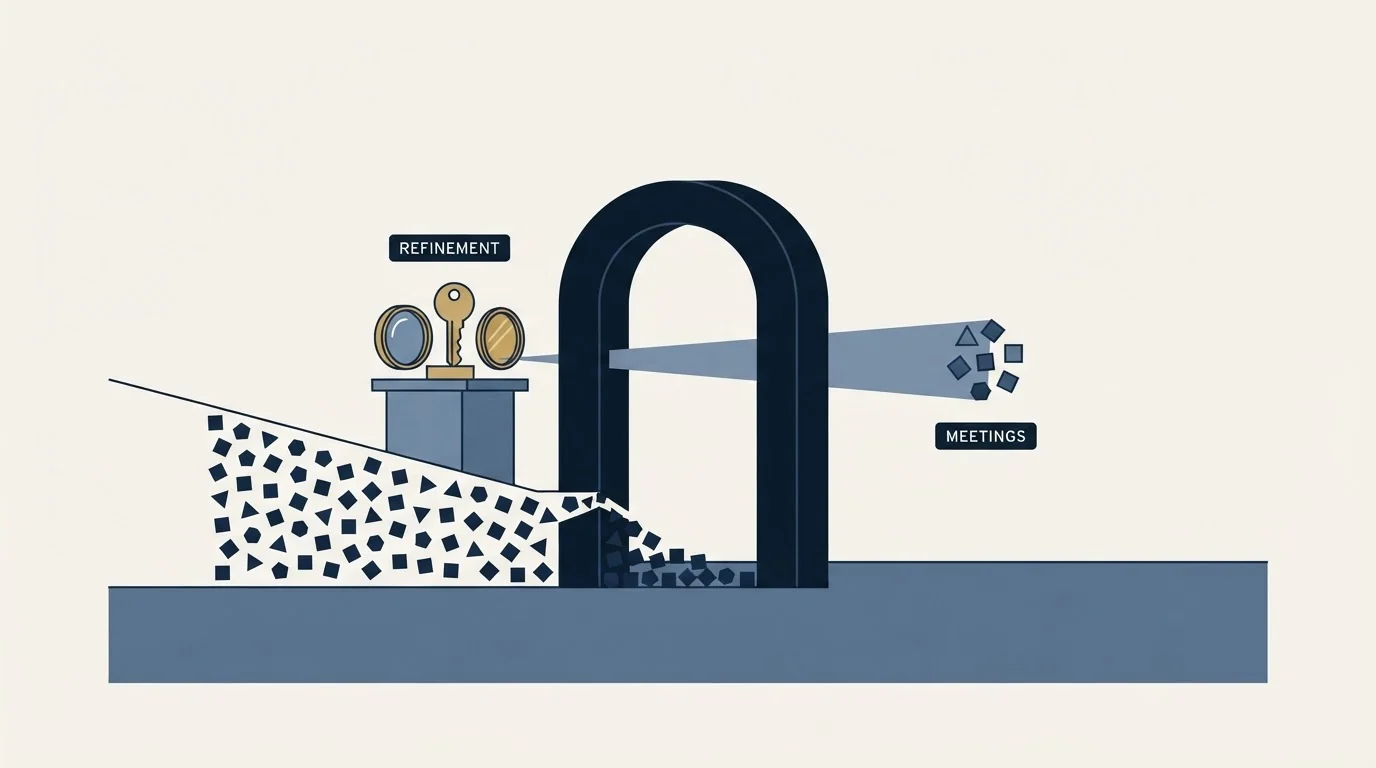
Three things, and none of them is more sends into the same list.
A new segment. Genuinely new, with its own filters and its own count, which resets the fit distribution rather than continuing down the existing one. This is a targeting decision and it deserves the same scrutiny as the original profile.
A new premise. The same accounts approached about something different, because a company that ignored one offer is not a company that has heard everything you sell.
A different channel into the same accounts. Adds reach per account rather than accounts, and it costs more per contact rather than less, so it earns its place where the account list is small and each account is worth the extra.
What all three have in common is that they change what is being sent or to whom. That is the general shape of the answer: past the point where a list has been worked properly, the lever is the premise rather than the throughput, which is the argument signal-based outbound makes about running a signal lane alongside a base lane rather than instead of it.
- Step 1Count what is left in the list
Companies meeting the original criteria that have not been contacted. This number decides whether the ceiling is the market or the execution.
- Step 2Check whether the criteria widened
Compare the filters that built the recent list against the ones agreed at the start. Silent widening is the usual explanation for a quality drop.
- Step 3Read the funnel stage by stage
Reply, book, hold and accept, before and after the increase. The step where the drop is anomalous names the constraint.
- Step 4Choose a premise or a segment rather than a volume
A new offer to the same accounts or a genuinely new segment with its own count. More sends into the worked portion of the list is the option that does not work.
- Step 5Re-agree the outcome definition before adding budget again
A loose definition absorbs a volume increase by counting worse meetings, so the criteria have to be checked at the same time as the number.
Why a good agency stalls and an ordinary one does not appear to
Two programmes at the same spend can look very different here, and the difference is often the starting quality rather than the scaling ability.
A programme that began with a tight list and a specific premise has spent its best material first, so its decline as it scales is visible and sharp. A programme that began broadly was already producing average results across an average population, so widening it changes very little. The first supplier looks like the one that cannot scale, when what actually happened is that it had something to lose.
The practical consequence is that a falling reply rate on a scaling programme is not by itself evidence of a worse vendor. Read it against how much of the qualifying list has been consumed. Where most of it has, the number is doing what it should. Where little of it has, the fall needs a different explanation and the constraint is somewhere in execution.
The short version

Doubling the budget does not double the meetings, because the list is worked best first and the second pass runs through a weaker population. Five constraints bind in a rough order: the size of the addressable market, the research labour per contact, sending capacity and reputation, reply handling, and the definition of a qualified outcome. Each leaves a different signature, so compare reply rate, bounce rate, the booked to held gap and sales acceptance before and after the increase rather than reading one headline number. Once a list has been worked properly, the lever is a new segment or a new premise rather than more sends, and a vendor who agrees to double volume without mentioning infrastructure is usually about to raise per-mailbox volume instead.
If you want a view of what the remaining list actually supports before committing more budget, you can see what a campaign would look like for your market.
Frequently asked questions.
Frequently asked questions- Why did doubling our outbound budget not double the meetings?
- Because the strongest part of the list was worked first. The filters that define fit are the filters that built the list, so the first pass runs through its best section and the second through a weaker one. Reply rates fall with the population rather than with the copy, and cost per qualified meeting rises without anything being done badly.
- How do we tell whether the list or the execution is the constraint?
- Compare the same counts before and after the increase. A falling reply rate with a flat bounce rate points at the population. A rising bounce rate or a fall across every version of the copy points at delivery. A widening gap between booked and held points at reply handling and scheduling. Flat held meetings with falling sales acceptance points at the criteria.
- Can an outbound agency just add more volume next month?
- There are three honest answers. They already hold warm sending capacity, which is checkable. They can add capacity and it takes a stated number of weeks, because each sender needs a domain and a warm up. Or volume is the wrong lever for the problem. An immediate yes with no mention of infrastructure usually means per-mailbox volume is about to rise.
- What buys more meetings once an outbound programme has hit its ceiling?
- A genuinely new segment with its own filters and its own count, a new premise to the same accounts so a company that ignored one offer hears about something different, or an additional channel into the same accounts where each account is worth the higher cost per contact. All three change what is sent or to whom rather than how much.
About the author.

Ben Carden is CRO at RevenueFlow, which builds and operates outbound revenue engines for B2B companies. Previously at Gartner Enterprise. Studied at London School of Economics.
Ben Carden · CRO
Connect on LinkedIn →Explore more.
Ready to scale your outreach?
We build GTM engines that book real meetings. See the receipts.
Related articles.
5 ABM Campaign Examples and How Each One Is Built
Five worked account-based campaign examples, each built on the same five fields: account set, tier, plays in order, owner and handoff, and the exit condition.
Two Agencies, One Target List: Who Owns Which Accounts
Two outbound suppliers on one market will contact the same companies unless the buyer splits it first. How to cut the list, run the exclusion feed and check the overlap.
Last Outbound Agency Did Not Deliver: Locating the Failure
The leads were bad names a symptom and no stage. Four places an outbound engagement fails, the counts that separate them, and what to change in the next purchase.
HR Lead Generation: The Renewal Clock and Who Signs
An HR buyer who agrees with every word still cannot act outside their own renewal window. Which triggers are observable, and who signs.
IT Lead Generation: The Buyer Runs Your Playbook
Technology buyers evaluate outbound for a living, and their purchases carry a security review nobody in your meeting owns. Which triggers are real.
Already Contracted With a Lead Generation Vendor: Run Two
Two vendors collide because neither can see the other's send queue. How to split by account, hold one suppression list, and run a bake-off that decides something.