Already Contracted With a Lead Generation Vendor: Run Two
Two vendors collide because neither can see the other's send queue. How to split by account, hold one suppression list, and run a bake-off that decides something.

Two lead generation vendors collide because a suppression list records who was contacted while nothing records who is queued to be contacted tomorrow, and neither vendor can read the other's queue. Split the work by account rather than by channel, hold one suppression list yourself, and agree one written definition of a billable meeting.
Key takeaways
- A suppression list answers what already happened; nothing across two vendors answers what is queued to send tomorrow.
- Splitting by channel fails because the prospect experiences one company approaching them twice, not two suppliers.
- A reply to either vendor has to suppress the prospect for both within a day, or the second approach reaches somebody who already declined.
- Two written definitions of a qualified meeting produce two numbers that cannot be compared, and the looser definition wins.
Reviewed and updated September 1, 2026
A prospect receives a cold email on Tuesday and a cold call on Thursday. Both come from companies working for the same client. Neither knows the other exists, because each is working from a list its own tool built, and each tool answers only one question: have we contacted this person. Nothing in either system answers the question that matters, which is whether somebody else is about to.
That is the mechanical problem with running two lead generation vendors at the same time, and it is unrelated to whether either of them is good. Two competent vendors with clean processes will still collide, because the thing that prevents a collision does not exist inside either of their stacks. It has to exist on your side, and it has to exist before either of them sends.
What actually collides
The objection that a company already has multiple lead sources in place is this problem stated from the buyer side, and it is worth taking literally. More sources are only additive while something on your side holds the account boundary, and the failure below arrives the same way whether the second source is another vendor, an inbound motion or a partner channel.
Four things, and they fail at different speeds.
The same person, contacted twice. The most visible and the least damaging in isolation. A prospect who gets two approaches in a fortnight from two different senders representing one company reads it as one company that is disorganised. The second message is competing with the first rather than adding to it.
The suppression list, held in two places. Your current customers, live opportunities, partners and anyone a rep is protecting have to be excluded before the first send. With one vendor that is a single handover. With two it is two handovers, two formats, and two update cycles, and the update cycle is where it breaks: a customer signed in March is on one vendor's list and not the other's, because nobody sent the March addition twice.
The definition of what you are buying. If one vendor bills per meeting and the other bills a retainer, you are not comparing them, whatever the dashboard says. Even where both bill per meeting, two different written definitions of a qualified meeting produce two incomparable numbers, and the vendor with the looser definition wins a comparison it should lose. Pinning down what qualified means is the work that makes the comparison possible at all.
Attribution, once a deal appears. A prospect touched by both vendors and closed by your own team is a dispute waiting for the invoice. It is cheap to settle in advance and expensive to settle afterwards, because by then both parties have a number in mind.
Neither vendor can see the other's queue
This is worth stating precisely, because it is the part that surprises people who assume a suppression list covers it.
A suppression list answers a question about the past. Have we contacted this person, did they reply, did they unsubscribe, are they a customer. Every competent vendor maintains one, and it works.
A conflict check answers a question about the future. Is this person already queued in a live campaign that has not sent yet. Inside one vendor's stack that is answerable, because the pending sends are in the same system. Across two vendors it is answerable by nobody, since neither has read access to the other's queue and neither would grant it. The distinction, and what happens when a team builds only the first half, is set out in cold email outreach platforms.
So the boundary cannot be a shared suppression file. It has to be a rule about who is allowed to touch which accounts, applied to the lists before they reach either vendor.
- Who it has contacted
- Who replied, bounced or unsubscribed
- Who is queued in its own campaigns
- Which of its own campaigns a person sits in
- Nothing at all about the other vendor
- Whether the other vendor is about to send tomorrow
- Whether a person already declined the other one
- Whether both are working the same title at the same account
- Whether a reply went to the other inbox
- The full account list and who owns each account
- The suppression list, in one place
- Both meeting definitions, side by side
- Which deals came from where
Split by account, never by channel
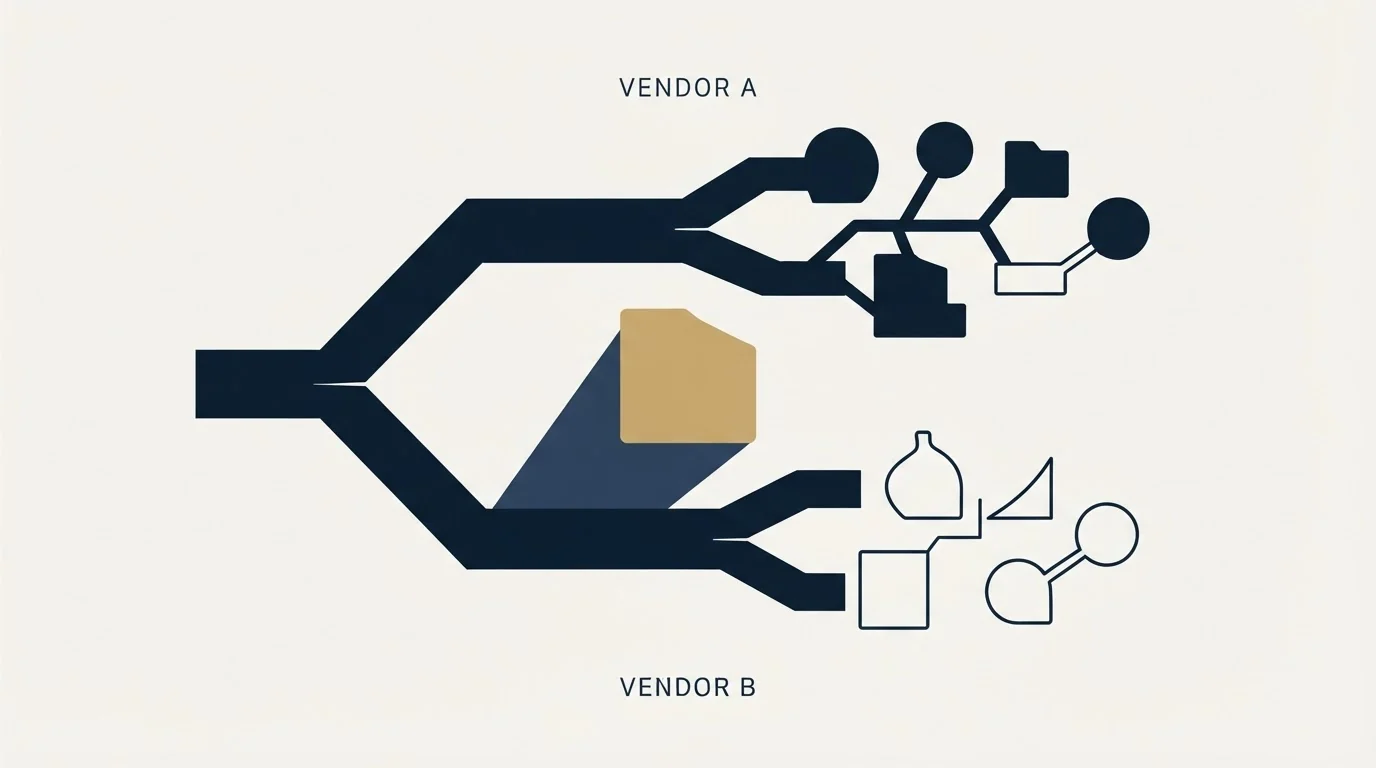
The intuitive split is by channel. One vendor runs email, the other runs the phone, and they do not overlap because they are doing different things.
They do overlap, because the prospect is one person. A finance director who gets an email on Monday and a call on Wednesday about the same offer experiences one company approaching them twice, and the fact that two suppliers were involved is invisible and irrelevant to them. Channel is a property of your supply chain. It is not a property of their inbox.
The split that holds is by account. Each vendor gets a disjoint set of companies, and the rule lives in your own list rather than in a shared document that both sides are trusted to respect. A named account belongs to exactly one vendor for the duration, and moving it is a deliberate act with a date on it.
Where the sets are genuinely disjoint the collision problem disappears, which is why the arrangements that work tend to be structural rather than negotiated: one vendor on a geography the other does not cover, one on a product line with a different buyer title, one on enterprise accounts and one on the segment below. Two vendors pointed at the same segment with a promise to coordinate is the arrangement to avoid, because the promise has to be kept every week by people who do not talk to each other.
- Step 1Draw the boundary on accounts, before either vendor sees a list
Geography, product line, segment or account tier. Not channel, because the prospect experiences one company rather than two suppliers.
- Step 2Hold one suppression list yourself and send the same file to both
Customers, live opportunities, partners and protected accounts. Update it on one schedule and push the update to both on the same day.
- Step 3Agree one written definition of the billable outcome
The same criteria, the same rejection window, the same valid reasons. Two definitions produce two numbers that cannot be compared.
- Step 4Write the no-touch rule into the list, not into a spreadsheet
Each vendor receives only its own accounts. A rule that depends on somebody remembering it is not a boundary.
- Step 5Set the review date and the decision it forces
A fixed window, then one primary partner or a documented reason to keep both.
What the duplication actually costs
Three costs, roughly in order of how often they matter.
The prospect. A person approached twice in a week by one company is less likely to answer either message, and a portion of them will mark one as spam rather than reply. That complaint is charged to whichever sending domain earned it, and on shared sending infrastructure the cost lands on other campaigns rather than on the one that caused it.
Your own market. Where the total addressable market is a few thousand companies, working it twice does not double the coverage. It halves the number of distinct companies you can approach with a fresh premise later, because the second approach has already been spent. What a lead generation agency costs treats cost per meeting as the comparison number, and cost per meeting quietly rises when two vendors are drawing from one finite pool.
The overhead you did not budget. Two onboardings, two ICP briefings, two copy approval cycles, two reporting formats to reconcile, and two sets of replies to route. That work is real and it lands on whoever owns the relationship on your side, which is usually one person who was already busy.
Running a genuine bake-off
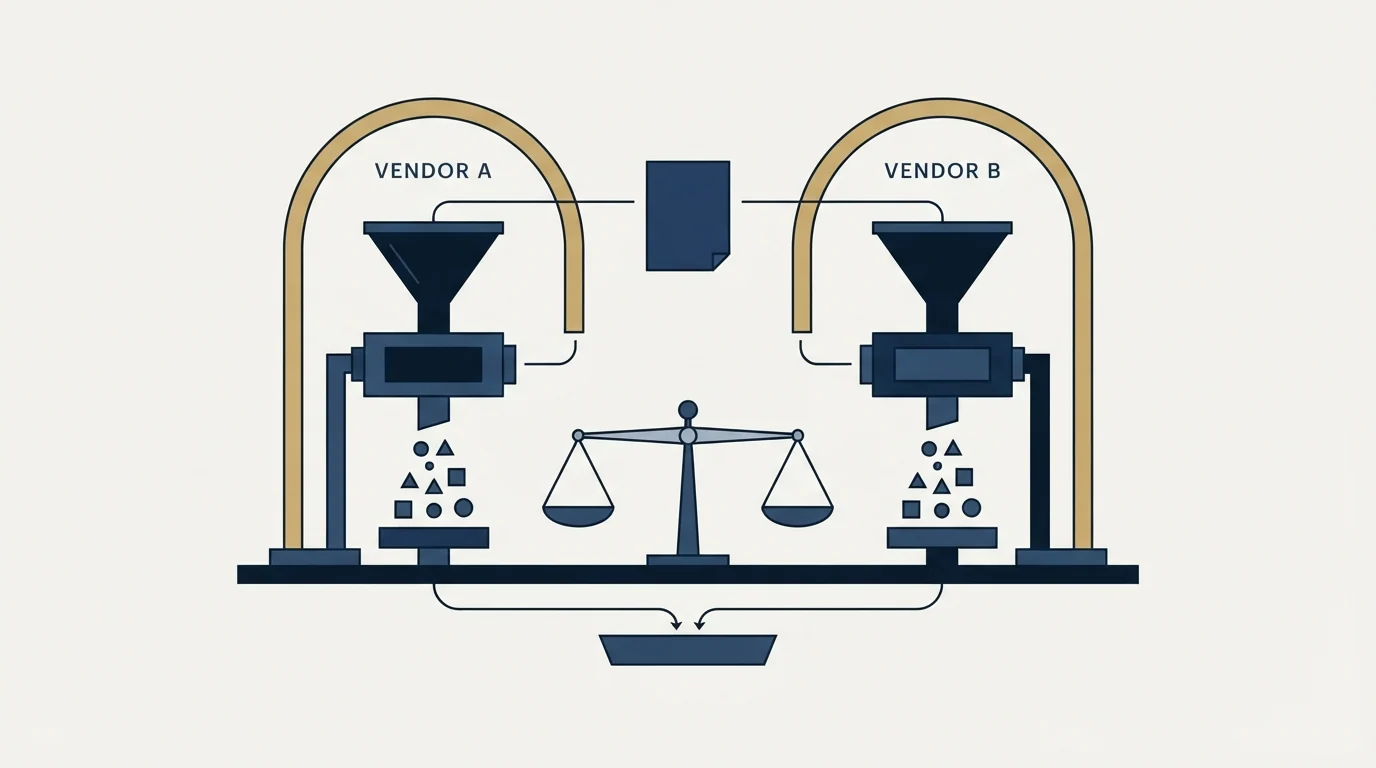
Comparing two vendors head to head is a legitimate reason to run both, and it needs a design or it produces a result nobody can act on.
Split the accounts evenly and randomly rather than by who looks more promising, because a vendor handed the better half wins on the split rather than on the work. Keep the offer identical, since a vendor testing a different proposition is answering a different question. Fix the window in advance and make it long enough to contain held meetings rather than booked ones, because the interesting difference between two vendors usually appears between booking and holding.
Then commit in advance to what the result decides. A bake-off with no decision attached becomes a permanent two-vendor arrangement by default, which is the expensive outcome arrived at without anyone choosing it.
- Yes: Each vendor has a disjoint, named account set
- Yes: One suppression list, held by you, pushed to both on the same schedule
- Yes: One written definition of the billable outcome, identical for both
- Yes: A stated rule for a prospect who replies to one and is on the other's list
- Yes: A review date, and what the result decides
- No: The split is by channel, with both vendors working the same accounts
- No: Overlap is prevented by both vendors agreeing to coordinate
- Depends: Both vendors are quoting the same offer to the same titles
The reply is the part people forget
A prospect who answers one vendor is not visible to the other, so they stay on the second list and receive the second approach after they have already declined the first. That is worse than an ordinary duplicate, because it is an approach to somebody who has just said no.
The fix is a rule agreed at kickoff: a reply of any kind, to either vendor, goes onto the shared suppression list within a day, and both sides act on it. It is unglamorous and it is the single highest-value coordination step in the arrangement, because it protects the population most likely to complain.
This is also where our own operating position matters, and it is worth stating as a position rather than as a standard. We run one message per campaign, with no bumps and no thread replies, so a person who does not answer is not written to again on the same premise. A second vendor sending a follow-up sequence into the same account set is doing something we would not do, and the two approaches do not merely differ in volume: they differ in what a non-reply is taken to mean. Establish which model each vendor runs before comparing their numbers, because a sequence and a single message produce very different reply counts from the same list.
When two vendors is the right answer
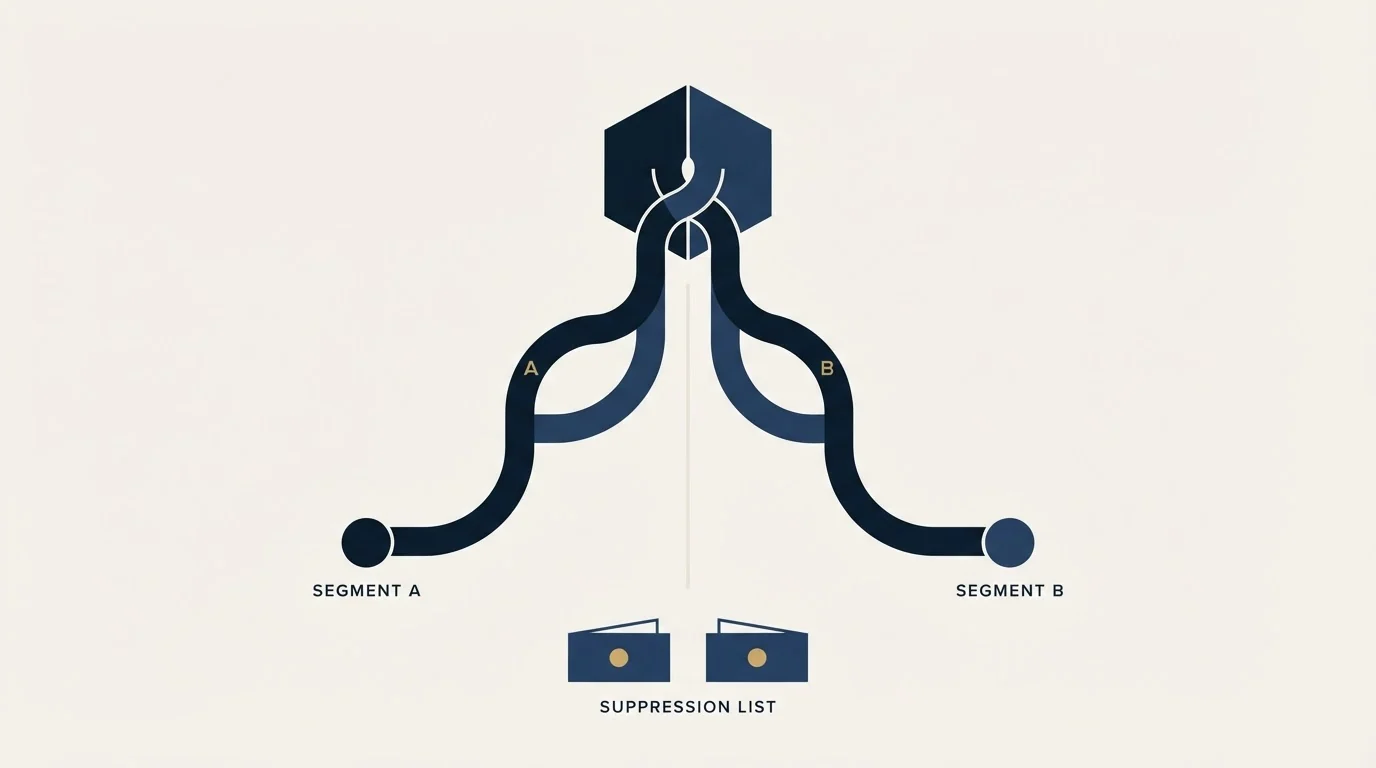
There are real cases, and they share a shape. The account sets are genuinely disjoint and would be even without a rule. The buyer titles differ enough that the messages are unrelated. One vendor holds a capability the other does not, such as a language, a market or a channel you do not run, and the accounts that need it are separable.
The case that is usually wrong is capacity. Adding a second vendor to the same segment because the first is not producing enough meetings assumes the constraint is the vendor's throughput. More often the constraint is the size of the list, the offer, or the definition of the meeting, and none of those is improved by a second supplier working the same pool. The five delivery models and the six diligence questions are the better places to look first, because both point at what you would be buying rather than at how much of it.
The short version
Two vendors collide because a suppression list answers what already happened and nothing answers what is queued to happen tomorrow, and neither vendor can see the other's queue. Split by account rather than by channel, since a prospect experiences one company rather than two suppliers. Hold one suppression list yourself, push updates to both on the same day, and agree that a reply to either vendor suppresses the prospect for both within a day. Use one written definition of the billable outcome or the comparison is meaningless. If the reason for the second vendor is capacity rather than coverage, check the list, the offer and the meeting definition first, because a second supplier working the same pool does not fix any of the three.
If you want the shape of a single-vendor arrangement with the meeting criteria agreed in writing before anything sends, you can see what a campaign would look like for your market.
Frequently asked questions.
Frequently asked questions- Can two lead generation agencies work for us at the same time?
- Yes, when their account sets are genuinely disjoint and the boundary is enforced in the lists you hand each of them rather than by a coordination promise. Split by geography, product line, segment or account tier. Both vendors working the same accounts and agreeing to coordinate is the arrangement that produces duplicate contact, because the promise has to be kept weekly by people who never speak.
- Will a shared suppression list stop two vendors contacting the same person?
- Only partly. A suppression list records contact that has already happened, so it catches customers, repliers and unsubscribes. It cannot catch a person sitting in the other vendor's campaign queue who has not been sent to yet, because neither vendor has read access to the other's pending sends. That gap is closed by giving each vendor a disjoint account list.
- Should we split two vendors by channel, one on email and one on the phone?
- That split reads clean on an org chart and fails in the prospect's week. A person who receives an email on Monday and a call on Wednesday about the same offer experiences one company approaching twice. Channel is a property of your supply chain rather than of their inbox. Split by account instead, so no prospect is in scope for both.
- How do we run a fair comparison between two lead generation vendors?
- Split the accounts evenly and randomly rather than by which half looks stronger, keep the offer identical, and use one written definition of a billable meeting for both. Fix a window long enough to contain held meetings rather than booked ones, and commit in advance to what the result decides, or the trial becomes a permanent two-vendor arrangement nobody chose.
About the author.

Ben Carden is CRO at RevenueFlow, which builds and operates outbound revenue engines for B2B companies. Previously at Gartner Enterprise. Studied at London School of Economics.
Ben Carden · CRO
Connect on LinkedIn →Explore more.
Ready to scale your outreach?
We build GTM engines that book real meetings. See the receipts.
Related articles.
Two Agencies, One Target List: Who Owns Which Accounts
Two outbound suppliers on one market will contact the same companies unless the buyer splits it first. How to cut the list, run the exclusion feed and check the overlap.
Last Outbound Agency Did Not Deliver: Locating the Failure
The leads were bad names a symptom and no stage. Four places an outbound engagement fails, the counts that separate them, and what to change in the next purchase.
5 ABM Campaign Examples and How Each One Is Built
Five worked account-based campaign examples, each built on the same five fields: account set, tier, plays in order, owner and handoff, and the exit condition.
HR Lead Generation: The Renewal Clock and Who Signs
An HR buyer who agrees with every word still cannot act outside their own renewal window. Which triggers are observable, and who signs.
IT Lead Generation: The Buyer Runs Your Playbook
Technology buyers evaluate outbound for a living, and their purchases carry a security review nobody in your meeting owns. Which triggers are real.
When Outbound Stops Scaling: What Breaks First
Doubling the budget rarely doubles the meetings. The five constraints that bind in order, the signature each one leaves in the numbers, and what actually buys more.