Qualified Lead Generation Services: What "Qualified" Means
Vendors mean four different things by qualified, and a price per lead is not a number until you know which one. What their own pages publish, and what they leave out.
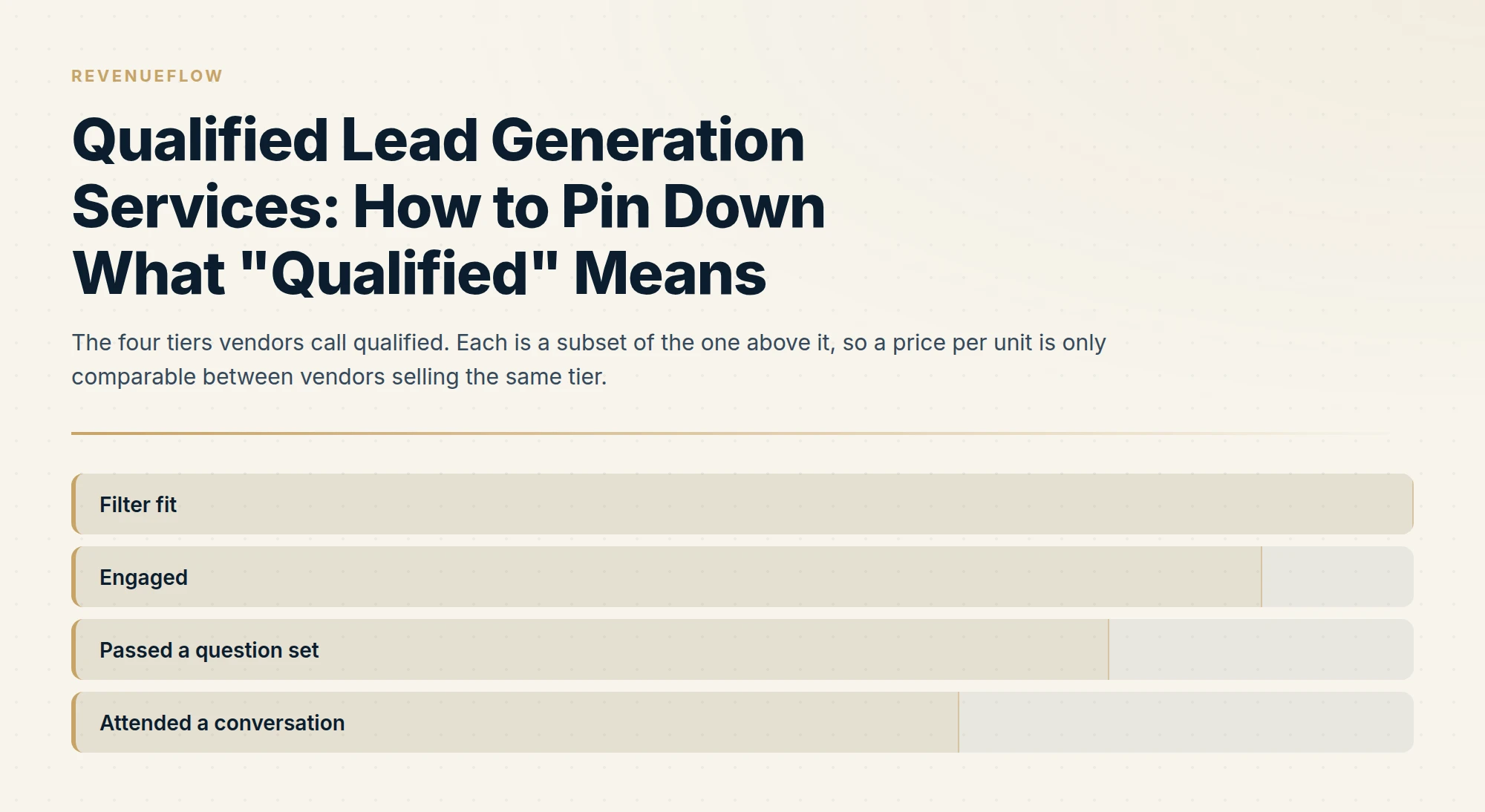
Qualified lead generation services use one word for four different depths: filter fit, engagement, a passed question set, and an attended conversation. A price per qualified lead is only comparable between vendors selling the same tier. Get the definition, the adjudicator and the dispute window in writing before discussing any rate.
Key takeaways
- Qualified covers four tiers: filter fit, engagement, a passed question set, and an attended conversation. Two quotes with the same unit price can differ by an order of magnitude in what they leave you to do.
- The shallower the tier, the more qualification labour stays with your team, so compare the vendor's price plus your own internal hours rather than the unit price alone.
- Vendors publish the unit and not the definition: Belkins lists plan tiers as 100+, 200+ and 30+ yearly appointments, Martal publishes 20 to 30 qualified leads a month, and SalesHive advertises 129K+ qualified meetings booked without publishing the standard.
- Budget, timing and authority make poor billing conditions because no vendor can control them. Keep them as qualifying questions the setter reports, never as invoice triggers.
Reviewed and updated September 2, 2026
A proposal arrives quoting a price per qualified lead, and the number looks reasonable against the last two quotes. Nowhere in the document does anybody say what makes a lead qualified. The word is carrying the entire commercial weight of the agreement and it is doing that job undefined, which means the vendor gets to decide what you receive after you have already agreed what you will pay for it.
This is the most consequential gap in the category and it is easy to close. It just has to be closed before the price conversation rather than after it, because the definition is what the price is a price of.
Four different things called qualified
Vendors are not being evasive when they use the word loosely. They genuinely mean four different things by it, and the four sit at very different depths in the same funnel.
The shallowest is filter fit. The contact matches the firmographic criteria you agreed: industry, headcount band, geography, job title. Nobody has spoken to them. What you receive is a contact record, and it is qualified in the sense that a search result is qualified.
Next is engagement. The contact did something: opened, clicked, replied without hostility, downloaded the thing. A human read the reply and judged it warm. This tier is where the word gets slipperiest, because a reply saying "who is this" and a reply saying "send me times" can both be logged as a positive response by somebody with a target to hit.
Third is a passed question set. Somebody asked the prospect a scripted series of questions and the answers cleared a bar. This is the BANT family, and it is the tier buyers most often ask for by name.
Deepest is an attended conversation. The prospect turned up to a meeting with your team and participated. Everything before this point is an intermediate artefact, and this is the only tier where the thing you bought is the thing your sellers actually consume.
Self-serve funnels invert that, since the five stages ClickFunnels builds its model around mostly assume the purchase completes on the page rather than in a booked conversation.
Matches the agreed firmographics. Nobody has spoken to them.
Opened, clicked or replied. Warmth judged by a human reading the reply.
Answered scripted questions and cleared a bar somebody set.
Turned up and participated. The only tier your sellers consume directly.
A price per qualified lead is not a number until you know which of those four rows it refers to. The gap between the top row and the bottom row is most of the work in an outbound programme, so two quotes with the same headline unit price can differ by an order of magnitude in what they cost you to use.
The work does not disappear, it moves
Here is the part that rarely makes it into a comparison spreadsheet. Every tier above the bottom one leaves qualification labour on your side of the line, and that labour has a cost you are already paying in salary.
Buy filter fit and your team does all of it: the sending, the replies, the chasing, the scheduling, the no-show recovery. You bought a list and a filter. Buy engagement and the vendor has absorbed the outreach and the first read of the reply, and your team still turns warm replies into calendar entries, which is the step where most of them evaporate. Buy a passed question set and the vendor has done the interrogation, though somebody on your side still has to book the meeting and get the prospect to attend it. Buy an attended conversation and the vendor carries all of it through to the moment somebody sits down.
So the diligence question worth asking every vendor is who reads the reply, because that is the step where the tiers actually differ and the one most likely to be answered by an automated classifier rather than by a person.
So the real comparison is the vendor's price plus the internal hours the tier leaves behind. A cheap unit at the top of the funnel is cheap because you are buying a smaller share of the work, and that is a perfectly sane thing to buy if you have the people to absorb it. It stops being sane when nobody has costed the hours and the leads pile up in a shared inbox that no owner was ever assigned.
The related trap is that top-of-funnel tiers are the easiest to produce in volume, so they are also the easiest to hit a target with. A vendor billed per filter-fit record has an incentive that points at record count, and record count is nearly free to generate. That is arithmetic rather than a character judgment, and it is the reason the tier and the billing unit have to be agreed in the same sentence.
A provider proposing to skip the buyer's own qualification process is proposing to move that labour back without saying so, and the tier and the billing unit are where that shows up before the first meeting does.
What the vendors actually publish

The pattern across the category is that vendors publish the unit and not the definition. That is verifiable rather than a suspicion, and the pages say so plainly.
Belkins builds its plan tiers around yearly appointment counts, listing 100 or more, 200 or more, and 30 or more for its small-business option, with no rates on the plans page at all. Its appointment setting page shows an average starter price from $5,000 and states that every package includes "manual lead research and validation according to your qualification criteria." That last phrase is the honest and correct answer, and it also hands the entire definition back to you. The criteria are yours to write, and they are not on the page because they cannot be.
Martal publishes a monthly production funnel for its outbound tier: 3,000 to 5,000 prospects targeted, 9,000 to 12,000 emails sent, 150 to 200 total responses, and 20 to 30 total qualified leads, with contract terms of a three month pilot campaign followed by a monthly subscription at a flat fee per month, priced on inquiry. The position of that qualified-leads row inside the funnel tells you a great deal: it sits below responses and above what Martal calls flipped leads, so the word there describes a subset of people who replied rather than people who attended anything.
SalesHive publishes no rate at all, setting each quote from the team model, the channel mix and a daily touch volume of 150, 250 or 500 plus, with no setup fees, no long-term contract and cancellation on written notice. Its home page advertises "129K+ Qualified meetings booked for our clients" alongside 2,285 clients and 47+ industries. That is a cumulative historical figure across every client the firm has ever had, and nothing on the page defines the qualifying standard behind it.
- Plan tiers listed as 100+, 200+ and 30+ yearly appointments
- Average starter price from $5,000 on the appointment setting page
- No rates at all on the plans and pricing page
- States research and validation run to your qualification criteria
- Outbound tier funnel shows 20 to 30 qualified leads a month
- Sits below 150 to 200 responses in the same published funnel
- Three month pilot, then monthly subscription
- Flat fee per month, quoted on inquiry
- No published rate; quote set on a call
- Priced by team model, channel mix and daily touch volume
- No setup fees, no long-term contract, cancel on written notice
- Advertises 129K+ qualified meetings booked, cumulative and undefined
None of this is a criticism of those three. Publishing a definition that will be renegotiated per client is genuinely hard, and a vendor who publishes a loose one is worse off than a vendor who publishes none. The practical consequence for you is simply that the definition will be drafted during your negotiation or it will not exist.
Why budget, timing and authority belong outside the billing
The most common thing a buyer tries to add is a BANT-style gate: the prospect must have a budget, must be buying inside some window, must be able to sign. It feels like tightening the specification. It actually breaks the model.
Budget, timing and authority are properties of a deal rather than properties of a meeting, and they are not properties any vendor can influence. Making them billing conditions asks the vendor to carry a risk they cannot manage, and there are only two ways that resolves. Either it gets priced back to you, because the vendor now has to run several times the volume to produce one billable unit, or it gets gamed, because the only lever available is coaching the prospect toward the answer that triggers the invoice. Both outcomes are worse than not having the clause.
There is a version of this that works well. Keep those questions in the script, have the setter report the answers, and use them to prepare properly and prioritise your calendar. The information is genuinely useful. What you avoid is letting the answers decide whether the meeting is billable. This is also the point where the general lead-management vocabulary stops helping: the MQL and SQL scoring model was built for inbound demand and does not transfer cleanly to a cold audience, which we set out in MQL vs SQL.
What a workable standard looks like

RevenueFlow is paid on attended meetings against criteria agreed in writing before launch, and our contracted standard has five points. The company is in the pre-approved audience. The participant has responsibility for or influence over the relevant area. The prospect agrees to a relevant business conversation. The prospect attends and participates. The prospect was not disclosed as an existing customer, active opportunity or suppressed account before outreach.
Budget, timing, authority and immediate intent are excluded on purpose, for the reasons above. Every one of the five is checkable afterwards by somebody who was not on the call, which is the property that makes a standard usable rather than decorative. If a criterion can only be assessed by the person who ran the meeting, it will be argued about rather than applied.
The adjudication mechanics matter as much as the wording. We book qualified prospects straight onto the calendar rather than holding them for review, and the client can cancel any booking. A held meeting counts as qualified unless the client flags it inside a three business day window with a reason that maps to the written criteria. "Wrong seniority for the area we agreed" is a valid rejection. "The call went badly" is not, because how a conversation felt is not something either side wrote down or can check. For the enforcement machinery underneath this in a pay-per-meeting agreement, including how a loose clause gets used, pay-per-appointment B2B goes further than this piece does.
- Yes: Which of the four tiers is the billable unit
- Yes: The definition in writing, in criteria a third party can check
- No: Whether budget, timing or authority appear as billing conditions
- Yes: Who adjudicates a disputed unit, by name
- Yes: How long you have to dispute, and what happens on silence
- Yes: What happens to a no-show: rebooked, credited, or billed
- Depends: Whether the same account can be billed twice in a period
The two questions that do the work
Ask every vendor to show you the definition in writing before you discuss price. A vendor who can produce one has thought about the problem, and a vendor who cannot is telling you the definition will be written by whoever is more motivated at invoice time. Neither answer is disqualifying on its own, and both are worth knowing on the first call rather than the first invoice.
Then ask to see the dispute process. Not whether one exists, which everybody says yes to, but the actual mechanics: who reviews, in what channel, inside what window, and what a rejection has to cite. A definition with no process behind it is a shared opinion, and shared opinions do not survive a slow month.
Everything else in vendor selection is downstream of those two answers. Which delivery model suits you and what each one costs is covered in the lead generation services guide, how the meeting purchase differs from the lead purchase in appointment setting vs lead generation, and what the best-documented vendors publish about their own terms in appointment setting companies. The diligence sequence for a shortlist sits in B2B lead generation companies.
The short version

Qualified describes four different depths of the same funnel, and a price per qualified lead is meaningless until you know which one is on offer. The shallower tiers leave qualification labour with you, so the comparison that matters is the vendor's price plus your own hours. Vendors publish the unit and not the definition, which is verifiable across their own pages. Budget, timing and authority make bad billing conditions because no vendor can control them. And a definition without a named adjudicator, a dispute window and a rule about what counts as a valid rejection is not a definition yet.
Get the standard written first, then find out what it costs. You can see what a campaign would look like for your market and what we would commit to in writing before anything sends.
Vendor pricing and terms verified against the vendors' own pages in mid-2026. All are subject to change; confirm current terms directly before contracting.
Sources: Belkins plans and pricing, Belkins appointment setting, Martal pricing, SalesHive pricing, SalesHive home
Frequently asked questions.
Frequently asked questions- What does qualified actually mean in a lead generation contract?
- It means whatever the contract says, and most contracts do not say. Vendors use the word for four different things: a contact matching your filters, a contact who engaged, a contact who answered a scripted question set, and a person who attended a meeting. Ask which tier is the billable unit before you discuss the rate attached to it.
- Should I ask a vendor to guarantee budget and decision authority?
- No. Budget, timing and authority are properties of a deal rather than of a meeting, and no vendor can influence them. Making them billing conditions either gets priced back to you or gets gamed by coaching prospects toward the answer that triggers an invoice. Keep them as questions the setter asks and reports back for your own preparation.
- How much do qualified lead generation services cost?
- Most publish nothing. Belkins shows an average starter price from $5,000 on its appointment setting page, while its plans page carries no rates at all, and SalesHive and Martal both quote per client after a call. Any published figure is an entry floor, and it is not comparable across vendors until you know which qualification tier it buys.
- What makes a qualified-lead definition enforceable?
- Three things beyond the wording. A named person on your side who adjudicates, a dispute window measured in business days with silence counting as acceptance, and a rule that a rejection must cite the written criterion it fails. Without those, the definition is a shared opinion, and shared opinions do not survive a slow month.
About the author.

Ben Carden is CRO at RevenueFlow, which builds and operates outbound revenue engines for B2B companies. Previously at Gartner Enterprise. Studied at London School of Economics.
Ben Carden · CRO
Connect on LinkedIn →Explore more.
Ready to scale your outreach?
We build GTM engines that book real meetings. See the receipts.
Related articles.
Last Outbound Agency Did Not Deliver: Locating the Failure
The leads were bad names a symptom and no stage. Four places an outbound engagement fails, the counts that separate them, and what to change in the next purchase.
Already Contracted With a Lead Generation Vendor: Run Two
Two vendors collide because neither can see the other's send queue. How to split by account, hold one suppression list, and run a bake-off that decides something.
B2B Lead Generation Companies by Pricing Model: 15 Vendors
Nine of fifteen B2B lead generation vendors publish a dollar figure and six publish none. The five pricing models behind the numbers, each figure cited to its page.
Lead Generation as a Service: What the Service Part Changes
Most vendors selling lead generation as a service have productised the scope and kept the price bespoke. What that trade buys you, and how to tell which half is fixed.
Lead Verification: What Each Check Actually Proves
Lead verification covers two different jobs. One asks whether a mailbox will accept mail, the other asks whether the person behind the row is real and lawful to contact.
5 ABM Campaign Examples and How Each One Is Built
Five worked account-based campaign examples, each built on the same five fields: account set, tier, plays in order, owner and handoff, and the exit condition.