B2B Appointment Setting Companies: What Each Publishes
Two major appointment setting vendors publish a starting price and two do not. What the published numbers actually say, and the three terms nobody prints.
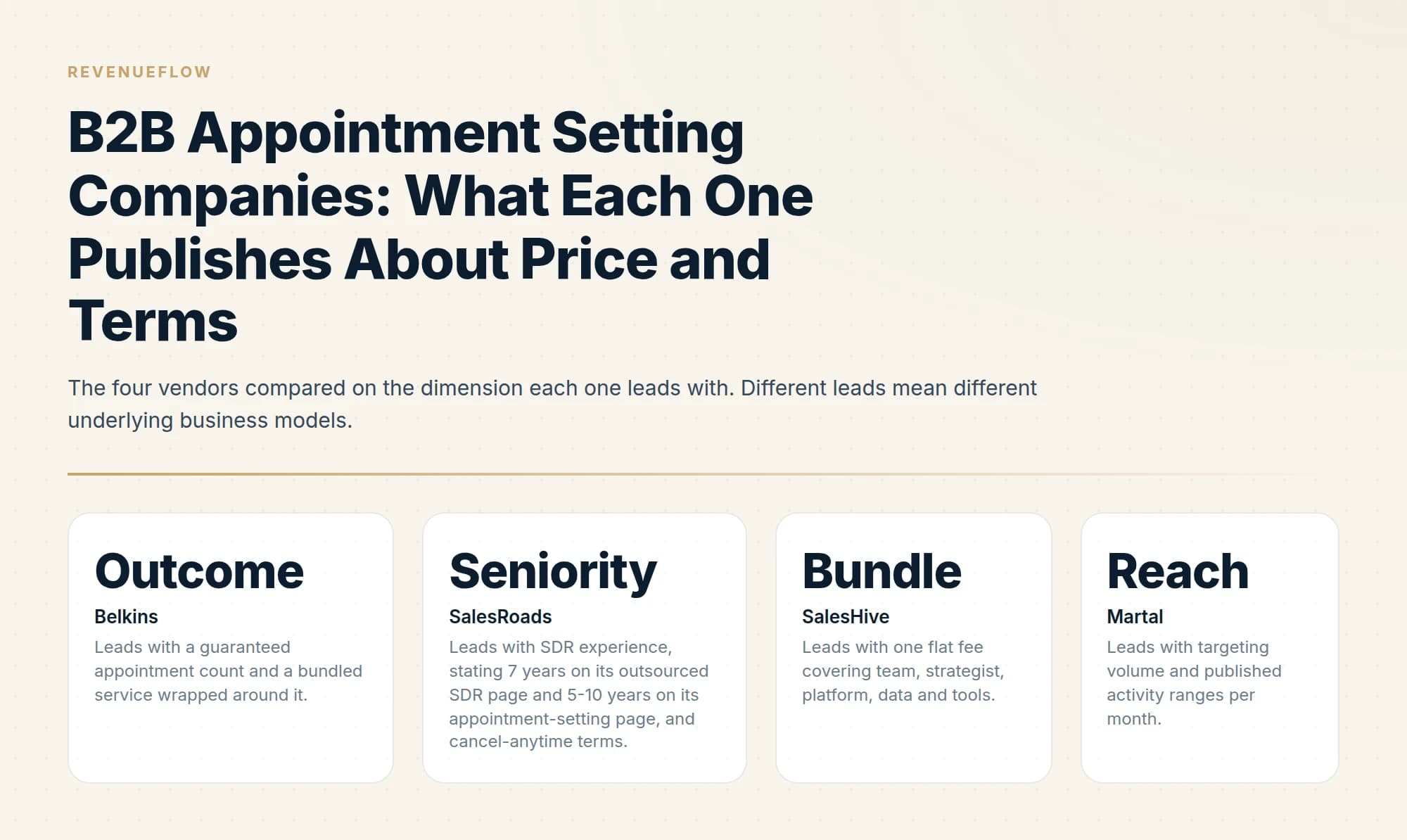
Most B2B appointment setting companies do not publish pricing. Belkins lists a starter from $5,000 including 100 guaranteed appointments a year, and SalesRoads lists one SDR at $11,950 per four weeks. SalesHive and Martal quote per client after a call.
Key takeaways
- SalesRoads quotes per four weeks, which is thirteen billing periods a year rather than twelve, so an $11,950 period is roughly $12,946 a month in annual terms.
- Guarantees differ in kind, not degree: Belkins commits to an appointment count, Martal publishes activity volumes, SalesRoads and SalesHive commit to neither and compete on cancel-anytime flexibility.
- Commitment length ranges from cancel-anytime at SalesRoads and SalesHive to a three or four month pilot at Martal, which is a real minimum spend.
- The meeting definition, the no-show policy and the dispute window decide what you receive, and none of the four publishes any of them.
Reviewed and updated September 21, 2026
Shortlisting appointment setting companies is harder than it should be, because most of them will not tell you what they charge until you have sat through a discovery call. That is a deliberate commercial choice, and it makes the category unusually opaque for something with a fairly standard delivery model.
Since transparency itself varies so widely, it is worth checking what happens when a vendor's pages disappear entirely, as with a vendor whose site vanished.
So rather than a ranked list, here is what the major vendors actually publish, what they deliberately leave off the page, and the three structural differences that matter more than any of the marketing.
That split between what a vendor prints and what it withholds repeats in adjacent categories, where the conversational tools left after Drift retired divide the same way on published rates.
What the published prices actually say
Two of the better-known vendors do publish numbers, and the numbers are not directly comparable.
- Starter from $5,000
- Quoted per month
- States 1,500 leads per month and 3 outreach channels
- States 100 guaranteed appointments per year
- One SDR $11,950 per 4 weeks
- Two SDRs $16,750, or $8,375 per rep
- Quoted per 4 weeks, not per month
- Cancel anytime, no commitment
- Flat monthly fee, quoted per client
- SalesHive varies by team location, channel mix and daily touch volume
- Martal runs a 3 to 4 month pilot before subscription
- Both require a call for numbers
The billing unit is the first trap. SalesRoads quotes per four weeks, which is thirteen billing periods a year rather than twelve. A single SDR at $11,950 per four weeks is roughly $12,946 a month in annual terms, not $11,950. That is not a hidden fee, it is on the page, but a spreadsheet comparing headline numbers across vendors will get it wrong unless somebody normalises it.
The second trap is that the published figure is a floor. "From $5,000" and a one-SDR price of $11,950 both describe entry configurations, and the configuration that matches your actual target market and volume is quoted separately.
Three differences that matter more than price
Buyers frequently say pricing is not the main factor when they are choosing between guaranteed meetings and a cheaper alternative, and the three structural differences below are what they are choosing between instead.
They guarantee different kinds of thing
This is the single biggest structural difference in the category and it is easy to miss because everyone uses the word "guarantee."
Belkins publishes a guaranteed appointment count: 100 appointments per year in the starter package. That is an outcome commitment, and it puts delivery risk on the vendor.
Martal publishes expected monthly output for its entry tier as activity ranges: 3,000 to 5,000 prospects targeted, 9,000 to 12,000 emails sent, 20 to 30 qualified leads. Those are volumes of work, and the two lead figures are expectations rather than guarantees.
SalesRoads and SalesHive publish no outcome guarantee at all, and instead compete on flexibility: both state you can cancel at any time.
None of these is wrong. A guaranteed appointment count transfers risk to the vendor and is priced accordingly. A cancel-anytime retainer transfers flexibility to you and leaves delivery risk where it was. What you must not do is read all three as the same promise.
Commitment length varies from zero to four months
SalesRoads and SalesHive both state no long-term contract and cancellation at any time. SalesHive adds that annual plans run at a lower monthly rate than month-to-month, which is the normal trade.
Martal structures the start as a pilot: three months for its outbound tier, four months for tiers that add sales commission. That is a real minimum spend before you can walk away, and it is defensible given ramp time, but it belongs in your comparison as a total-commitment figure rather than a monthly one.
Some are selling a team, others are selling an outcome
SalesHive describes one flat fee covering the SDR team, a strategist, the platform, data and tools, priced by team location, channel mix, and daily touch volume of 150, 250 or 500 plus. That is a staffing product: you are buying capacity, and the output follows from it.
Belkins describes a service wrapped around a guaranteed appointment count, including a sales audit, manual lead research against your qualification criteria, copywriting, booking and no-show recovery. That is an outcome product.
The distinction predicts how the relationship goes when results dip. With a staffing product, the answer is usually more activity or a different channel mix. With an outcome product, the vendor owns the problem.
What nobody publishes, and should
Three things are missing from essentially every vendor page, and all three are worth asking for in the first call.
- Yes: The written definition of a qualified meeting, in criteria you can check
- Yes: What happens to a no-show: rebooked, credited, or billed
- Yes: The dispute window and what counts as a valid rejection
- Depends: Who owns the sending domains at the end of the engagement
- No: Headline price is the whole cost
The meeting definition is the important one. A guaranteed appointment count is only as good as the definition of an appointment, and a vendor with a volume commitment has an obvious incentive to define it loosely. Belkins does publish that leads are researched and validated "according to your qualification criteria," which is the right shape, but the criteria themselves are agreed per client and are not on the page.
Domain ownership is the one people forget until the end. If the vendor bought and warmed the sending domains, walking away can mean losing the warmed infrastructure your results were built on, and starting again from cold somewhere else. The fix costs nothing if you arrange it at the start: buy the domains yourself and lend them to the vendor for the duration.
Deciding whether to source your own prospect emails matters just as much, and what these tools actually read on LinkedIn explains why many so-called scrapers guess at addresses instead of reading them directly.
Reading the numbers vendors do publish
Buyers who say a supplier's results sound too good to be true are usually reacting to a number of this kind, and the filter is the same one: ask whether the figure is cumulative, selected or forward-looking, since only the third describes an engagement like theirs.
Every vendor page carries statistics, and they are a different category of claim from pricing. Pricing is a commitment. A statistic is a selected historical result, and the selection is the point.
Belkins publishes that it has operated since 2017 across 40+ countries, resulting in 67,200+ deals, for clients in 50+ industries, with a regional breakdown running from 40,000+ appointments in North America down to 1,300+ in Africa. SalesRoads publishes 19+ years in business and individual case studies citing 937 and 1,100 appointments scheduled. Martal publishes expected monthly output ranges for its entry tier.
Three of those are different kinds of number and only one is a commitment.
Cumulative totals describe the vendor's whole history across every client. A total of 67,200 deals says the operation is large and long-running, which is genuinely useful information about stability and process maturity. It says nothing about what one client receives, because the denominator is unpublished.
Case-study figures describe a selected client. A case study showing 1,100 appointments is real, and it was chosen because it went well. The useful question is not whether it happened but what the median engagement looks like, which no vendor publishes and every vendor knows.
Forward-looking output ranges, like Martal's 3,000 to 5,000 prospects targeted and 20 to 30 qualified leads a month, are the most informative of the three, because they describe what a new client should expect rather than what a past client received. They are still expectations rather than guarantees unless the contract says otherwise, which is worth confirming in writing.
The practical filter: when a vendor quotes a statistic, ask whether it is cumulative, selected, or forward-looking. Only the third tells you anything about your engagement, and only a contractual version of it binds anyone.
Where the four differ most in practice

Leads with a guaranteed appointment count and a bundled service wrapped around it.
Leads with SDR experience, stating an average of 14 years on its pricing page and 5-10 years on its appointment-setting page, and cancel-anytime terms.
Leads with one flat fee covering team, strategist, platform, data and tools.
Leads with targeting volume and published activity ranges per month.
What a vendor leads with is a reasonable proxy for what they are confident about. A vendor leading with a guaranteed count is comfortable carrying delivery risk. A vendor leading with SDR tenure is telling you the quality of the conversation is the product. A vendor leading with bundle completeness is competing on simplicity of procurement. A vendor leading with volume is competing on reach.
None of those is a weakness, but each implies a different failure mode when things go wrong, and each suits a different buyer.
How to actually run the comparison
Normalise everything to one number and one page.
- Step 1Normalise the billing unit
Convert four-week pricing to annual, then divide by twelve. Thirteen periods is not twelve.
- Step 2Get the meeting definition in writing
From every vendor, before comparing prices. A cheap meeting on a loose definition is not cheap.
- Step 3Compute total committed spend
Monthly figure times the minimum commitment, including any pilot period.
- Step 4Divide by guaranteed output
Where a vendor guarantees a count, this is a real cost per meeting. Where they do not, mark it unknown rather than estimating.
That last step is worth being strict about. It is tempting to fill the unknown with the vendor's case-study numbers, but a case study is a selected result and not a commitment. Leaving the cell blank keeps the comparison honest, and the blank itself is information: it tells you which vendors are asking you to carry the delivery risk.
Beyond the four

The category is larger than the vendors above. Callbox, CIENCE, UnboundB2B, MarketJoy, LevelUp Leads and Superhuman Prospecting all operate in the same space, and none of them publishes standard rates either. The evaluation approach does not change: normalise the unit, get the definition in writing, and separate the outcome commitments from the activity commitments.
For the framework behind the definition itself, we set out what a workable qualified-meeting standard contains in appointment setting versus lead generation, and the equivalent cost breakdown for general lead generation retainers is in the lead generation agency cost guide. If you are weighing this against hiring, outsourced SDR versus in-house runs the build-versus-buy arithmetic.
The short version
Two of the four best-documented vendors publish a starting price, and their billing units differ enough that the headline figures mislead. Guarantees differ in kind rather than degree: one commits to an appointment count, one to activity volumes, two to nothing but flexibility. Commitment ranges from cancel-anytime to a four-month pilot. And the three terms that determine what you actually receive, the meeting definition, the no-show policy and the dispute window, appear on nobody's pricing page.
RevenueFlow is paid on attended meetings against criteria agreed in writing before launch, which is the definition-first version of this. You can see what a campaign would look like for your market.
Vendor pricing and terms verified against the vendors' own pages in mid-2026. All are subject to change; confirm current terms directly before contracting.
Sources: Belkins appointment setting, SalesRoads appointment setting, SalesRoads pricing, SalesHive pricing, Martal pricing
Frequently asked questions.
Frequently asked questions- How much do appointment setting companies charge?
- Published entry prices start from $5,000 at Belkins and at $11,950 per four weeks for one SDR at SalesRoads, but most vendors including SalesHive and Martal publish nothing and quote per client. Treat any published figure as a floor for an entry configuration rather than the price you will pay.
- Do appointment setting companies guarantee results?
- Some do and the guarantees are not equivalent. Belkins publishes a guaranteed appointment count of 100 a year in its starter package. Martal publishes expected activity volumes instead, which are work commitments rather than outcomes. SalesRoads and SalesHive publish no outcome guarantee and offer cancellation at any time.
- What should I ask an appointment setting company before signing?
- Ask for the written definition of a qualified meeting in criteria someone outside the call can check, what happens when a prospect does not show, and how long you have to dispute a meeting and on what grounds. None of these appear on vendor pricing pages, and all three determine what you actually receive.
- Why is comparing appointment setting quotes so hard?
- The billing units differ, the published figures are entry floors rather than real quotes, and the guarantees are different kinds of promise. Normalise every quote to an annual figure divided by twelve, then get each vendor's meeting definition in writing before comparing any prices at all.
About the author.

Ben Carden is CRO at RevenueFlow, which builds and operates outbound revenue engines for B2B companies. Previously at Gartner Enterprise. Studied at London School of Economics.
Ben Carden · CRO
Connect on LinkedIn →Explore more.
Ready to scale your outreach?
We build GTM engines that book real meetings. See the receipts.
Related articles.
B2B Lead Generation Companies by Pricing Model: 15 Vendors
Nine of fifteen B2B lead generation vendors publish a dollar figure and six publish none. The five pricing models behind the numbers, each figure cited to its page.
Lead Generation as a Service: What the Service Part Changes
Most vendors selling lead generation as a service have productised the scope and kept the price bespoke. What that trade buys you, and how to tell which half is fixed.
Lead Verification: What Each Check Actually Proves
Lead verification covers two different jobs. One asks whether a mailbox will accept mail, the other asks whether the person behind the row is real and lawful to contact.
5 ABM Campaign Examples and How Each One Is Built
Five worked account-based campaign examples, each built on the same five fields: account set, tier, plays in order, owner and handoff, and the exit condition.
Jotform Alternatives: The Meters Differ in Kind, Not in Size
Four form builders at similar headline rates count completely different things: per account, per form, per year, or per lead. That is what decides the bill.
Formstack vs Jotform: Two Meters, Two Different Buyers
One counts submissions per form, the other per account. One publishes a three-seat tier, the other one seat everywhere. Compliance lands in different places too.