Outsourced SDR vs In-House: The Cost Math on Your Numbers
The comparison most teams run is a salary against a retainer. Here is how to build both sides fully loaded, divide by meetings held, and adjust for ramp.
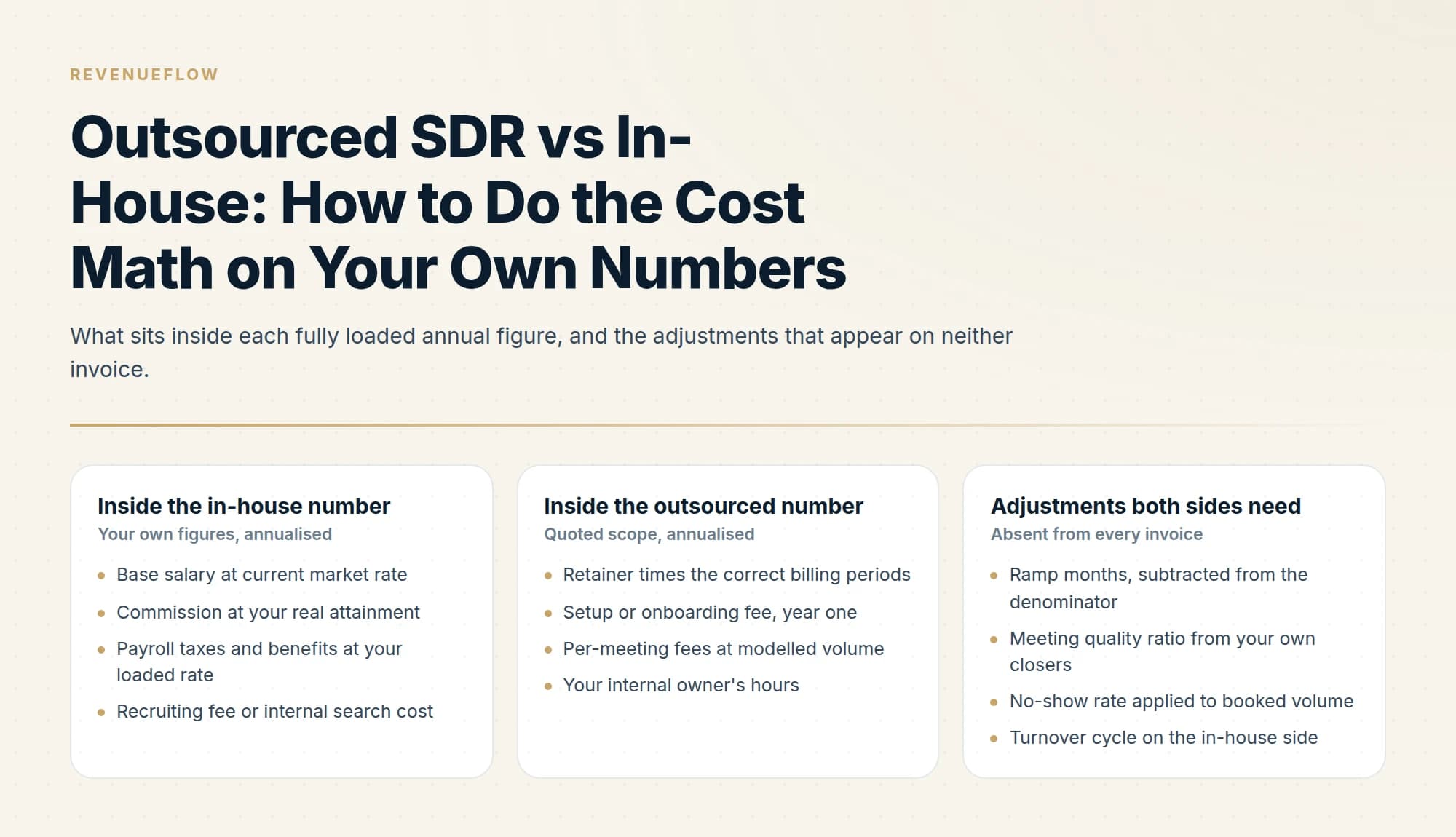
Comparing an SDR salary against an agency retainer compares one person's base pay against an invoice covering a rep, the team behind them, data, sending infrastructure and management. The honest comparison puts fully loaded annual cost against fully loaded annual cost, divides each by meetings actually held, and adjusts for ramp.
Key takeaways
- The in-house number has more lines than most people expect: base, commission at your actual attainment, payroll taxes and benefits, recruiting, tools and sending infrastructure, management time, and equipment.
- Every one of those lines should come from your own records rather than a published benchmark, because your recruiters, your last three offers and your finance team's burden rate are current and local in a way no range can be.
- Ramp is the line most comparisons omit entirely, and it removes months from year one, so the denominator is productive months rather than twelve.
- Divide each side by meetings actually held, not meetings booked, because a no-show costs the same as a held meeting on one side of the comparison and nothing on the other.
- Ask three vendors to quote against one written scope. A quote is a fact about your situation, which is more than any published price range can offer.
- Three conditions decide the choice ahead of cost: whether the pitch is repeatable, whether a manager exists to coach, and whether results are needed in weeks or months.
Reviewed and updated September 5, 2026
Outsourced SDR vs In-House: How to Do the Cost Math on Your Own Numbers
Most teams run this comparison as a salary against a monthly retainer. One of those figures is a single person's base pay. The other is an invoice covering a rep, the team behind them, the data, the sending infrastructure and the management. The agency loses a comparison it was never entered into.
The honest version compares fully loaded annual cost against fully loaded annual cost, divides each by the meetings actually held, and adjusts for ramp. The calculation is simple. It has more lines in it than most people expect, and every line has to come from your own figures.
Here is how to build both sides.
How this decision plays out depends on the seat you sit in. We keep persona-specific outbound guides for founders, SaaS founders, VPs of sales, SDR managers, RevOps leads, agency owners, consultants, recruiters, professional-services firms, and heads of marketing.
Why there are no salary figures in this article
The authoritative source for US occupational wages is the Bureau of Labor Statistics. Its site refuses automated requests with an HTTP 403, and its public data API does not carry occupational wage data. Every SDR salary benchmark circulating elsewhere is aggregator data with no checkable primary source behind it.
We publish no figure we cannot verify at source, so there is no salary band here, no on-target earnings range, and no cost-per-meeting benchmark.
You hold better inputs than any benchmark would give you anyway. Your recruiters know what SDRs are being placed at in your market this quarter. Your last three offers are a matter of record. Your finance team knows your burden rate to the decimal. Those numbers are current, local and true, which no published range can be for you at the same time. The line-by-line method for turning a base salary into a fully loaded annual figure is in SDR salary and the fully loaded cost.
Agency pricing works the same way. Ask three vendors to quote against one written scope. A quote is a fact about your situation.
One framing worth correcting before the arithmetic starts. The question is often asked as whether an agency is cheaper and better than hiring, and those are two questions with different answers. Cheaper is settled by the calculation below, on your own figures, and it frequently goes either way. Better is a question about which risk you would rather hold: a hire is capacity you direct and whose learning stays in the building, and an agency is an outcome somebody else is accountable for on infrastructure you do not have to build. A quote that looks decisively cheaper than a salary is usually comparing an invoice against a base rate rather than against a loaded one.
Everything below is arithmetic and calendar structure, and that part travels.
Building the in-house number
Teams already running outbound campaigns ourselves is the most common starting position for this comparison, and it changes the arithmetic rather than settling it: the in-house number below is then a real measured figure rather than an estimate, which makes the comparison sharper on both sides.
Anyone who suspects an in house sales team is too expensive should build this number before accepting the intuition, because the seven lines below routinely total to something quite different from the salary figure the objection was formed against.
Buyers who have decided against outsourcing meeting generation to an external agency have usually decided it on a number that was never built, and the arithmetic below is the version that survives being shown to a finance team.
Seven lines. Work down them with your own figures and put the total somewhere you can defend it.
Base salary. Take it from your recruiters or from the last three offers you made for the role. Use the number you would have to pay to hire this quarter, not the one you paid two years ago.
Commission at the attainment you actually see. Budget the full on-target variable, because a strong year will cost you all of it. Then model expected spend at the attainment your team genuinely averages, which your CRM can tell you if anyone has ever set a quota. For a first hire with no history, budget the full variable and treat any shortfall as a saving.
Payroll taxes and benefits. A percentage of cash compensation, and your finance team can give you the exact figure for your jurisdiction and your benefits package. Ask for the loaded rate they already use in headcount planning.
Recruiting. Either an agency fee, usually quoted as a percentage of base, or the internal cost of running the search: recruiter hours, hiring manager hours, and job board or sourcing spend. Price the route you would actually use.
Tools, data and sending infrastructure. Sum the monthly per-seat cost of the sequencer, the data provider, the mailboxes and domains, the dialler if you use one, and any enrichment credits. Multiply by twelve. Count only what this seat adds on top of licences you already hold.
Management time. Take the fully loaded cost of whoever will manage the rep, then multiply it by the share of their working week that coaching will take. Get that share by asking the manager how long a weekly one to one, call reviews and pipeline inspection actually take them. This is usually the largest surprise in the build.
Equipment and onboarding. Laptop, headset, licences, and the hours your team spends training somebody who is not yet producing. A one-off cost that returns with every replacement hire.
- Step 1Gather your own inputs first
Market base salary from recruiters or recent offers, your finance team's loaded benefits rate, your average quota attainment, your ramp length, your no-show rate. Do not start the model until you have these.
- Step 2Total the in-house year
Base, expected commission, payroll taxes and benefits, recruiting, tools and sending infrastructure, management time, equipment and onboarding. Build year one and a steady-state year separately, because recruiting and onboarding only appear in the first.
- Step 3Total the outsourced year
Retainer times the correct number of billing periods, plus setup fees, plus any per-meeting fees at your modelled volume, plus your own internal hours at their fully loaded cost.
- Step 4Convert calendar months into productive months
Twelve months minus the ramp months, on each side. The ramp is paid for in full and produces almost nothing, so it belongs in the cost and not in the output.
- Step 5Divide by meetings actually held
Cost per meeting equals fully loaded annual cost divided by meetings held during the productive months. Held, not booked.
- Step 6Test the assumptions that carry the result
Re-run with a low and a high meeting rate, apply your closers' quality ratio to the outsourced side, and apply your no-show rate. If the ranking flips, cost is not what is deciding this.
Two structural points about the total. It is a year-one number, and a steady-state year is lower, because recruiting and onboarding fall away while everything else stays. And it repeats: the role has high churn, so recruiting, onboarding and ramp return on whatever cycle your own retention data shows.
Ramp: what your first year actually buys
A new SDR is unproductive at the start. They are learning the product, the objections, the systems and the market. That period is paid for in full and produces very few meetings.
Take the ramp length from your own history. Ask your sales leader how long the last two hires took to reach a normal month, and use that figure.
Then do the subtraction. Twelve calendar months minus the ramp months gives you the productive months your year-one spend buys. A steady-state year buys twelve, until the rep leaves.
- Before day oneThe search
Weeks of recruiter and hiring manager time, with no output at all. Cost lands in year one whether the hire works out or not.
- From day oneRamp
Full salary, full benefits, full tooling, very few meetings. Use your own historical ramp length rather than an assumed one.
- After ramp, to month twelveProductive months
Twelve minus your ramp length. This block is the denominator for year-one cost per meeting, and it is the number the naive comparison quietly assumes is twelve.
- Year twoSteady state
Twelve productive months. Recruiting, equipment and onboarding have gone, so the annual cost drops while output rises.
- On departureThe cycle restarts
Search, ramp and onboarding return together. Run this at whatever interval your own tenure data shows, not at a benchmark interval.
Outsourced programmes ramp too. It is usually shorter, because the vendor already has the infrastructure, the data and a team who have run the motion before, but the first weeks go on list building, copy and domain warm-up. Ask the vendor how many weeks pass before meetings land, and put that into the same subtraction.
Building the outsourced number
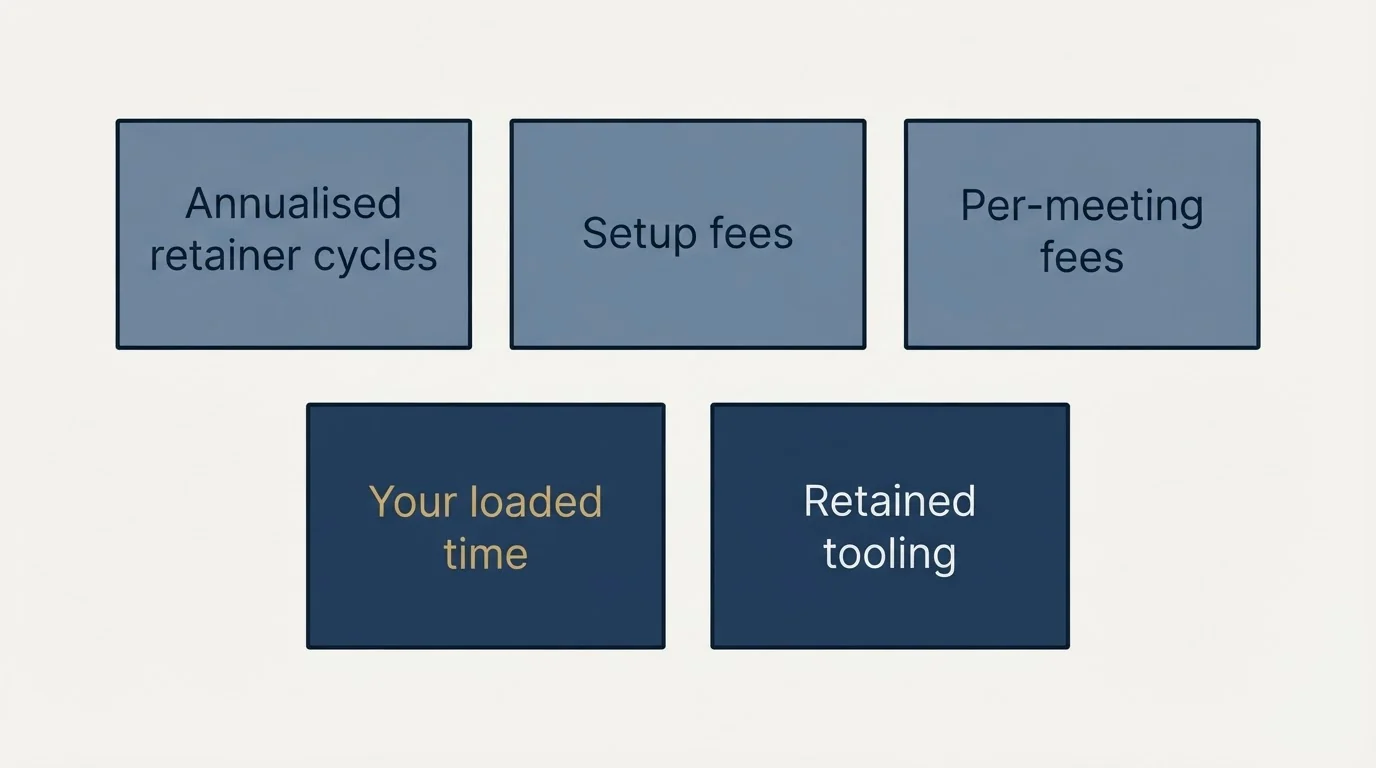
The invoice is not the whole cost on this side either.
The retainer, annualised correctly. Twelve months if you are billed monthly. If the vendor bills in four-week cycles, a year contains thirteen of them, and that extra period is a full cycle of spend that never appears in a monthly budget line.
Setup or onboarding fees. One-off, and they belong in year one exactly as your equipment line does.
Per-meeting or per-appointment fees, where the model carries them. Multiply by the meeting volume you are modelling, and note that this line grows when the programme works.
Your own time. Somebody internally owns the relationship, reviews replies, approves copy and handles escalation. Price those hours at their fully loaded cost, the same way you priced management time on the in-house side. Clients forget this line, and forgetting it is why programmes nobody looks at underperform.
Tooling you keep. A CRM seat, a calendar tool, sometimes a shared inbox. Usually small, still worth listing.
- Base salary at current market rate
- Commission at your real attainment
- Payroll taxes and benefits at your loaded rate
- Recruiting fee or internal search cost
- Sequencer, data, mailboxes, domains, dialler
- Management hours at fully loaded cost
- Equipment and onboarding, year one
- Retainer times the correct billing periods
- Setup or onboarding fee, year one
- Per-meeting fees at modelled volume
- Your internal owner's hours
- CRM and calendar seats you keep
- Any data or tooling excluded from the scope
- Ramp months, subtracted from the denominator
- Meeting quality ratio from your own closers
- No-show rate applied to booked volume
- Turnover cycle on the in-house side
- Contract exit terms and domain ownership
- Management attention the programme still consumes
Divide by meetings actually held
Teams reach this arithmetic from either direction, and the phrasing usually arrives as cost per qualified meeting booked rather than as a cost model: the question is what the meetings that actually held last month cost, once every input is counted rather than just the ones that arrive as invoices.
One figure decides this. Fully loaded annual cost divided by meetings held, across the productive months your spend buys. Run it for the in-house first year, for an in-house steady-state year, and separately for each vendor quote.
Three assumptions move the answer more than anything in the cost build.
The meeting rate. A strong rep and an average rep are a long way apart on monthly output, and whichever figure you plug in carries the whole comparison. Model a low case and a high case on both sides. If the ranking flips between them, cost has not decided this and something else has to.
A team already running it in house is in the strongest position to use this arithmetic, and usually the least likely to run it, because the in-house cost is already being paid and therefore feels like zero. It is not zero and the lines above are where it hides: the fully loaded seat, the ramp already spent, the tooling attributable to the seat, and the founder or manager hours going into list building and reply handling. Run the same division on the motion you have now, then compare. The answer is frequently to keep it in house, and it is worth reaching that answer with a number attached.
Meeting quality. A rep sitting in your building hears the objections, joins the discovery call and adjusts by Thursday. Most outsourced programmes have a longer loop. If your closers convert internally sourced meetings at a higher rate, apply that ratio to the outsourced cost per meeting before comparing. Ask your closers for the ratio; they will have a view within a day.
Buyers ask whether outsourced meetings convert at a lower rate than internally sourced ones, and the answer is that it is measurable rather than assumed: ask your own closers for the ratio, apply it to the outsourced cost per meeting before comparing, and treat a large gap as a feedback-loop finding rather than as a verdict on the model.
Attendance. Cold-sourced meetings get no-shows. Contract on attended meetings. Your calendar data gives you the attendance rate for internally sourced meetings, and any vendor worth signing will tell you theirs.
The three conditions that actually decide it
A team whose in-house SDRs are performing well already has the strongest version of this argument, and the comparison still has one useful thing to say. Run the numbers on the marginal seat rather than on the existing team, because the question is never whether the current reps work but whether the next one is the cheapest way to buy the next meeting.
Cost is rarely the deciding factor. These three usually are.
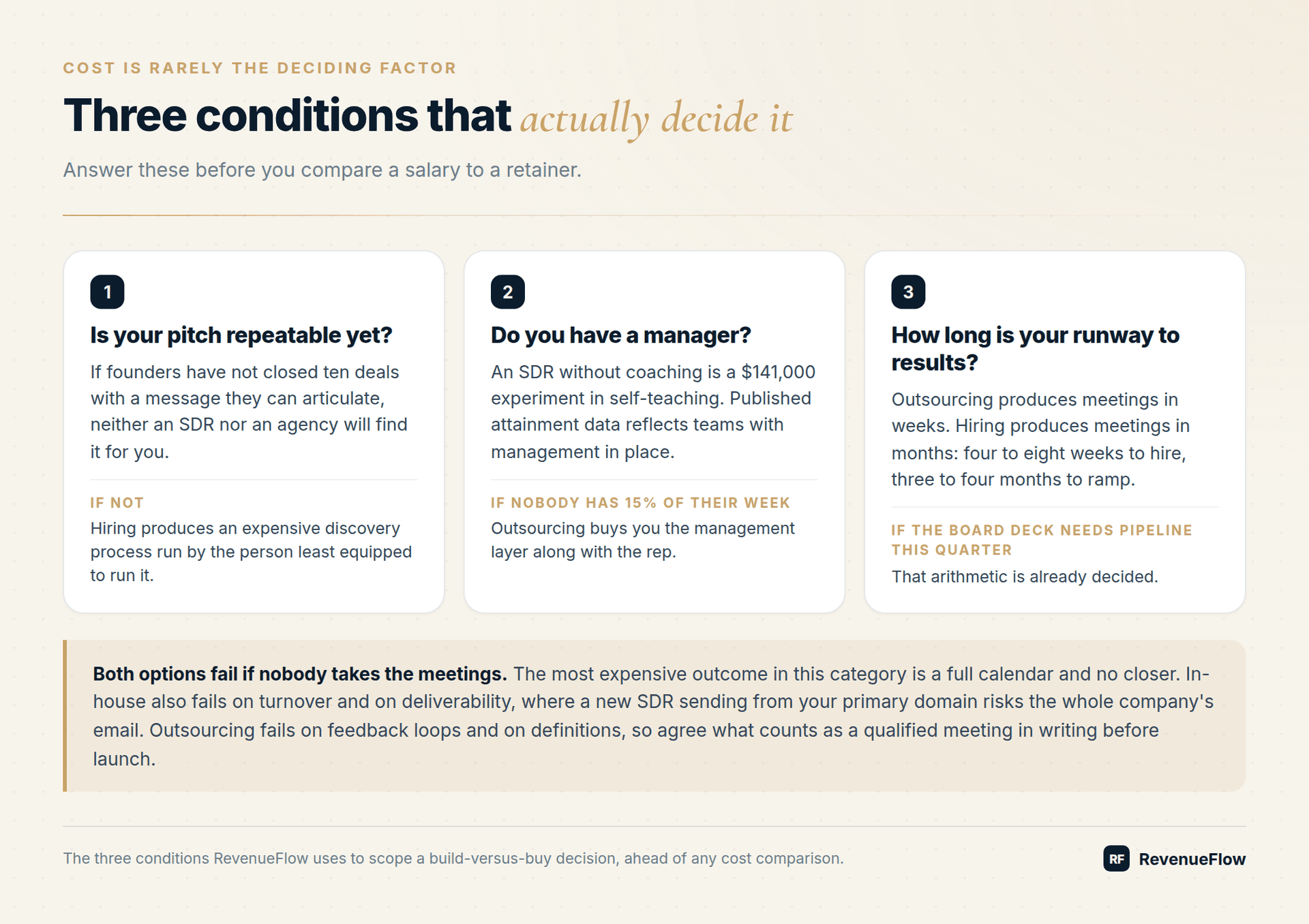
1. Is your pitch repeatable yet? If your founders have not closed deals repeatedly with a message they can articulate, neither an SDR nor an agency will find it for you. Hiring at that stage funds an expensive discovery process run by the person least equipped to run it.
2. Do you have a manager? An SDR without coaching is an expensive experiment in self-teaching. If nobody has real hours in their week for call reviews and pipeline inspection, outsourcing buys the management layer along with the rep, and that layer is a large part of what a retainer covers.
3. How long is your runway to results? Outsourcing produces meetings in weeks. Hiring produces meetings after a search and then a ramp. If the board deck needs pipeline this quarter, the calendar has already answered the question.
Where each option quietly fails
High employee turnover in a sales team belongs in this comparison as a cost line rather than as a separate people problem, because the search, the ramp and the onboarding return together on whatever cycle your own tenure data shows, and the understanding of what works leaves with the person.
In-house fails on turnover. When a rep leaves, their understanding of what works leaves with them. Documented sequences and recorded calls are the only defence, and most teams build neither.
In-house fails on infrastructure. Deliverability is a specialist operational job. A new SDR sending cold volume from your primary domain puts the whole company's email at risk, not only their own quota.
Outsourcing fails on feedback loops. The distance grows between what the market says and what your product team hears. The fix is a weekly call where somebody reads actual replies instead of a dashboard.
Outsourcing fails on definitions. If a qualified meeting has not been defined before launch, month three becomes an argument about it.
Both fail if nobody takes the meetings. The most expensive outcome in this category is a full calendar and no closer.
- Yes: A written definition of a qualified meeting, with firmographic and seniority criteria
- Yes: You pay for meetings that are attended
- Yes: A stated no-show and reschedule policy
- Yes: Named owner on your side, with the hours costed into the model
- Yes: Who owns the sending domains, and what happens to them if the engagement ends
- Yes: A weekly review in which somebody reads real replies
- No: Volume targets with no quality criteria attached to them
- No: A meeting definition left to be settled once meetings start arriving
The third option nobody prices
The build-versus-buy framing hides a third path: one operator running an automated system in place of a team of reps. Much of what an SDR does daily, including list building, research, sequencing and follow-up scheduling, is mechanical, which is the argument in the five things SDRs are hired to do that can be automated and in the stack that replaces an SDR seat.
The honest caveat is that the operator is not free and is harder to hire than an SDR. That role is emerging as its own function, described in the traditional SDR function is dying, meet the GTM engineer. The arithmetic wins on scale: one operator serves the whole team, while SDR cost climbs in step with pipeline targets.
Cost this path the same way as the other two. Operator salary, loaded, plus the tooling, divided by the meetings the system produces in its productive months. If the shortlist includes software as well as people, the comparison in AI appointment setters vs human setters vs agencies extends the same method.
When an agency like us is the wrong answer
We run outbound end to end and charge only for qualified meetings that are attended. Hire in-house instead when your ICP is a few hundred named accounts and relationship depth beats volume, when your sales cycle needs the same person from first touch to close, when regulated or consent-only channels restrict unsolicited contact, or when you genuinely need a bench to promote from and the SDR seat is a training ground for future closers. That last one is a legitimate reason to accept a worse cost per meeting, and it never appears in agency pitches.
For the wider pricing picture across service models, see what a B2B lead generation agency actually costs.
If outsourcing wins on your numbers, we only charge for qualified meetings that are actually attended, with the definition agreed in writing before launch. See if you qualify for a free campaign.
This article deliberately contains no salary, pricing or cost-per-meeting benchmarks. Occupational wage data from the Bureau of Labor Statistics is not available to automated access, and aggregator figures cannot be verified at source, so the method above runs on figures you can obtain and check yourself.
Frequently asked questions.
Frequently asked questions- How much does an in-house SDR really cost per year?
- More than the salary, and the multiplier depends on figures only you hold. Build it line by line: base, commission at your own attainment rate, payroll taxes and benefits at your finance team's burden rate, recruiting, tools and sending infrastructure, a share of a manager's time, and equipment. We publish no benchmark here because no verifiable source exists for one.
- Is outsourcing SDRs cheaper than hiring?
- That depends entirely on your own two numbers, and the comparison is only meaningful once both sides are fully loaded and divided by meetings actually held. Watch two things that reverse the answer: whether the agency bills on booked or attended meetings, and whether the in-house rep produces better-qualified meetings than the agency does.
- Why does this article not give SDR salary figures?
- The authoritative source for US occupational wages is the Bureau of Labor Statistics, whose site refuses automated requests and whose public data API does not carry occupational wage data. Every benchmark circulating elsewhere is aggregator data with no checkable primary source. We publish no figure we cannot verify at source.
- How long does it take an SDR to ramp?
- Long enough that it belongs in the arithmetic rather than in a footnote. Count the weeks to hire and the months to full productivity, subtract both from year one, and divide the annual cost by the productive months that remain. An outsourced programme starts sooner, which is the deciding factor when a quarter is already behind.
- When should you hire an SDR instead of outsourcing?
- Hire in-house when your target list is a few hundred named accounts where relationship depth beats volume, when the same person needs to carry a deal from first touch to close, when regulated channels restrict unsolicited outreach, or when the SDR seat is deliberately a training ground for future closers.
About the author.

Ben Carden is CRO at RevenueFlow, which builds and operates outbound revenue engines for B2B companies. Previously at Gartner Enterprise. Studied at London School of Economics.
Ben Carden · CRO
Connect on LinkedIn →Explore more.
Ready to scale your outreach?
We build GTM engines that book real meetings. See the receipts.
Related articles.
Demand Generation Agency vs Cold Outbound: Which You Need
Demand gen builds awareness, outbound harvests it. 2026 pricing for both, a three-test decision rule, and the market conditions where each one fails.
Cold Email Agency: What You Get and What It Costs
What a cold email agency delivers, 2026 pricing across retainer, per-meeting and hybrid models, the in-house comparison, and when hiring one is wrong.
Sales Activity Tracking: What the Record Has to Say
Most activity tracking fails at capture rather than analysis. The unit you count decides what every later number can mean, and no tool fixes a wrong choice.
Sales Commission: A Plan That Survives a Bad Quarter
The headline rate is the last decision, not the first. How to derive a commission plan from contract value and margin, and the clauses that decide a bad quarter.
Sales Crediting: Who Gets Paid on a Four-Person Deal
Crediting decides who is recorded as earning a sale, and it is a separate decision from the rate. Settle the rule before the quarter, not after the close.
The Seven-Step Sales Process: What Each Step Assumes
Prospecting through follow-up, walked one box at a time. Each of the seven steps carries an assumption about the buyer, and most of them have quietly stopped holding.