B2B Companies Hire SDRs for 5 Things That Can Be Automated
Prospect, enrich, qualify, outreach, book. Each of the five jobs inside an SDR role now has a mature tooling category behind it. Here is the stack, and what is left for a human afterwards.
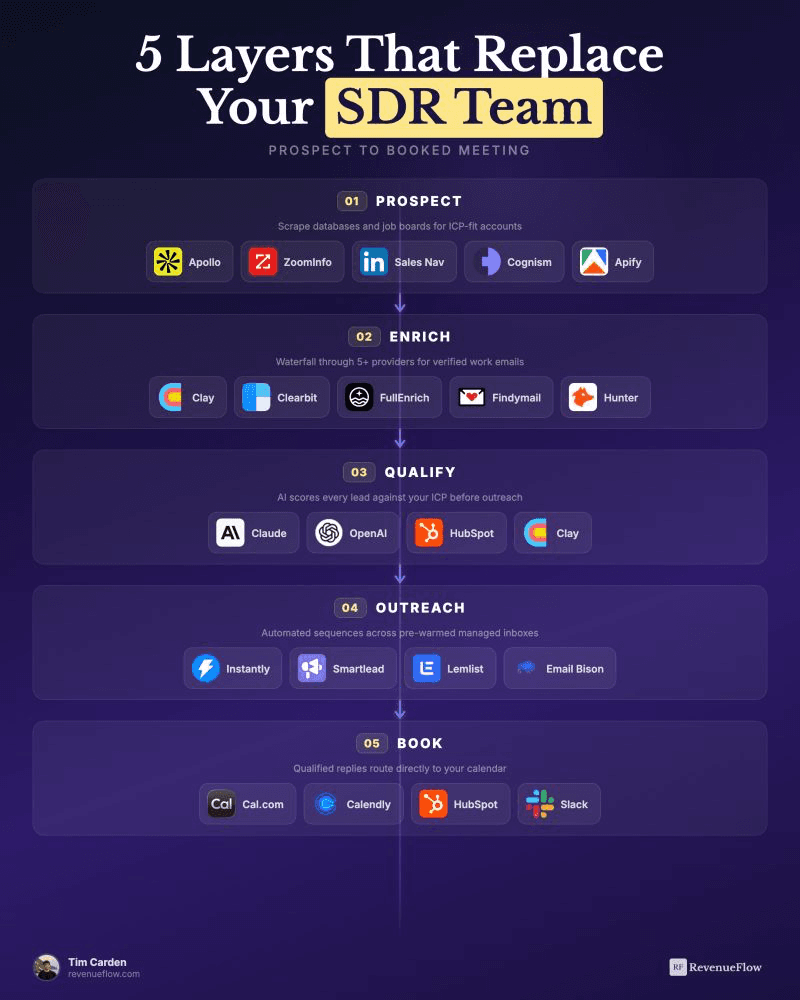
SDRs perform five distinct tasks: prospecting, enriching contact data, qualifying leads, executing outreach, and booking meetings. Each task now has mature automation tools available. Apollo and ZoomInfo handle prospecting, Clay and FullEnrich waterfall email enrichment, AI models score qualification, Instantly and Smartlead manage sequences, and Calendly routes replies to calendars. What remains for humans is strategic work: defining ideal customer profiles, crafting offers, handling live conversations, and correcting scoring errors.
Key takeaways
- The SDR role consists of five automatable tasks: prospecting, enriching data, qualifying leads, executing outreach sequences, and booking meetings.
- Waterfall enrichment through multiple providers delivers meaningfully better contact coverage than any single database, especially for smaller companies and non-US geographies.
- Qualifying leads before enriching them reduces data spend on every campaign by filtering out bad-fit accounts before paying to find their contact information.
- Automating response routing converts reply latency from a staffing problem into a configuration problem, preventing prospects from moving on during delays.
- The tasks being automated are the same repetitive activities that traditionally taught new SDRs the craft, removing the apprenticeship pathway to senior roles.
Reviewed and updated September 5, 2026
Most B2B Companies Hire SDRs to Do 5 Things
Write down what an SDR actually does in a week and you get five distinct jobs bundled into one headcount.
Prospect. Enrich. Qualify. Outreach. Book.
Each of those now has a mature tooling category behind it. That is why the role is being unbundled rather than eliminated, and why "are SDRs dead" is the wrong question to argue about.
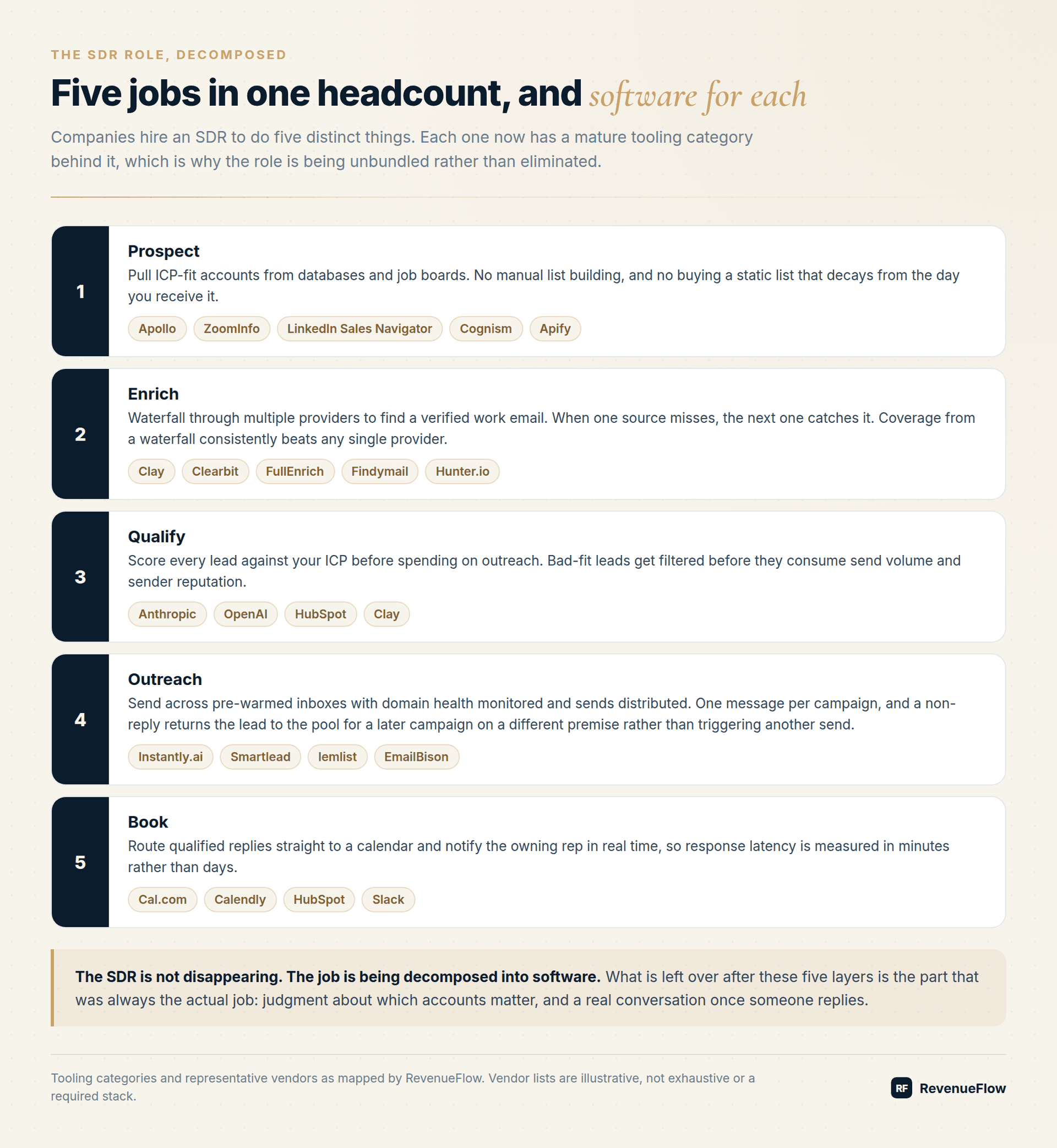
1. Prospect
Apollo, ZoomInfo, LinkedIn Sales Navigator, Cognism, and Apify pull ICP-fit accounts from databases and job boards automatically.
The change here is not speed. It is freshness. A static list starts decaying the moment you export it, because people change jobs and companies change shape. Pulling on demand against filters means the list reflects reality at the time you send, not at the time you bought it.
2. Enrich
Clay, Clearbit, FullEnrich, Findymail, and Hunter.io waterfall through multiple providers to find verified work emails. If one source misses, the next one catches it.
Waterfall coverage is meaningfully better than any single provider. No individual database has complete coverage of any market, and the gaps are not random. They cluster around smaller companies, non-US geographies, and recently changed roles, which is often exactly where your best-fit accounts live.
3. Qualify
This is the layer most teams skip, and skipping it is expensive.
Score every lead against your ICP before you spend on outreach. Anthropic and OpenAI models, HubSpot scoring, and Clay's AI columns all do this. Bad-fit leads get filtered out before they consume send volume.
The sequencing is the point. Qualifying after enrichment means paying to find emails for companies you were never going to contact. Qualifying first, using cheap signals like the website and firmographics, cuts enrichment spend on every campaign.
It also protects deliverability. Sending to people who have no reason to care produces the engagement pattern that mailbox providers use to identify spam.
4. Outreach
Instantly.ai, Smartlead, lemlist, and EmailBison run sequences across pre-warmed inboxes. Domain health is monitored. Sends are distributed across mailboxes. Follow-ups fire on schedule.
The unglamorous half of this layer is infrastructure. Domains, DNS records, warmup, and rotation determine whether anything you send arrives at all. Teams consistently over-invest in copy and under-invest in the pipes that carry it.
Which stages inside this layer can safely run unattended, and which need a person reading the output, is worked through in cold outreach automation.
5. Book
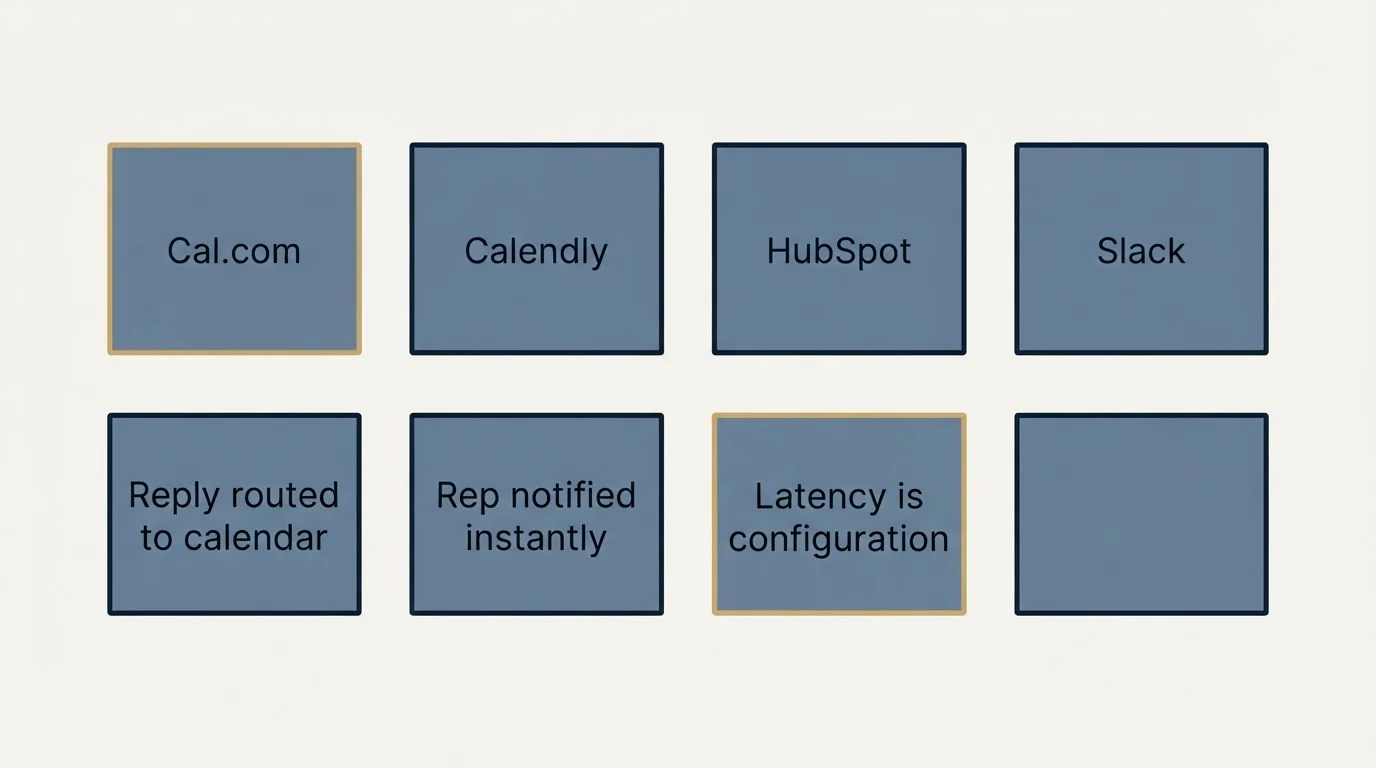
Cal.com, Calendly, HubSpot, and Slack route qualified replies directly to a calendar and notify the rep in real time.
Response latency is the quietest killer in outbound. A prospect who replies at 9am and hears back at 4pm the next day has already moved on. Automating the routing turns that from a staffing problem into a configuration problem.
What Is Actually Left
Strip out those five layers and something remains. It is worth being precise about what.
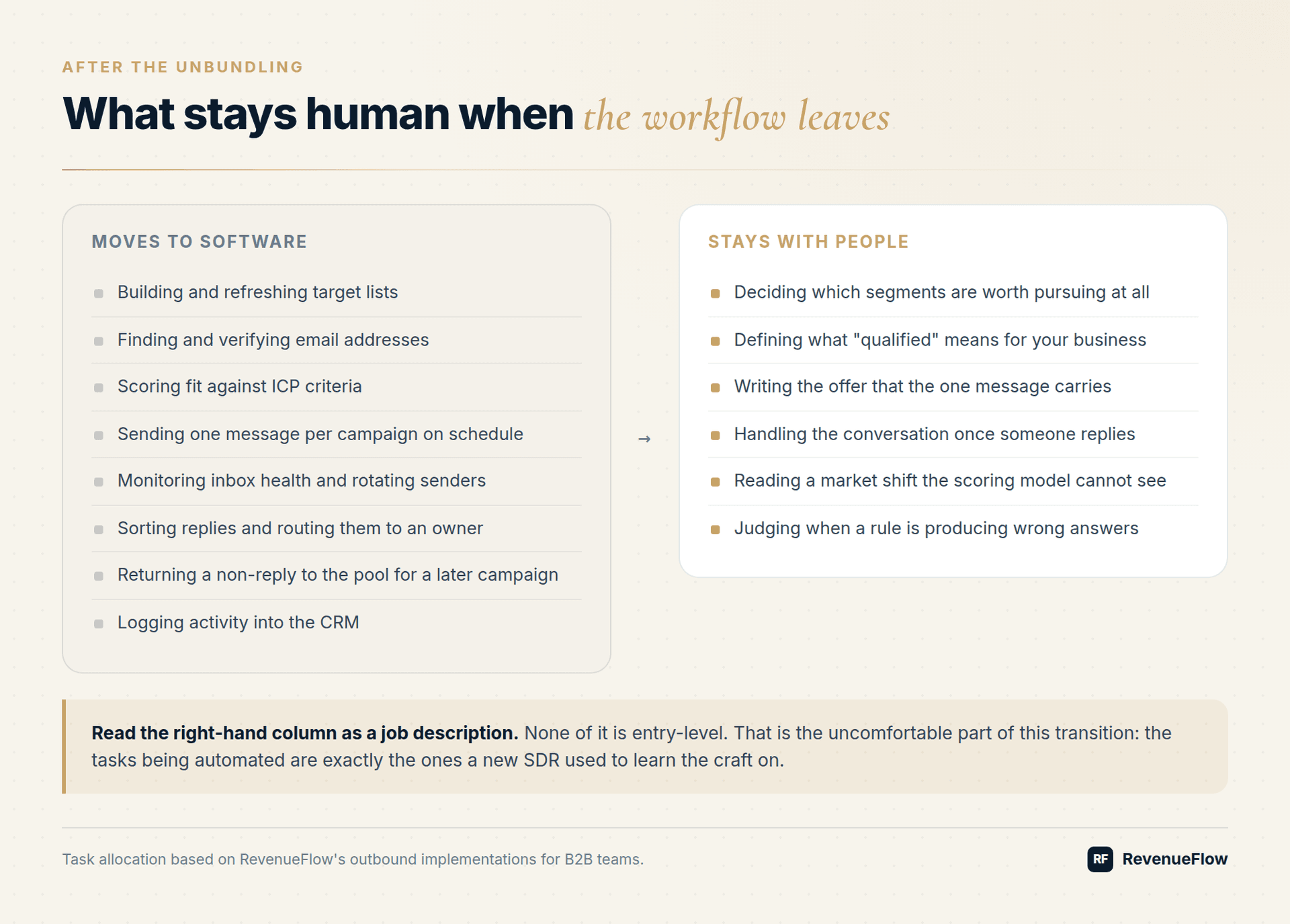
Deciding which segments are worth pursuing. Defining what qualified means for your business. Writing the offer the sequence carries. Handling the conversation once someone replies. Noticing when the scoring model is confidently wrong.
None of that is entry-level work.
Which points at the genuinely uncomfortable part of this transition. The tasks being automated are exactly the ones a new SDR used to learn the craft on. Building lists teaches you what a good account looks like. Getting ignored teaches you what a bad message sounds like. Remove the repetition and you remove the apprenticeship.
Teams that unbundle the role without thinking about that end up with a senior layer and no pipeline of people to replace it.
What This Does Not Fix
Automating the five layers makes a working motion cheaper and faster. It does not make a broken one work.
If your offer is unclear, automation delivers an unclear offer to more people. If your ICP is wrong, you will disqualify the wrong accounts at scale. The system amplifies whatever judgment you put into it, in both directions.
There is also a real operating cost. Five tool categories means five vendors, five sets of credentials, and something connecting them. That connective work does not disappear. It moves from an SDR's calendar to whoever owns the system.
The Honest Summary
The SDR is not disappearing. The job is being decomposed into software, and what remains is smaller, more senior, and more valuable.
The teams getting this right are not the ones that cut headcount fastest. They are the ones that moved their existing people up to the work in the right-hand column and let software take the rest.
The Five Layers At A Glance
| Layer | What it replaces | Representative tools |
|---|---|---|
| Prospect | Manual list building in Sales Navigator | Apollo, ZoomInfo, Cognism, Apify |
| Enrich | Buying one database and accepting the gaps | Clay, Clearbit, FullEnrich, Findymail, Hunter.io |
| Qualify | Emailing everyone and hoping | Claude, GPT, HubSpot scoring, Clay AI columns |
| Outreach | Sending and remembering to follow up | Instantly, Smartlead, lemlist, EmailBison |
| Book | Replies waiting in a shared inbox | Cal.com, Calendly, HubSpot, Slack |
Frequently Asked Questions
Are SDRs actually going away?
The headcount is shrinking in many teams, but the role is being unbundled rather than eliminated. What remains is smaller, more senior, and closer to what the job was supposed to be: judgment about targeting, and real conversations once someone replies.
Which layer should I automate first?
Qualification, because it is the cheapest change with the largest downstream effect. Scoring leads before you enrich them cuts data spend on every campaign and keeps send volume pointed at people who might plausibly care.
Does automating enrichment actually improve data quality?
Waterfalling across several providers meaningfully improves coverage over any single source, because the gaps in each database are not random. They cluster around smaller companies, non-US geographies, and recently changed roles. It costs more per record than a single provider and finds contacts a single provider never would.
What breaks when you remove the manual work?
The apprenticeship. Building lists teaches a new rep what a good account looks like, and getting ignored teaches them what a bad message sounds like. Teams that automate without deliberately replacing that learning end up with a senior layer and nobody coming up behind it.
Will this work if my ICP is unclear?
No, and it will fail expensively. Automation amplifies whatever judgment you put into it. A vague ICP produces confident disqualification of the wrong accounts at scale, which is worse than doing it slowly by hand.
Related Reading
- Most Sales Teams Spend $180K/Year on SDRs to Do What 48 Tools Already Do Faster
- Demand Generation Agency vs Cold Outbound: Which One You Actually Need
- Why Most Sales Teams Are Still Stuck in 2015 (And the Restructure That Fixes It)
We build AI-native pipeline systems and you pay per qualified meeting, not a retainer. No paying for activity. You only pay when we book you a qualified sales meeting. See if you qualify.
Frequently asked questions.
Frequently asked questions- Are SDRs actually going away?
- SDR headcount is shrinking in many teams, but the role is being unbundled rather than eliminated. What remains is smaller, more senior, and closer to the intended purpose: exercising judgment about targeting and handling real conversations once someone replies. The transition removes repetitive execution tasks while preserving strategic work.
- Which SDR task should I automate first?
- Qualification delivers the largest downstream impact at the lowest cost. Scoring leads before enriching them cuts data spend on every campaign by filtering out bad-fit accounts before you pay to find contact information. It also protects deliverability by preventing sends to people with no reason to engage, which mailbox providers flag as spam.
- Does automating SDR tasks fix a broken sales motion?
- No. Automation makes a working motion cheaper and faster, but it amplifies whatever judgment you feed it. If your offer is unclear, automation delivers that unclear offer to more people. If your ICP is wrong, you disqualify the wrong accounts at scale. The system requires sound strategy to produce better outcomes.
- What work remains for humans after automating the five SDR tasks?
- Strategic and conversational work stays with people: deciding which market segments to pursue, defining what qualified means for your business, writing the offers that sequences carry, handling live conversations once prospects reply, and noticing when scoring models make confident errors. None of this is entry-level work.
- Why does waterfall enrichment work better than a single provider?
- No individual contact database has complete market coverage, and gaps cluster around smaller companies, non-US geographies, and recently changed roles, often your best-fit accounts. Waterfall enrichment queries multiple providers in sequence, so if one source misses a contact, the next one catches it, delivering meaningfully higher coverage across these critical segments.
About the author.

Tim Carden is CMO / CTO at RevenueFlow, which builds and operates outbound revenue engines for B2B companies. Studied at McGill University.
Tim Carden · CMO / CTO
Connect on LinkedIn →Explore more.
Ready to scale your outreach?
We build GTM engines that book real meetings. See the receipts.
Related articles.
Demand Generation Agency vs Cold Outbound: Which You Need
Demand gen builds awareness, outbound harvests it. 2026 pricing for both, a three-test decision rule, and the market conditions where each one fails.
Outsourced SDR vs In-House: The Cost Math on Your Numbers
The comparison most teams run is a salary against a retainer. Here is how to build both sides fully loaded, divide by meetings held, and adjust for ramp.
Cold Email Agency: What You Get and What It Costs
What a cold email agency delivers, 2026 pricing across retainer, per-meeting and hybrid models, the in-house comparison, and when hiring one is wrong.
Sales Kickoff Meeting: The Decisions It Has to Leave With
A kickoff is the one moment a whole sales organisation can change at once. The four decisions it has to publish, and the week-six check that tests them.
Demand Gen Strategy: Diagnose the Constraint Before Funding
Fourteen initiatives across six channels, funded evenly, is the output of not making a decision. Three constraints, one afternoon of testing, and one thing to fund.
Sales Funnel vs Customer Journey: Accounting vs Behaviour
A funnel is a seller-side accounting model built to be counted. A journey is a buyer-side behaviour model built to be understood. Keeping them separate is the point.