Demand Gen Strategy: Diagnose the Constraint Before Funding
Fourteen initiatives across six channels, funded evenly, is the output of not making a decision. Three constraints, one afternoon of testing, and one thing to fund.
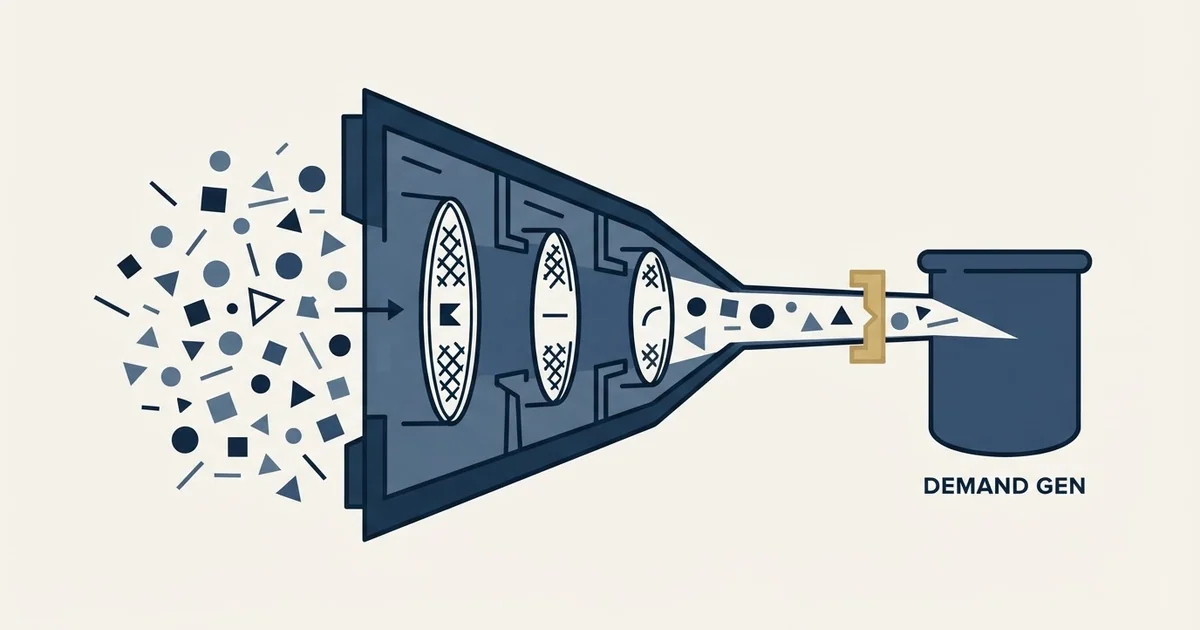
A company short of demand is stuck at one of three places: nobody knows the problem has a name, they know the category and not you, or they know you and do not act. Each needs different work. Test which one you have, fund that one properly, and agree how long you will wait before judging it.
Key takeaways
- Name one constraint and fund it properly, because an even split across six channels funds none of them enough to move.
- Test for category search volume, competitor presence and on-site conversion; the answers separate three constraints needing opposite work.
- Decide how many months the funder will wait before judging the plan, and let that number set the split between creating and capturing demand.
- Measure creation channels on leading indicators and capture channels on pipeline, since a blended cost per lead always argues for cutting the slow one.
Reviewed and updated September 1, 2026
Demand Gen Strategy: Diagnose the Constraint Before You Fund the Plan
A demand generation plan lands with fourteen initiatives across six channels. Paid social, a podcast, a webinar programme, three content pillars, a community, review-site presence, partner co-marketing. Every line is defensible. Nobody in the room can say which one is fixing the actual problem, because nobody has said what the actual problem is.
That is the characteristic failure of demand gen planning. Not bad tactics, and not insufficient budget. A portfolio assembled from things that work for other companies, funded evenly, and therefore funded too thinly to move any of them.
The plan gets better when it starts from a diagnosis instead of a channel list.
Three constraints, and the test that tells you which one you have
A company that is not generating enough demand is stuck at one of three places, and they need almost opposite work.
Nobody knows the problem has a name. Your buyers have the pain and have not framed it as a category. They are not searching, because you cannot search for a thing you cannot name. Nothing you publish gets found, and any comparison content you write is competing for an audience that does not exist yet.
They know the category and do not know you. People search for what you sell and land on competitors. There is a market, there is a shortlist, and you are not on it.
They know you and do not act. Traffic is fine, brand recall is fine, and the number of people who take a next step is low. The problem is at the point of conversion rather than upstream of it.
The test that separates them costs one afternoon. Take twenty accounts that look exactly like your best customers and check three things: does anyone at these companies search for your category, does your brand appear anywhere in their orbit, and do the ones who visited you take any action. Search volume for the category name answers the first, a look at who ranks answers the second, and your own analytics answers the third.
Most teams assume the second constraint because it is the one marketing knows how to fix. The first is more common in newer categories and much more expensive to be wrong about.
- Step 1Test for category awareness
Is there search volume for the category name, and do your buyers use that name? No volume means the constraint is upstream of everything else.
- Step 2Test for presence
When someone does search the category, who appears? If competitors own every result, the constraint is visibility rather than awareness.
- Step 3Test for conversion
Of the people who already arrive, how many take any action? A healthy top and a flat bottom is a conversion constraint wearing a demand costume.
- Step 4Fund the one that failed
One constraint, funded properly, for long enough to read the result. The other two wait.
What to build first, by constraint
If the category has no name in your buyers' heads, the first build is a point of view, published somewhere with an existing audience. Not your blog, which nobody has a reason to visit yet. A podcast with guests who bring their own listeners, a newsletter people forward, a talk, original research that other people cite. The job is to attach language to a problem people already feel. This is slow, it is the hardest to measure, and it is the only thing that works when nobody is searching.
Direct outreach is the other instrument that works in this state, because it reaches people who will never search. The two are complements rather than alternatives: outreach tells one person at a time, publishing tells the market. Which to fund first is largely a question of whether you can name the accounts, and the priced version of that decision is in demand generation agency vs cold outbound.
If the category is searched and you are absent, the first build is presence on the decision-stage surfaces. The pages where a shortlist gets made: comparison pages, alternatives pages, review sites, the documentation a technical evaluator reads. This is the cheapest of the three constraints to fix and the one with the shortest feedback loop.
If people arrive and nothing happens, stop funding demand entirely until it is fixed. Adding traffic to a broken conversion path buys you a larger number of people who now know you did not answer their question. The work is in what you offer and who replies, and it is covered in inbound lead generation.
The budget shape nobody wants to say out loud
The standard advice is to always be creating demand, on the reasoning that most of your market is not in the market right now. The reasoning is sound and the advice is unaffordable for a large number of companies that receive it.
Creating demand means paying to change what people believe, and belief changes slowly. The spend precedes the return by quarters, sometimes by years, and it does not stop being true if your runway is nine months. A company that needs pipeline inside two quarters and spends its budget on category creation will run out of money while being strategically correct.
The honest allocation depends on how long you can wait, so decide that number first and let it set the split. If you can wait a year, fund creation properly and accept a slow start. If you cannot, fund capture and outreach now, and take the smallest possible position in creation so the option stays open. What you should not do is split evenly, which funds a category-creation effort too small to change anything and a capture effort too small to pay for it.
The three buyer states this rests on, and the different play each one needs, are set out in demand creation, capture and conversion.
Measurement, honestly
Demand generation is genuinely hard to measure and most of the difficulty is structural rather than a tooling gap.
That is also the honest answer to a search for demand gen metrics, because the useful question is which family a number belongs to and how long its lag is rather than which figures to put on a dashboard.
The mechanism is a lag between the thing that changed someone's mind and the thing that captured them, usually with several months and several people in between. Whatever the buyer clicked last gets the credit, which systematically over-credits capture surfaces and under-credits everything that made the person want to look. A branded search is recorded as a free organic win, and the podcast episode that caused it is recorded as nothing.
Three practices make it tractable:
Ask. A single open field on the form asking how they heard about you, kept as free text and read by a human monthly, outperforms most attribution software for demand-creation channels specifically. It is the only instrument that can see a conversation with a colleague.
Watch branded search volume as a demand-creation output. People searching for your name by name is the cleanest available proxy for demand you created, and it moves before revenue does.
Measure creation channels on leading indicators and capture channels on pipeline. Holding a podcast to a pipeline number in its first two quarters kills it before it can work. Holding a comparison page to the same standard is entirely fair.
And one thing to stop: reporting cost per lead across creation and capture together. They produce different objects and the blended number will always argue for cutting the slow one. The honest treatment of that arithmetic, including why the number misleads even within one channel, is in cost per lead B2B.
- Yes: Names one constraint and says how it was diagnosed
- Yes: Concentrates the budget on that constraint rather than spreading it
- Yes: States how long the funder is willing to wait before judging it
- Yes: Measures creation channels on leading indicators, capture on pipeline
- No: Lists channels first and reasons afterwards
- No: Reports one blended cost per lead across every channel
Where we differ from standard practice

Most demand gen plans include a track that emails captured contacts on a schedule until they act. We never run those. One message per campaign, built on one premise, sent once, with no scheduled reminder afterwards.
The argument is the same one that applies to the plan as a whole. A schedule substitutes for having a reason, and a reason is the scarce resource. When a fact changes at an account that makes our case newly relevant, that is worth one carefully written message, and it is a new campaign rather than the next item on a timer. What happened when we stopped is in we stopped using follow-up emails.
Applied to strategy, the same principle says something useful: if you cannot articulate why a channel deserves the next quarter's money beyond the fact that it is already running, that is the channel to cut.
The one-year test
Write down, before funding anything, what you expect to be true in twelve months if the plan works. Not a revenue number, which depends on too many things you do not control. Something specific and observable: this many people search our category name each month, we appear on the shortlist page for these three comparisons, this many customers name this channel unprompted.
A plan that cannot produce that sentence is a list of activities. A plan that can produce it is testable, and being testable is most of what separates a strategy from a budget. The one-page version of the same discipline applied a level up is in go-to-market strategy.
The short version

Diagnose which of the three constraints you actually have before choosing a single channel. Fund that one properly rather than funding all of them thinly. Decide how long you can wait and let that set the split between creating demand and capturing it. Measure the slow channels on leading indicators and ask people how they heard about you, because the software cannot see the conversation that did the work.
If your constraint is that your buyers will never search for you, the instrument for that is direct and specific. We will build one researched message to twenty named accounts so you can see what it looks like: free campaign.
Frequently asked questions.
Frequently asked questions- How do I know which demand generation problem I actually have?
- Take twenty accounts that resemble your best customers and check three things: whether anyone searches your category name, who appears when they do, and whether people who already visit you take any action. No search volume means the constraint is awareness. Competitors owning the results means presence. A flat bottom means conversion.
- How should a demand generation budget be split?
- Let the wait decide it. If the funder can wait a year, fund demand creation properly and accept a slow start. If pipeline is needed in two quarters, fund capture and direct outreach now and take the smallest position in creation that keeps the option open. An even split is the one choice that reliably fails.
- Why is demand generation so hard to measure?
- Because the thing that changed someone's mind and the thing that captured them are usually different, separated by months and several people. Last-touch reporting credits the capture surface and records the podcast that caused a branded search as nothing. Ask people how they heard about you and read the free text monthly.
- Is always-on demand creation the right advice?
- The reasoning is sound and the advice is unaffordable for many companies that receive it. Changing what a market believes takes quarters and the spend precedes the return. A company needing pipeline within two quarters that funds category creation will run out of money while being strategically correct.
About the author.

Ben Carden is CRO at RevenueFlow, which builds and operates outbound revenue engines for B2B companies. Previously at Gartner Enterprise. Studied at London School of Economics.
Ben Carden · CRO
Connect on LinkedIn →Explore more.
Ready to scale your outreach?
We build GTM engines that book real meetings. See the receipts.
Related articles.
Demand Generation Agency vs Cold Outbound: Which You Need
Demand gen builds awareness, outbound harvests it. 2026 pricing for both, a three-test decision rule, and the market conditions where each one fails.
Sales Kickoff Meeting: The Decisions It Has to Leave With
A kickoff is the one moment a whole sales organisation can change at once. The four decisions it has to publish, and the week-six check that tests them.
Time Decay Attribution: Setting the Half-Life
Time decay weights recent touches more heavily, and the half-life that controls how fast credit fades decides more than the choice of model does.
Last-Touch Attribution: What It Credits, and What It Deletes
Last-touch gives every point of credit to the final interaction, which in outbound is the email that got the reply rather than the work that earned it.
Position-Based Attribution: The U, the W and the Timestamp
U-shaped and W-shaped attribution are one model with a switch, and the switch is whether your CRM can be trusted to stamp lead creation.
Sales Funnel vs Customer Journey: Accounting vs Behaviour
A funnel is a seller-side accounting model built to be counted. A journey is a buyer-side behaviour model built to be understood. Keeping them separate is the point.