Position-Based Attribution: The U, the W and the Timestamp
U-shaped and W-shaped attribution are one model with a switch, and the switch is whether your CRM can be trusted to stamp lead creation.
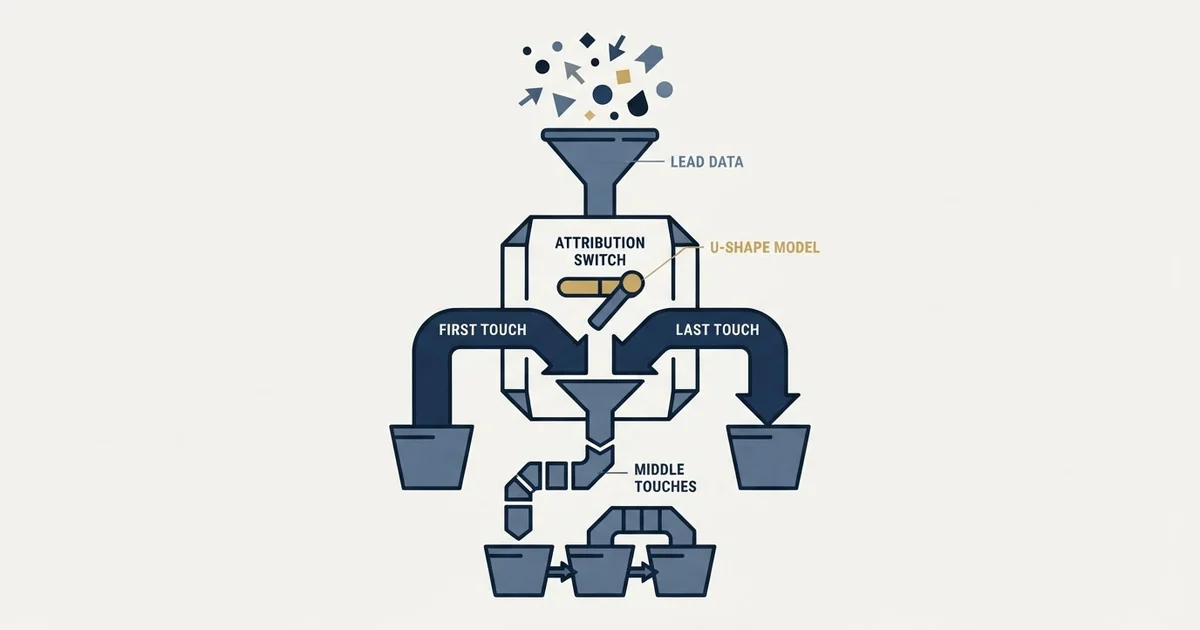
U-shaped attribution gives forty percent of the credit to the first touch, forty to the last, and spreads twenty across the middle. W-shaped adds a third weighted milestone at lead creation, conventionally thirty percent each with ten spread across the rest. Choose between them on whether that middle timestamp is reliable.
Key takeaways
- The forty, twenty, forty and thirty, thirty, thirty, ten splits are conventions agreed by repetition across tools, not values derived from any study.
- W-shaped attribution attaches roughly a third of the credit to a lead-creation timestamp that is a definition rather than an observed event.
- Query the lead-created field's distribution by day before trusting a W-shaped model, because a spike on one date is a backfill rather than demand.
- The middle band is divided by the number of middle touches, so an identical touch is worth ten times more on a short journey than on a long one.
Reviewed and updated September 2, 2026
Position-based attribution answers a question the single-touch models refuse to hear: what if the first contact and the moment of commitment both mattered, and the twelve emails in between mattered less than either. It is the only family of rule-based models built around that intuition, and it comes in two shapes that get written up as separate models and are really one model with a switch.
The U-shaped version weights the first and last touches heavily and spreads what remains across the middle. The W-shaped version adds a third heavily weighted milestone in the middle, usually the point where a lead becomes an opportunity. Understanding why the second one exists explains what is wrong with the first.
The two shapes, and the weights that define them
The conventional split gives forty percent of the credit to the first touch, forty percent to the last, and distributes the remaining twenty percent evenly across everything between them. Plotted, the weights form a U, which is where the name comes from.
The conventional W-shaped split gives thirty percent each to three milestones, first touch, lead creation and opportunity creation, and distributes the remaining ten percent across the rest. Plotted, that is a W.
Neither set of weights is derived from anything. They are conventions, agreed by repetition across the tools that implement them, and a team is free to change them. That freedom is the point at which position-based attribution turns into a custom model, which has its own conditions.
- First touch and last touch carry the weight
- Middle touches share the remainder evenly
- Needs only two events your CRM already stamps
- Silent about what happened in the middle of a long cycle
- First touch, lead creation and opportunity creation
- Designed around a B2B funnel rather than a purchase
- Needs a reliable lead-creation timestamp
- Fails quietly when that timestamp is unreliable
- Position in the journey predicts influence
- Some touches genuinely matter more than others
- The milestones are recorded accurately
- Journey length does not change the weighting
Why the W exists, and what it demands in return
The U-shaped model has a specific blind spot in B2B. On a ninety-day cycle with fifteen touches, the middle is where the persuasion happens: the demo, the security review, the conversation with the second stakeholder. The U compresses all of it into the published twenty percent, shared evenly, which weights a throwaway newsletter open the same as the technical evaluation that unblocked the deal.
The W addresses this by naming one middle event and weighting it properly. That is a real improvement in the model and it moves the difficulty somewhere else, into the data.
A first touch is easy to record: it is the earliest timestamp you have. A last touch is easy: it is the latest before the conversion. Lead creation is neither, because it is a definition rather than an event. It happens when somebody decides a contact has become a lead, and in a CRM that decision is expressed as a field change that can be set by an automation, by a rep, by an import, or by a routine backfill that touches ten thousand records on one afternoon.
So the published thirty percent of the W-shaped model is attached to a timestamp whose accuracy nobody has audited. When that timestamp is wrong, the model does not fail loudly. It produces a confident number in which the middle weight has been assigned to whatever was happening on the day of an unrelated data migration.
The audit that has to happen before either model is worth running
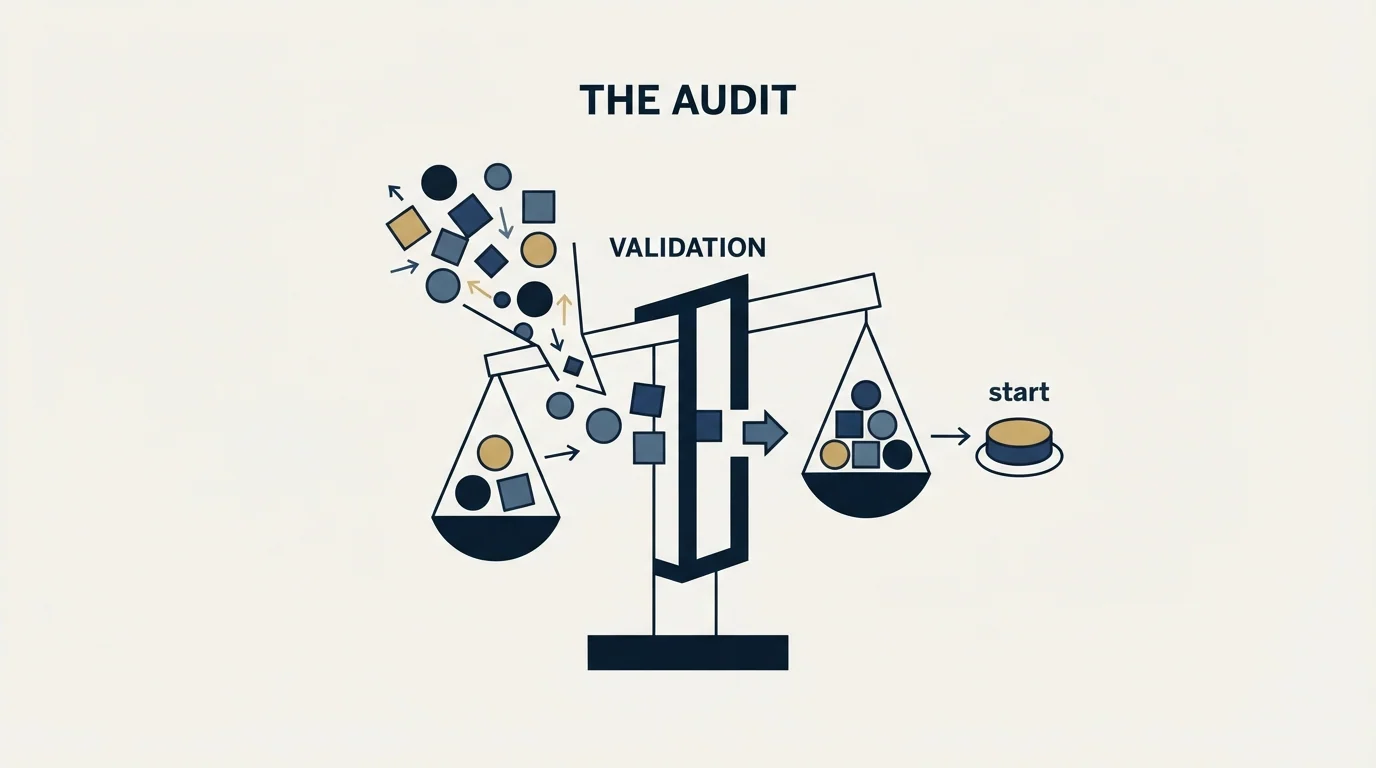
Both models rest on event data, so the useful work is upstream of the model entirely.
Check that first touch is really first. A contact who was imported from a list, then filled in a form six months later, often carries the form as their earliest recorded interaction because the import wrote no touch. The model will then hand its published forty percent to a channel that did not find the person.
Check what sets your lead-created field. Query the distribution of that timestamp by day. A healthy distribution is spread across working days. A spike on one date is a backfill, and every deal in that spike is carrying a fabricated middle milestone.
Check that a stage cannot be skipped. If deals routinely jump from lead to closed won without an opportunity stamp, the W has nothing to weight and will quietly redistribute. What each stage means and how it is entered is the substance of the MQL and SQL definitions two teams have to agree on, and the same discipline that makes those definitions survive an argument is what makes position-based attribution possible at all.
Check the stage entry criteria are testable by somebody else. A stage whose entry criterion is a seller's judgment produces a timestamp that measures the seller's admin habits. The exit criteria in a pipeline stage design are what make a milestone a fact rather than an opinion.
- Yes: First touch is recorded for imported contacts, not just form fills
- Yes: The lead-created timestamp is set by one mechanism you can name
- Yes: That timestamp's distribution by day carries no backfill spike
- Yes: Opportunity creation has an exit criterion a second person could check
- No: Deals routinely skip stages and get stamped retrospectively
The remainder is where the model quietly changes shape
One property of both splits gets almost no attention and changes the answer more than the headline weights do: the leftover share is divided by the number of middle touches, so its per-touch value depends on how many there were.
Under the U-shaped split the illustrative arithmetic is stark: a journey with two middle touches gives each of them ten percent, and a journey with twenty middle touches gives each of them one percent. The same newsletter open is therefore worth ten times more on a short journey than on a long one, purely because of how many other things happened around it. Under the W-shaped split the effect is sharper still, because the published remainder is ten percent rather than twenty.
That is defensible if you believe influence really is diluted by volume. It is indefensible if the extra touches are automated ones your own systems generated, because then the model is dividing credit by your own sending frequency. Check what is counted as a middle touch before reading anything into the middle band, and exclude machine-generated events from the count if they are in it.
Choosing between them honestly
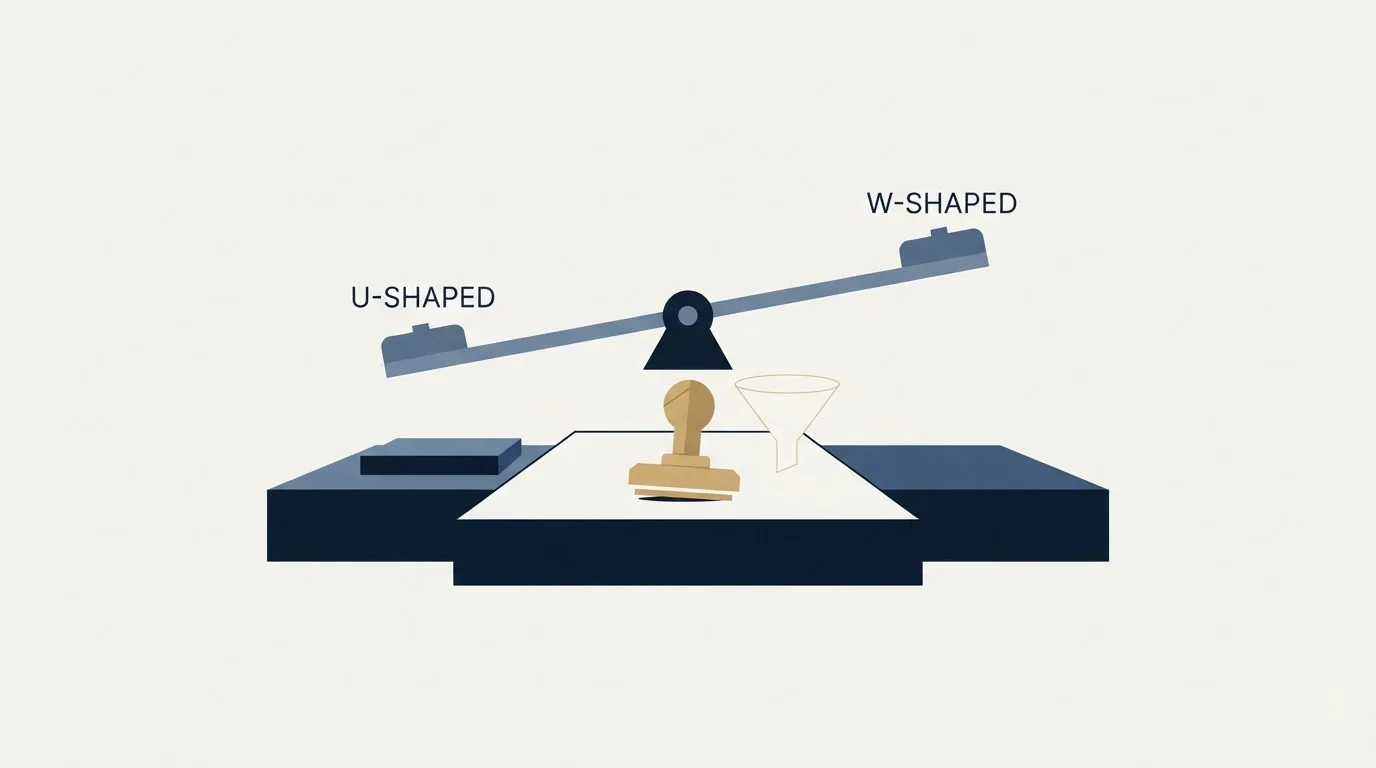
The choice is not really about which model is more accurate. It is about which milestone you can evidence.
If your CRM stamps lead creation reliably and the definition is agreed between marketing and sales, the W is the better description of a B2B journey and there is no good reason to prefer the U. If it does not, the U is the safer model, because it weights only the two events that are hard to get wrong.
The failure worth avoiding is choosing the W because it sounds more sophisticated, then discovering that the middle weight is noise. A model that is wrong in a way nobody can see is worse than a simpler one that is wrong in a way everybody understands, because only the second one gets corrected.
There is a third option that gets skipped. If neither timestamp survives the audit, the honest position is to run no attribution model at all for a quarter, fix the event data, and revisit. Attribution over bad events produces decisions, and the decisions are real even when the number behind them is not.
What position-based models do to outbound specifically
An outbound programme usually generates one touch per contact, because a campaign carries a single message rather than a sequence. Under a position-based model that one touch is simultaneously the first and the last, which implementations typically resolve by giving it everything.
The result reads as though outbound produced the entire deal, which flatters the channel and hides the thing that actually varied. Two campaigns with identical send mechanics and different lists produce very different results, and the difference sits in targeting and offer rather than in the touch the model can see. A programme that grades itself on position-based credit will keep concluding that outbound works and never learn which outbound worked.
The measurement that separates them is not an attribution model. It is holding the send constant and varying one input at a time, which is what a properly structured outbound playbook is for, and reading the result at the meeting rather than at the reply.
The platform constraint to check first
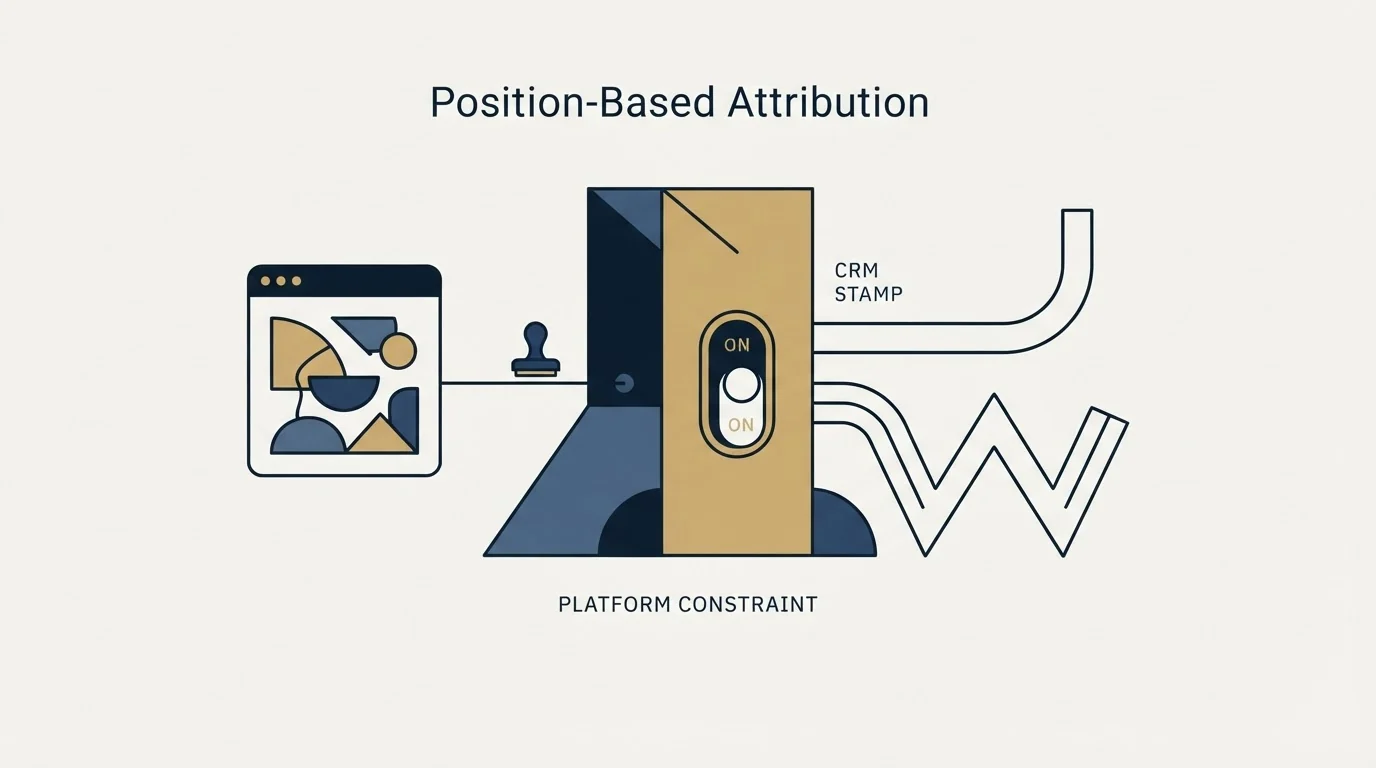
Position-based attribution is often described as a setting you select in a reporting tool. Google's Analytics help page states that "the first click, linear, time decay, and position-based attribution models are no longer available as of November 2023", and the Google Ads help page says the same models are "no longer supported by Google", noting that affected conversion actions "have been upgraded to use data-driven attribution".
Outside Google's products the position-based models remain available and configurable, including in the B2B attribution tools where the W-shaped model originated and where pipeline rather than transactions is the unit. That is the relevant surface for most companies reading about it, but it is worth confirming which one an article is describing before designing a reporting plan around it.
The short version
U-shaped attribution weights the first and last touches at forty percent each and spreads twenty percent across the middle. W-shaped attribution is the same idea with a third weighted milestone at lead creation, usually thirty percent each with ten percent spread across the rest. Those weights are conventions rather than findings, and the choice between the two models is decided by whether your CRM stamps lead creation reliably, not by which sounds more advanced. Audit that timestamp's distribution before either model is worth running. For the single-touch alternative and its own distortion, see last-touch attribution; for the recency-weighted alternative, see time decay.
If the question underneath the model is whether outbound is producing meetings worth crediting, see what a campaign would look like for your market.
Google attribution model behaviour verified against two of Google's own help pages, for Analytics and for Google Ads, fetched mid-2026. The weight splits above are conventions agreed across tools rather than derived values. Verify current platform behaviour before relying on it.
Sources: Google Analytics: About attribution and attribution modeling, Google Ads: About attribution models
Frequently asked questions.
Frequently asked questions- What is the difference between U-shaped and W-shaped attribution?
- U-shaped weights two milestones, the first touch and the last, and spreads the remainder across everything between. W-shaped adds a third weighted milestone in the middle, usually lead creation. The W is designed for B2B journeys where the middle carries real persuasion, and it needs a reliable timestamp for that middle event to be worth using.
- What weights does U-shaped attribution use?
- The conventional split is forty percent to the first touch, forty percent to the last, and the remaining twenty percent divided evenly across the middle touches. Those numbers are a convention rather than a finding, and most tools let you change them. Changing them turns the model into a custom one, which carries its own conditions.
- How do I know if my CRM can support a W-shaped model?
- Query the distribution of your lead-created timestamp by day. A healthy field is spread across working days; a spike on a single date means a bulk update wrote it and every deal in that spike carries a fabricated milestone. Also check that deals cannot skip from lead to closed without an opportunity stamp.
- Does position-based attribution work for cold outbound?
- Poorly, because a campaign carrying a single message produces one touch that is both first and last, so most implementations give it everything. That flatters the channel and hides what varied, which is targeting and offer rather than the send. Holding the send constant and varying one input at a time is more informative than any weighting.
About the author.

Ben Carden is CRO at RevenueFlow, which builds and operates outbound revenue engines for B2B companies. Previously at Gartner Enterprise. Studied at London School of Economics.
Ben Carden · CRO
Connect on LinkedIn →Explore more.
Ready to scale your outreach?
We build GTM engines that book real meetings. See the receipts.
Related articles.
Time Decay Attribution: Setting the Half-Life
Time decay weights recent touches more heavily, and the half-life that controls how fast credit fades decides more than the choice of model does.
Last-Touch Attribution: What It Credits, and What It Deletes
Last-touch gives every point of credit to the final interaction, which in outbound is the email that got the reply rather than the work that earned it.
Lifecycle Stage, Lead Status, Deal Stage: Three Fields
Lifecycle stage records position, lead status records activity, and deal stage lives on the deal. Merging them breaks funnel reporting in ways nobody notices for a year.
Cross-Sell vs Upsell: Different Trigger, Different Owner
An upsell has a trigger that arrives on its own. A cross-sell has none and needs a diagnosis somebody funds. That is the difference that decides the work.
Sales Call Planning: The Plan a Booked Call Needs
A call cannot produce a commitment nobody named in advance. The four fields a call plan carries, and why the ask has to be decided before the meeting opens.
GTM Misalignment: The Four Disagreements Underneath It
Misalignment is diagnosed as a relationship problem and treated with meetings. It is a definitions and measurement problem, and there are four of them.