Cross-Sell vs Upsell: Different Trigger, Different Owner
An upsell has a trigger that arrives on its own. A cross-sell has none and needs a diagnosis somebody funds. That is the difference that decides the work.
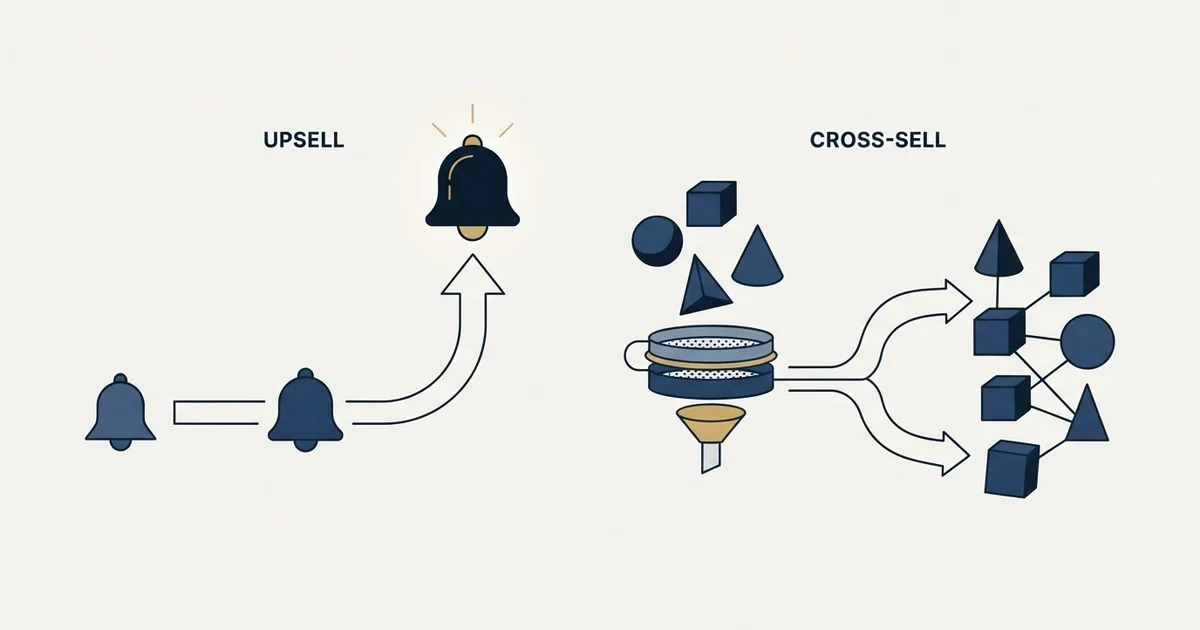
An upsell sells more of what the customer already decided to buy, triggered by consumption evidence in your own usage data. A cross-sell sells something adjacent, and nothing in usage signals it, so it needs a diagnostic conversation. That asymmetry decides who owns each motion and why expansion revenue needs two lines rather than one.
Key takeaways
- An upsell trigger arrives on its own from usage data, while a cross-sell has no trigger at all because the adjacent problem sits outside your telemetry.
- Asking one person to protect a relationship and open a new sale inside it puts those objectives in tension every time the answer looks like a no.
- A cross-sell into an account whose current implementation is struggling is the fastest way to lose a renewal nobody was worried about.
- Reporting expansion as one number hides which motion produced it, so a quarter carrying more renewals reads as a better quarter for reasons unrelated to the work.
Reviewed and updated October 1, 2026
A revenue team gets an expansion number for the first time and puts it on the customer success function, which already talks to every account. Six weeks later the number has not moved and the account managers report that they are having the conversations. They are. They are having one conversation, in one register, and calling it both motions, which is why neither is producing anything predictable.
The textbook distinction is easy and nearly useless on its own. An upsell moves the customer to a larger or higher version of what they already bought. A cross-sell adds something adjacent to it. Every consumer example makes this obvious: a bigger seat on the same flight is an upsell, headphones from the catalogue are a cross-sell.
What that formulation leaves out is everything that decides whether either motion works in a business account, which is what has to be true before the ask, who is allowed to make it, and what it costs when it misfires. Those three answers differ sharply between the two, and the differences are the reason to keep the words apart.
The one-line definitions, and where they mislead
An upsell asks the customer to buy more of the thing they already decided to buy. More seats, a higher tier, a longer term, a larger volume commitment.
A cross-sell asks them to buy something they have not decided about. A different product, a service alongside the software, a module that solves a problem adjacent to the one they hired you for.
The consumer framing misleads in one specific way. It presents both as offers made at the point of purchase, which is true in a shop and false in a business relationship, where the purchase happened months ago and the person you are talking to may not be the person who bought.
That timing difference is the whole reason the two motions need separating in a B2B account. An upsell usually has a trigger that arrives on its own. A cross-sell almost never does.
What has to be true before the ask
This is the distinction that changes the work, and it is the one the definitions skip.
An upsell needs evidence of consumption. They are near a limit, the team using it has grown, usage of a capped feature has climbed, a term is ending. The account has demonstrated the demand itself, and the ask is administrative more than persuasive: you are proposing that the contract catch up with what the account is already doing.
A cross-sell needs a diagnosis. Nothing in the current usage tells you whether the adjacent problem exists, because the adjacent problem lives in a part of their operation your product does not touch. Somebody has to find out, and finding out is a discovery conversation rather than a report.
That asymmetry explains a pattern most expansion programmes hit. Upsell revenue arrives roughly on schedule once the signals are instrumented. Cross-sell revenue does not arrive at all until somebody funds the conversation that produces it, and it keeps being forecast anyway because it sits in the same column on the same slide.
- Trigger arrives on its own: a limit, a headcount change, a renewal date
- The evidence is in your own usage data
- The ask is largely administrative once the trigger is real
- Misfiring reads as billing pressure
- Naturally owned by whoever holds the commercial relationship
- No trigger arrives on its own; the problem is outside your telemetry
- The evidence has to be produced by a conversation
- The ask is a new sale with a shorter trust runway
- Misfiring reads as a vendor selling rather than helping
- Needs somebody willing to run discovery, which is a different skill
Who is allowed to open which one

The default arrangement puts both motions on the account manager because the account manager already has the relationship. That works for one of them and fails quietly for the other.
An upsell sits comfortably there. The trigger is visible in the account, the conversation is about the contract, and the person holding the relationship is the right person to have it.
A cross-sell asks the same person to run a diagnostic conversation about a part of the business they have never discussed, with a buyer they may never have met, about a product they support rather than sell. Some account managers do this well. Most were hired to protect a relationship, and being asked to open a new sale inside it puts the two objectives in direct tension every time the answer looks like a no.
The practical resolution is to separate the permission from the relationship. The account manager surfaces the possibility and makes the introduction. Somebody whose job is the new sale runs the diagnosis. That costs a handoff and it removes the conflict that otherwise makes the conversation not happen at all.
The second decision is the crediting rule, and it belongs in writing before the first contested case rather than after it. Where an account manager surfaces an opportunity a seller closes, both contributions are real, and a policy that recognises only one of them decides which behaviour stops.
What each one costs when it misfires
Both motions spend the same scarce asset, which is the customer's willingness to treat you as useful rather than as a supplier trying to grow the account.
An upsell that misfires reads as billing pressure. The customer hears a vendor noticing they have grown and pricing that growth, which is defensible if the value grew too and corrosive if it did not. The protection is that the trigger is real: if the account genuinely hit a limit, the conversation is about their constraint rather than your target.
A cross-sell that misfires reads worse, because it says you were not paying attention. Proposing an adjacent product to a customer whose current implementation is struggling is the single fastest way to lose the renewal you were not thinking about. The precondition is not enthusiasm about the second product. It is that the first one is working, measurably, and that somebody has checked.
- Yes: The original problem is measurably solved, checked rather than assumed
- Yes: For an upsell, the consumption trigger is real and visible in usage
- Yes: For a cross-sell, somebody has diagnosed the adjacent problem in a conversation
- Yes: The person you are asking has authority for this second decision
- Yes: The crediting rule between the relationship owner and the seller is written down
- No: An open support escalation is running on the original implementation
- No: The ask is being made because the quarter is short rather than because a trigger fired
How each shows up in outreach
The message differs more than most expansion programmes allow for, and running one template across both is the commonest reason expansion email performs worse than cold outreach against the same accounts.
An upsell message can be short and factual, because the recipient already holds the context. Naming the specific thing that changed in their usage, saying what it implies, and proposing the conversation is usually the whole message. The reference to their own data is what makes it read as service rather than as a pitch.
A cross-sell message cannot lean on that context, because there is none. It has the same job a first cold message has, which is to name a problem precisely enough that the reader recognises their own situation, with one advantage: the sender is known. That advantage is smaller than teams expect, and it disappears entirely when the message is addressed to somebody in the account who has never heard of you.
Worked versions of both sit in the corpus. Cross-sell templates covers the adjacent ask and the timing patterns that make it land, and upsell templates covers the usage-triggered version.
One house constraint applies to both and is worth stating, because it removes a device most expansion sequences rely on. We send one message per campaign, with no bumps and no thread replies. In an expansion context that is less of a sacrifice than it sounds: an existing customer who did not answer an expansion message has given you an answer.
- Step 1Confirm the original outcome
Is the problem you were hired for measurably solved. Anything else is premature and reads as inattention
- Step 2Establish which motion this is
A consumption trigger makes it an upsell. Nothing in usage makes it a cross-sell and it needs a diagnosis
- Step 3Assign the owner
The relationship owner for an upsell. The relationship owner introduces, a seller diagnoses, for a cross-sell
- Step 4Make the specific ask
For an upsell, name the change in their own data. For a cross-sell, name the adjacent problem in their words
- Step 5Record which motion produced it
Two figures rather than one, so next period can tell which of the two is actually working
The measurement trap
Expansion revenue is usually reported as one number, and that single figure is the reason most expansion programmes cannot be improved.
The two motions have different lead times, different owners and different failure modes, so a combined figure moves for reasons nobody can attribute. A quarter where upsell revenue rose on renewals and cross-sell produced nothing reads identically to a balanced quarter, and the programme keeps funding the half that is not working.
The correction is small. Two lines rather than one, with the trigger recorded on each deal. That also exposes the timing problem: upsell revenue concentrates around renewal dates, so a period containing more renewals looks like a better period for reasons that have nothing to do with the work.
The arithmetic worth running once, with invented figures purely to show the shape and describing no real company: suppose an account base of two hundred customers produces sixty thousand of expansion in a quarter, of which fifty-four thousand came from twelve upsells triggered by renewals and six thousand from two cross-sells. Read as one number the programme looks healthy. Read as two, the cross-sell motion has produced two deals across two hundred accounts, and the next quarter should either fund the diagnostic conversations properly or stop forecasting the column.
When neither is the right move
Two conditions make expansion the wrong place to look, and both are common enough to check first.
Where retention is the actual problem, expansion arithmetic flatters the account base. A customer who is going to leave in two quarters contributes to this period's expansion number and removes it later, and a programme measured on gross expansion will not see the trade.
Where the second product is not ready, a cross-sell campaign converts your best customers into the reference set for something that does not work yet, and that damage is not recoverable at renewal.
The related question is whether the growth is available in the account base at all. An account base that is small, or concentrated, or already fully penetrated has a ceiling that no expansion motion crosses, and the honest answer is new logos rather than a better expansion sequence. Where that is the finding, the value argument is the same one a new sale needs, and the arithmetic step after the diagnosis is where it gets built.
The short version
An upsell sells more of the decided purchase and a cross-sell sells something adjacent to it. The definitions are the easy half. The differences that decide the work are that an upsell has a trigger arriving on its own from your own usage data, while a cross-sell has no trigger at all and needs a diagnostic conversation somebody has to fund.
Give them different owners. The relationship owner runs the upsell. For a cross-sell the relationship owner introduces and a seller runs the discovery, because asking one person to protect a relationship and open a new sale inside it puts those objectives in tension. Write the crediting rule down before the first contested case.
Check that the original problem is solved before either ask, report the two motions as two numbers with the trigger recorded, and stop forecasting a column that has produced two deals across two hundred accounts. The conversation that produces a cross-sell is a discovery conversation, and the structure that makes one disqualify well applies to it unchanged.
Whether that original problem was solved is largely settled in the first sixty days of the account, and the messages that decide it are set out in a customer onboarding template.
Where the honest answer is that the account base has reached its ceiling and the growth has to come from new logos, see what one campaign against your own segment produces.
Frequently asked questions.
Frequently asked questions- What is the difference between cross-selling and upselling?
- An upsell asks the customer to buy more of what they already decided to buy: more seats, a higher tier, a longer term. A cross-sell asks them to buy something adjacent they have not decided about. In a business account the operational difference matters more: an upsell has a trigger in your usage data and a cross-sell does not.
- Who should own cross-sell conversations?
- Separate the permission from the relationship. The account manager surfaces the possibility and makes the introduction, and somebody whose job is the new sale runs the diagnosis. That costs a handoff and removes the conflict that otherwise stops the conversation happening, because most account managers were hired to protect a relationship rather than open a sale inside it.
- When should you not attempt either motion?
- When the original problem is not measurably solved, when an open support escalation is running, or when the second product is not ready. A cross-sell campaign into a struggling implementation turns your best customers into the reference set for something that does not work yet, and that damage is not recoverable at renewal.
- How should expansion revenue be reported?
- As two lines with the trigger recorded on each deal. The two motions have different lead times, owners and failure modes, so a combined figure moves for reasons nobody can attribute. Splitting it also exposes the timing effect, since upsell revenue concentrates around renewal dates and a period containing more renewals looks stronger without any change in the work.
About the author.

Ben Carden is CRO at RevenueFlow, which builds and operates outbound revenue engines for B2B companies. Previously at Gartner Enterprise. Studied at London School of Economics.
Ben Carden · CRO
Connect on LinkedIn →Explore more.
Ready to scale your outreach?
We build GTM engines that book real meetings. See the receipts.
Related articles.
Sales Call Planning: The Plan a Booked Call Needs
A call cannot produce a commitment nobody named in advance. The four fields a call plan carries, and why the ask has to be decided before the meeting opens.
Lifecycle Stage, Lead Status, Deal Stage: Three Fields
Lifecycle stage records position, lead status records activity, and deal stage lives on the deal. Merging them breaks funnel reporting in ways nobody notices for a year.
Time Decay Attribution: Setting the Half-Life
Time decay weights recent touches more heavily, and the half-life that controls how fast credit fades decides more than the choice of model does.
Last-Touch Attribution: What It Credits, and What It Deletes
Last-touch gives every point of credit to the final interaction, which in outbound is the email that got the reply rather than the work that earned it.
Position-Based Attribution: The U, the W and the Timestamp
U-shaped and W-shaped attribution are one model with a switch, and the switch is whether your CRM can be trusted to stamp lead creation.
The JOLT Effect: Selling to a Buyer Who Cannot Decide
The loss that shows no competitor and no rejection. What the JOLT research names, why the standard urgency playbook makes it worse, and the four moves that answer it.