Last-Touch Attribution: What It Credits, and What It Deletes
Last-touch gives every point of credit to the final interaction, which in outbound is the email that got the reply rather than the work that earned it.
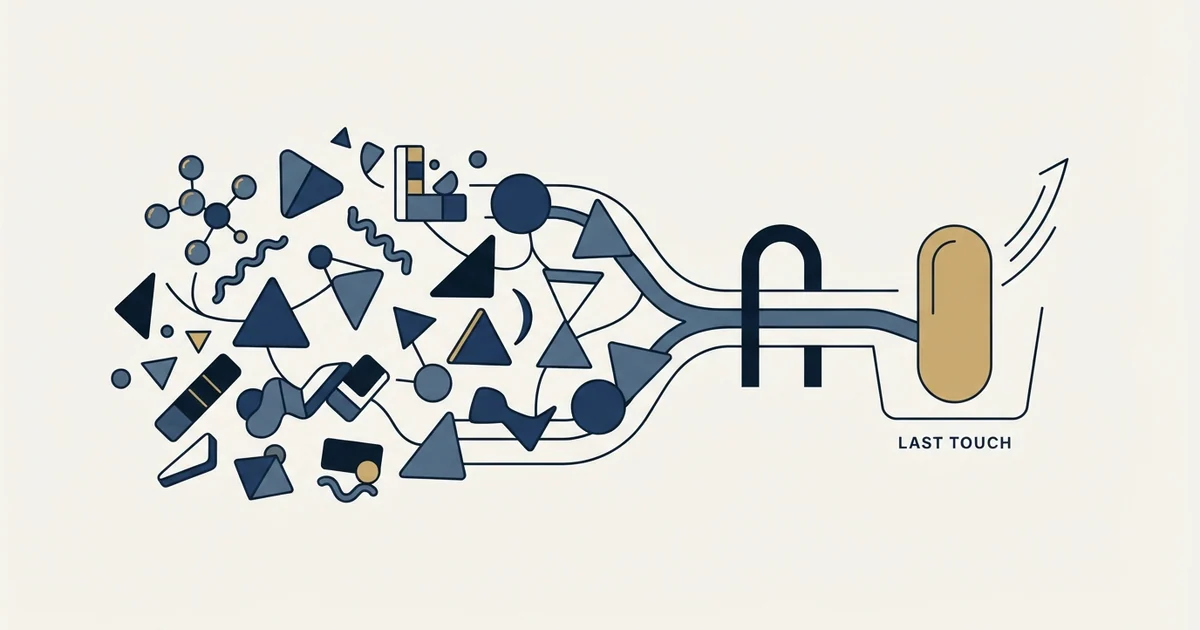
Last-touch attribution assigns all credit for a conversion to the final tracked interaction before it. In B2B outbound that is almost always the message that got the reply, so the targeting, list and timing decisions that produced the reply are credited to nothing. Use it to ask what captured intent, never to compare channels.
Key takeaways
- Last-touch assigns one hundred percent of conversion credit to the final tracked interaction, and first-touch does the same for the earliest one.
- Comparing an early channel against a late one on last-touch credit measures position in the journey rather than contribution to it.
- Google's help pages state that first click, linear, time decay and position-based models were removed from its products in November 2023.
- List quality and targeting are not touchpoints, so no attribution model can credit them, which is why last-touch data tends to defund the list.
Reviewed and updated August 29, 2026
A prospect replies to a cold email on a Tuesday, books a call, and closes eleven weeks later. The CRM records one marketing touch against that deal: the email. Everything that decided the reply happened before it. Somebody chose the segment, somebody wrote an offer that made sense to a finance leader rather than a marketing one, somebody found a verified address so the message arrived at all, and somebody sent it on a week when the buyer had budget left. Last-touch attribution credits none of that. It credits the envelope.
That is not a flaw in the implementation. It is the model working exactly as designed, and understanding what it is designed to do is the only way to use it without letting it quietly reshape where the budget goes.
What the model actually does
Last-touch attribution assigns one hundred percent of the credit for a conversion to the final tracked interaction before it. The rule is complete in one sentence, which is most of its appeal: no weights to argue about, no lookback window to negotiate, no data science to commission.
It has a mirror image in first-touch attribution, which assigns everything to the earliest recorded interaction instead. Both belong to the same family, single-touch attribution, and both share the same property: a journey with nine touchpoints is reduced to one credited moment and eight uncredited ones.
The reduction is not neutral. It systematically rewards whatever sits closest to the conversion event, which in almost every B2B motion means the channel that books meetings rather than the channels that make a meeting bookable.
- Rewards discovery channels
- Blind to everything that closed the deal
- Flatters content and paid awareness
- Useful for asking where demand originates
- Rewards conversion channels
- Blind to everything that created the demand
- Flatters outbound, retargeting and branded search
- Useful for asking what closes an existing intent
- The order the touches happened in
- How long the journey took
- Which touch changed the buyer's mind
- How many touches were needed at all
Why outbound teams get an inflated reading
Cold outbound is almost always the last tracked touch before a booking, because the booking happens inside the outbound motion. A prospect who has read three articles, seen a conference talk and asked a peer about you still books through the email that arrived on the right week, so the email takes the full credit for a decision it did not make on its own.
The inflation runs in the other direction too, and this is the half that costs money. When outbound is the last touch, the sourcing decisions upstream of it become invisible. The list build, the waterfall enrichment that produced a deliverable address, the qualification criteria agreed before launch: none of these are touchpoints, so none of them can receive credit under a model that only credits touchpoints. A team optimising on last-touch data will keep spending on the send and stop spending on the list, and the send is the cheap half.
It also creates a specific reporting failure with a long tail. Because last-touch is the default in most reporting tools, an outbound programme frequently looks better than the same programme measured any other way, right up to the point where somebody asks why pipeline stopped growing when send volume doubled.
The three questions it answers well
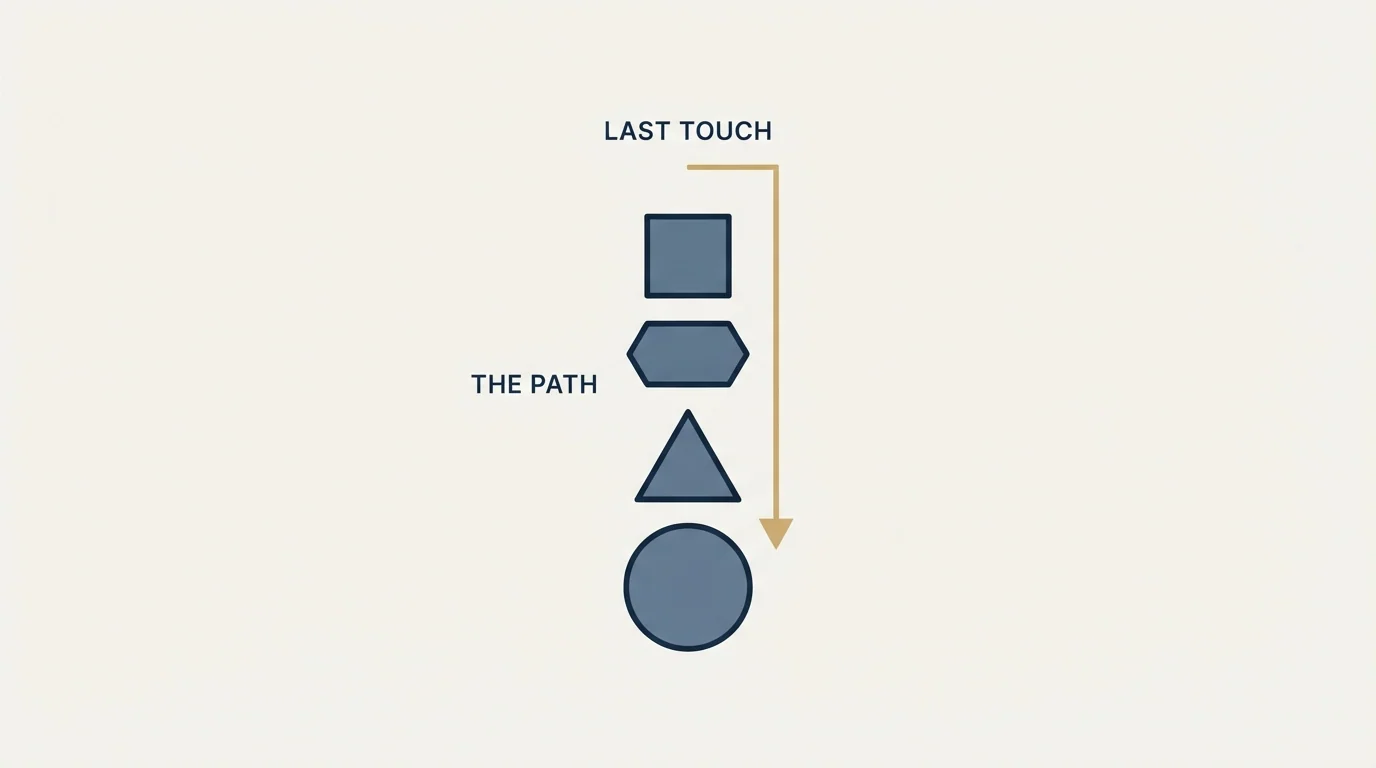
Discarding the model entirely is the wrong correction. Last-touch is genuinely the right instrument for a narrow set of questions, and it is more honest about its own limits than the multi-touch models are.
What converts existing intent. When a buyer has already decided to look, last-touch tells you which surface they used to act. That is a real question with a real answer.
Where the process breaks at the end. A channel that produces many last touches and few closes is a conversion problem rather than a demand problem, and single-touch data is enough to see it.
What to do when the data is thin. A multi-touch model needs enough journeys to be worth weighting. A young programme with forty closed deals does not have that, and a complicated model over forty deals is arithmetic dressed as insight. Last-touch at least does not pretend.
Google removed the alternatives, which changes the practical choice
Comparisons of attribution models routinely present first-click, linear, time-decay and position-based as options you pick in a reporting tool. On Google's own surfaces, that has not been true for some time.
Google's Analytics help page on attribution models states that "the first click, linear, time decay, and position-based attribution models are no longer available as of November 2023", and lists exactly three that remain in Attribution reports: "Data-driven attribution", "Paid and organic last click", and Google paid channels last click. The Google Ads help page carries the same note in its own words, saying those models are "no longer supported by Google", and adds that conversion actions using them "have been upgraded to use data-driven attribution".
Two things follow for a team choosing a model in 2026. Inside Google's products the practical choice is between a data-driven model and a last-click one, so a plan that assumes you can simply switch to position-based in Google Analytics needs rewriting. And outside Google's products, in CRM-based and B2B-specific attribution tools, the rule-based models are all still available and still configurable, which is where a B2B team measuring pipeline rather than ecommerce revenue is usually working anyway.
That split is worth stating plainly because the two halves of the internet disagree about it and neither half says which surface it is describing.
Reading a last-touch report without being misled
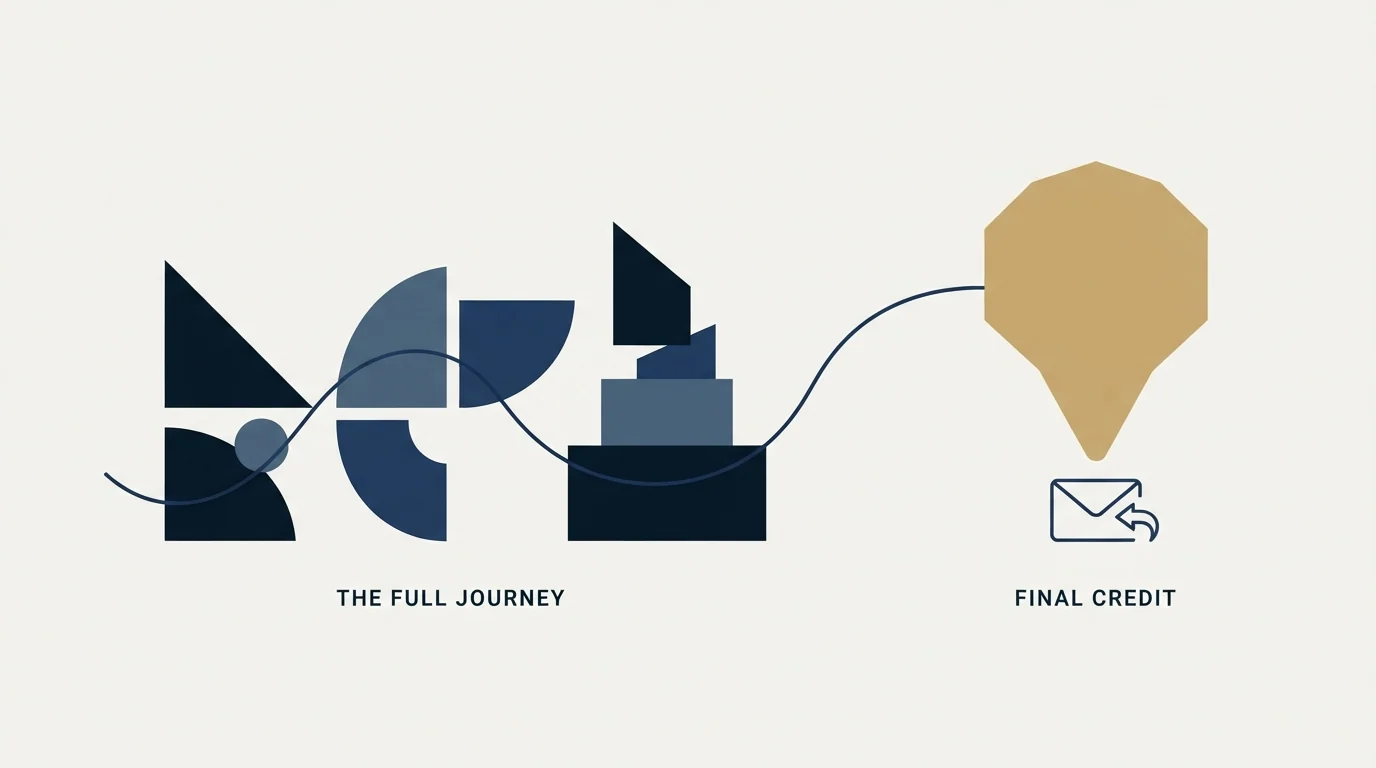
Three habits make the number usable.
Read it beside a count of touches. A conversion credited to one email after eleven touches and a conversion credited to one email after one touch are different events. The average path length per channel is usually available even when the attribution model is not, and it tells you how much the model is hiding.
Never compare channels on last-touch credit alone. Channels that sit early in a journey will always lose that comparison, whatever they contributed, so the comparison measures position rather than performance.
Separate the creation of demand from its capture. A single reporting view that answers both questions at once does not exist, and the attempt to build one is what produces most attribution arguments. Keeping the two questions apart is cheaper than reconciling them.
- Yes: You know the average number of touches on the paths it summarises
- Yes: You know the lookback window the tool applied
- Yes: You are asking what captured intent, not what created it
- Depends: You have checked whether direct traffic is excluded from credit
- No: You are using it to compare an early channel against a late one
The fourth item is worth expanding, because it is a real behaviour rather than a hypothetical. Google's Analytics help page states that its attribution models "exclude direct visits from receiving attribution credit", qualifying that only "unless the path to key event consists" entirely of them. A buyer who types your domain in after reading something, which is common in B2B, therefore has that visit routed to an earlier touch rather than credited as the last one. Whether your tool does the same is worth checking before you conclude anything from a report.
What to use instead, and when the answer is nothing
The honest sequence for a B2B team is smaller than the vendor comparisons suggest.
If you have fewer than a hundred closed deals, no attribution model will separate signal from noise, and the useful measurement is qualitative: ask the buyer on the call how they came to be on it, and record the answer in a field. That is a one-line CRM change and it beats a model.
If you have volume and a long cycle, a multi-touch model that credits the milestones your CRM actually stamps is worth the setup, which is what the position-based models do and where they fail. If the argument is about recency rather than position, the time decay model is the one that formalises it, and its half-life setting turns out to matter more than the choice of model.
And if the question is really about whether outbound is working, attribution is a detour. The measurements that answer it are the ones tied to the motion itself: reply quality, the ratio of booked to held meetings, and how far into the sales cycle those meetings travel. A programme whose meetings die at the second stage has a targeting problem that no weighting scheme will surface.
Where the model belongs in a stack

Last-touch is a reasonable default for the reporting layer and a poor default for the budgeting layer. Keep it for the operational question of which surface produced this week's bookings, and keep it away from the annual conversation about which channel deserves more money.
The teams that get this wrong are rarely the ones who misunderstand the model. They are the ones who let a default in a reporting tool become the definition of contribution, then discover a year later that the channels which built the pipeline were defunded on the evidence of a rule that could never have credited them. Deciding which questions the model is allowed to answer is the whole of the work, and it costs nothing.
If the real question is whether an outbound programme is producing meetings worth attributing at all, see what a campaign would look like for your market.
The short version
Last-touch attribution gives all the credit for a conversion to the final tracked interaction, which in B2B outbound is almost always the message that got the reply rather than the work that made the reply possible. Use it to ask what captured existing intent, never to compare an early channel against a late one, and check what your tool does with direct traffic before reading anything into the result. Inside Google's own products the rule-based alternatives were removed in November 2023, so the practical choice there is now data-driven or last-click; outside them, the rule-based models remain available and the pipeline stages your CRM stamps decide which ones can work.
Google attribution model behaviour verified against Google's own Analytics and Google Ads help pages, fetched mid-2026. Verify current behaviour with the platform before relying on it.
Sources: Google Analytics: About attribution and attribution modeling, Google Ads: About attribution models
Frequently asked questions.
Frequently asked questions- What is last-touch attribution in simple terms?
- It is a rule that gives all the credit for a conversion to the last interaction recorded before it. If a buyer read three articles, attended a webinar and then replied to an email, the email takes everything and the rest take nothing. The rule is complete in one sentence, which is both its appeal and its main limitation.
- Is last-touch attribution bad?
- It is the wrong instrument for comparing channels and a reasonable one for asking what converted existing intent. The problem is not accuracy but scope. Because it is the default in most reporting tools, teams use it to answer budget questions it was never able to answer, and channels that sit early in a journey lose that comparison whatever they contributed.
- Can you still use last-touch attribution in Google Analytics?
- Yes. Google's Analytics help page lists three models available in Attribution reports: data-driven attribution, paid and organic last click, and Google paid channels last click. What it removed in November 2023 were first click, linear, time decay and position-based. Outside Google's products, those rule-based models are still available in CRM-based and B2B attribution tools.
- What should a small B2B team use instead?
- Below roughly a hundred closed deals, no model separates signal from noise, so the cheapest useful measurement is asking buyers on the call how they came to be on it and recording the answer in a field. Above that, a multi-touch model is worth the setup only if your CRM stamps the milestones it needs reliably.
About the author.

Ben Carden is CRO at RevenueFlow, which builds and operates outbound revenue engines for B2B companies. Previously at Gartner Enterprise. Studied at London School of Economics.
Ben Carden · CRO
Connect on LinkedIn →Explore more.
Ready to scale your outreach?
We build GTM engines that book real meetings. See the receipts.
Related articles.
Time Decay Attribution: Setting the Half-Life
Time decay weights recent touches more heavily, and the half-life that controls how fast credit fades decides more than the choice of model does.
Position-Based Attribution: The U, the W and the Timestamp
U-shaped and W-shaped attribution are one model with a switch, and the switch is whether your CRM can be trusted to stamp lead creation.
Cross-Sell vs Upsell: Different Trigger, Different Owner
An upsell has a trigger that arrives on its own. A cross-sell has none and needs a diagnosis somebody funds. That is the difference that decides the work.
Sales Call Planning: The Plan a Booked Call Needs
A call cannot produce a commitment nobody named in advance. The four fields a call plan carries, and why the ask has to be decided before the meeting opens.
Lifecycle Stage, Lead Status, Deal Stage: Three Fields
Lifecycle stage records position, lead status records activity, and deal stage lives on the deal. Merging them breaks funnel reporting in ways nobody notices for a year.
The JOLT Effect: Selling to a Buyer Who Cannot Decide
The loss that shows no competitor and no rejection. What the JOLT research names, why the standard urgency playbook makes it worse, and the four moves that answer it.