Lifecycle Stage, Lead Status, Deal Stage: Three Fields
Lifecycle stage records position, lead status records activity, and deal stage lives on the deal. Merging them breaks funnel reporting in ways nobody notices for a year.
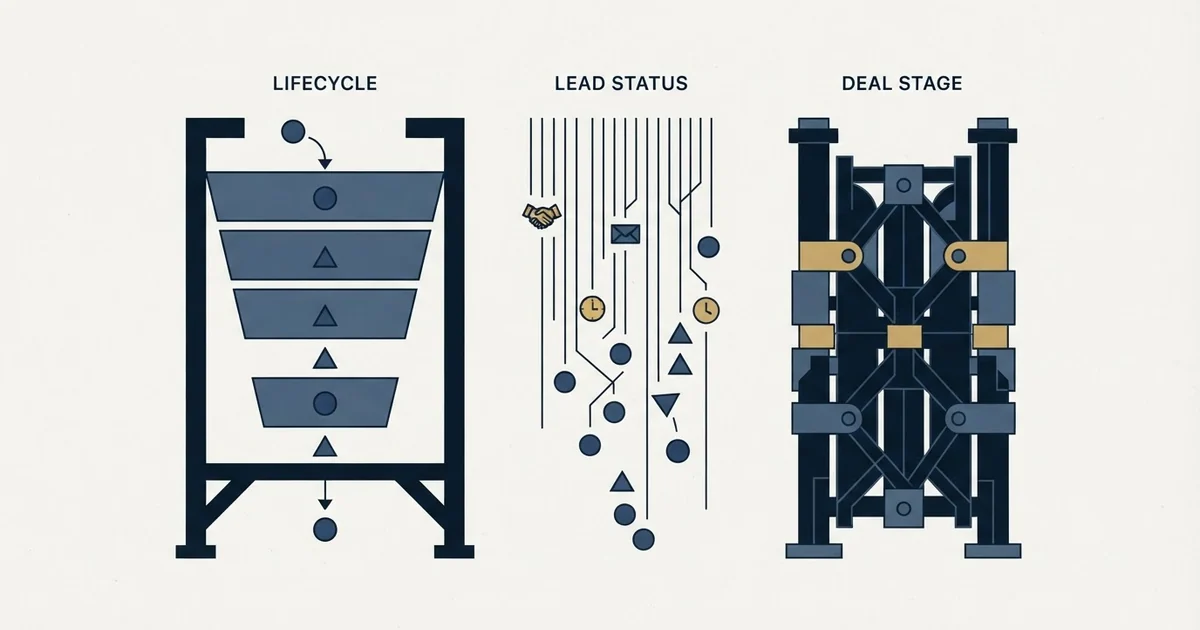
Lifecycle stage records where a contact sits in the funnel and moves forward only. Lead status records what is happening to them right now and moves freely. Deal stage lives on the deal record, because one contact can carry several. If an answer could differ across two deals with the same person, it belongs on the deal.
Key takeaways
- Lifecycle stage is a property of the person and should move in one direction, so automation that demotes stalled records destroys its value for cohort reporting.
- Lead status describes the current sales attempt and should be cleared once a contact becomes a customer, or every active-sales report includes them.
- If an answer could be different for two deals with the same person, the value belongs on the deal rather than on the contact.
- Wiring a lead score threshold straight into lifecycle stage turns a prediction into a recorded fact, and retuning the model silently rewrites history.
Reviewed and updated September 1, 2026
Three fields in a CRM answer three different questions and get filled in as though they answered one. Lifecycle stage says where a contact sits in the funnel overall. Lead status says what is happening to them right now. Deal stage says how far a specific piece of revenue has travelled. Teams that treat them as one field end up with reporting that cannot distinguish a contact nobody has touched from one who asked to be left alone, and with a funnel report that double counts.
The distinction is worth ten minutes because it is cheap to get right at setup and expensive to unpick later, once eighteen months of records carry the confusion.
What each field is actually for
Lifecycle stage is a property of the person or the company: subscriber, lead, marketing qualified lead, sales qualified lead, opportunity, customer. It describes position, and it is designed to move in one direction. A contact who becomes a customer does not go back to being a lead when a second deal opens.
Lead status is a property of the current sales attempt on that person: new, attempted, connected, working, unqualified, and whatever else your team adds. It describes activity, and it moves in any direction, repeatedly. Somebody can be attempted, then connected, then working, then back to attempted when they go quiet.
Deal stage is a property of a deal record, not of a person at all. One contact can sit on three open deals at three different stages, which is exactly why the stage cannot live on the contact.
- Where they sit in the funnel
- Moves forward, rarely backward
- Owned jointly by marketing and sales
- One value per record at a time
- What is happening to them right now
- Moves in both directions, often
- Owned by the sales team alone
- Meaningless once they are a customer
- How far this revenue has travelled
- One value per deal, several deals per contact
- Owned by sales, audited by finance
- Where forecasting actually reads from
The rule that keeps them apart
A single test resolves nearly every argument about which field to use: ask whether the answer could be different for two deals with the same person. If it could, the value belongs on the deal. If it could not, and it describes a permanent step forward, it belongs on lifecycle stage. If it could not, but it describes what a rep is doing this week, it belongs on lead status.
Applied to real cases:
- A contact who requested a demo, then went quiet, is still a sales qualified lead by lifecycle stage and is back to attempted by lead status. Both are true at once.
- A customer whose colleague fills in a form does not revert to lead. The company is a customer; the new interest is a new deal.
- A prospect in a paid pilot is not a customer until the commercial terms exist, but the pilot is a deal at a named stage. Two fields, two answers, no contradiction.
Where it goes wrong in practice
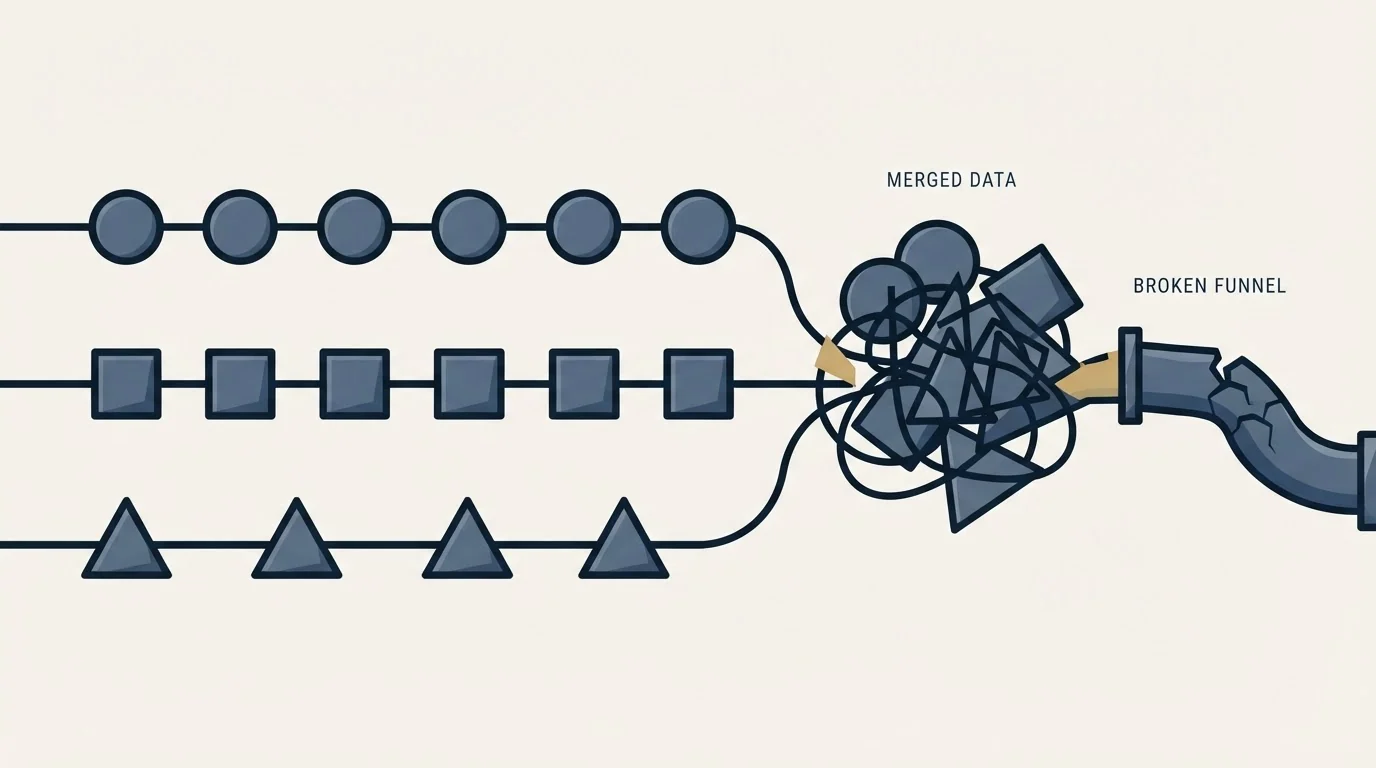
Four failure modes account for most of the mess, and all four are visible in the data before anybody notices them in a report.
Lifecycle stage used as a to-do list. A team without a lead status field starts encoding activity into lifecycle stage: a value like "contacted, no reply" appears alongside "marketing qualified lead". The moment that happens, the funnel report stops being a funnel, because the values are no longer ordered steps.
Lead status left populated after the sale. A customer carrying a lead status of "working" is not wrong exactly, but every report filtering on active sales activity now includes them. The cheap fix is a rule that clears lead status when lifecycle stage reaches customer.
Backward movement written into lifecycle stage. Automation that demotes a stalled opportunity back to lead destroys the one property that makes the field useful for cohort reporting, which is that the sequence of dates is monotonic. Model the stall as a lead status or a closed lost deal instead.
Two systems both writing the field. A marketing automation rule and a sales workflow both setting lifecycle stage, on different criteria, produces a value that flips depending on which fired last. This is the failure that survives longest, because each system's own logs look correct.
- Yes: Every lifecycle stage value is a step, not an activity
- Yes: Lead status is empty or cleared on every customer record
- Yes: Exactly one system writes lifecycle stage, and you can name it
- Yes: No record's lifecycle stage has moved backward in the last quarter
- No: Deal stage is duplicated onto the contact for convenience
What an outbound programme should set, and when
Cold outbound complicates the picture in one specific way: the contact did not raise a hand, so they did not enter the funnel through any of the events the default stages describe.
The workable convention is narrow. A cold contact loaded for a campaign is not a lead, because nothing about them has changed; they are a target. Give them a lifecycle stage that means exactly that, or leave the field empty and carry the campaign membership separately, which is cleaner. Set lead status to new when the campaign starts, and let it move as the rep works the reply.
Promotion to a qualified stage happens on the reply, not on the send. That distinction matters more than it looks, because a programme that promotes on send generates a marketing qualified lead count identical to its send volume, and the number becomes decorative. The agreed criteria for that promotion are the same ones the MQL and SQL boundary has to survive, and the reason to write them down before launch rather than after is that both teams have to be able to check them.
Once a meeting is booked, an opportunity exists and the deal record carries the stage from there. The contact's lifecycle stage moves to opportunity once and stays there.
The default value set is a starting point, not a standard
The stage names a team inherits come from whichever CRM it set up first, and they arrive looking like an industry standard. They are not. They are one vendor's default, chosen to fit an inbound motion where a subscriber signs up, converts on a form, and is scored into qualification.
Two consequences follow for anybody whose motion is not that.
The subscriber stage is dead weight for a company with no newsletter, and leaving an unused value in the list is not free: it appears in every funnel chart as a stage with zero records, which readers interpret as a broken step rather than an unused one. Remove values you do not use, and remove them before the first report rather than after somebody has built a dashboard on them.
And the set has no vocabulary for a contact you sourced rather than one who arrived. Adding one value for that, applied consistently, is worth more than any amount of downstream reporting cleverness, because it is the only way to separate demand you created from demand that came to you. Without it, the two populations are mixed in every stage count from the top of the funnel down, and no filter can pull them apart later.
Whatever you choose, write the allowed values down with a one-line definition each, and make the definitions checkable by somebody who was not in the meeting. A stage whose entry criterion is a feeling produces a field that measures who filled it in.
Do not let scoring set the stage directly
A common shortcut wires a lead score threshold straight into lifecycle stage: above sixty becomes a marketing qualified lead automatically. It is tempting because it removes a manual step, and it introduces a subtle problem.
A score is a prediction. A lifecycle stage is a claim about a fact. Wiring one into the other converts a probabilistic estimate into a recorded state, and the state is then used in reports that assume it was observed. When the scoring model is retuned, which happens routinely, the historical series changes meaning without anybody editing a record.
The safer pattern is to let the score drive routing and prioritisation, and to let a checkable criterion drive the stage. What a score can and cannot carry is the subject of lead scoring generally, and the platform-specific mechanics of the fit and engagement split are covered in HubSpot lead scoring.
Ownership, and why it is the actual fix
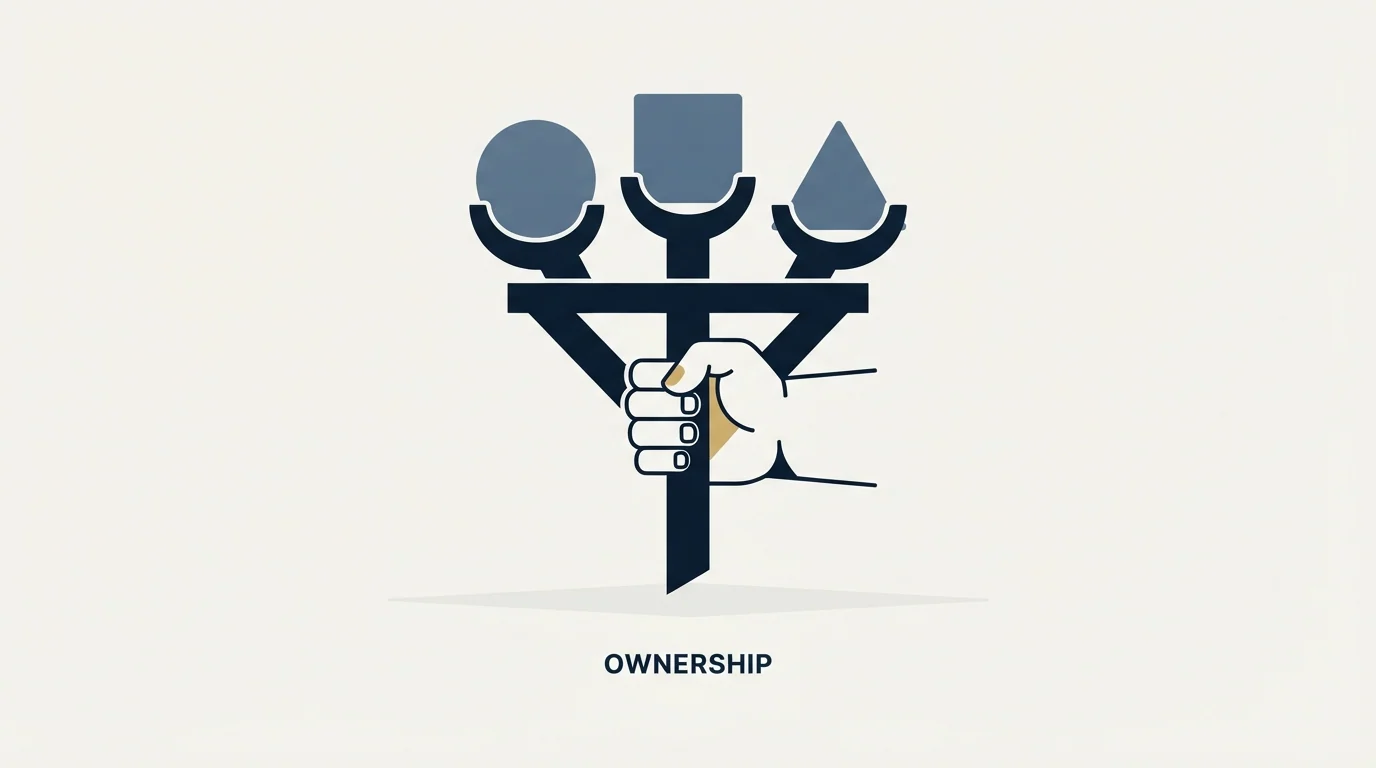
Every failure above is a symptom of the same root cause: no named owner for the field definitions.
The fields sit on the boundary between marketing and sales, which is exactly where ownership tends to dissolve, and unowned definitions drift one small change at a time until nobody can say what a quarter-old number meant. Where handoffs leak between GTM teams is the general version of this problem, and CRM field semantics are its most common instance.
The fix is unglamorous. One person owns lifecycle stage and its allowed values. One person owns lead status. Changes to either are dated and recorded somewhere a report author can read, so that a series break is visible rather than mysterious. That is the whole intervention, and it costs a document.
The short version
Lifecycle stage records where a contact sits in the funnel and moves forward only. Lead status records what is happening to them right now and moves freely, and should be cleared once they become a customer. Deal stage lives on the deal, because one contact can carry several. When in doubt, ask whether the answer could differ across two deals with the same person: if it could, it belongs on the deal. Give the two contact fields a named owner, keep scoring out of the stage itself, and audit for backward movement once a quarter. For how the stages themselves earn their place, see sales pipeline stages.
If the upstream question is how cold contacts should enter this model at all, see what a campaign would look like for your market.
Frequently asked questions.
Frequently asked questions- What is the difference between lifecycle stage and lead status?
- Lifecycle stage is where a contact sits in the funnel overall, such as lead, marketing qualified lead or customer, and it is meant to move forward only. Lead status is what a rep is doing with them right now, such as attempted, connected or working, and it moves back and forth repeatedly. Both can be true at once.
- Should lifecycle stage ever move backward?
- No. The value of the field for cohort reporting comes from the sequence of stage dates being monotonic, and a demotion breaks that permanently for every report built on it. Model a stall as a change in lead status, or as a closed lost deal, both of which are designed to move in either direction without corrupting the funnel.
- How should cold outbound contacts be staged?
- A contact loaded for a campaign has not changed in any way, so they are a target rather than a lead. Either give them a stage value that means exactly that or leave the field empty and carry campaign membership separately. Promote on the reply rather than on the send, otherwise your qualified count simply mirrors send volume.
- Why does my funnel report double count?
- Usually because deal stage has been copied onto the contact record, so a contact with two open deals appears at two stages, or because activity values have been added to the lifecycle stage list so the values are no longer ordered steps. Check both before rebuilding the report, since neither is a reporting bug.
About the author.

Ben Carden is CRO at RevenueFlow, which builds and operates outbound revenue engines for B2B companies. Previously at Gartner Enterprise. Studied at London School of Economics.
Ben Carden · CRO
Connect on LinkedIn →Explore more.
Ready to scale your outreach?
We build GTM engines that book real meetings. See the receipts.
Related articles.
Position-Based Attribution: The U, the W and the Timestamp
U-shaped and W-shaped attribution are one model with a switch, and the switch is whether your CRM can be trusted to stamp lead creation.
Cross-Sell vs Upsell: Different Trigger, Different Owner
An upsell has a trigger that arrives on its own. A cross-sell has none and needs a diagnosis somebody funds. That is the difference that decides the work.
Sales Activity Tracking: What the Record Has to Say
Most activity tracking fails at capture rather than analysis. The unit you count decides what every later number can mean, and no tool fixes a wrong choice.
Sales Call Planning: The Plan a Booked Call Needs
A call cannot produce a commitment nobody named in advance. The four fields a call plan carries, and why the ask has to be decided before the meeting opens.
Time Decay Attribution: Setting the Half-Life
Time decay weights recent touches more heavily, and the half-life that controls how fast credit fades decides more than the choice of model does.
GTM Misalignment: The Four Disagreements Underneath It
Misalignment is diagnosed as a relationship problem and treated with meetings. It is a definitions and measurement problem, and there are four of them.