MQL vs SQL: Definitions That Survive an Argument
An MQL is marketing's prediction. An SQL is sales accepting it. The missing acceptance stage, why scoring drifts, and why outbound needs its own vocabulary.
An MQL is a lead marketing judges worth a sales touch, based on fit plus engagement. An SQL is a lead sales has reviewed and accepted into active work. The useful part is not the definitions but the agreement on who applies them, on what evidence, and what happens on disagreement.
Key takeaways
- Most funnels are missing the sales-accepted stage between MQL and SQL, which is where the recurring argument actually lives.
- Treat fit as a gate rather than a scoring contributor, so engagement points cannot push an unqualified contact over the MQL threshold.
- A stage is only real if it comes from a structured field in the system of record. Stages inferred from free text are not facts.
- Outbound does not fit the MQL model because there is no prospect-initiated signal to score. It needs its own stages and merges with the inbound funnel at the meeting.
Reviewed and updated September 1, 2026
The argument is always the same. Marketing reports a strong month on MQLs. Sales says the leads were unusable. Both are looking at the same records and both are correct, because nobody wrote down what the labels mean in terms anyone could check.
MQL and SQL are handoff markers. An MQL is a lead marketing believes is worth a sales touch. An SQL is a lead sales has accepted and committed to work. The value of the pair is not the definitions, which are easy. It is the agreement about who applies them, on what evidence, and what happens when the two functions disagree.
MQL stands for marketing qualified lead, and the expansion is the least useful part of the definition: what decides whether the label means anything is the written test a lead has to pass before it earns it.
Marketers search this as MQL marketing, and the phrasing is a clue to the argument below: the label is applied by marketing, which is what makes it a prediction rather than a commitment.
Teams often talk about SQL leads as a single population, and the label only means something once somebody says who applied it and on what evidence.
An MQL in marketing is that first label: the point at which marketing asserts a contact is worth a salesperson's time, on criteria marketing owns and sales has to be able to check.
The definitions
MQL leads is the plural people search for when they mean the population rather than the label, and the population is only as meaningful as the criterion that admitted it.
MQL, marketing qualified lead. A contact who has met a threshold marketing set: the right firmographic profile plus some engagement signal, such as a demo request, a pricing page visit, or a content download combined with the right job title. Marketing owns the criteria.
A separate limitation shows up upstream: the enrichment and intent signals feeding those engagement scores often come from platforms whose three layers of use stop short of actual qualification.
SQL, sales qualified lead. A lead that sales has reviewed and accepted as worth active pursuit. Sales owns this one. The acceptance step is the point of the label.
A note on the acronym: in a sales context SQL means sales qualified lead. In an engineering context it means the database language. If your documentation is read by both audiences, spell it out the first time, because the collision causes real confusion in shared docs and dashboards.
- Based on fit plus engagement signals
- Threshold set by marketing, often a score
- Predictive: this looks like someone worth calling
- Volume is high and quality varies
- Based on a human review or a conversation
- Accepted into a rep's active workload
- Committal: someone has agreed to work this
- Volume is lower and the bar is explicit
The stage that is usually missing
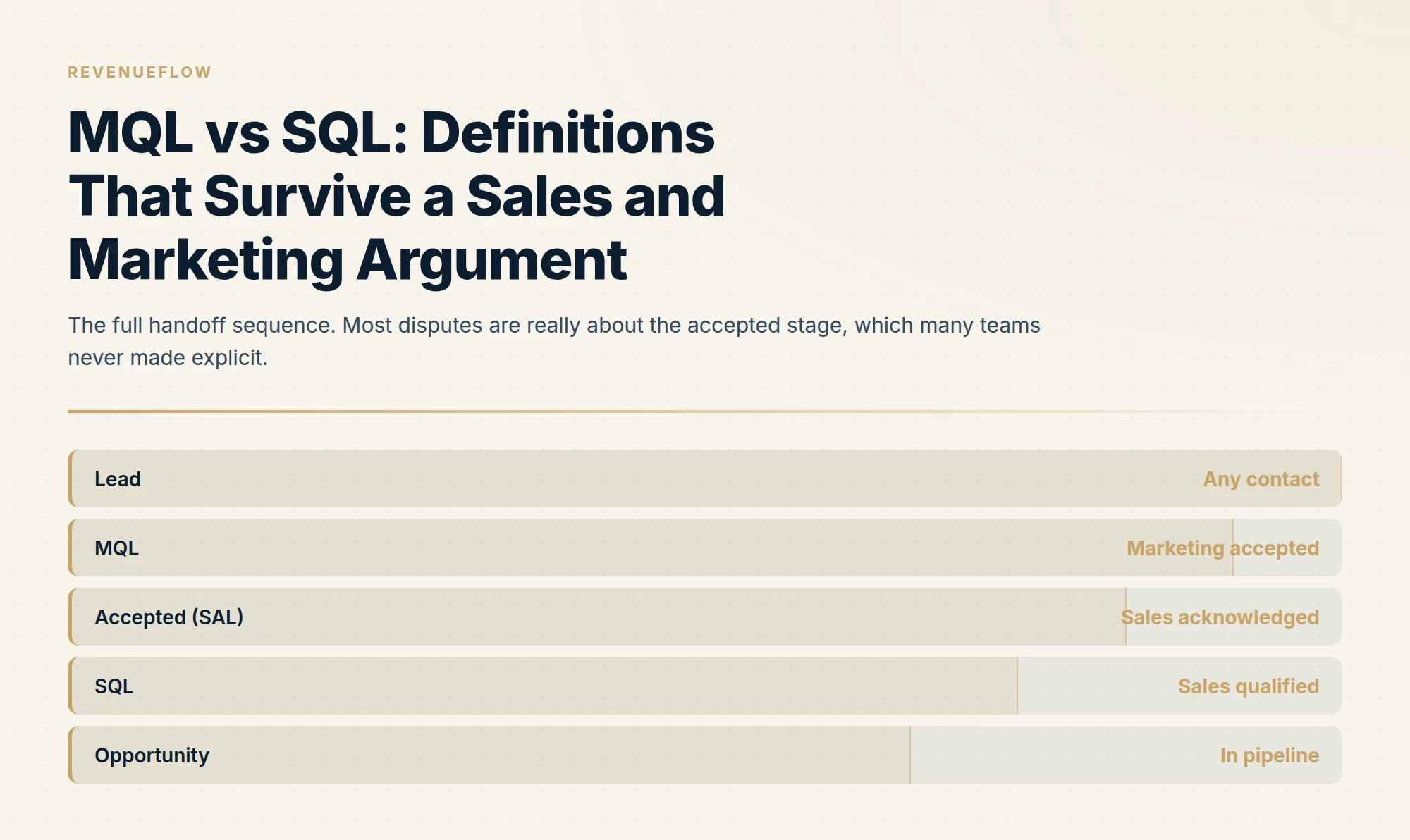
Most funnels that argue about MQL-to-SQL conversion are missing the stage in between, which is where the argument actually lives.
In the database, no qualification applied.
Met marketing's threshold. Passed to sales.
A rep has looked at it and agreed it is workable. The missing stage.
Contact made, fit confirmed, being actively worked.
Forecastable, with a value and a close date.
Without the accepted stage, an MQL that a rep silently ignores is indistinguishable from an MQL that a rep worked and disqualified. Both show up as "did not become an SQL," and marketing has no way to tell whether the criteria were wrong or the follow-up never happened. Adding an explicit acceptance step, with a required reason on rejection, converts a recurring argument into a data question.
That step also settles the question of which of the two to pursue first, which is usually asked as though it were a preference. It is not a choice between populations. An SQL has already been accepted by the person who has to work it, so it is worked now; an MQL is a prediction awaiting that acceptance, so the useful action is to accept or reject it rather than to queue it behind other work. A team arguing about which to pursue is almost always missing the acceptance step, and the argument disappears once the step exists.
Scoring, and why it drifts

Most MQL thresholds are implemented as a lead score: points for job title, company size, pages viewed, emails opened, forms completed. Cross the number and the record flips to MQL.
Two things go wrong reliably.
Engagement points outrun fit points. Someone with no buying authority who reads a lot of content accumulates enough behavioural score to cross the threshold, while the right buyer who visited twice does not. The fix is treating fit as a gate rather than a contributor: no fit, no MQL, whatever the engagement score says. Fit criteria come from your ideal customer profile, which is upstream of the scoring model and is what the model should encode.
Nobody revisits the weights. Scoring models are set during an implementation project and then run for years. The pages change, the content changes, the market changes, and the score keeps arithmetic from a previous era. A quarterly review against what actually converted is enough to keep it honest.
Where the stage comes from matters more than the threshold
One operating rule is worth more than a well-tuned scoring model: a stage is only real if it comes from a structured field in the system of record.
Stages inferred from free text are not facts. A note containing the word "qualified," a subject line mentioning a demo, an email thread that reads positive: none of these are stage transitions, and treating them as such produces counts that nobody can reproduce. We learned this the expensive way on our own reporting, where a lead was double-counted as qualified because the word appeared in a notes field.
The same discipline applies to the definitions themselves. If your MQL criteria live in a slide from last year and your scoring model lives in the marketing automation platform, those two will diverge and the platform wins, silently. The executable definition is the one in the system.
That same insistence on structured, system-of-record data applies to attribution, where what counts as a qualifying touch determines whether marketing influenced pipeline means anything at all.
A definition that survives contact
An unclear definition is what produces the recurring argument about which leads count, and it ends when the criteria name what somebody has to have said or done rather than what they appear to be.
- Yes: Written down somewhere both teams can find, not in a slide
- Yes: Fit criteria expressed as ranges and lists, not adjectives
- Yes: A named person in each function owns the definition
- Yes: Rejection requires a reason code that maps to the criteria
- Yes: Stage lives in a structured field, not inferred from notes
- Depends: The definition has been reviewed in the last two quarters
- No: Anyone can override the stage without a reason
The rejection reason code is the highest-leverage item. When a rep rejects an MQL, the reason should map to a criterion: wrong company size, wrong role, existing customer, no budget authority, bad contact data. A rejection reason of "not a fit" is not information. Reason codes turn the monthly argument into a ranked list of what to fix, and the ranking usually shows one or two causes accounting for most of the loss.
Outbound does not fit this model, and that is fine
The MQL and SQL vocabulary comes from inbound marketing, where the prospect acts first and the score interprets that action. Outbound has no such signal. Nobody downloaded anything. The prospect's first action is a reply.
Forcing outbound into MQL reporting produces nonsense, usually by classing every contacted prospect as a lead and reporting a catastrophic conversion rate. Outbound needs its own stages, typically running from targeted to contacted to replied to meeting booked to meeting held. Only at the meeting stage does it merge sensibly with the inbound funnel.
If you buy outbound from a vendor, this is worth settling in the contract, because it determines what you are paying for. A vendor delivering "leads" and a vendor delivering held meetings are selling different things at different points on that sequence, a distinction we worked through in appointment setting versus lead generation. The cost comparison for both sits in the lead generation agency cost guide.
Making the handoff work

- Step 1Define together
Both functions agree the criteria and both sign off. One document, one owner each.
- Step 2Encode in the system
Criteria become structured fields and a scoring model. The system is the definition.
- Step 3Require acceptance
A rep explicitly accepts or rejects, with a reason code on rejection.
- Step 4Review the reasons
Rejection reasons ranked by volume become the input to the next revision.
The review loop is the part that gets dropped, and dropping it is what makes the definitions rot. The criteria were a hypothesis about who buys. Rejection reasons and closed-won data are the evidence. Without a scheduled revision, you are running last year's hypothesis and arguing about the results.
The service level nobody writes down
Definitions settle what a lead is. They say nothing about what happens next, and the gap between "marketing passed it" and "someone called it" is where a surprising share of MQL value evaporates.
Two commitments are worth writing into the same document as the criteria.
A response time. How quickly a passed MQL gets a first attempt. The right number depends on your market, but the important property is that it exists and is measured, because "when the rep gets to it" is not a process and produces a queue nobody can see. Speed matters most on leads generated by an action the prospect just took, where the window of relevance is short.
A minimum attempt count before disposal. How many attempts, across how many channels, before a lead can be marked dead. Without this, disposal rates vary by rep and marketing cannot tell whether its criteria are wrong or the follow-through is uneven. With it, an unworked lead is visible as a process failure rather than hidden inside a conversion rate.
Both of these are more useful than tuning the scoring model, and both are easier to agree, because they are commitments about behaviour rather than arguments about who is right.
A worked example of criteria
Abstract criteria produce abstract arguments. Here is the shape that holds up, using a made-up profile purely to show the structure.
Fit gate, all required: company headcount between 50 and 500; industry within a named list; based in a market you sell into; not an existing customer, active opportunity, or named competitor.
Engagement threshold, any one: requested a demo or pricing conversation; attended a live event you ran; two or more visits to pricing or product pages within fourteen days; replied to an outbound sequence with interest.
Job-title gate: the contact holds, reports into, or has been named as an influencer on the relevant function.
Notice what the fit gate does. It is expressed as ranges and lists rather than adjectives, it can be evaluated by someone who was not involved, and it is a gate: failing it means no MQL regardless of engagement. Notice also that the engagement list contains actions, not scores. Scores are a convenient way to implement thresholds and a poor way to write them down, because a score of 47 is not a criterion anybody can argue with or improve.
Where intent data fits
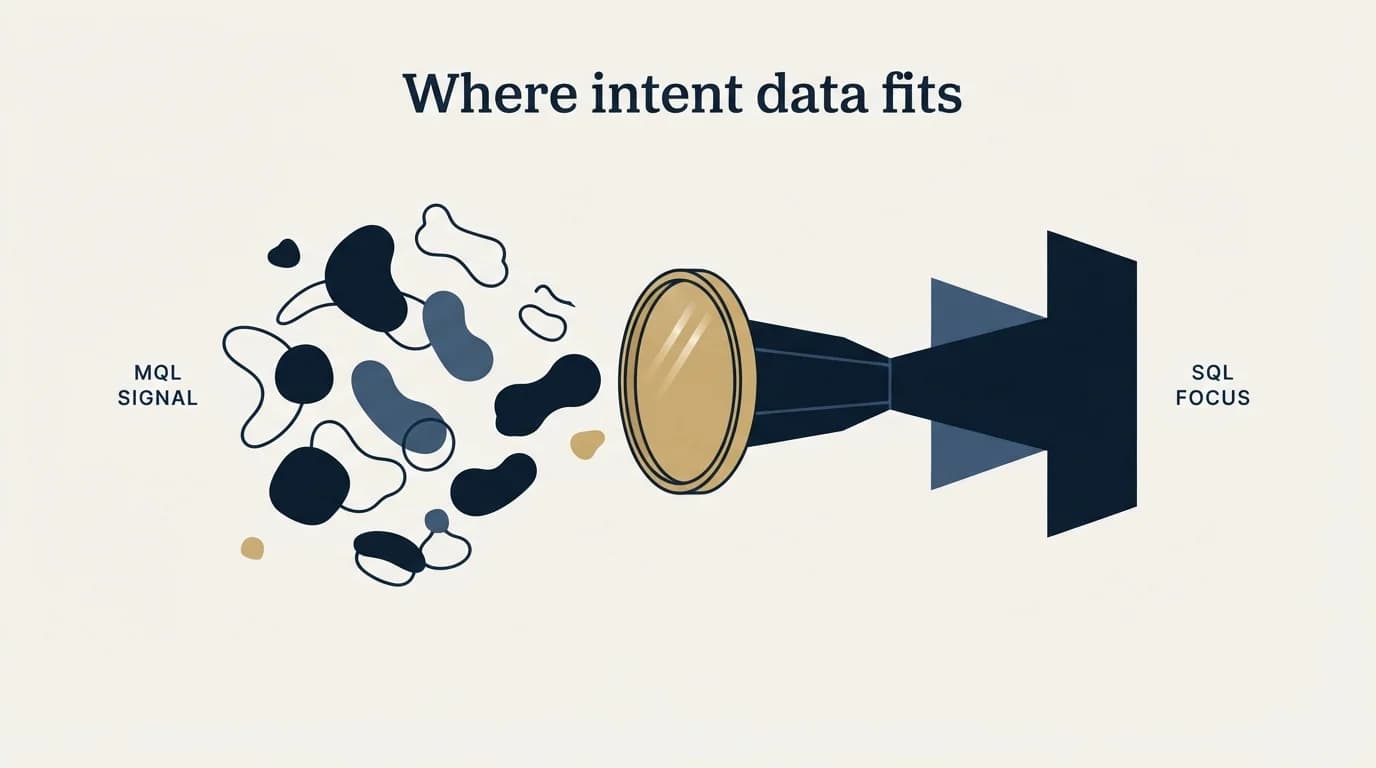
Intent signals, whether third-party topic data or first-party signals like repeat pricing-page visits, are usually plugged into the scoring model as extra engagement points. That is the weakest use of them.
They work better as a prioritisation layer over accounts that already pass the fit gate: same qualification bar, different order of attack. That keeps intent from inflating scores for accounts that were never a fit, which is the most common way intent data makes lead quality worse. We covered what the signals do and do not predict in the B2B intent data guide, and the first-party side in website visitor identification.
The short version
An MQL is marketing's prediction that a lead is worth a call. An SQL is sales accepting that prediction. The gap between them is a real stage that deserves an explicit acceptance step and a reason code on rejection. Gate on fit before scoring engagement, keep the stage in a structured field rather than inferring it from notes, and review the criteria against what actually closed at least twice a year. Outbound needs its own stage vocabulary and merges with this one at the meeting, not before.
If the outbound half is what you are trying to solve, we are paid on attended meetings against criteria agreed in writing before launch. You can see what a campaign would look like for your market.
Frequently asked questions.
Frequently asked questions- What is the difference between an MQL and an SQL?
- An MQL is a marketing qualified lead, meeting a threshold marketing set from fit and engagement signals. An SQL is a sales qualified lead, one that sales has reviewed and accepted as worth active pursuit. Marketing owns the first label and sales owns the second.
- What is an SAL or sales accepted lead?
- It is the acknowledgement step between MQL and SQL, where a rep confirms a passed lead is workable before qualifying it further. Without it, a lead a rep silently ignored looks identical to one that was worked and disqualified, so marketing cannot tell whether criteria or follow-up was the problem.
- Why do MQLs convert poorly to SQLs?
- The most common causes are engagement points outrunning fit criteria, so high-consumption non-buyers cross the threshold, and scoring weights that were set during implementation and never revisited. Requiring a reason code on rejection turns the question into a ranked list of what to fix.
- Do MQL and SQL apply to outbound?
- Not cleanly. The vocabulary comes from inbound, where the prospect acts first and scoring interprets that action. Outbound has no such signal, so it needs its own stages running from targeted to contacted to replied to meeting booked to meeting held, merging with the inbound funnel at the meeting.
About the author.

B2B cold email experts helping companies generate qualified leads through done-for-you outreach campaigns.
RevenueFlow Team
Explore more.
Ready to scale your outreach?
We build GTM engines that book real meetings. See the receipts.
Related articles.
Sales Cycle Length Benchmarks: What Each Figure Counts
The published B2B sales cycle benchmarks, sorted by what each page says it counted. The same number means two different things in two of them.
B2B Lead Lists for Aviation Companies: Build or Buy
Aviation is one of the few industries whose accounts are published by its regulator, which changes what is worth buying and what is worth downloading yourself.
Cold Calling for Food and Beverage Companies: Three Doors
Cold calling for a food or beverage company: who picks up at a chain, a distributor and an independent grocer, where each publishes its door, and when the phone is wrong.
Win Rate Benchmarks: Which Figures State a Population
A catalogue of the published average sales win rates, sorted by whether the page names the population behind its own number. Most do not.
LinkedIn Outreach for Banks: A Regulated Message
How a bank's relationship managers use LinkedIn to reach business owners: what the FFIEC guidance, FINRA's notices and LinkedIn's own rules require, and where to stop.
Cold Calling for PPC Agencies: What You Can See First
A paid media prospect is partly readable before the call and has already been told by the platform what to do when a stranger rings about its ads.