What ZoomInfo Is Used For: The Three Layers
ZoomInfo sells find, enrich and engage as one platform, and most teams use one layer. What each does, how credits are consumed, and where it stops.
ZoomInfo is used to find companies and contacts that match a target market, to enrich records a revenue team already holds, and to engage those contacts through its own sales automation. Its documentation calls it a go-to-market intelligence platform with 100M+ companies and 500M+ professionals; most teams buy all three layers and use one.
Key takeaways
- ZoomInfo's developer documentation defines it as a go-to-market intelligence platform that helps teams find, enrich and engage companies and contacts, with 100M+ companies and 500M+ professionals.
- Its product navigation is organised into three layers, Intelligence (find), Engagement (act) and Orchestration (keep the CRM clean), and most subscriptions are bought for all three and used for one.
- ZoomInfo and Zoom are unrelated companies; ZoomInfo's own blog says they are two very different companies serving entirely different business needs.
- Credits, not seats, decide whether a subscription lasts the year: one credit covers a record's email, mobile, firmographic, technographic and intent data, and credits are retained for a year.
Reviewed and updated September 19, 2026
A finance approver looks at a renewal quote with ZoomInfo on it, sees a number with a comma in it, and asks the rep what the tool actually does. The rep says "it's where we get contacts." That answer is true and it is also the reason the renewal is hard to defend, because the platform sold in that quote does considerably more than supply contacts, and the parts nobody is using are usually the parts being paid for.
Here is what ZoomInfo is used for, in the vendor's own description, and where it stops being the answer.
Read as a catalogue, the ZoomInfo products list is shorter than the navigation suggests: four packaged lines, a data-delivery track, and a set of surfaces that sit on top of the same database.
How does ZoomInfo work is the underlying question here: it aggregates business-contact data from contributed address books, public records and its own research, and sells access to the result.
Asked in the plainest form people use, what do they do, the answer is narrower than the category language suggests: the company sells access to a contact and company database, plus signals about which of those companies are showing interest, plus the plumbing to push both into the systems a revenue team already runs.
Teams weighing that data layer against a pipeline tool often end up running both, a tradeoff explored in Copper paired with ZoomInfo.
What is ZoomInfo used for?
ZoomInfo is used to find companies and contacts that match a target market, to enrich the records a revenue team already holds, and to engage those contacts through its own sales automation. Its developer documentation describes it as a go-to-market intelligence platform for exactly those three verbs, find, enrich and engage, and most customers pay for all three and use one. Everything below is the detail behind that sentence.
First, the name collision
ZoomInfo and Zoom are unrelated companies. ZoomInfo publishes a page on its own blog specifically to settle this, and it opens by saying that "ZoomInfo and Zoom are two very different companies serving entirely different business needs" (pipeline.zoominfo.com/sales/zoominfo-vs-zoom). On that page ZoomInfo describes itself as a go-to-market intelligence platform and describes Zoom Video Communications as a video conferencing and collaboration platform for meetings, webinars and team chat.
That is the whole of the relationship. Neither owns the other, and a ZoomInfo subscription buys nothing on the video side. The confusion is common enough that a vendor wrote a comparison page against a company it does not compete with, which is a useful signal about how often the question is asked.
What the platform is, per the vendor
ZoomInfo's developer documentation gives the tightest available definition of the product from the company itself. The docs host describes ZoomInfo as "a go-to-market intelligence platform that helps sales, marketing, and revenue teams find, enrich, and engage the right companies and contacts", with access to "100M+ companies, 500M+ professionals, and 50+ real-time buying and business signals" (docs.zoominfo.com).
Three verbs are doing the work there: find, enrich, engage. Those map onto the three layers ZoomInfo's own product navigation is organised around, and they are also the honest way to audit a subscription, because most teams buy all three and use one.
Alongside those, ZoomInfo names a set of surfaces rather than features: ZoomInfo Copilot, GTM Workspace, GTM Studio and ZoomInfo MCP, plus packaged product lines for Sales, Marketing, Talent and Operations, and a Data as a Service line for teams that want the data delivered into their own systems rather than used through an interface.
What people mean when they say lead generation with ZoomInfo
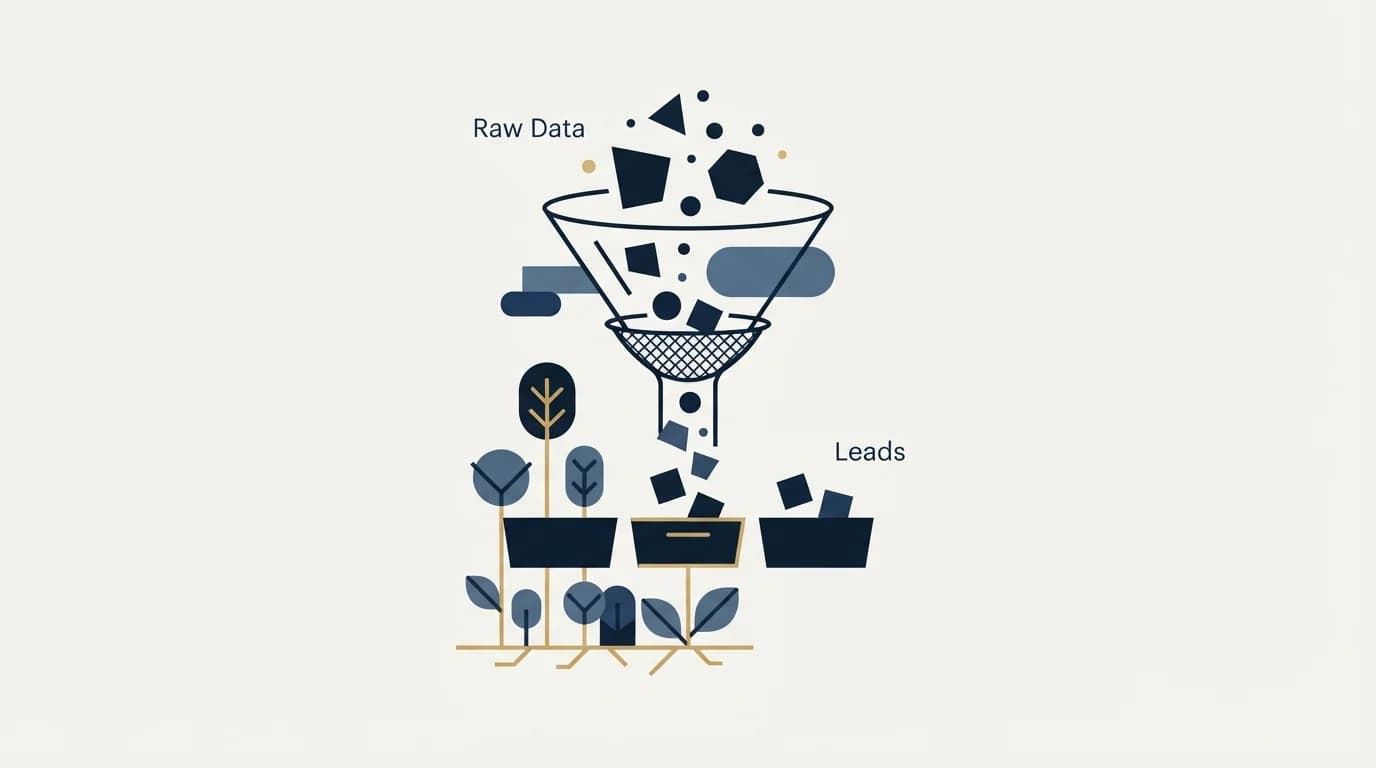
The lead generation job is the first layer only. You define a market with firmographic filters, you narrow it with technographic data or intent, and you export or sync the contacts that match. That is a list, and a list is a starting condition rather than pipeline.
Teams weighing a CRM against this list-building layer can see how the categories differ in the comparison of Pipedrive and ZoomInfo.
The gap between the two is where the platform gets blamed for things that are not its fault. A list that matches your filters can still be the wrong list, because the filters encode what you asked for rather than what is true. Employee-count bands go stale, technology detection reports what a site advertises rather than what a team runs, and a title filter returns the people whose profile says a title rather than the people who own the decision. None of that is a data-quality defect. It is the difference between a query and a qualification.
The second thing that gets attributed to the data is reply rate. A verified mailbox tells you a message can be delivered. It carries no information about whether the person wants the message, which is decided by the offer and the timing rather than the source of the address.
The marketing side, and what it is not
ZoomInfo's marketing surface is account-based rather than campaign-based. Its published solutions menu lists ads audiences for paid social against target accounts, website chat that identifies and routes visitors, web form optimisation, and website visitor tracking that turns anonymous page views into named accounts.
The distinction worth holding onto is that this is audience infrastructure rather than a channel. ZoomInfo can tell a paid social platform who to show an ad to and can tell a chat widget which visitor is worth routing to a human. It does not write the ad, own the budget, or replace the demand work. Teams that buy the marketing line expecting a demand programme in a box end up paying for targeting they were already doing in a spreadsheet.
The engagement layer, including what the Engage question is really asking

ZoomInfo has sold an outbound execution product under more than one name, and search traffic still carries the older ones. On ZoomInfo's current published solutions menu the engagement layer appears as sales automation, described as streamlining phone and email outreach, alongside conversation intelligence for analysing calls. Chorus, the conversation intelligence product ZoomInfo acquired, is named directly in ZoomInfo's own comparison copy as the surface that provides it.
Teams weighing engagement tools against the data layer can see how the roles split apart in the cross-category look at Salesloft and ZoomInfo.
Whatever it is called in the quarter you are reading this, the buying question does not move: you are being asked to pay for a sequencer and a dialer inside the same contract as the data. That bundles well on paper and it creates one real risk, which is that switching sending tools later means unpicking a contract that also holds your data supply. Buying the data and the sending separately costs more line items and preserves the ability to change one without the other.
Our own position on that layer is a matter of documented policy rather than preference. We run one message per campaign, with no bumps and no thread replies, and a fresh angle on a new campaign when a segment is worth re-approaching. A platform that makes multi-step sequences the default path is not wrong for everyone, and it is not the shape of our practice.
Credits, which is where the money actually goes
Seat count is the number on the quote. Credits are the number that decides whether the subscription lasts the year.
ZoomInfo's explainer describes the model plainly: "One ZoomInfo credit provides broad enrichment coverage across people, company data, and signals, including verified emails, mobile numbers, firmographics, technographics, job postings, website activity, and intent", and states that credits are retained for a year, with refreshes of an enriched record within that period covered.
Two consequences follow, and both are worth raising before signing rather than in month four.
The first is that credit consumption is a function of how you work, not of how many people you employ. A team that exports carefully and enriches in batches spends slowly. A team that runs broad exports to see what is in there spends a year's allocation in a quarter, and the overage conversation is not a negotiation.
The second is that credit retention across a year makes annual planning possible and makes mid-year panic buying unnecessary. Knowing the retention window exists is worth more than most of the feature list, because it changes how you pace exports.
Where the platform stops

Three limits are structural rather than fixable by a better plan.
Coverage is uneven by geography and company size. A database of that scale is deepest where its collection is densest, which in practice means large North American companies are covered better than small European ones. That is not a criticism of the vendor so much as a reason to test coverage on your actual segment before signing, using your own target list rather than a demo account's.
Data decays whatever the source. People change jobs, companies restructure, and a record verified in March is a different asset in November. This is why data decay is a running cost rather than a one-time cleanup, and why the enrichment layer exists at all.
A database sends nothing. The platform can tell you who to contact and, on the engagement layer, give you a way to contact them. It cannot make the message worth reading. Teams that measure the tool by reply rate are measuring their copy.
Pre-purchase checks
- Test coverage against your own target account list, not a curated demo segment
- Ask for the credit allocation in writing, plus the overage rate
- Establish whether you are buying data only or data plus the engagement layer
- Confirm which API scopes your subscription includes, since access is subscription-gated
- Agree who owns list quality internally before the first export
- Assume a headline contact count describes the database rather than your segment
How to decide
If your bottleneck is that nobody can find the right accounts, the intelligence layer is the part that earns its price, and the rest is optional. If your bottleneck is that the accounts are known and the outreach is not landing, more data will not fix it and a cheaper source will do the same job. Comparing the field on that axis is what the alternatives round-up is for, and the two head-to-head reads worth having beside it are UpLead against ZoomInfo on price per record and Apollo against ZoomInfo on data accuracy.
If the interesting part of the platform is the signals rather than the records, the buying question changes shape again, and the honest starting point is what intent data can and cannot tell you before you price the module that supplies it.
The last question is the one finance was really asking. A go-to-market data platform is a supply decision. What turns supply into meetings is a campaign, and if you would rather test that half first, we will run a campaign for you and you can price the data against what it produced.
Platform descriptions and product names are taken from ZoomInfo's own documentation and blog. Verify current terms with the vendor before relying on them.
Frequently asked questions.
Frequently asked questions- What is ZoomInfo used for?
- ZoomInfo is used for three jobs. Finding companies and contacts that match a target market, with firmographic, technographic and intent filters. Enriching the records a team already holds in its CRM. And engaging those contacts through its own sales automation for phone and email. Its documentation describes it as a go-to-market intelligence platform for exactly those verbs, and most customers pay for all three and use one.
- What does ZoomInfo do, in plain terms?
- It sells access to a contact and company database, signals about which of those companies are showing interest, and the plumbing to push both into the systems a revenue team already runs. ZoomInfo's own docs put the database at 100M+ companies and 500M+ professionals with 50+ real-time buying and business signals. What it does not do is write the message or earn the reply; those stay with the team.
- Is ZoomInfo the same company as Zoom?
- No. ZoomInfo and Zoom Video Communications are unrelated, separately traded companies, and ZoomInfo publishes a page on its own blog to settle the confusion, describing the two as very different companies serving entirely different business needs. ZoomInfo is a go-to-market intelligence platform; Zoom is a video conferencing and collaboration platform. A ZoomInfo subscription buys nothing on the video side.
- How do ZoomInfo credits work?
- Per ZoomInfo's own explainer, one credit provides enrichment coverage across people, company data and signals, including verified emails, mobile numbers, firmographics, technographics, job postings, website activity and intent, and credits are retained for a year with refreshes of an enriched record covered inside that period. Consumption depends on how a team exports, so careful batch enrichment spends slowly and broad exploratory exports spend a year's allocation in a quarter.
About the author.

B2B cold email experts helping companies generate qualified leads through done-for-you outreach campaigns.
RevenueFlow Team
Explore more.
Ready to scale your outreach?
We build GTM engines that book real meetings. See the receipts.
Related articles.
LinkedIn Outreach for Banks: A Regulated Message
How a bank's relationship managers use LinkedIn to reach business owners: what the FFIEC guidance, FINRA's notices and LinkedIn's own rules require, and where to stop.
Appointment Setting for Business Brokers: The Seller Meeting
What a bought meeting with a business owner has to be for a brokerage: the three-part qualification, the confidentiality rules, the licence line and the owner's reasons.
B2B Lead Lists for Aviation Companies: Build or Buy
Aviation is one of the few industries whose accounts are published by its regulator, which changes what is worth buying and what is worth downloading yourself.
Cold Calling for Food and Beverage Companies: Three Doors
Cold calling for a food or beverage company: who picks up at a chain, a distributor and an independent grocer, where each publishes its door, and when the phone is wrong.
Win Rate Benchmarks: Which Figures State a Population
A catalogue of the published average sales win rates, sorted by whether the page names the population behind its own number. Most do not.
Cold Calling for PPC Agencies: What You Can See First
A paid media prospect is partly readable before the call and has already been told by the platform what to do when a stranger rings about its ads.