Apollo vs ZoomInfo: Testing Data Accuracy on Your Market
Published accuracy percentages do not transfer between markets. A repeatable test design for comparing two data providers on your own ICP, and what each vendor publishes.
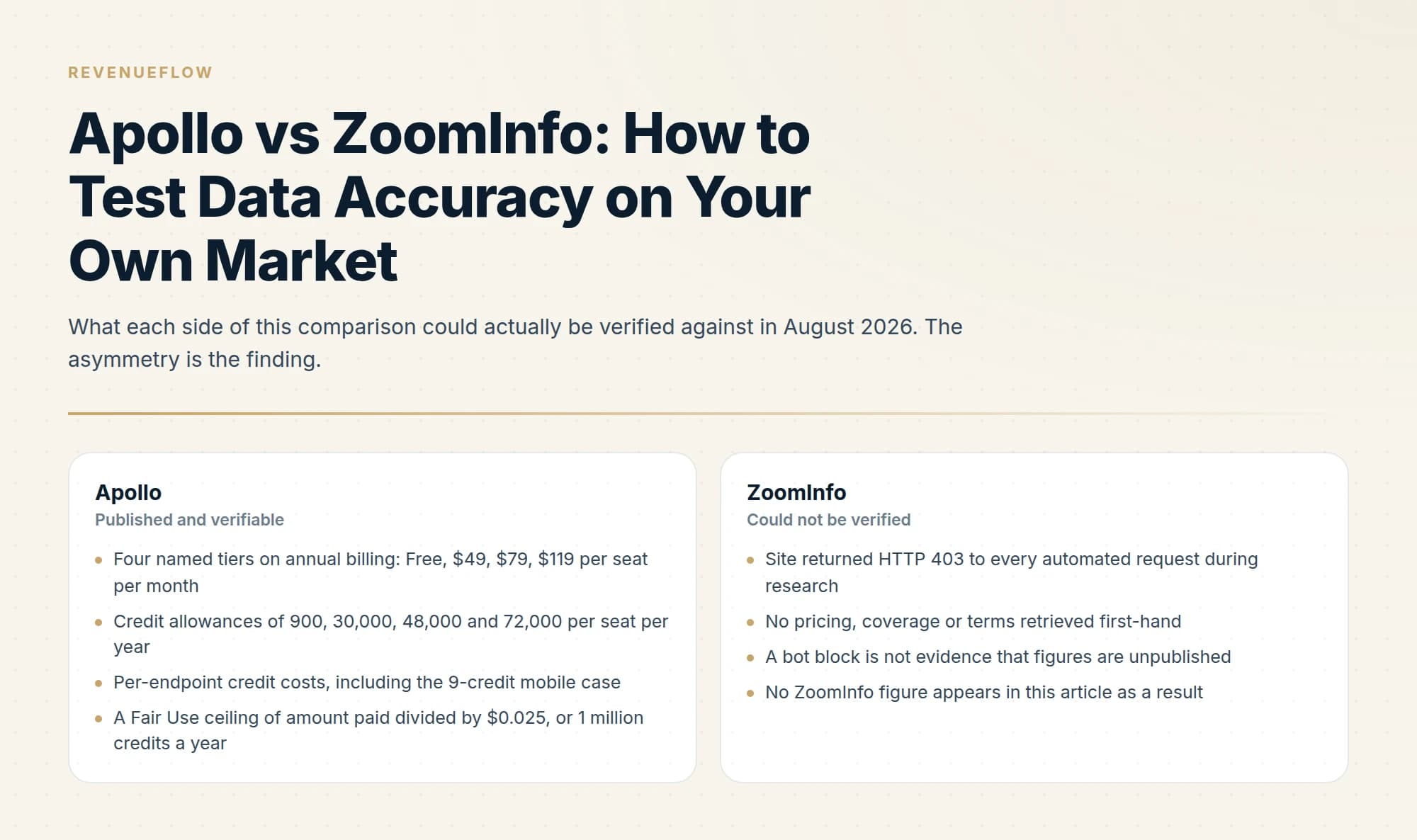
Published accuracy figures do not transfer between markets, because coverage varies by geography, company size and industry. Draw 200 contacts from your real ICP, run identical inputs through both providers, verify with a neutral third party, and score on cost per verified deliverable contact.
Key takeaways
- Match rate and accuracy are different measurements that trade off, so only deliverable contacts per hundred attempted compares providers meaningfully.
- Catch-all domains verify as neither valid nor invalid, and how a test handles that tier can move a headline accuracy figure by tens of percentage points.
- Apollo publishes plan prices, rate limits and per-endpoint credit costs openly, including that some waterfall vendors charge when no data is found.
- Job-title currency is a separate failure mode from deliverability, and every bounce metric scores a stale-title contact as a success.
Reviewed and updated September 5, 2026
Every Apollo versus ZoomInfo comparison you can find quotes an accuracy percentage. Almost none of them say what was sampled, what counted as correct, or who paid for the test. The numbers are usually one vendor's marketing, one blogger's 50-contact spot check, or a figure that has been copied between articles long enough that nobody remembers the source.
We are not adding another one. We have not run a controlled accuracy test across both platforms, so we are not going to publish a figure as though we had. What follows is more useful anyway: how to run the test on your own market in an afternoon, what the two vendors publish about themselves, and where the comparison genuinely breaks down.
Why published accuracy figures do not transfer
A data provider's accuracy is not one number. It varies by geography, by company size, by seniority, and above all by industry, because the underlying sources differ in coverage.
That is the honest answer to whether the Apollo contact database is any good for you: it is good in the segments its sources cover well and thin in the ones they do not, which is why the test below is worth an afternoon.
A provider that is excellent on North American mid-market software can be poor on European manufacturing, and both statements can appear in honest reviews from different buyers. When you read "95% accurate", the missing clause is "on the sample we drew, in the segments we happened to test". Your segment is not that sample.
Two further problems make cross-vendor figures worse.
Match rate and accuracy are different measurements, and they trade off against each other. A provider that returns an address for 90% of your list and is right 70% of the time is not obviously better or worse than one that returns for 60% and is right 95% of the time. The comparison only means something once you combine them into deliverable contacts per hundred attempted.
Catch-all domains break the arithmetic entirely. On an accept-all mail server, every address verifies as neither valid nor invalid. An enterprise-heavy list produces a large ambiguous tier that no verifier can resolve, and how a test treats that tier moves the headline number by tens of percentage points. Counting it as correct flatters everyone; discarding it changes the denominator.
What each vendor publishes about itself
- Four named tiers on annual billing: Free, $49, $79, $119 per seat per month
- Credit allowances of 900, 30,000, 48,000 and 72,000 per seat per year
- Per-endpoint credit costs, including the 9-credit mobile case
- A Fair Use ceiling of amount paid divided by $0.025, or 1 million credits a year
- Site returned HTTP 403 to every automated request during research
- No pricing, coverage or terms retrieved first-hand
- A bot block is not evidence that figures are unpublished
- No ZoomInfo figure appears in this article as a result
Here the two behave very differently, and that difference is itself decision-relevant.
Apollo publishes freely. Its pricing page lists four named tiers on annual billing: Free, Basic at US$49, Professional at US$79 and Organization at US$119, all priced per seat per month, with credit allowances of 900, 30,000, 48,000 and 72,000 per seat per year. Its developer documentation publishes rate limits by plan and per-endpoint credit costs, including the awkward details: people enrichment costs 1 credit for demographics or an email and 9 if a mobile number is returned, email waterfall enrichment typically costs 1 to 4 credits but can exceed 20 on some configurations, and some waterfall vendors consume credits per lookup even when no data is found. Apollo's Unlimited plans carry a published Fair Use ceiling of the lesser of amount paid divided by US$0.025, or 1 million credits per account per year. Apollo's own materials describe a database of more than 240 million contacts.
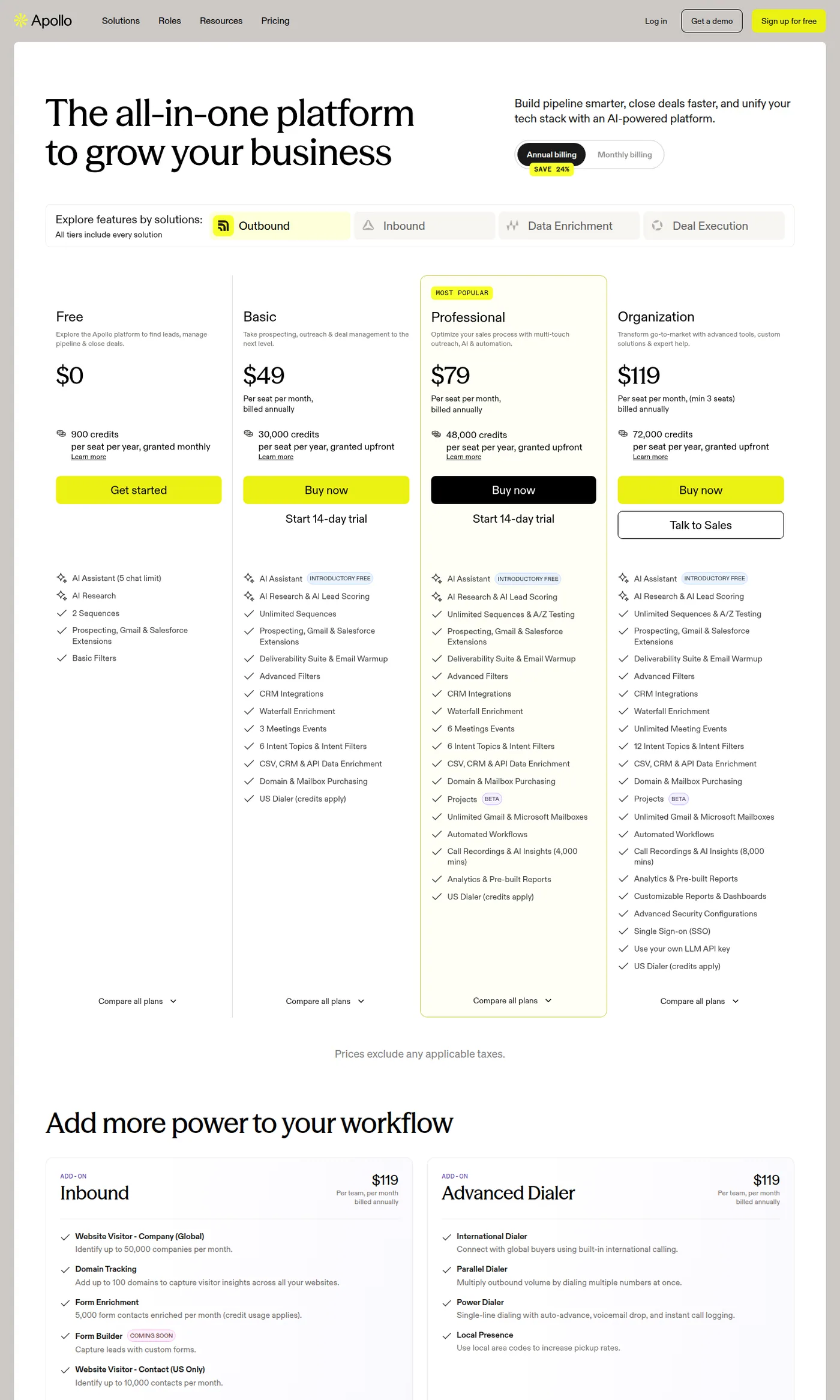
Apollo's published pricing on its default annual-billing view, captured mid-2026.
ZoomInfo we could not verify. Its site returned an HTTP 403 to every automated request we made while researching this article, so we did not retrieve its pricing, its coverage claims, or its terms. That is a statement about our access rather than about ZoomInfo: a 403 is a bot block, not evidence that a page does not exist or that figures are unpublished. We are naming it because the alternative is quoting ZoomInfo numbers from third-party blogs, and a comparison built on one verified side and one hearsay side is worse than no comparison at all.
So this article contains no ZoomInfo figures. Get them from ZoomInfo, in writing, as part of a quote.
Run the test yourself
This is the part that actually decides the purchase, and it takes an afternoon.
- Step 1Fix the sample first
Draw 200 contacts from your real ICP: same companies, same seniority band, same geography. Freeze the list before you touch either tool.
- Step 2Run the identical list through both
Same identifiers supplied to each, same fields requested. Asking one for mobiles and not the other invalidates both the accuracy and the cost comparison.
- Step 3Verify with a neutral third party
Never use either vendor's own verification to score itself. Segment catch-all results into their own bucket rather than forcing a verdict.
- Step 4Score on deliverable contacts per hundred
Then divide total spend by that number. Cost per verified deliverable contact is the only figure that compares two providers honestly.
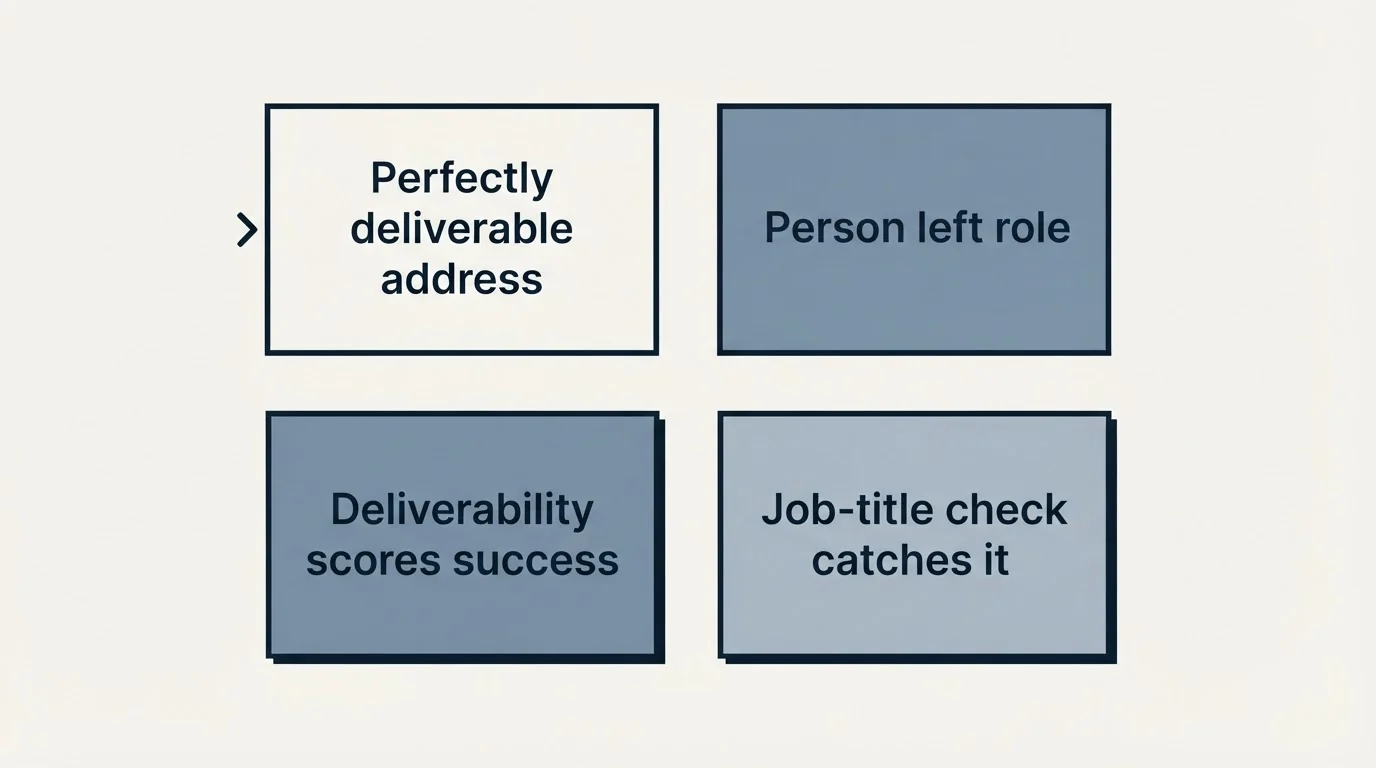
The job-title check is the one people skip and later regret. An address can be perfectly deliverable and attached to someone who left the role eight months ago, which is a data-freshness failure that every deliverability metric will score as a success. A message to the wrong person at the right company is a wasted send that no bounce rate will ever show you.
- Yes: The sample is drawn from your ICP, not from a convenience list
- Yes: Both providers get identical inputs and are asked for identical fields
- Yes: Verification is done by a third party neither vendor controls
- Yes: Catch-all results are bucketed separately, not scored as pass or fail
- Yes: Job-title currency is checked, not only whether an address exists
- No: Scoring on match rate alone
- Depends: Whether your sample is large enough for the difference you care about
How big a sample do you actually need
Two hundred is the number in the diagram above, and it is worth knowing why rather than treating it as arbitrary.
Small samples cannot distinguish small differences. If one provider is right 80% of the time and the other 75%, a 50-contact test will frequently rank them the wrong way round purely by chance, and you will make a multi-thousand-dollar annual decision on noise. Two hundred contacts is enough to see a gap of roughly ten percentage points with reasonable confidence, which is the size of gap that should actually change your choice.
If the two providers come out within a few points of each other on 200 contacts, the honest reading is that they are equivalent for your market and you should decide on the other factors below rather than running a larger test to break the tie. A difference you need 2,000 contacts to detect is a difference too small to matter operationally.
One sampling trap worth avoiding. Do not draw the test sample from contacts either provider already gave you, because that guarantees a match on one side and measures nothing. Build the frame from a neutral source: a conference attendee list, a public directory, your own CRM, or companies identified independently of both tools.
What to ask each vendor in writing
The test measures data. These questions measure the contract, and they are where the unpleasant surprises usually live.
Ask what the renewal terms are and whether the price is locked for the term. Ask whether seat count can be reduced at renewal or only increased. Ask what happens to data you exported if you cancel, and whether you retain the right to keep using it. Ask what the overage rate is when you exceed your allocation, and whether the system blocks or bills. Ask whether the coverage claim in the sales deck is broken down by your specific geography and industry, and request that breakdown in writing.
Apollo answers most of the pricing half of that list publicly, which is a genuine point in its favour when comparing against any vendor that requires a call to disclose a number. Publishing prices is not the same as being cheaper, and it does make the evaluation faster and the comparison honest.
The costs that sit outside the accuracy number
Two providers with identical accuracy can still differ substantially in what they cost to operate.
Metered export. Apollo consumes export credits whenever a contact leaves the platform, including CSV export and API enrichment synced to an outside system. If your architecture verifies independently and sends from separate infrastructure, which it should, contacts leave constantly and that meter runs constantly. The pricing breakdown covers how it works.
Solo founders comparing data providers still need somewhere to actually send the campaign once contacts are verified, and tools built for solo outbound senders rounds up the lightweight platforms suited to that job.
Teams weighing contract shape against workflow fit will find Apollo's role versus a CRM like Copper clarifies that these tools solve different problems rather than competing directly.
Contract shape. A published self-serve price you can cancel behaves very differently from an annual commitment negotiated through a sales process, regardless of which is cheaper per record. Seat minimums, term length and renewal terms belong in the comparison alongside data quality.
Rate limits. If you are enriching programmatically, the ceiling on throughput is a real operational cost. Apollo publishes its limits by plan, with enrichment endpoints uncapped hourly and daily on paid tiers while search endpoints are capped at 2,000 requests a day on the mid tiers. The API guide covers what that shape implies for job design.
What we would actually do
Buy the smallest viable increment of both, run the 200-contact test above, and let your own market decide. Apollo makes this cheap: trials include 50 credits and 5 mobile credits, and there is a free-forever Starter tier to fall back to.
Then treat the winner as a data source rather than a solution. Whichever provider you choose, the address it returns is a claim until a verifier confirms it, and the campaign it feeds still depends on infrastructure the data vendor has nothing to do with. Our deliverability guide covers that layer, and the Apollo review covers where the all-in-one framing helps and where it does not.
For a feature-level view of the two products, we maintain a separate Apollo versus ZoomInfo comparison.
We run sourcing and outbound for clients on a pay-per-qualified-meeting basis, which means we carry the cost of getting this decision right rather than passing it to you as a tool recommendation. You can see what a campaign would look like for your market.
Apollo prices and credit allowances are read from Apollo's pricing page as rendered on its default annual-billing view, captured 11 August 2026; credit consumption, Fair Use limits and rate limits are from the same page and Apollo's developer documentation, same date. No ZoomInfo figures appear in this article: ZoomInfo's site returned HTTP 403 to automated requests during research, so nothing from it could be verified first-hand. Request current terms directly from each vendor.
Sources: Apollo.io pricing, Apollo API pricing and credits, Apollo API rate limits
Frequently asked questions.
Frequently asked questions- Is Apollo or ZoomInfo more accurate?
- No honest general answer exists, because accuracy varies by geography, company size, seniority and industry. A provider strong on North American software can be weak on European manufacturing. Run 200 contacts from your own ICP through both with identical inputs, verify with a neutral third party, and let your market decide.
- Why does this article not include ZoomInfo pricing?
- Because we could not verify it. ZoomInfo's site returned HTTP 403 to automated requests while we researched this, so nothing from it was retrievable first-hand. A bot block is not evidence that figures are unpublished, but quoting them from third-party blogs would make half this comparison hearsay. Request current terms directly from ZoomInfo.
- How do I run a fair data provider comparison?
- Freeze the sample before touching either tool, supply identical identifiers and request identical fields from both, and verify results with a third party neither vendor controls. Bucket catch-all domains separately rather than scoring them, check whether job titles are current, then divide total spend by verified deliverable contacts.
- What costs should I compare besides the data itself?
- Metered export, contract shape and rate limits. Apollo consumes export credits whenever contacts leave the platform, which a verify-elsewhere architecture does constantly. A self-serve monthly price behaves differently from an annual commitment regardless of per-record cost. And throughput ceilings are a real operational cost on programmatic enrichment.
About the author.

B2B cold email experts helping companies generate qualified leads through done-for-you outreach campaigns.
RevenueFlow Team
Explore more.
Ready to scale your outreach?
We build GTM engines that book real meetings. See the receipts.
Related articles.
Firmographic Data Providers: What Six of Them Publish
Six firmographic data providers read from their own pages: the fields each sells, the coverage each states, how the data is delivered, and who prints a price.
Zeliq Pricing: One Seat Rate and a Credit Meter
Zeliq prices one self-serve seat in dollars with a credit meter that never expires. Both billing states, the three credit rates, the top-up ladder and the Custom floor.
Bookyourdata Pricing: 25 Packs, Priced Per Contact
Bookyourdata sells credits in twenty-five packs with no subscription. The dated ladder, the per-contact rates rendered in the browser, the guarantee rule and BeSpoke.
Salesgear Pricing: Two Ladders Under One Plan Title
Salesgear's page is titled as one plan and carries a Data ladder and an Outreach ladder. Both at both billing states, what each meters, and the two vendor-side conflicts.
Social Selling Tools by Job, and the Account-Risk Line
Fourteen social selling tools sorted into six jobs, split by whether each acts through your LinkedIn account or beside it, from the vendors' own pages.
Seamless.AI Email Finder: How It Works, What a Credit Buys
How Seamless.AI's email finder resolves a contact in real time, what one Universal Credit buys, the Total AI score on every address, and what the Chrome extension reads.