Firmographic Data Providers: What Six of Them Publish
Six firmographic data providers read from their own pages: the fields each sells, the coverage each states, how the data is delivered, and who prints a price.
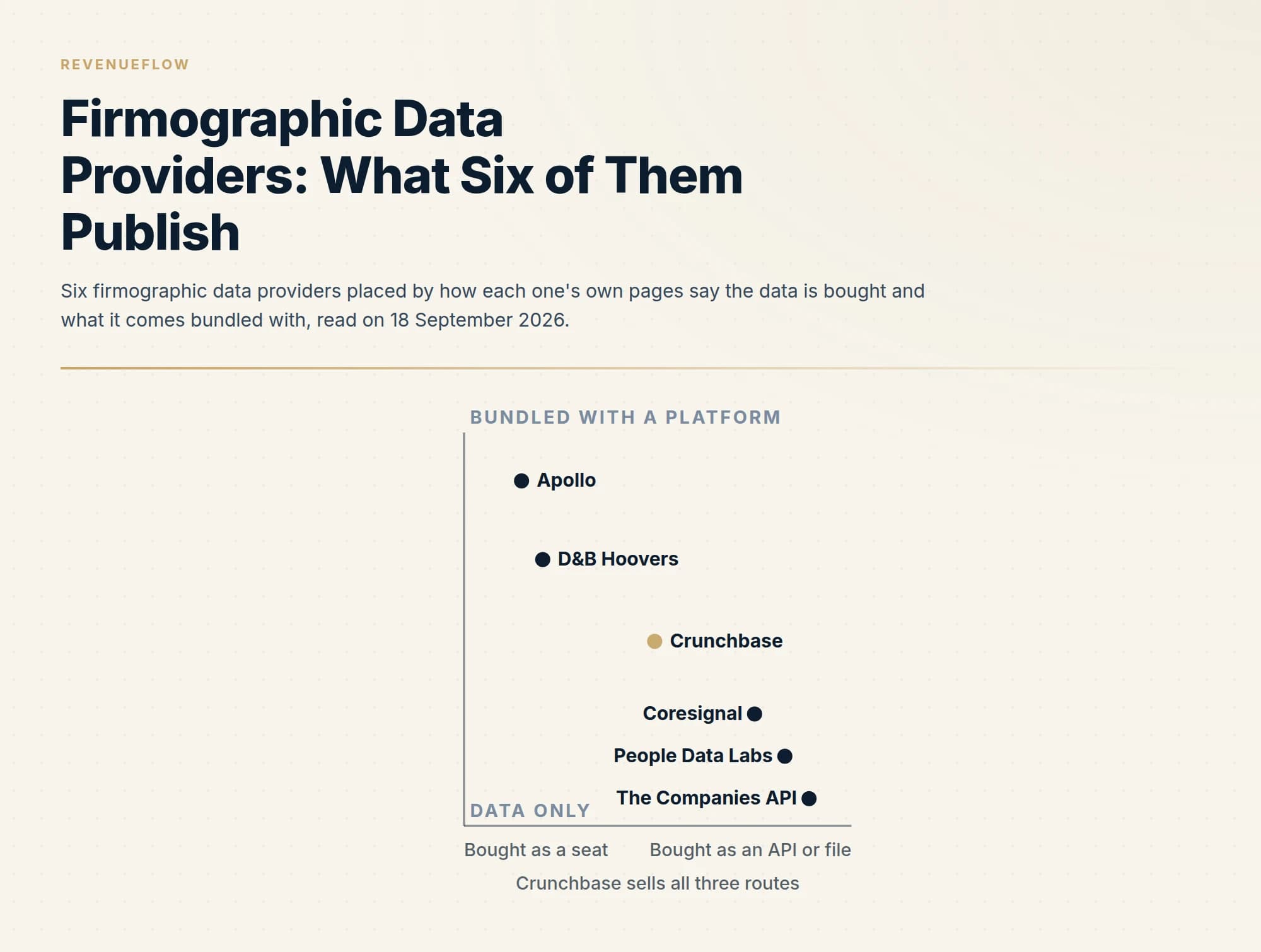
Firmographic data providers fall into four kinds: the identifier business (D&B Hoovers), the private-company tracker (Crunchbase), developer data vendors (People Data Labs, Coresignal, The Companies API) and sales platforms with company data inside (Apollo). On 18 September 2026, three of those six printed a price. Choose the kind by who will use the data, then test match rate.
Key takeaways
- People Data Labs states over 70MM+ company profiles, charges per match, and publishes a full company schema naming every field before purchase.
- The Companies API printed monthly plans from $95 for 50,000 credits on 18 September 2026, and its homepage gave two different counts of its data points.
- Coresignal delivers firmographic data as a flat file or through a Company API, and its Growth card showed $1,000 a month for 150,000 credits in the monthly state.
- D&B Hoovers and Crunchbase's API and licensing routes publish no price; stated coverage figures are not comparable across vendors.
Reviewed and updated September 18, 2026
Search for firmographic data providers and the first page is written by companies that sell data. Every one of the ten results we pulled for this piece came from a data vendor, and five of the ten are best-of roundups published by a vendor in the category. That format is useful for learning the names and much less useful for choosing between them.
This page does the slower thing. It reads what six providers say about themselves on their own product, documentation and pricing pages, as fetched on 18 September 2026, and records the same four facts for each: which company fields they sell, what coverage they state, how you get the data out, and whether a price is published. Two further vendors are named at the end with a note on why they could not be read. If the term itself is new, our glossary entry on firmographic data defines the attributes and the industry codes, and the method for testing any provider against your own segment is in our guide to choosing a B2B database. Neither is repeated here.
Four kinds of company, one product name
The six providers below all sell company attributes such as industry, headcount, revenue, location and age. They are not the same kind of business, and the kind predicts the access, the pricing and what else comes bundled.
The identifier business. Dun and Bradstreet anchors its company data to the D-U-N-S Number, which its own page describes as "a unique nine-digit identifier used exclusively for businesses." Sales teams meet that data through D&B Hoovers.
The private-company tracker. Crunchbase's homepage title is "Private Company Data & Predictive Intelligence", and its strength is funding, leadership and growth signals on young companies.
The developer data vendors. People Data Labs, Coresignal and The Companies API sell company records through an API or a file, priced by usage, to teams that will write code against them.
The sales platform. Apollo sells a prospecting application in which company data is one ingredient, alongside contacts and sending.
The six, from their own pages
Dun and Bradstreet: D&B Hoovers
The D&B Hoovers product page sells outcomes rather than fields. It promises to "Identify high-potential companies and contacts most likely to convert using trusted business intelligence and buying signals", and its call to action is a free trial request. The page as fetched states no record count, no field list and no price. The D-U-N-S page explains the identifier that sits underneath, a nine-digit number assigned per business entity, which is the reason large companies with procurement and credit teams often hold D&B data already. For a sales team the practical question is whether someone else in the company has a licence you can extend.
Crunchbase
Crunchbase lists six products in its navigation: Pro, Business, API, MCP, Data Enrichment and Data Licensing. Its API page describes the data as "Advanced financials, firmographics, and risk analysis" and says you can "Enrich your CRM, automation platforms, and internal systems with live financials, firmographics, and company predictions." The licensing page offers to "License the same private market intelligence that powers Crunchbase" and ends with "Contact us to explore API pricing." So the application tiers are a seat purchase and the API and licensing routes are a sales conversation. Crunchbase's coverage claim on these pages is about update volume rather than company count.
People Data Labs
People Data Labs is the most documented of the six. Its company data page states "Access over 70MM+ company profiles, from stealth startups to conglomerates", offers an Enrichment API, a Search API and a Data License feed, and says "Every record you get back is the most up-to-date version we have in our dataset, refreshed each month." The billing unit is the match: "We charge per match, letting you define match strictness and required fields to ensure you get maximum value."
Its public schema documentation is the useful part for an evaluator, because it names every field before you sign anything. Beside identity fields such as name, website, linkedin_url and ticker, the company schema lists employee_count, employee_count_by_country, size, industry, naics and sic codes, tags, founded, location, inferred_revenue, and funding fields including total_funding_raised and latest_funding_stage.
As published on the People Data Labs company pricing page on 18 September 2026, read in a rendered browser session, the Free plan is $0 a month for up to 100 monthly records, and the Pro plan is listed as starting at $98 a month. The page offers monthly or annual terms and says "Save 20% and access all of the data upfront with annual commitments", and it does not say which term the starting figure assumes. Enterprise is custom.
Coresignal
Coresignal's firmographic page describes the product in one line: "It provides you with data fields such as company name, size, location, industry, and more." Delivery is stated just as plainly: "This data is available as a flat file, or accessible via Company API." The company says its data is collected from the public web, and the page cites certification by the Ethical Web Data Collection Initiative.
As published on Coresignal's pricing page on 18 September 2026, in its default monthly billing state, the Growth card for its database APIs displayed $1,000 a month for 150,000 monthly credits, shown as $0.007 per credit, with a selector that moves the credit level and a yearly option marked 10% off. The card lists a three-month credit rollover. Dataset purchases are handled by its sales team.
The Companies API
The Companies API is the smallest vendor here and the most transparent on price. Its homepage says "Over 50M+ Companies in database" and offers "Get 500 credits for free", with enrichment endpoints billed at one credit per company. It lets you search "by industry, location, number of employees, and 50+ other criteria."
One detail is worth noticing because it shows how loosely coverage language gets written. The same homepage says "Enrich companies in a single API call with 300+ data points" in its headline and "Retrieve all the essential information on any company (100+ data points)" further down. Both were on the page on the same day. Count the fields in a sample response rather than trusting either line.
As published on The Companies API's pricing page on 18 September 2026, in the pay-monthly state where each card reads "Billed every month", Startup is $95 a month for 50,000 credits, Scaleup is $295 a month for 250,000 credits and Enterprise is $595 a month for 500,000 credits. An annual option is labelled two months free.
Apollo
Apollo's navigation states its coverage as "Access 240M contacts & 30M companies", and its company attributes are used through search filters and CRM enrichment inside the application, with an API for the rest. As published on Apollo's pricing page on 18 September 2026, in its default annual billing state, there is a free plan and paid plans from $49 per seat per month. The details of those plans and their credits are in our Apollo pricing guide. The difference from the three API vendors is what you are buying: a seat in a sales tool that contains firmographics, not a firmographic dataset.
| Provider | Coverage as the vendor states it | How the data is delivered |
|---|---|---|
| D&B Hoovers | No count on the product page read | Application, by free trial request |
| Crunchbase | Update volume stated, no company count | Application tiers, API, data licensing |
| People Data Labs | Over 70MM+ company profiles | Enrichment API, Search API, licence feed |
| Coresignal | Millions of companies, no exact count | Flat file or Company API |
| The Companies API | Over 50M+ companies | API, one credit per company |
| Apollo | 30M companies | Application seats, plus an API |
Who publishes a price, and who does not
Three of the six print a number and three route you to sales, and the split follows the kind of company. The developer vendors publish because their buyers expect a credit card and a key. The identifier business and the private-company tracker sell licences whose price depends on use, seats and redistribution rights.
| Row | Web application | API | Bulk file or licence | Free tier or trial | Price published |
|---|---|---|---|---|---|
| D&B Hoovers | Yes | Not stated | Not stated | Yes | No |
| Crunchbase | Yes | Yes | Yes | Yes | Partial |
| People Data Labs | Not stated | Yes | Yes | Yes | Yes |
| Coresignal | Not stated | Yes | Yes | Yes | Yes |
| The Companies API | Not stated | Yes | Not stated | Yes | Yes |
| Apollo | Yes | Yes | Not stated | Yes | Yes |
Crunchbase is marked partial because its application tiers are sold through a checkout while its API and licensing pages say to contact sales. For the two API vendors that print per-credit prices, remember that a credit is not a company. Coresignal's pricing page says the number of credits deducted "depends on the self-service feature, data field, or action used", so the cost of one enriched company depends on which fields you ask for.
Two we could not read
Data Axle's site returned a browser challenge to both of our fetch routes on 18 September 2026, so nothing is said about it here. ZoomInfo's homepage and pricing address returned access-denied responses the same day. One ZoomInfo product page did serve, and it states that its Operations product can "Apply 300+ firmographic, technographic, and intent attributes to rank accounts most likely to convert", which confirms firmographics are part of what ZoomInfo sells and tells you nothing about coverage or cost. Our roundup of ZoomInfo alternatives covers that vendor from sources we could read at the time. A blocked page is a limit on our reading, never evidence about the vendor.
Clearbit, which appears in many older lists, now opens on a page reading "Clearbit has joined HubSpot", so treat any standalone Clearbit pricing you find elsewhere as historical.
Where firmographics come from, and why two vendors disagree
Every provider assembles the same attributes from a small set of origins. Demandbase's help centre, describing its own data, lists the first of them as "Public business registries: Basic firmographics such as industry, revenue, number of employees." Coresignal names the public web. People Data Labs describes a monthly rebuild of its dataset. Crunchbase describes proprietary ingestion systems with verification by a team of researchers.
That is why two vendors give two headcounts for one company. A registry filing, a LinkedIn employee count and a web crawl are three different measurements taken at three different times, and revenue for a private company is usually modelled, which People Data Labs makes explicit by naming its field inferred_revenue. None of this makes firmographic data unreliable for targeting. It makes it approximate, and the right response is to filter in bands and to combine sources where a field matters, which is the logic of waterfall enrichment.
Choosing by the job
Pick the kind of provider before the provider. If a salesperson will build lists by hand, you want an application, which means Apollo or D&B Hoovers from this set, and you will pay per seat. If an engineer or a RevOps analyst will enrich a CRM or score accounts in code, you want one of the three API vendors, and you will pay per match or per credit, with People Data Labs offering the fullest published schema to evaluate against. If the question is which young companies just raised money, that is Crunchbase's home ground and the others are weak substitutes.
Then test the shortlist on your own segment. Take a few hundred companies you already know well, run them through each free tier, and compare the returned headcount, industry code and location with what you know to be true. Stated coverage is marketing copy. Match rate on your own market is the only coverage figure that matters, and an ideal customer profile written as checkable criteria is what makes that test possible.
We build lists for outbound campaigns, and we do not resell or endorse any provider on this page. If you would rather see what a well-filtered list produces before buying a data contract, you can see what a first campaign looks like against your own market.
The short version
Firmographic data providers come in four kinds: the identifier business (D&B Hoovers), the private-company tracker (Crunchbase), developer data vendors (People Data Labs, Coresignal, The Companies API) and sales platforms with company data inside (Apollo). On 18 September 2026 three of those six printed a price on their own pages and three sent you to sales. Stated coverage figures are not comparable across vendors, and one vendor's own homepage gave two different counts of its data points. Choose the kind of provider by who will use the data, then test match rate on companies you already know.
Fields, coverage statements, delivery options and prices above were read from each provider's own pages on 18 September 2026, from stored snapshots; the People Data Labs pricing page was read in a rendered browser session that day. Billing states are given beside each figure. Verify current terms with each vendor before relying on them.
Sources: D&B Hoovers, D-U-N-S Number, Crunchbase API, Crunchbase data licensing, People Data Labs company data, People Data Labs company schema, People Data Labs company pricing, Coresignal firmographic data, Coresignal pricing, The Companies API, The Companies API pricing, Apollo pricing, ZoomInfo Operations, Understanding Demandbase Intent
Frequently asked questions.
Frequently asked questions- Who are the main firmographic data providers?
- Six that document themselves well enough to compare are Dun and Bradstreet through D&B Hoovers, Crunchbase, People Data Labs, Coresignal, The Companies API and Apollo. ZoomInfo and Data Axle also sell company data, but their sites blocked automated reading on 18 September 2026, so this comparison says little about them. Clearbit now opens on a page saying it has joined HubSpot.
- How much does firmographic data cost?
- It depends on the kind of provider. As published on 18 September 2026, The Companies API listed monthly plans from $95 for 50,000 credits, Coresignal's Growth card showed $1,000 a month for 150,000 credits in the monthly state, and People Data Labs listed a free tier of 100 records and a Pro plan starting at $98 a month. D&B Hoovers published no price.
- What fields count as firmographic data?
- Company attributes used for targeting: industry and industry codes, employee count, revenue, location, founding year and funding. People Data Labs' public company schema is a concrete example, listing employee_count, size, industry, naics, sic, location, founded, inferred_revenue and funding fields. Revenue for private companies is usually modelled rather than reported, which is why that vendor names its field inferred_revenue.
- How do I compare firmographic data providers?
- Pick the kind of provider first: an application if salespeople will build lists by hand, an API if engineers or RevOps will enrich records in code. Then run a few hundred companies you already know through each free tier and compare the returned headcount, industry code and location with the truth. Match rate on your own market is the only coverage figure that matters.
About the author.

B2B cold email experts helping companies generate qualified leads through done-for-you outreach campaigns.
RevenueFlow Team
Explore more.
Ready to scale your outreach?
We build GTM engines that book real meetings. See the receipts.
Related articles.
Bookyourdata Pricing: 25 Packs, Priced Per Contact
Bookyourdata sells credits in twenty-five packs with no subscription. The dated ladder, the per-contact rates rendered in the browser, the guarantee rule and BeSpoke.
Airscale Pricing: Three Plans, One Credit, Four Rates
Airscale prints a different credit cost on every plan, and its advertised per-email price belongs to the custom one. The dated ladder and the rollover rules.
Apollo Integrations: What Connects, and on Which Plan
Apollo's integrations marketplace sorted by job: what its own pages say each CRM sync moves, which plan ticks which integration, and what a sync costs.
LeadIQ Salesforce Integration: What Syncs, What Blocks It
How LeadIQ's Salesforce integration works, from LeadIQ's own help centre: per-user OAuth, Lead or Contact, domain matching, duplicates, API calls and plan gates.
Snitcher Pricing: The $49 Table Is the Annual Rate
Snitcher's visible price table is the annual-billing ladder. The ten bands at both billing states, the unique-company meter, and the rules on a help page.
Autobound Pricing: One-Time Credit Packs, Not Seats
Autobound's pricing page sells one-time credit packs for a signal data API, not seats. The six packs, the per-endpoint meter, and what a company costs.