Is Clay Free? The Free Plan, the Trial and Where Each Stops
Clay's free plan, its 14-day trial and the no-charge-on-a-miss rule are three different things. What each holds and where it stops, from clay.com on 19 September 2026.
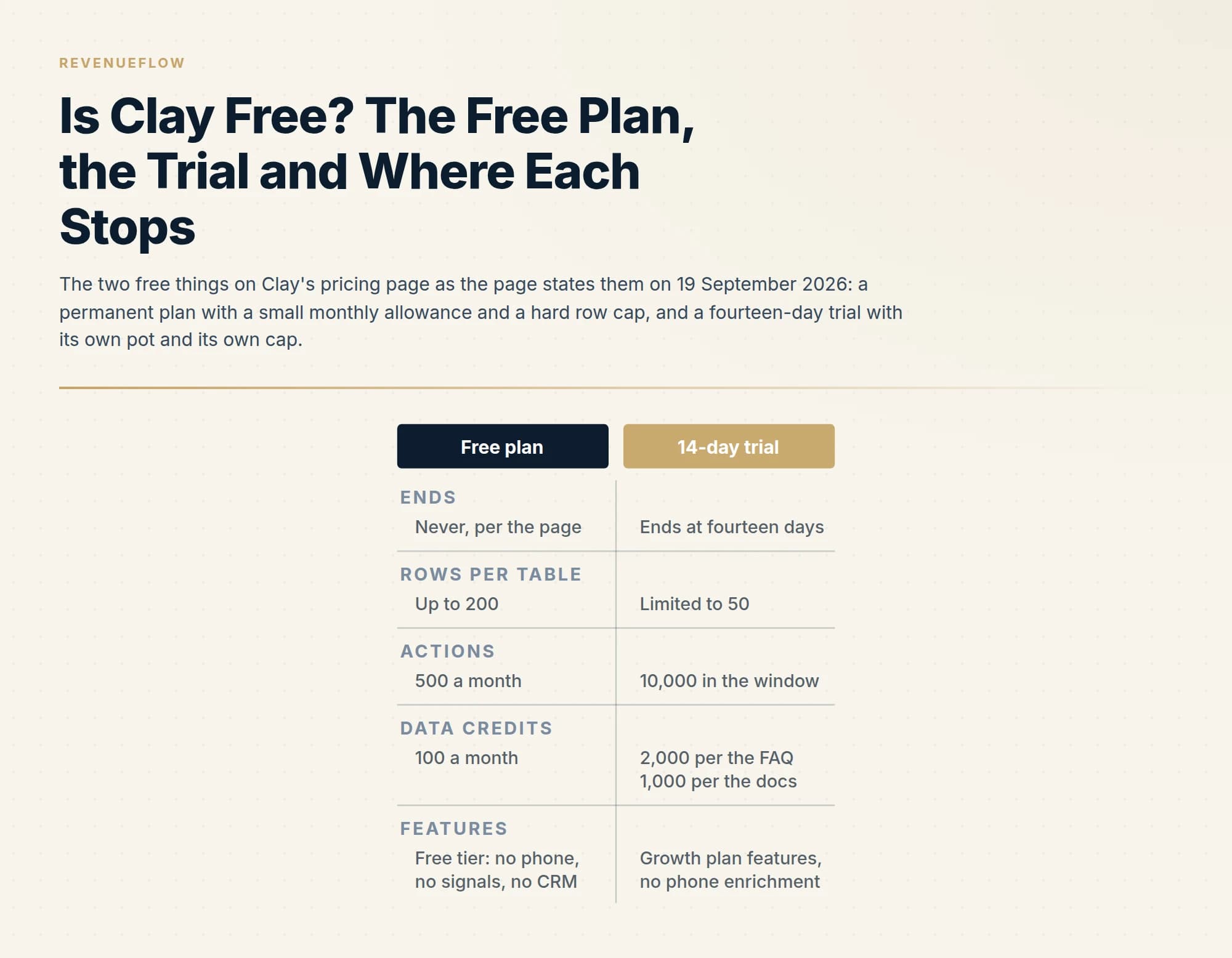
Clay is free in three senses. The Free plan is permanent, 500 actions and 100 data credits a month, unlimited seats and tables, waterfalls, Claygent and your own keys, capped at 200 rows per table, without phone data, signals, CRM sync, rollover or top-ups. The 14-day trial runs on Growth features at 50 rows; a miss is never charged.
Key takeaways
- The free plan and the 14-day trial are separate: the plan is permanent with 500 actions and 100 data credits a month and a 200-row table cap; the trial runs on the Growth feature set for fourteen days with a 50-row cap.
- Clay's own pages disagree on the trial's credit pot on the same day: the FAQ says 2,000 credits and up to 10,000 actions, the plans and billing document says 1,000 data credits, and the documentation adds that phone enrichment is off during the trial.
- On every plan an enrichment that returns no result is not charged actions or credits, and bringing your own API key skips data credits entirely, which makes a free workspace usable for a provider you already pay for.
- Launch removes the row cap and adds phone data and signals; Growth adds CRM sync, HTTP API and webhooks; rollover and top-ups exist only on paid plans, so a free workspace's unused credits vanish at month end.
Reviewed and updated September 19, 2026
Clay's pricing page carries a plan called Free and a button that says Start 14-day trial, side by side, and they are two different things. The free plan is a permanent tier with a small monthly allowance and a hard row cap. The trial is a two-week window on a paid tier's features with its own credit pot and its own row cap. A third free thing sits underneath both: on every plan, an enrichment that returns nothing costs nothing. Getting those three apart is the whole answer, and Clay's own pages, read on 19 September 2026, give all three in their own words.
This page is about the free tier, the trial and the boundary between them and the paid plans. The paid ladder itself, the two currencies Clay bills in and what one enriched row really costs are on Clay pricing, which this page links rather than repeats. A companion page, GMass free, takes another vendor's free tier apart the same way: a free plan, a trial, and the number that decides the bill.
The free plan, as the pricing page states it
The Free card on Clay's pricing page, fetched on 19 September 2026, opens with "Start building in Clay for free. No strings attached." and lists its allowance as 500 actions a month, which the page also states as 6,000 actions a year, and 100 data credits a month, stated as 1,200 a year. The card then lists what the plan includes: unlimited seats and tables, multi-provider waterfalls, up to 200 rows per table, enrichment with Claygent, and bringing your own API key.
The pricing page's own FAQ calls the tier a low risk way to learn and experiment with Clay, and restates what it holds: "Includes unlimited seats and tables, multi-provider waterfalls, Claygent enrichment, Clay Sequencer for email, and up to 200 rows per table. Comes with 100 Data Credits and 500 Actions/mo."
Two of those phrases carry the plan's whole character. Unlimited seats and tables means the constraint is never how many people or how many tables but how big any one table can be and how much data can be bought in a month. And 200 rows per table is a cap on the table: a list of 2,000 companies is ten tables or it is not on the free plan at all.
The comparison table further down the same page adds the exclusions that the card leaves out. The data enrichment row carries the note "Free plan does not include phone number enrichment". Signals of every kind (job changes, company news, social listening, web intent, webhooks) are marked not included on Free. HTTP API integrations, CRM integrations and data warehouse connections are not included. Table version history is not included. Under credits economics, rollover credits and credit top-ups are both marked not included on Free, and the priority support queue is not included. Source sync frequency is one day on Free, Launch and Growth alike. One line on the page disagrees with itself: the FAQ's summary of the free plan names the Clay Sequencer for email as included, while the comparison table marks launching email campaigns as not included on Free; both readings are recorded as the page carried them.
The trial, and the two numbers the vendor publishes for it
Two of Clay's own pages describe the trial and they do not agree, so both are given as read on 19 September 2026.
Clay's FAQ entry on what the free trial includes answers: "You get access to the features from our Growth plan and 2,000 credits to test Clay out. Tables in trial are limited to 50 rows and up to 10,000 actions." The same entry recommends the vendor's learning resources and running just 20 to 30 rows at a time while getting familiar with the tool.
Clay University's plans and billing document, under a heading called Trials, says: "Clay offers a 14-day free trial with 1,000 data credits, giving you access to webhooks, CRM integrations, email sequencers, and HTTP API capabilities." It adds two rules the FAQ entry left out on the day both were read: "Phone number enrichments aren't available during the trial period. To access this feature, upgrade to a paid plan." and "If your team wants to do a trial, each team member can create their own trial account to explore Clay independently."
So the trial's credit pot is 2,000 on the FAQ and 1,000 on the documentation, both read on the same day. One of them is stale and there is no way to tell which from outside. Plan on the smaller figure and read the balance in the usage dashboard on the day the trial starts, which is the number the vendor will actually honour.
What the two pages agree on matters more than the gap. The trial runs on a paid tier's feature set, which is its point: the webhooks, CRM sync and HTTP API that the free plan excludes are exactly what a trial is for testing. Its table cap is 50 rows, a quarter of the free plan's 200, so a trial is for proving a workflow rather than running a list. And phone enrichment is off during the trial by the documentation's account, so that data type cannot be evaluated for free at all.
The FAQ entry
- The features from the Growth plan
- 2,000 credits to test Clay out
- Tables limited to 50 rows
- Up to 10,000 actions
- Recommends running 20 to 30 rows at a time
The plans and billing document
- A 14-day free trial
- 1,000 data credits
- Webhooks, CRM integrations, sequencers, HTTP API
- No phone number enrichment during the trial
- One trial account per team member
Both pages were read on the same day. The credit figure is the gap; the row cap and the feature set agree.
Where the free plan actually stops
Every limit on the free plan is small, and only one of them decides whether it is usable for an outbound team. Take them in the order they bite.
Rows per table stops a list. 200 rows is the ceiling on any single table. Clay's University plans and billing document gives the paid tiers' table limit as 50,000 rows for Launch and Growth, so the gap between free and paid is not a matter of degree. On the free plan a real target list is either split across tables by hand or never loaded.
Data credits stop enrichment. 100 credits a month is the pot. The same documentation says: "Each fully enriched record typically costs 6-20 data credits (including company and person profile, email, phone number, and custom AI enrichments). The more private API keys you use, the fewer data credits you'll spend per record." Dividing the vendor's own figures, 100 credits covers somewhere between five and sixteen fully enriched records a month; the arithmetic is done here from the published range and the vendor does not state it. An email-only enrichment consumes fewer credits than the full record, so the count of usable rows is higher for a list that wants addresses and nothing else, but the order of magnitude is tens, not hundreds.
Actions stop workflows later than credits do. 500 actions a month, at one action per enrichment, per AI run and per exported record as the credits documentation sets out, outlasts 100 credits, so on a free workspace the credits run out first unless the workflow leans on transformations and formatting, which cost no actions at all.
The exclusions stop the integration. No CRM sync, no webhooks, no HTTP API and no signals on Free means the free plan ends where the workflow leaves Clay. A CSV export is available; a live connection to the systems the list feeds is a Growth feature by the pricing page's comparison table. The free plan is for building a table and looking at it.
The two rules that soften this are both on the pricing page. First, bringing your own API key: "If you bring your own API keys for third-party data, you skip Data Credit costs entirely and only use Actions for the platform work Clay handles behind the scenes." A team that already holds a provider contract can drive it through a free workspace and pay Clay only in actions. Second, no charge for a miss: "If an enrichment returns no result, you're not charged Data Credits or Actions." A row that fails every provider in a waterfall costs nothing, which is a materially different rule from the finders that bill the lookup. So the question a free workspace asks of every enrichment is whether a result came back, yes or no, and then whether the data was bought from Clay's marketplace or arrived through your own key: a miss costs nothing, a hit always costs one action, and credits are charged by data type only for marketplace data.
What the paid tiers change, without the prices
The paid plans are Launch, Growth and Enterprise, and Clay pricing carries their ladders. What this page needs from them is the boundary: which free-plan limit each tier removes, as the pricing page states it on 19 September 2026.
Launch, in the page's own summary, includes everything in Free "plus phone number enrichment, job change and signal tracking, email campaign integrations, and up to 50,000 rows per table. Includes 2,500 Data Credits and 15,000 Actions/mo." So the first paid step removes the row cap that stops a list, adds the phone data type the free plan excludes, and multiplies the credit pot by twenty-five.
Growth, in the same summary, includes everything in Launch "plus CRM auto-sync and enrichment, HTTP API integrations, webhook automation, web intent signal tracking, audience pushes to ads platforms, and priority support. Includes 6,000 Data Credits and 40,000 Actions/mo." That is the tier whose features the trial runs on, which is why a trial can test a CRM sync and a free workspace cannot.
Two paid-tier rules matter to somebody deciding whether to leave the free plan. Rollover: the pricing page FAQ says "On Launch and Growth plans, unused credits can accumulate up to 2x your monthly credit amount", while the free plan's rollover line reads not included, so a free workspace's unused credits are gone at the month end rather than carried into the next month. Top-ups: the plans and billing document says "You can also purchase one-off data credits at a 30% premium during your billing cycle.", and the pricing page marks credit top-ups as not included on Free, so a free workspace that runs out of credits waits for the month to turn.
One caution on the entry price. Clay's pricing page renders both billing states into one document. The plan cards show a Launch headline that is the sum of the annual rungs for actions and credits, and the FAQ on the same page says "Launch (starting at $185/mo)", which is the sum of the monthly rungs. The figure a visitor sees first depends on which state the toggle is showing, so anyone quoting a Clay entry price should say which billing state it came from.
| Free plan limit | What it stops | Which tier removes it |
|---|---|---|
| 200 rows per table | A real target list will not fit | Launch, which the docs put at 50,000 rows per table |
| 100 data credits a month | More than five to sixteen full records | Launch, at 2,500 a month, with rollover and top-ups |
| No phone enrichment | Building a calling list | Launch; also excluded from the trial |
| No signals | Job change and company news signals | Launch for job change and news; Growth for web intent |
| No CRM sync, API or webhooks | Any live connection out of Clay | Growth |
| No rollover, no top-ups | Credits kept into the next month | Launch and Growth |
What a free workspace is good for on an outbound team
The free plan is a workbench for learning the tool and proving a waterfall on a sample, the trial is a fortnight for proving the integration, and neither runs a campaign.
Treat the free plan as a rehearsal of the decision the paid plan will force. Load 200 representative rows, the kind Clay pricing recommends sampling before any annual commitment, run the waterfall in the order you intend to run it, and read two numbers: how many rows came back with an address, and how many credits that cost. On the free plan the credits figure is bounded by the monthly 100, which is enough for an email-only pass over a modest sample and nowhere near enough for full records; on the trial the pot is larger and the row cap is smaller, which makes the trial the better place to test a CRM push and the free plan the better place to test a provider order. Ordering and stopping rules, which decide credit spend on a hard list, are in building a Clay waterfall that does not waste credits.
Bringing your own keys is the lever that changes the arithmetic on a free workspace most, because it moves the data cost out of Clay's credits entirely and leaves only the action count, the allowance the free plan is more generous with. A team with an existing verifier or finder contract can run that provider through a free workspace at 500 enrichments a month and never touch a data credit. What it cannot do is push the result anywhere but a CSV.
Claygent, which the free plan includes, is the other thing worth trying while nothing costs money. Its own rules and where an agent beats a data provider are in Clay agents; on a free workspace the relevant fact is that the pricing page prices most AI models at a flat number of data credits per task, drawn from the same 100-credit pot unless the workspace supplies its own model key, so a research prompt across a full 200-row table asks for more credits than the month holds.
Where this sits next to the way we run outbound: our stack does not build lists in Clay, and this page makes no claim about what Clay's data returns on any market. Every campaign we run sends one message per person, on one premise, with nothing scheduled behind it, so the list question that matters to us is whether one address per company is right before anything is sent, which is a verification question rather than a tool question. If you would rather have the list built, verified and sent than meter a free workspace against a 200-row cap, we can put a first campaign in front of your market.
The short version
Clay is free in three senses that should not be confused. The free plan is permanent, includes unlimited seats and tables, multi-provider waterfalls, Claygent and your own API keys, and stops at 200 rows per table, 100 data credits and 500 actions a month, with no phone data, no signals, no CRM sync, no rollover and no top-ups. The trial is fourteen days on the Growth feature set with a 50-row table cap and a credit pot that Clay's FAQ puts at 2,000 and its documentation at 1,000, with phone enrichment off. And on every plan an enrichment that returns nothing is not charged. Read the balance on day one, sample 200 real rows, and decide from what they cost.
Every figure and quotation above is from clay.com, university.clay.com and clay.com/faq as fetched on 19 September 2026. The vendor revises these pages, and the two trial figures show they do not always revise them together; confirm the current terms with Clay before relying on them.
Frequently asked questions.
Frequently asked questions- Is Clay free to use?
- Yes, on a permanent free plan that Clay's pricing page describes as no strings attached. As read on 19 September 2026 it includes 500 actions and 100 data credits a month, unlimited seats and tables, multi-provider waterfalls, Claygent enrichment and bring-your-own API keys, with a hard cap of 200 rows per table and no phone number enrichment, signals, CRM sync, rollover or credit top-ups.
- What do you get in the Clay free trial?
- Clay's FAQ says the 14-day trial gives access to the Growth plan's features and 2,000 credits, with tables limited to 50 rows and up to 10,000 actions. Clay's plans and billing documentation, read the same day, says 1,000 data credits with webhooks, CRM integrations, sequencers and the HTTP API, and states that phone number enrichment is not available during the trial. Read the dashboard balance on day one.
- How many rows can you enrich on Clay's free plan?
- Any single table is capped at 200 rows. The monthly pot of 100 data credits is the tighter limit for full records: Clay's documentation says a fully enriched record typically costs 6 to 20 data credits, which works out at roughly five to sixteen full records a month. An email-only pass costs fewer credits per row, and rows enriched through your own API keys cost no credits at all.
- Do unused Clay credits roll over on the free plan?
- No. Clay's pricing page marks rollover credits and credit top-ups as not included on the free plan. On Launch and Growth the same page says unused credits can accumulate up to twice the monthly amount, and the plans and billing documentation says one-off credits can be bought at a 30 percent premium during a billing cycle. A free workspace that runs out simply waits for the month to turn.
About the author.

B2B cold email experts helping companies generate qualified leads through done-for-you outreach campaigns.
RevenueFlow Team
Explore more.
Ready to scale your outreach?
We build GTM engines that book real meetings. See the receipts.
Related articles.
Seamless.AI Email Finder: How It Works, What a Credit Buys
How Seamless.AI's email finder resolves a contact in real time, what one Universal Credit buys, the Total AI score on every address, and what the Chrome extension reads.
Apollo Integrations: What Connects, and on Which Plan
Apollo's integrations marketplace sorted by job: what its own pages say each CRM sync moves, which plan ticks which integration, and what a sync costs.
Firmographic Data Providers: What Six of Them Publish
Six firmographic data providers read from their own pages: the fields each sells, the coverage each states, how the data is delivered, and who prints a price.
Autobound Pricing: One-Time Credit Packs, Not Seats
Autobound's pricing page sells one-time credit packs for a signal data API, not seats. The six packs, the per-endpoint meter, and what a company costs.
Airscale Pricing: Three Plans, One Credit, Four Rates
Airscale prints a different credit cost on every plan, and its advertised per-email price belongs to the custom one. The dated ladder and the rollover rules.
TexAu Pricing: Four Tiers, Billed Only on a Match
TexAu charges credits only when a lookup succeeds. The four tiers at both billing states, the rollover cap, and three places the page disagrees with itself.