TexAu Pricing: Four Tiers, Billed Only on a Match
TexAu charges credits only when a lookup succeeds. The four tiers at both billing states, the rollover cap, and three places the page disagrees with itself.
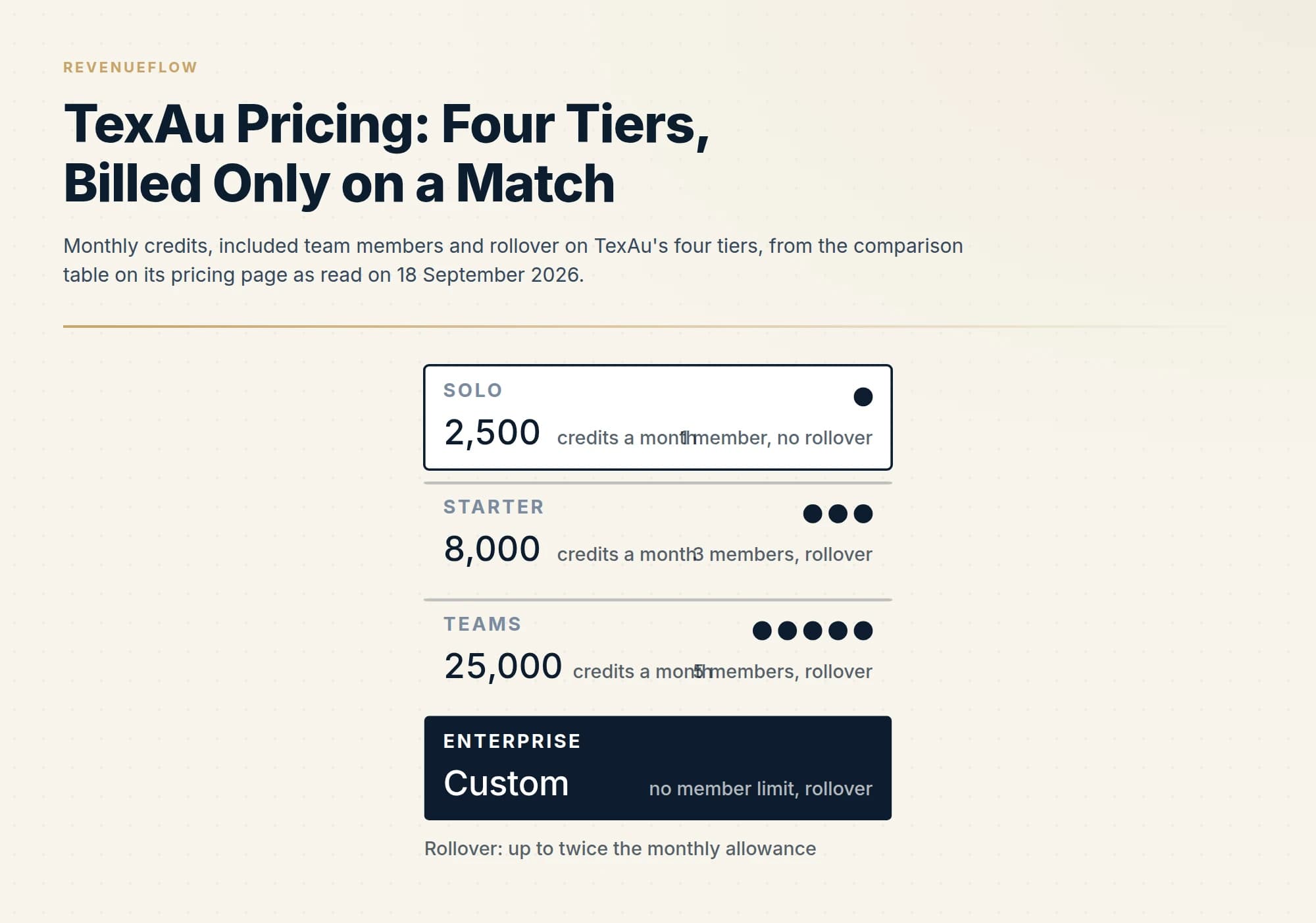
As published on TexAu's pricing page on 18 September 2026, Solo is $79, Starter $199 and Teams $549 a month on yearly billing, or $99, $249 and $649 monthly, with 2,500, 8,000 and 25,000 credits a month. Credits are charged only when a lookup succeeds. Rollover to twice the monthly allowance applies on Starter and above.
Key takeaways
- TexAu's pricing page on 18 September 2026 lists Solo at $79, Starter at $199 and Teams at $549 a month on yearly billing, and $99, $249 and $649 on monthly billing.
- Credits are charged only on a successful match; the vendor's own example is 100 searches, 72 matched and 72 credits charged, with the waterfall billed once.
- The vendor's ratio is about five credits per enriched lead, since 2,500 credits is described as roughly 450 to 500 enriched leads and 8,000 as about 1,600.
- Rollover to twice the monthly allowance applies on Starter and above, top-ups do not roll over, and the page's savings percentage fits no single tier's published figures.
Reviewed and updated September 18, 2026
TexAu's pricing page works one example harder than any other: 100 searches, 72 matched, 28 failed, 72 credits charged. The 28 misses cost nothing. That single rule, which the vendor calls pay-on-match, is what the four tiers are built around, and it changes how a credit allowance should be read.
The page also disagrees with itself in three small places about what yearly billing saves and who gets rollover, which is worth knowing before a figure from it goes into a budget. Everything below comes from texau.com as fetched on 18 September 2026: the pricing page in both billing states and the about page. TexAu here means the enrichment and workflow product at texau.com. Its about page says the company "started as a small set of LinkedIn automation scripts" and describes the current product in four words: "V3 is the rewrite." Reviews written about the earlier tool describe a different price list.
Four tiers, two billing states
The page introduces itself plainly: "One product. Four tiers." It opens on yearly billing, with a toggle to monthly, and the tier cards print a monthly-equivalent figure in both states.
As published on TexAu's pricing page on 18 September 2026, in the yearly state the page opens on, Solo is $79 a month with 2,500 credits a month and one team member, Starter is $199 a month with 8,000 credits a month and three team members, and Teams is $549 a month with 25,000 credits a month and five team members. Enterprise is custom, with a custom credit volume, unlimited team members, single sign-on, security review support and an EU data residency option.
Switched to monthly billing in a rendered browser session on 18 September 2026, the same three cards read $99, $249 and $649 a month. The page address gains a billing parameter when the toggle is used, so a shared link can open in either state; check which one you are looking at before quoting a number.
Extra people cost extra on two tiers. The comparison table lists an additional member price of $99 per member per month on Starter and on Teams, with no such option shown for Solo. Workspaces follow the same counts: one on Solo, three on Starter, five or more on Teams. CRM sync is one-way and daily on Solo and Starter and two-way and hourly on Teams.
Pay-on-match is the whole pricing model
The page states the rule several ways. Credits are, in its words, "charged only when a lookup succeeds". A panel headed pay-on-match adds: "Credits are deducted only when a successful match comes back." The FAQ defines the unit: "One successful email find is one credit. One verified email is one credit." And it says a miss costs zero credits across all 32 enrichment integrations.
The waterfall is priced the same way. The page says the waterfall tries 12 sources for one credit, so a lookup that fails at eleven providers and succeeds at the twelfth is billed once. Lead search draws from the same pool: the page lists it as "Lead search priced in the same credits", with no separate meter.
The vendor publishes three worked scenarios, and they are the clearest statement of the model. In the first, 100 searches produce 72 matches and 28 failures, and 72 credits are charged. In the second, 1,000 searches produce 840 matches and 840 credits. In the third, an import of 5,000 rows brings in 4,997 and skips 3 duplicates, and the page says only new rows are charged. Its about page puts the principle in one sentence: "We charge for results, not attempts."
What a credit allowance buys in leads
Because a lead usually needs more than one successful action, the credit count is not a lead count. The page gives its own conversion: "2,500 credits often covers roughly 450-500 enriched leads depending on your waterfall and verification mix". The Solo card repeats it as about 500 enriched leads, and the Starter card puts 8,000 credits at about 1,600.
Both of those work out to about five credits per enriched lead, which is this article's division of the vendor's own pairs. The Teams card gives no lead figure. On the same ratio 25,000 credits would be about 5,000 enriched leads, and that number is an extrapolation made here, offered only to show the scale. The vendor is explicit that the mix moves it: a lead that needs an email find, a verification and a score costs more credits than one that needs the email alone.
The rate per credit falls as the tier rises. Dividing each yearly-state figure by its monthly credits, which is arithmetic performed here on the published numbers, Solo works out to about $0.032 per credit, Starter to about $0.025 and Teams to about $0.022. On monthly billing the same division gives about $0.040, $0.031 and $0.026. Under pay-on-match those are rates per successful action, so the fair comparison with a pay-per-attempt tool is against that tool's rate divided by your own hit rate.
Rollover, top-ups and running out
Rollover is where the page contradicts its own headline. A banner near the top lists, as a feature of the pricing model, rollover of up to two times the monthly balance. The comparison table then shows rollover as a dash for Solo and a tick for the other three tiers, and the FAQ settles it: credits roll over month to month up to twice the monthly allowance "on Starter and above". A Solo subscriber gets no rollover.
Top-ups behave differently from the monthly allowance. The FAQ says "You can buy a credit top-up at the same per-credit rate as your tier, or upgrade." and adds that top-ups do not roll over; only the monthly allowance does. It also says the platform keeps working when the balance is gone: "actions that would exceed your balance are queued and billed against the next month if you let them run". That last clause is the one to read twice. A large job started near the end of a cycle can consume next month's allowance before the month begins.
Three places the page disagrees with itself on billing
None of these changes a card price. Each changes how a figure from the page should be quoted.
The savings label and the numerals do not match. TexAu's pricing page says, in the line under its headline, that yearly billing saves about 17 percent, and describes that as two months free. Set against the two published states, which is this article's arithmetic, Solo at $79 against $99 and Starter at $199 against $249 are each a saving of about 20 percent, and Teams at $549 against $649 is about 15 percent. The per-card labels on the yearly view, which read "Save $240/yr", "Save $600/yr" and "Save $1,200/yr", do agree with the numerals: each is twelve times the monthly gap. So the dollar labels are reliable and the percentage label is an approximation that fits no single tier.
A row in the comparison table is mislabelled. In the yearly view the row headed "Annual total" prints the three monthly-equivalent figures with a per-year suffix, so Solo appears as $79 a year. Twelve months at $79 is $948, which is this article's multiplication and the figure a buyer should expect on a yearly invoice. In the monthly view the same row keeps its heading and prints the monthly figures with a per-month suffix.
The FAQ describes plans as monthly. Asked about downgrading, it answers: "Plans are monthly. Switch any time before the next billing cycle." On a page that opens on yearly billing, that answer describes the monthly state only. What a yearly subscriber can change mid-term is not stated, and a separate FAQ answer says only that annual billing is "available with savings".
texau.com/pricing, yearly view
The headline line gives one savings rate for yearly billing and calls it two months free. 1
Each tier card prints its own yearly saving as an amount. 2
The table row headed Annual total prints the monthly-equivalent figure with a per-year suffix. 3
- 1An approximation. The published states imply a larger saving on Solo and Starter and a smaller one on Teams.
- 2Reliable. Each amount equals twelve times the gap between the two published states.
- 3A labelling slip. The yearly invoice is twelve times the figure shown, not the figure itself.
Trial, audience and where it sits
The page offers a 14-day trial and says of it: "No credit card. Full access to the workflow." It adds that you can "Upgrade, downgrade, or cancel any time." Every tier includes email verification, waterfall enrichment, AI lead scoring, schedulers, templates and what the vendor calls a GTM Co-Pilot; Teams adds premium data sources, up to five intent alerts and a dedicated account team.
TexAu names its buyer on the pricing page: "For agencies, founders, and GTM teams." Its about page describes a spreadsheet-shaped workspace that searches, enriches, verifies, scores and pushes to a CRM and a sending tool. That puts it on the same shelf as the orchestration layers covered in Clay's pricing, where the cost per action varies by which provider answers, and beside single-rate sources such as FullEnrich. The ordering logic that makes any of them cheap is in waterfall enrichment, and the separate, smaller budget line that protects a sending domain is in email verification tools. An older stack write-up on this site, the 20-tool sales stack, lists TexAu in its earlier social-signal role, which is the product the rewrite replaced.
The short version
As published on TexAu's pricing page on 18 September 2026, Solo is $79, Starter $199 and Teams $549 a month on the yearly billing the page opens on, and $99, $249 and $649 on monthly billing, with 2,500, 8,000 and 25,000 credits a month and one, three and five team members. Extra members are $99 each a month on Starter and Teams. Enterprise is custom.
Credits are charged only on a successful match, the waterfall bills once however many sources it tries, and the vendor's own ratio is about five credits per enriched lead. Rollover to twice the monthly allowance applies on Starter and above, top-ups do not roll over, and overspend is queued against next month.
Quote the per-card dollar savings, not the percentage label, and read the Annual total row as a monthly figure. If the list is not the constraint and the conversations are, you can see what a first campaign produces first.
Tiers, figures, credit rules and FAQ answers above were read from TexAu's own pricing page on 18 September 2026, with the monthly state read in a rendered browser session that day, and the company history from its about page. The percentage savings, per-credit rates, credits per lead and the twelve-month total are this article's arithmetic on those published figures. Verify current terms with the vendor before relying on them.
Sources: TexAu pricing, About TexAu
Frequently asked questions.
Frequently asked questions- How much does TexAu cost?
- As published on TexAu's pricing page on 18 September 2026, Solo is $79 a month, Starter $199 and Teams $549 on the yearly billing the page opens on, and $99, $249 and $649 on monthly billing. They include 2,500, 8,000 and 25,000 credits a month. Enterprise is custom, and extra members cost $99 each a month on Starter and Teams.
- Does TexAu charge for failed lookups?
- No. The pricing page read on 18 September 2026 says credits are charged only when a lookup succeeds and that a miss costs zero credits across all 32 enrichment integrations. Its own example is 100 searches with 72 matches and 72 credits charged. The waterfall tries 12 sources for one credit, so it bills once however many sources it tries.
- Do TexAu credits roll over?
- On Starter and above, yes. The pricing FAQ read on 18 September 2026 says credits roll over month to month up to twice the monthly allowance on Starter and above, and the comparison table shows no rollover for Solo. Purchased top-ups do not roll over, and actions that exceed the balance are queued and billed against the next month.
- Is there a TexAu free trial?
- Yes. The pricing page offers a 14-day trial with no credit card and full access to the workflow, and says you can upgrade, downgrade or cancel at any time. Because billing is on successful matches only, the trial is a fair way to measure your own hit rate, which is the number that turns a credit allowance into a lead count.
About the author.

B2B cold email experts helping companies generate qualified leads through done-for-you outreach campaigns.
RevenueFlow Team
Explore more.
Ready to scale your outreach?
We build GTM engines that book real meetings. See the receipts.
Related articles.
Airscale Pricing: Three Plans, One Credit, Four Rates
Airscale prints a different credit cost on every plan, and its advertised per-email price belongs to the custom one. The dated ladder and the rollover rules.
Autobound Pricing: One-Time Credit Packs, Not Seats
Autobound's pricing page sells one-time credit packs for a signal data API, not seats. The six packs, the per-endpoint meter, and what a company costs.
Snitcher Pricing: The $49 Table Is the Annual Rate
Snitcher's visible price table is the annual-billing ladder. The ten bands at both billing states, the unique-company meter, and the rules on a help page.
LeadGibbon Pricing: Three Monthly Plans, No Annual Tab
LeadGibbon publishes three monthly plans and no annual rate. The dated ladder, the verified-emails-only meter, the rollover rule, and what the page does not publish.
Bookyourdata Pricing: 25 Packs, Priced Per Contact
Bookyourdata sells credits in twenty-five packs with no subscription. The dated ladder, the per-contact rates rendered in the browser, the guarantee rule and BeSpoke.
SalesQL Pricing: Four Plans, Priced Per Credit
SalesQL publishes four plans on a monthly-first pricing page. Here is the dated ladder, the per-profile credit meter, the seat limits, and what the page leaves out.