B2B Database: What to Test Before You Pay
Total record count is the number every vendor leads with and the one that predicts least. The test that replaces it takes a day and settles the purchase.

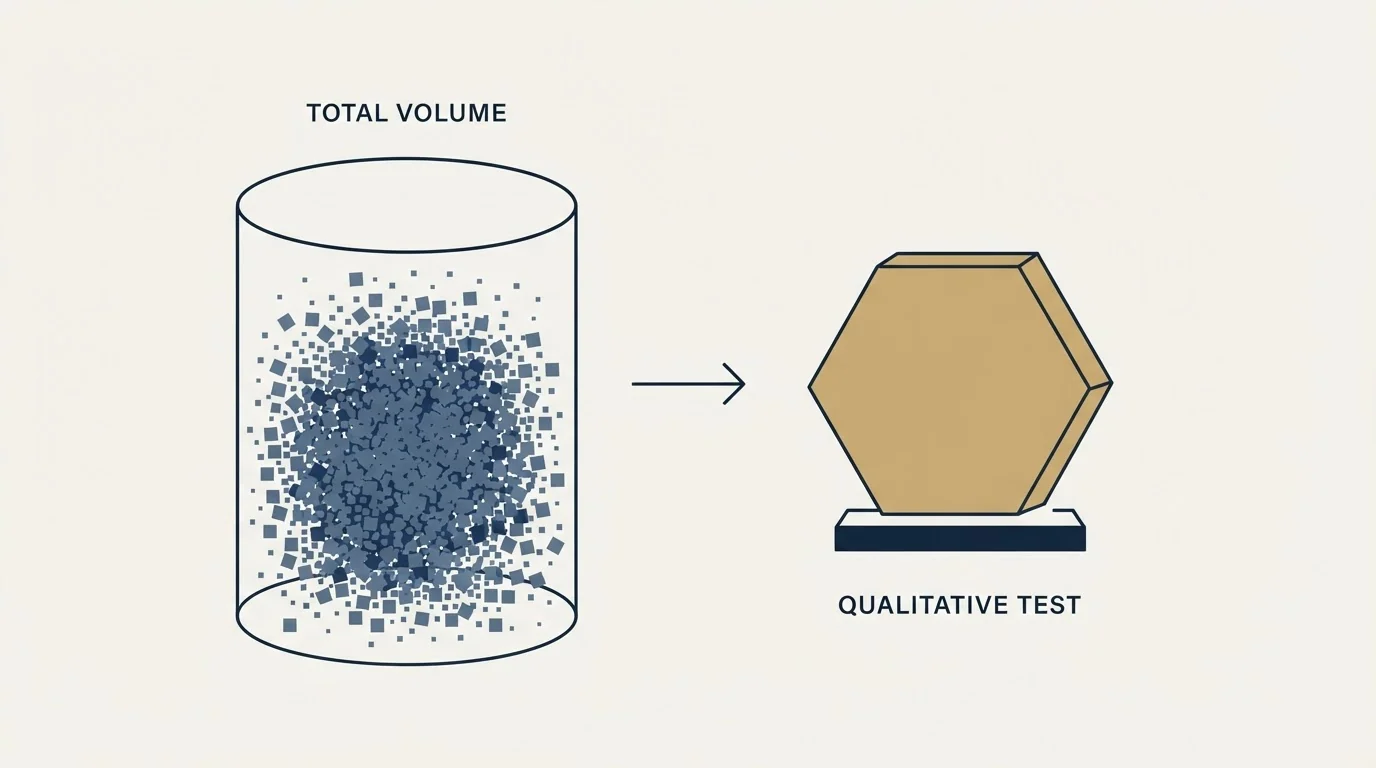
Judge a B2B database on coverage of your own segment rather than its total record count. Match a hundred companies you chose yourself during the trial, count how many carry the field your campaign filters on, and hand-check twenty returned people. Then read the credit meter and the exit terms, because vendors publish genuinely different definitions of a credit.
Key takeaways
- Total record count grows whenever a vendor adds a geography you do not sell into, so it is comparable across vendors and predictive of nothing about your segment.
- Coverage is cheap to compute and gets published; accuracy needs a person to check returned values by hand and never does, so hand-check twenty rows before believing any percentage.
- UpLead's pricing page defines one credit as one contact unlocked for download or export, while Cognism's defines a credit as one revealed contact with no charge for viewing a contact already revealed. The same word, two different bills.
- A segment defined by something no vendor stocks, such as a software footprint or a service mix, is the case where the database is the wrong purchase and a per-campaign build is not.
Reviewed and updated September 2, 2026
A sales lead compares two contact databases on the number each one puts at the top of its page, picks the larger, and signs an annual contract. Three weeks later the team runs its actual segment against the product, which is mid-sized logistics companies in two countries with a named role, and the query returns a few hundred usable rows out of hundreds of millions.
Nothing in the comparison predicted that, because nothing in the comparison was about that segment. The total record count is the number every vendor in this category leads with and the one that decides least about whether the product works for you.
What follows is the set of questions that does decide it, in the order worth asking them, and the one test that settles the whole purchase in an afternoon. It is deliberately not a ranked list of vendors. Which company sells the best database is a question whose answer changes by segment, by geography and by quarter, and a ranking published today is a claim about somebody else's segment.
The one test that replaces every published number
Take a hundred companies you already know belong in your target segment. Not a sample the vendor picks and not a filter you build inside their interface. A hundred names your team could defend in a room, sourced from your own closed-won list, your own pipeline and a manual scan of the market.
Hand that list to the vendor during the trial and ask for a match. Count how many of the hundred the product finds at all, then count how many come back with the specific field your campaign is going to filter on, which is usually a role rather than a company attribute. Then take twenty of the returned people and check them by hand against the company's own site and their own professional profile.
That is a day of work and it produces the only three numbers that describe your purchase: what share of your segment exists in the product, what share of those carries the field you need, and what share of the returned values is currently true. Every published figure is a claim about a population you cannot inspect, which is the same problem match rate describes from the vendor side.
Those three numbers are also what lead generation data reduces to once vendor totals are set aside, because a field the campaign never filters on is not part of the purchase.
- Counts every contact in every market the vendor sells into
- Grows whenever the vendor adds a geography you do not sell into
- Comparable across vendors and predictive of nothing
- Costs the vendor nothing to increase
- Cannot be wrong, because no definition of a usable record is attached
- Counts only companies that pass your own written definition
- Falls when your segment is narrow, which is when it matters most
- Measurable only on a list you built yourself
- Decides the ceiling on every campaign you run this year
- Frequently an order of magnitude below what the headline implies
The reason to do this during a trial rather than after signing is that the answer is not negotiable afterwards. A database either holds your segment or it does not, and no amount of account management changes that inside a contract term.
Coverage and accuracy are two numbers and only one of them gets quoted

Coverage is cheap to compute and easy to publish. Submit rows, count how many came back with a value, print the percentage. Accuracy needs a person to check whether the returned value is true today, one row at a time, against a source that is itself current.
The same asymmetry decides what a sales lead database is worth, because the count on the page is a claim about every market the vendor sells into and the coverage that matters is of the segment you wrote down.
A provider returning a plausible but stale job title for most of a list scores identically on coverage to a provider returning the correct title for the same share. The number that reaches a comparison spreadsheet is the one that is cheap to produce. CRM enrichment works through the same split on the enrichment side, and the consequence is identical here: stale data is worse than missing data, because a blank field gets checked before somebody writes to that person and a confidently wrong field gets used.
The field that goes wrong most expensively is the employer. A message naming somebody's previous company is not a near miss. It is evidence to the reader that nobody checked, delivered to exactly the person you wanted to impress, and the mechanism behind it is ordinary data decay rather than a bad vendor.
The meter is where the money actually moves
Every vendor in this category sells credits and no two of them mean the same thing by the word. This is the part of the purchase that is genuinely readable in advance, because the vendors publish it, and it is the part buyers skip because it looks like small print.
Two examples from the vendors' own pricing pages, which are quoted here because they are unusually explicit rather than because they are recommendations.
UpLead's pricing page states that "A credit unlocks a contact for download or CRM export and gives you access to their email and mobile direct dial." and that "One credit = one contact." So the meter is the export, one for one, as published on uplead.com on 2 September 2026.
Cognism's pricing page states that "Credits are used to reveal, enrich, or export a contact." and that "1 credit = 1 revealed contact", adds "No charge for viewing previously revealed contacts", and says "Each seat includes an allocation of credits as part of the subscription." On its enrichment side the same page states that "Credits are only used again when key details change, like a job move". So the meter is the reveal, seats carry allocations, re-viewing a record you already paid for is free, and maintenance of a record you already hold is not a new charge, as published on cognism.com on 2 September 2026.
Those are two coherent and quite different pricing models sitting behind one word. The questions that fall out of them apply to any vendor in the category, and the answers belong in writing before the contract rather than in a sales call.
Does a credit spend on submission or on a result. A tool that charges for a lookup that returned nothing is charging you for its own coverage gap.
Do credits reset or roll over, and what happens to unused ones at renewal.
Are seats and credits separate lines, so that adding a person to the team changes the bill twice.
Does re-exporting a record you already paid for cost again, which decides whether keeping the data in your own system is worth the engineering.
Is enrichment of an existing record metered on the same pool as new discovery, and does a refresh of a record whose details did not change cost anything.
The arithmetic that follows is invented for illustration and is not a measurement of any vendor. A team enriching four thousand records a quarter pays four thousand credits under a per-submission meter whatever the match rate, and pays roughly two thousand four hundred under a per-result meter at a sixty percent match. Same product, same work, a difference of about forty percent on the line item, decided entirely by a sentence on the pricing page.
Recency is a property of the record, not of the vendor

A vendor refresh cadence stated as a company-wide policy tells you very little, because refresh is not applied evenly. Records that many customers query get re-verified often, and records in a thin segment can sit untouched for a long time. The refresh a vendor advertises is an average over a population weighted towards the popular rows, and your segment is unlikely to be the popular rows.
Two questions get past the policy statement. Does the product expose a last-verified date on each record, at field level rather than at row level, so that your own pipeline can decide what to trust. And does the vendor distinguish between a record it re-checked and a record it merely re-imported from the same upstream source it took the row from originally.
Where the answer to the first question is no, the practical response is to verify immediately before the send rather than at build time, which is the discipline set out in list hygiene and priced in email list cleaning. A verification result is a claim about one moment, and a file verified at purchase and sent a month later has been unverified for a month.
What the contract says about the rows after you leave
This is the question that separates the three things sold under the word database, which email marketing database works through in full: a database you own and build, subscription access to somebody else's, and a purchased export.
A B2B data list is usually that third thing, a purchased export filtered on a handful of conditions, and it carries none of the refresh a subscription buys, so the only questions left are what the rows were worth on the day they were captured and how fast that falls.
Subscription access is the middle option, and it is the one on the table whenever a vendor is selling seats and credits rather than a file. Read what the terms say about the rows you exported during the term. Some subscriptions permit continued use of exported records and some do not, and the difference decides whether the contract is a purchase or a rental. It also decides how much engineering it is worth doing to hold the data in your own systems, because building a pipeline into a store you have to empty at renewal is work with an expiry date on it.
The second contract question is exclusivity, which does not exist and should not be expected to. Every competitor in your category queries the same product with broadly similar filters, so a segment defined by three common conditions has been pulled repeatedly by companies selling adjacent things. The rows are correct and the audience is tired.
- Yes: A hundred companies from your own segment were matched during the trial and the result was counted
- Yes: Twenty returned people were checked by hand against the company site and their own profile
- Yes: The credit meter is written down: on submission or on result, and what a miss costs
- Yes: Seat count and credit pool are separated, so team growth changes one line rather than two
- Yes: Records carry a last-verified date you can read and filter on
- Yes: The terms state what happens to exported rows when the subscription ends
- No: The decision was made on total record count because it was the only comparable number
- No: Accuracy was accepted from a published percentage rather than measured on your own sample
When a database is the wrong purchase
Two situations, and they are common enough to be worth naming before the trial rather than after it.
The first is a segment defined by something no vendor sells. Companies running a particular piece of software, companies that opened a second location this year, companies whose service mix matches a specific offer. Those definitions are frequently the good ones, because they carry a reason to write rather than a demographic, and they are exactly the definitions a filter menu cannot express. When the ideal customer profile is written in terms the product does not stock, enrichment fills the fields the vendor happens to have and the campaign still cannot be built. Writing the segment query first and listing the fields it needs, as the ideal customer profile guide sets out, is what surfaces that mismatch before the invoice rather than after it.
The second is a programme small enough that the subscription is the wrong shape. A team contacting a few hundred carefully chosen companies a quarter is buying an annual platform to answer a question that a per-campaign build answers better, and the per-campaign build produces a list nobody else is working. The mechanics of that route, and the distinction underneath it between a filter and a signal, are the highest-leverage idea in B2B prospecting.
- Step 1Write the segment first
Ranges, lists and exclusions, specific enough that somebody outside the team could build the list from the words alone.
- Step 2List the fields the query needs
Usually four rather than forty. Anything the campaign does not filter on is not part of this purchase.
- Step 3Build the hundred-company control list
From closed-won, from pipeline and from a manual market scan. Never from the vendor's own interface.
- Step 4Match the control list in the trial
Count matches, count the field you need, then hand-check twenty of the returned people.
- Step 5Read the meter and the exit terms
How a credit is spent, what a miss costs, and what happens to exported rows at the end of the term.
Where we stand
RevenueFlow builds lists per campaign rather than maintaining a subscription database, and every campaign carries exactly one message with no bumps and no thread replies. Those two positions are connected. A single message only works when the list is tight enough that the message is true for everybody on it, and a filter menu that can express three demographic conditions will not produce a list that tight. The narrowness is the product.
That is a preference rather than a rule for everybody. Teams running high volume across many segments get real value out of a subscription, and the evaluation above is written for them as much as for anybody. What does not survive scrutiny is choosing between two of them on a headline record count, which is a comparison of two marketing departments.
For the fields a database cannot supply, the ordering that keeps the cost down is in waterfall enrichment, and the selection question that sits above all of it, which person at the company is worth writing to at all, is in finding and reaching decision makers.
The short version
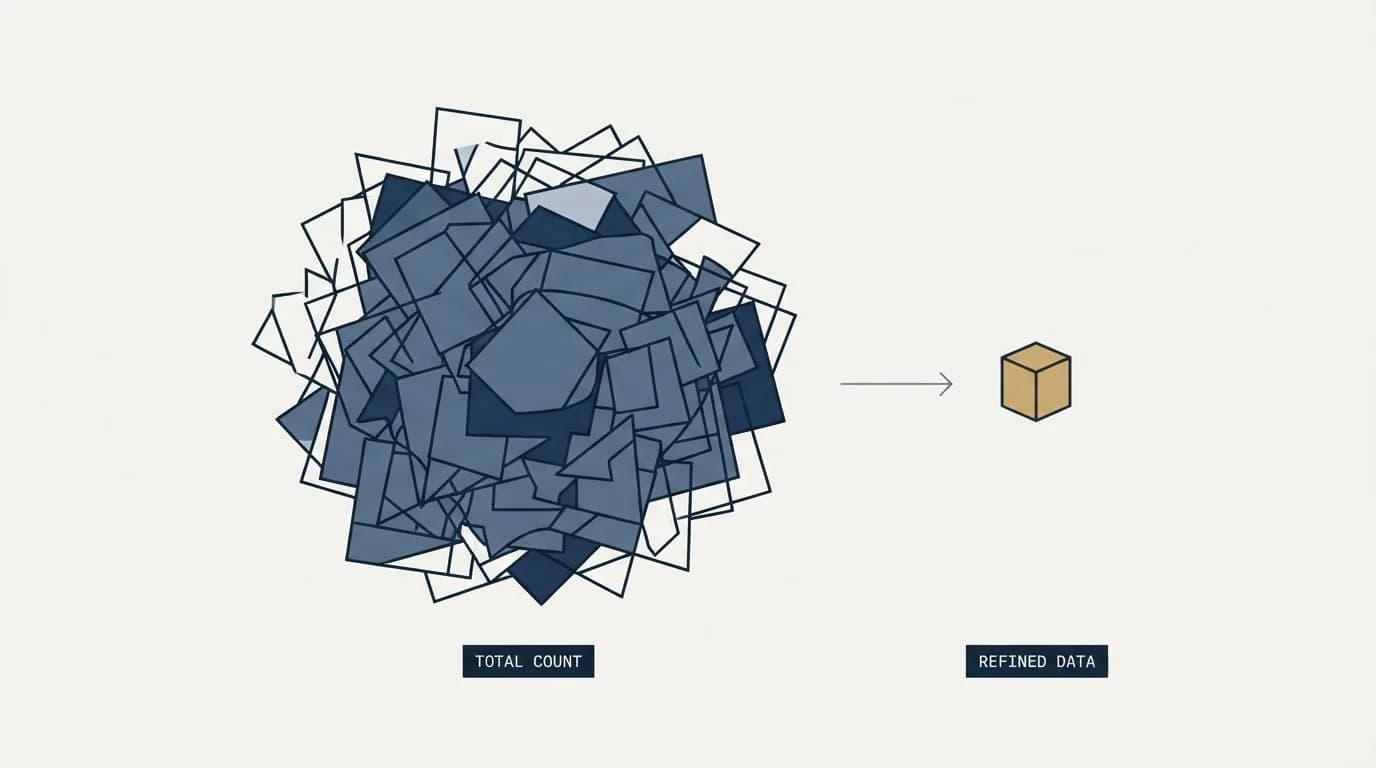
Total record count is the number every vendor leads with and the one that predicts least. Coverage of your own segment, measured on a hundred companies you chose yourself, is the number that decides whether the product works, and it can only be measured during a trial.
Coverage and accuracy are two different numbers and only the cheap one gets published, so hand-check twenty returned rows before believing any percentage. Read the credit meter in writing, because vendors publish genuinely different definitions of the same word and the difference between charging on submission and charging on result moves the bill by a wide margin.
Ask whether records carry a readable last-verified date, verify immediately before the send whatever the answer, and read what the terms say about exported rows at the end of the term. Where the segment is defined by something no vendor stocks, or the programme is small enough that a per-campaign build produces a better list, the honest answer is that this is the wrong purchase.
If the real question is whether a list built against your own definition beats a subscription you can sign this afternoon, see what a first campaign produces and compare the two on replies rather than on row count.
Credit and meter wording is quoted from UpLead's and Cognism's own pricing pages, fetched 2 September 2026. Vendors change these terms. Verify current terms with the vendor before relying on them.
Sources: UpLead pricing, Cognism pricing
Frequently asked questions.
Frequently asked questions- How do I compare two B2B databases fairly?
- Not on their published record counts, which measure different populations and are not defined. Build a list of a hundred companies from your own closed-won accounts, your pipeline and a manual market scan, then ask each vendor to match it during the trial. Count matches, count how many carry the field your campaign will filter on, and hand-check twenty of the returned people against the company site. Those three numbers describe your purchase and no published figure does.
- What does a credit actually cost me?
- It depends on what the vendor counts, and the definitions differ. UpLead's pricing page states that one credit unlocks one contact for download or CRM export. Cognism's states that one credit is one revealed contact, that seats carry an allocation, and that viewing a previously revealed contact is free. Ask whether a credit is spent on submission or on a result, because a tool charging for a lookup that returned nothing is charging you for its own coverage gap.
- How current is the data in a B2B database?
- It varies by record rather than by vendor, which is why a company-wide refresh policy tells you little. Records many customers query get re-verified often and records in a thin segment can sit untouched, and your segment is unlikely to be the popular one. Ask whether the product exposes a last-verified date at field level, and verify immediately before the send whatever the answer.
- Should I buy a database or build lists per campaign?
- Buy when you run high volume across several segments and need repeatable access to a broad population. Build when the segment is defined by something no filter menu expresses, such as a software footprint or a service mix, or when the programme is small enough that a per-campaign build produces a list nobody else is working. A subscription is queried by every competitor in your category with similar filters, so the rows are correct and the audience is tired.
About the author.

Ben Carden is CRO at RevenueFlow, which builds and operates outbound revenue engines for B2B companies. Previously at Gartner Enterprise. Studied at London School of Economics.
Ben Carden · CRO
Connect on LinkedIn →Explore more.
Ready to scale your outreach?
We build GTM engines that book real meetings. See the receipts.
Related articles.
Crunchbase Pricing: The Annual Rate Is Introductory
The annual figure Crunchbase shows a new visitor is a first year rate, and its own help centre says so. Where the price lives, and why the export cap decides it.
Drift Competitors: What Replaced It and What Each Costs
Drift is retired and drift.com now serves a Salesloft page. What the successors publish about price, who owns them now, and which one fits which job.
Warm Lead: What Made It Warm, and When It Expires
Warmth is a property of evidence rather than of a person. Store the action and its date, because a temperature column cannot be turned back into the event behind it.
Email Marketing Database: What a Bought One Costs
Three different objects are sold under this one phrase, and the platforms ranking for it forbid the version half the results are selling.
Two Agencies, One Target List: Who Owns Which Accounts
Two outbound suppliers on one market will contact the same companies unless the buyer splits it first. How to cut the list, run the exclusion feed and check the overlap.
IT Lead Generation: The Buyer Runs Your Playbook
Technology buyers evaluate outbound for a living, and their purchases carry a security review nobody in your meeting owns. Which triggers are real.