Crunchbase Pricing: The Annual Rate Is Introductory
The annual figure Crunchbase shows a new visitor is a first year rate, and its own help centre says so. Where the price lives, and why the export cap decides it.
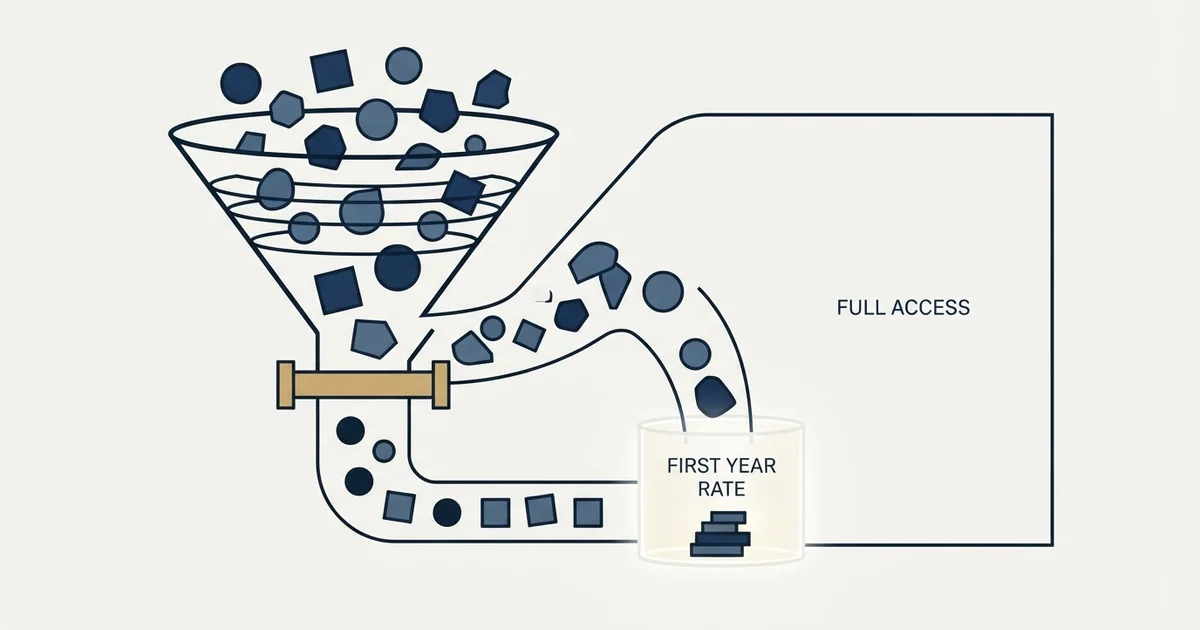
As published on its own purchase page on 2 September 2026, Crunchbase Pro renders a struck through $79.00 beside a live $49 per month billed annually, or $99 billed monthly, with Business starting at $199 per month billed annually. The vendor's help centre calls the discount a first year introductory offer.
Key takeaways
- The $49 annual rate is a first year introductory price against a standing $79, which the vendor's own help centre states in prose and the pricing card shows only as a struck through figure.
- Neither the marketing site nor its structured data carries a price, and the purchase page that does renders in the browser, which is why third party figures for this vendor disagree.
- Exports are capped at 2k rows a month on Pro and 5K on Business, and the route past those ceilings is a quoted API rather than the next published tier.
- This is a company level dataset with a funding and momentum layer rather than a contact database, so the contact half of an outbound stack is a separate purchase with a separate meter.
Reviewed and updated September 2, 2026
The annual price Crunchbase shows a new visitor is a first year rate, and the vendor's own help centre says so in one sentence. The pricing page itself shows the discounted figure beside a struck through one and does not spell out that the discount lapses.
Nothing there is hidden. It is simply distributed across three surfaces, one of which a plain fetch cannot read at all, which is why third party pages quoting a Crunchbase price disagree with each other so consistently.
Where the price actually lives
Two of the three obvious places to look, the marketing product page and the pricing link on the marketing site, carried no figure when each was fetched on 2 September 2026.
The marketing site's product page for Crunchbase Pro publishes structured data describing the product with an offer object that carries availability and a purchase link and no price at all. The pricing link on that site resolves to the same product page. Neither surface prints a number.
The page that does is the purchase flow at the application domain, and it renders its prices in the browser. Fetched with a plain request on 2 September 2026 it returned an HTTP 200 carrying under a hundred characters of visible text, which reads exactly like a page publishing nothing. Rendered through a headless browser the same URL returned the full ladder. That gap is worth naming because it is the mechanism behind most of the contradictory figures in circulation: a scraper reads the shell, a person reads the page, and both report honestly.
Enumerating the surfaces is the honest method when a rate is missing, and BrightTALK's six pages carry no price between them, leaving a dated aggregator scrape to fill the gap.
The published ladder

As published on Crunchbase's own purchase page on 2 September 2026, the ladder runs two named products and a custom route.
Pro renders a struck through $79.00 beside a live $49, both labelled per month billed annually, under a banner reading that the annual first year saves thirty eight percent. The same card offers $99 per month billed monthly, and a seven day free trial on either route. Pro is described as covering search across more than four million private companies with full results, real time financial data, exports of up to 2k rows per month, and tracking through saved searches, lists, alerts and stages.
Business is listed as starting at $199 per month billed annually. It is described as everything in Pro plus exports of 5K rows per month, an AI agent for industry trends, proprietary predictions and insights, and CRM integrations with auto enrichment add-ons.
Custom Data Access is quoted rather than listed, covering API and model context protocol access for organisations powering their own workflows, agents and products.
The struck through figure is the one to read carefully, because a two figure card means three different things across this category and only the markup resolves it. Here the higher number sits in a dedicated struck amount element inside the price block, and both figures share the same per month billed annually label, so this is a promotion against a standing rate rather than a monthly against an annual.
The vendor's own help centre settles it in prose. Its article on buying Crunchbase Pro, last updated in August 2025, states that Pro can be purchased either on an introductory offer of thirty eight percent off Crunchbase Pro Annual for new users in the first year only, or at $99 billed monthly.
Take the two surfaces together and the arithmetic is unambiguous. That published discount applied to the published standing $79.00 gives $48.98, which is the $49 on the card. Twelve months at $49 is $588 for a first year. Twelve months at the standing $79 is $948 for the second, before any list price change. Twelve months at $99 on the monthly route is $1,188.
- Search across 4M+ private companies
- Full search results
- Exports up to 2k rows a month
- Saved searches, lists, alerts and stages
- AI agent listed as limited
- Everything in Pro
- Exports of 5K rows a month
- Predictions and insights features
- CRM integrations to Salesforce and HubSpot
- Dedicated customer success
- API access for internal tools
- Model context protocol access
- Data licensing for products you build
- Purchased through the sales team
- No published figure
The export cap is the meter
Read the plan comparison rather than the cards and the difference between the two published tiers narrows to a small set of lines, one of which decides most evaluations.
All company information, unlimited search results, saved search and list updates, stages, notes and tagging are present on both. The AI agent is listed as limited on Pro and full on Business. Predictions and insights features are Business only. CRM integrations to Salesforce and HubSpot, consolidated billing and team admin features are Business only. Model context protocol access and CRM enrichment for Salesforce and Monday Sales are both marked as add-ons rather than included.
The line that moves is the export. Pro exports up to 2k rows a month and Business exports 5K, and the vendor's own frequently asked questions repeat both figures and point anybody needing more at the API.
That single number is the meter for anybody using this product as a prospecting source rather than as a research tool. Two thousand rows a month is roughly one modest list build, and it resets monthly rather than accumulating. A team running weekly campaigns off funding signals will meet that ceiling in the first month, and the upgrade path from it is not the next tier but the API, which is quoted rather than published.
The vendor is explicit about which API is which. Its help content describes Crunchbase Data Enrichment as a full and unlimited API connection for internal tools, and Crunchbase Data Licensing as API access for building custom applications and products. Both are sold through the sales team.
Splitting a self serve product from a quoted one is common, and PartnerStack prices its self serve tier on outcome while leaving its three platform plans behind a demo.
- Step 1Count rows, not seats
Decide how many company records you need to export in a month. The published export ceilings are the first constraint either self serve tier hits.
- Step 2Separate research from sourcing
Reading profiles in the interface is unlimited on both tiers. Getting records out is capped. Those are two different products in one subscription.
- Step 3Price the second year, not the first
The annual rate carries a first year introductory discount. Budget the standing rate and treat the discount as a one off saving.
- Step 4Check what your CRM already does
CRM integration and enrichment sit on the upper tier and as add-ons, so establish whether your stack already covers that path before paying for it.
What the data actually is

The pricing question and the fit question run together on a company data provider, and the vendor's own numbers help place it.
Crunchbase's marketing site states that it delivers more than thirty million verified data updates annually across more than four million private companies, sourced through its own ingestion systems, external sources, analyst validation and live signals from more than eighty million professionals. The Pro feature list adds heat scores, funding data and financials, with automatic notifications when a tracked company changes.
Read that against what an outbound team needs and the shape becomes clear. This is a company level dataset with a strong funding and momentum layer. It is not a contact database. There are no email addresses or phone numbers in the export, and no verification of them, because that is not what the product is.
So a Crunchbase subscription sits upstream of an outbound stack rather than inside it. It answers which companies to approach and when, and the contact layer is a separate purchase with a separate meter. Waterfall enrichment covers the ordering that makes the contact half cheap, and what firmographic data covers sets out which company attributes a targeting model can actually act on.
For the contact side priced on its own terms, ZoomInfo pricing covers what that vendor publishes and what has to be asked for, Apollo.io pricing covers the credit model at the self serve end, and Clay pricing covers what an orchestration layer charges per enriched row.
Reading the audience question honestly
One thing worth stating for anyone comparing this subscription against a sales tool. Crunchbase's own solutions menu names six audiences: go to market teams, investors, product developers, analysts, wealth managers and entrepreneurs.
Its go to market page is unambiguous about the sales use case, describing reaching high intent buyers early, prioritising accounts, segmenting with sector level predictions and feeding live private market data into CRM and revenue operations dashboards. Its customer stories carry a sales enablement specialist, a head of marketing campaigns and a lead generation use case alongside venture capital and private equity firms.
So the go to market buyer is real and named. It is also one of six, and the product's centre of gravity in funding and private market prediction is closer to the investor audience than a sales tool comparison usually assumes. That matters for a budget conversation: this is a company intelligence subscription that a sales team can use, priced accordingly, rather than a sales tool priced for sales.
The vendor states SOC 2 Type II compliance on its own pages. As with any external data supplier, that describes the supplier's controls and does not transfer a lawful basis for contacting anybody to the buyer.
The short version

Crunchbase publishes Pro at $49 a month billed annually as a first year introductory rate against a standing $79, or $99 billed monthly, with a seven day free trial, and Business starting at $199 a month billed annually. API and data licensing are quoted through the sales team. The figures are not on the marketing site or in its structured data, and the purchase page that carries them renders them in the browser, which is why circulating third party figures disagree.
Budget the standing annual rate rather than the introductory one, and decide on the export ceiling rather than the price. Two thousand rows a month on Pro and five thousand on Business are the constraint that actually binds a prospecting workload, and the route past them is a quoted API rather than the next tier.
If the constraint is the supply of qualified conversations rather than the supply of company records, see what a first campaign produces on your own market, and cost per lead in B2B covers the arithmetic that whole purchase reports into.
Plan prices, export limits and product descriptions above were read from Crunchbase's own purchase page and marketing site on 2 September 2026, and the introductory offer wording from its help centre article on buying Crunchbase Pro (support.crunchbase.com article 360001616808), last updated August 2025. The marketing site's pricing link resolves to its Crunchbase Pro product page rather than to a rate card. Verify current terms with the vendor before relying on them.
Frequently asked questions.
Frequently asked questions- How much does Crunchbase cost?
- As published on its own purchase page on 2 September 2026, Crunchbase Pro is $49 per month billed annually or $99 per month billed monthly, with a seven day free trial. Crunchbase Business starts at $199 per month billed annually. API and data licensing access is quoted through the sales team rather than published.
- Why do published Crunchbase prices disagree with each other?
- Two reasons. The annual rate carries a first year introductory discount against a standing rate, so a page quoting either figure can be correct depending on when it was written. And the page carrying the ladder renders in the browser, so a scripted fetch returns a near empty shell and reports no pricing at all.
- What is the difference between Crunchbase Pro and Business?
- The plan comparison keeps company information, unlimited search results, saved searches, stages and tagging on both. Business adds predictions and insights features, the full AI agent, CRM integrations to Salesforce and HubSpot, consolidated billing and team admin, and raises the monthly export ceiling from 2k rows to 5K.
- Does a Crunchbase subscription include contact data?
- No. The product is a company level dataset covering more than four million private companies with funding history, financials and heat scores, and the exports are company records. Email addresses and phone numbers are a separate purchase from a contact data provider, with their own credit meter and their own verification step.
About the author.

Ben Carden is CRO at RevenueFlow, which builds and operates outbound revenue engines for B2B companies. Previously at Gartner Enterprise. Studied at London School of Economics.
Ben Carden · CRO
Connect on LinkedIn →Explore more.
Ready to scale your outreach?
We build GTM engines that book real meetings. See the receipts.
Related articles.
B2B Database: What to Test Before You Pay
Total record count is the number every vendor leads with and the one that predicts least. The test that replaces it takes a day and settles the purchase.
Typeform Alternatives: Read the Response Meter First
Typeform meters responses with a hard ceiling and counts seats inside the plan. What Tally, Fillout, Formbricks and Jotform count instead, from their own pricing pages.
FullEnrich Pricing: You Pay Only for Found Data
FullEnrich spends credits only on data it finds and verifies, and a mobile number costs ten times a work email. The bands, and the mix that decides the bill.
LeadMagic Pricing: What a Credit Buys Per Endpoint
LeadMagic publishes two different per credit rates for the same plan, and both are right. The four tiers, the endpoint costs, and the clock that separates them.
Foleon Pricing: No Published Price, a 24-Month Term
Foleon publishes no rate on its plans page and publishes the whole commitment behind it. The term, the notice window and what happens to the Docs after.
Optimizely Cost: What the Plans Page Publishes
Optimizely's plans page carries no prices, by either fetch route. What its own pages do disclose, where the circulating figures come from, and what rivals publish.