ZoomInfo Pricing: What the Vendor Publishes and What to Ask
ZoomInfo publishes a pricing model and no prices, and its own FAQ denies the price floor competitors publish for it. What is knowable before the call.
ZoomInfo publishes no dollar figures anywhere in its official pricing materials. It discloses only the pricing model: seat-based licensing combined with credit usage, where one credit equals one exported profile and credits must be purchased in bulk minimums. The only way to get an actual number is to request a quote, since every published dollar figure online originates from a third party, not ZoomInfo.
Key takeaways
- ZoomInfo's pricing FAQ explicitly denies that its pricing starts at $15,000, naming Cognism, Demandbase, Lusha, and Apollo as sources of that claim.
- ZoomInfo's pricing page lists three published cost criteria: features and functionality, number of licenses, and credit usage.
- One ZoomInfo credit equals the export of a single professional or company profile, and credit usage occurs only on export, not on search or view.
- ZoomInfo names package tiers such as ZoomInfo Professional and Copilot Advanced with included credit volumes of 75,000 and 150,000 credits, plus 25 intent topics, but attaches no prices to them.
- ZoomInfo's own pages contradict each other on the credit model, with the Sales product page describing platform-based access rather than per-credit constraints, unlike the pricing page's stated one-credit-per-export rule.
Reviewed and updated September 1, 2026
ZoomInfo's own pricing FAQ contains a sentence that almost no other vendor would print. Asked whether its pricing starts at $15,000, the page answers: "No, despite claims from Cognism, Demandbase, Lusha, Apollo, and others, ZoomInfo's pricing does not start at $15,000."
Read that twice. A vendor that publishes no rate card is publicly correcting a number four competitors have been publishing on its behalf. That single sentence tells you almost everything about how this market works, and it is the honest starting point for anyone trying to find out what ZoomInfo costs.
This page sets out what ZoomInfo actually publishes about price, what it explicitly denies, where its own pages disagree with each other, and how to get to a real number. No dollar figure appears anywhere below, and the reason for that is the subject of the article.
The product ZoomInfo sells under the name ZoomInfo Sales is what most buyers mean by ZoomInfo sales intelligence, and the per-record maths below is the honest way to price it.
ZoomInfo credits are the unit that meters exports rather than searches: the pricing page describes a credit as the export of a professional or company profile out of the platform, states each export costs one credit, and states credits require a minimum bulk purchase.
A ZoomInfo subscription is priced per seat with a credit allocation attached, so the two questions that decide the renewal figure are how many licences are genuinely in use and how many exports the team runs against them.
What a ZoomInfo licence costs is the same question as what the subscription costs divided by seats, and the vendor publishes neither; what it does publish is that the model is seat-based, which makes the licence count the one input you fully control.
What ZoomInfo publishes
ZoomInfo's pricing page is a real page listed in the company's own sitemap. It carries a pricing model without carrying any prices.
The page states the criteria: features and functionality, number of licenses, and credit usage. Its FAQ layer restates the same thing as three core factors, naming the number of user licenses the team needs, monthly credit consumption for data exports, and the depth of B2B intelligence required. Elsewhere on the same FAQ, contract length and volume discounts are named as further factors.
On structure, ZoomInfo is unambiguous. Its pricing FAQ states plainly that ZoomInfo uses a seat-based pricing model, with total cost determined by the number of users who will access the platform.
The credit mechanism is documented at similar detail. The pricing page describes a credit as representing the export of a professional or company profile from the platform, states that each export costs one credit, and states that credits require a minimum purchase of bulk credits. It also states that credit usage occurs only when a user exports a profile out of the platform, to a CSV or into an application, which means searching and viewing are metered differently from taking the record with you.
The packages get named without being priced. The pricing page names ZoomInfo Professional and Copilot Advanced alongside their included credit volumes, including a 75K included credits tier and a 150K one, with 25 intent topics. So the shape of the ladder is public. The rungs have no numbers on them.
- Yes: The pricing model: features and functionality, number of licenses, credit usage
- Yes: That the model is seat-based
- Yes: That each export costs one credit, and credits require a minimum bulk purchase
- Yes: Package names and their included credit volumes, including a 75K and a 150K credit tier
- Yes: That contract length and volume discounts affect the number
- No: A price for any package
- No: A dollar rate per credit
- No: A published entry point or minimum contract value
That absence is a positive finding rather than a failure to look. The canonical pricing route's own content was read directly and contains no currency figure at all. What ZoomInfo sells you is a quote.
The $15,000 denial, and why it matters to your research
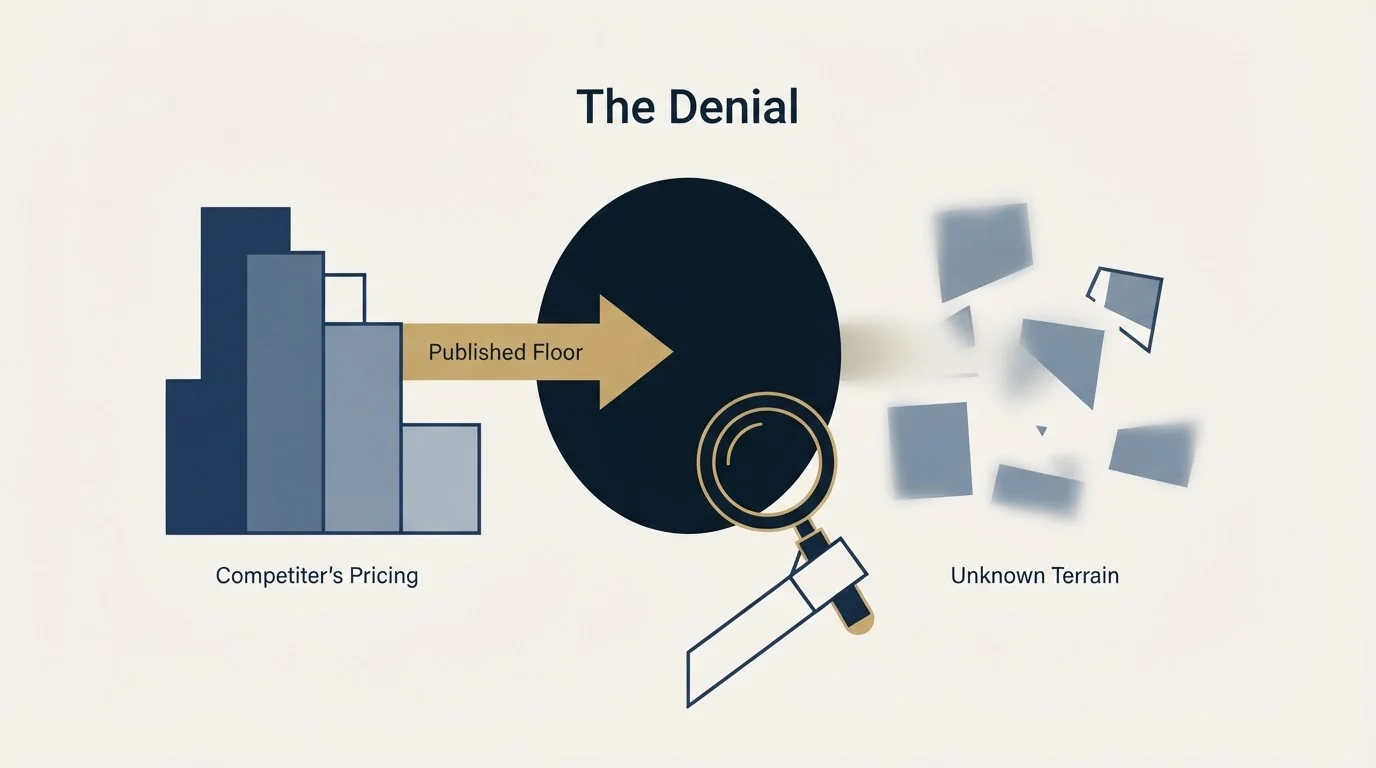
The number circulating for years as ZoomInfo's entry price appears on competitor comparison pages, review directories and procurement blogs. ZoomInfo's pricing FAQ names four of those competitors and denies the figure outright.
Cognism itself follows the same quote-gated pattern, and its own pricing page reveals a similar credit structure worth comparing, as covered in how Cognism structures its quotes.
You do not have to decide whether ZoomInfo or its competitors are telling the truth to get value from that exchange. The useful conclusion is narrower and more reliable: every specific dollar figure you find for ZoomInfo online was written by someone who is not ZoomInfo, and the vendor has gone on record rejecting the most widely repeated one.
That is why this article states none of them. A number sourced from a competitor's comparison page is a marketing asset, not a price. A number in a procurement-data post is one buyer's negotiated outcome under terms you cannot see, which is closer to a rumour than a rate.
The practical instruction: when you find a ZoomInfo price online, find out who published it and what they sell. In most cases the answer explains the number.
Where ZoomInfo's own pages disagree
Vendors contradict themselves across their own pages, and ZoomInfo does it twice in ways that matter to a buyer.
The credit model. The pricing page states that each export costs one credit. The ZoomInfo Sales product page answers a credit question by stating that ZoomInfo uses platform-based access rather than per-credit constraints. Both sentences are on zoominfo.com. They imply materially different behaviour at volume, and the difference is exactly the one a buyer modelling cost needs resolved.
The customer count. The pricing FAQ says over 20,000 customers rely on ZoomInfo. The pricing page, in an otherwise near-identical block of copy, says over 30,000. That one does not change your bill, but it is a good calibration on how carefully any given number on a marketing page has been maintained.
Take the first contradiction to your account team and get the answer that applies to your contract in writing. Do not average them and do not assume the more favourable one applies to you.
There is a third gap, and it is the one that stops precise modelling dead. ZoomInfo's API reference links a "Credit Usage and Limits" guide repeatedly. That page returns a 404 on both the standard and the enterprise documentation paths. The single document that would let a buyer calculate credit burn per action is the one link that does not resolve.
How much does ZoomInfo cost, in the only answer anyone can honestly give

The question has a real answer and it is structural rather than numeric. Your cost is a function of four things you control and one you do not.
- Step 1Seats
ZoomInfo states the model is seat-based, so the licence count is the primary multiplier. Decide who genuinely needs a seat rather than who would like one.
- Step 2Credit volume
Packages carry a predetermined number of monthly credits. Each export costs one credit on the pricing page's model, and credits require a minimum bulk purchase.
- Step 3Data depth
The FAQ names depth of intelligence as a core factor: basic contact data sits at one end, technographics, org charts and real-time intent at the other.
- Step 4Add-ons
The pricing FAQ names premium applications and add-ons, including conversation intelligence and AI prospecting, as separate from the core package.
- Step 5Term
Contract length and volume discounts are named as factors, which is the lever most buyers under-use and the one the vendor most expects to discuss.
The one you do not control is that the number is set in a negotiation where the vendor has run the process thousands of times and you have run it once. That asymmetry is the actual reason quoted pricing persists in this category. It is not sinister. It is just the game, and knowing you are in it changes how you prepare.
Is ZoomInfo worth it, and how to answer that for your own team
Worth is a ratio, and only one side of it is the vendor's to supply. The question is not whether ZoomInfo's data is good in the abstract. It is whether the records you specifically need, in your specific market, at the seat count you specifically require, produce more revenue than the quote you are specifically offered.
Four tests that answer it before you sign anything.
Test coverage on your own market, not on a demo list. Take 200 accounts you actually want, in the segment and geography you actually sell to, and check them during the trial. ZoomInfo's pricing FAQ states that it offers a free trial, typically including unlimited searches and views of contact and company profiles. That is the window in which a coverage question is cheap to answer. Coverage claims in aggregate tell you nothing about a niche vertical or a non-US market.
The browser extension itself deserves scrutiny too, since it can surface contact and company records on any page you visit, as detailed in what the ZoomInfo Chrome extension installs.
Count the seats that will genuinely be used. Seat-based pricing punishes optimistic rollouts. A licence bought for someone who logs in twice a quarter is pure loss, and it renews automatically unless someone notices.
Model credit burn against how your team actually works. If your motion is list-building, exports are your unit of consumption and the export-per-credit rule is the one that governs your bill. If your motion is researching named accounts, you may consume far less than the package assumes and be paying for headroom.
Teams that still want to compare credit mechanics across vendors will find LeadIQ's credit pricing breakdown useful, since it shows exactly what each contact action consumes.
Price the alternative properly. The right comparison is not ZoomInfo against nothing. It is ZoomInfo against the specific alternative you would otherwise run, including the labour to operate it. Vendors that publish real numbers make that arithmetic possible: our Apollo pricing breakdown is a useful contrast precisely because Apollo's tiers are public, and the ZoomInfo alternatives comparison covers the wider field.
- You can build a budget before talking to anyone
- Comparison across vendors is arithmetic rather than negotiation
- The list price is usually the price, so leverage is limited
- Fit is your job to assess, since nobody scopes it with you
- The number reflects your seats, credits, depth and term
- Contract length and volume are explicit levers on the FAQ
- You cannot benchmark without talking to peers who bought recently
- Preparation moves the number more than negotiation technique does
Getting to a real number

Five things to have settled before the pricing conversation, because each of them is a variable the quote is built from.
Your actual seat count, split into must-have and nice-to-have. Bring the smaller number and let the larger one be the expansion conversation at renewal.
Your realistic monthly export volume. Estimate it from what your team does today rather than from what the platform makes possible.
The data depth you need, named specifically. Contact and firmographic data is the base. Technographics, org charts and intent are the depth axis ZoomInfo's own FAQ names, and each one you add moves the quote.
Your term appetite. ZoomInfo names contract length and volume discounts as factors, which is the vendor telling you where the flexibility lives. A longer term is worth something to them and should be worth something to you.
Your walk-away alternative, costed. Not a bluff. An actual plan you would execute if the quote came back too high, with its own price attached. That is the only thing in the room that reliably moves a number.
And one thing to get in writing rather than assume: the credit behaviour on records you re-enrich, given that the vendor's own pages describe the credit model two different ways. Ask which sentence applies to your contract, and get the answer in the paper rather than in an email.
The honest summary
ZoomInfo publishes a pricing model, a set of factors, a seat-based structure and a credit mechanism, and publishes no price. It publicly denies the price floor its competitors attribute to it. Its own surfaces describe the credit model in two incompatible ways, and the one document that would resolve the arithmetic is linked but not published.
None of that makes it the wrong purchase. Plenty of teams get more out of it than they pay. It does mean the entire cost question resolves in a conversation you should walk into prepared, with your own coverage test already run, your seat count already trimmed, and your alternative already costed. If you find a number online before that conversation, treat it as somebody else's marketing rather than as your price. For the head-to-heads most buyers are actually running, the Apollo comparison and the Cognism comparison are the two that come up most.
If what you are really buying is meetings rather than records, there is a shorter path. RevenueFlow builds and runs the campaigns and charges per qualified meeting, against criteria agreed in writing before launch, which you can see on your own market with a free campaign.
Pricing and features verified as of mid-2026. Verify current terms with the vendor before relying on them.
Frequently asked questions.
Frequently asked questions- Does ZoomInfo pricing really start at $15,000?
- ZoomInfo itself denies this. Its own pricing FAQ states that despite claims from competitors Cognism, Demandbase, Lusha, and Apollo, its pricing does not start at $15,000. No verified starting price is published anywhere by ZoomInfo, so any specific figure circulating online originates from a third party rather than the vendor.
- How does ZoomInfo's pricing model actually work?
- ZoomInfo prices per seat with a credit allocation attached to each subscription. The published cost criteria are features and functionality, number of licenses, and credit usage, with contract length and volume discounts named as additional factors. The two variables buyers control are how many licenses are in use and how many credits get exported.
- What is a ZoomInfo credit and how is it used?
- A ZoomInfo credit represents the export of a professional or company profile from the platform, and each export costs exactly one credit. Credits are only consumed when a user exports a record to a CSV or into another application, meaning searching and viewing profiles does not use credits. Credits must be purchased in bulk minimums.
- Why doesn't ZoomInfo publish its prices?
- ZoomInfo's canonical pricing page and pricing FAQ contain a documented pricing model but no currency figures at all, making the quote-based approach a deliberate structure rather than an oversight. This means every specific dollar amount found online for ZoomInfo comes from competitors, review sites, or individual buyers' negotiated outcomes, not from ZoomInfo directly.
- What ZoomInfo package tiers are named publicly?
- ZoomInfo names ZoomInfo Professional and Copilot Advanced as package tiers on its pricing page, including a 75,000 credit tier and a 150,000 credit tier, with the latter including 25 intent topics. The credit volumes are disclosed, but no price is attached to either package.
About the author.

B2B cold email experts helping companies generate qualified leads through done-for-you outreach campaigns.
RevenueFlow Team
Explore more.
Ready to scale your outreach?
We build GTM engines that book real meetings. See the receipts.
Related articles.
Zeliq Pricing: One Seat Rate and a Credit Meter
Zeliq prices one self-serve seat in dollars with a credit meter that never expires. Both billing states, the three credit rates, the top-up ladder and the Custom floor.
Salesgear Pricing: Two Ladders Under One Plan Title
Salesgear's page is titled as one plan and carries a Data ladder and an Outreach ladder. Both at both billing states, what each meters, and the two vendor-side conflicts.
Bookyourdata Pricing: 25 Packs, Priced Per Contact
Bookyourdata sells credits in twenty-five packs with no subscription. The dated ladder, the per-contact rates rendered in the browser, the guarantee rule and BeSpoke.
Lavender Pricing: Two Products, No Pricing Page
Lavender has no pricing page. The Email Coach ladder per seat at both billing states, the free routes, and the separate per-agent price for Ora.
Autobound Pricing: One-Time Credit Packs, Not Seats
Autobound's pricing page sells one-time credit packs for a signal data API, not seats. The six packs, the per-endpoint meter, and what a company costs.
Airscale Pricing: Three Plans, One Credit, Four Rates
Airscale prints a different credit cost on every plan, and its advertised per-email price belongs to the custom one. The dated ladder and the rollover rules.