Apollo.io vs ZoomInfo: Which B2B Data Platform to Choose?
Both platforms offer extensive B2B databases and enrichment capabilities. Here's an objective breakdown of pricing, features, data quality, and use cases to help you choose the right platform for your needs.
Apollo.io suits startups and small teams needing affordable B2B data with built-in outreach tools, with paid plans from $49-$119/month and a functional free tier. ZoomInfo suits enterprises needing the largest database, deep intent data, and technographics, but requires annual contracts starting around $14,995/year.
Key takeaways
- Apollo.io's database includes 240M+ contact profiles and 30M+ company records.
- ZoomInfo's database includes 260M+ professional profiles, 100M+ company records, and 150M+ verified email addresses.
- Apollo.io's Organization tier costs $119/month with a three-seat minimum, while its Professional tier at $79/month totals under 10% of ZoomInfo's entry-level paid tier.
- ZoomInfo's paid tiers range from roughly $14,995/year (Professional) to $39,995/year (Elite), all requiring annual contracts.
- ZoomInfo offers intent signals covering 11,000+ topics and technographic data, while Apollo.io offers more limited technographic information.
Reviewed and updated September 1, 2026
Apollo.io vs ZoomInfo: Which B2B Data Platform Should You Choose?
When evaluating B2B data platforms, Apollo.io and ZoomInfo consistently rank among the top options. Both offer contact databases, enrichment features, and sales intelligence tools. However, they serve different market segments with distinct pricing models and feature sets.
This guide provides an objective comparison based on publicly available information to help you make an informed decision.
The Quick Answer
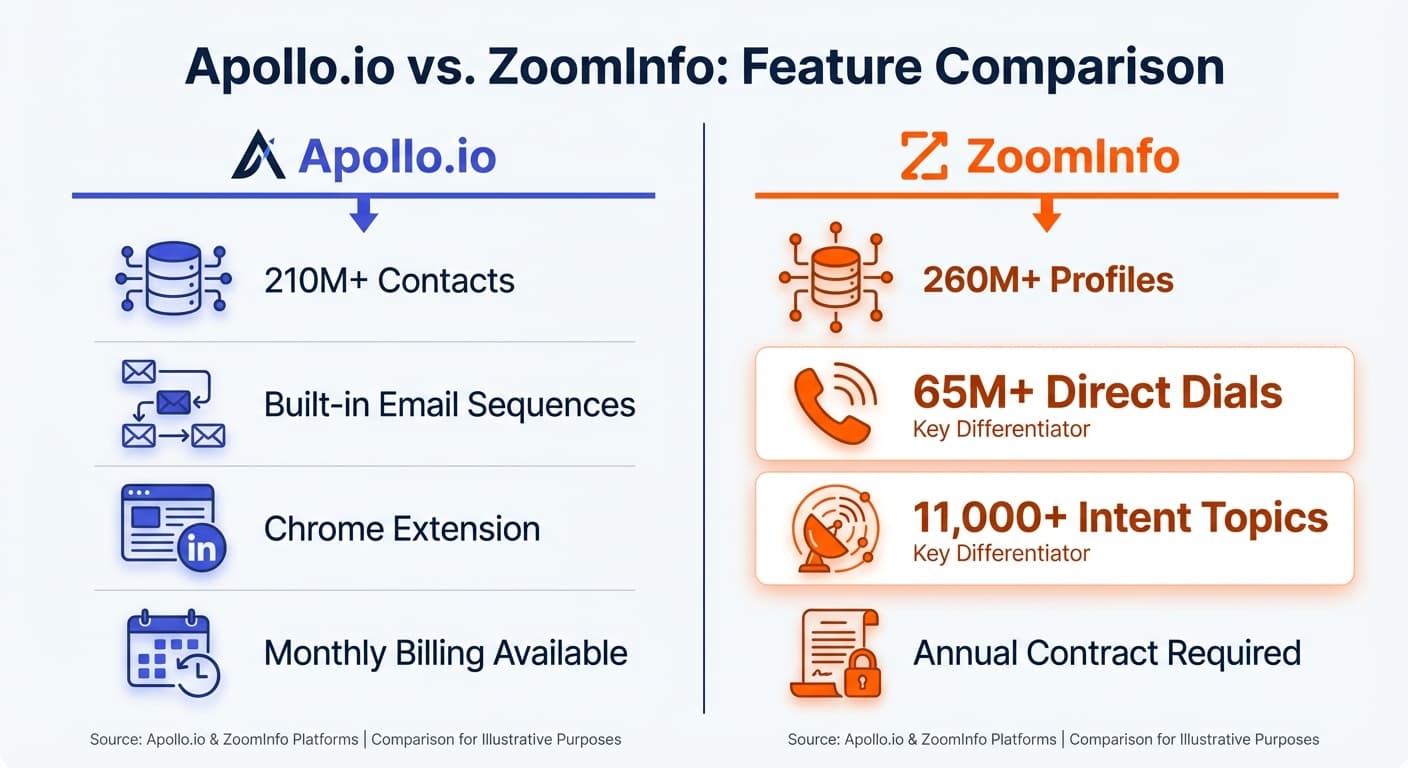
If you're a startup, small team, or individual sales rep looking for affordable access to B2B data with built-in outreach tools, Apollo.io offers strong value. The free tier provides meaningful functionality, and paid plans remain accessible at $49-$119/month.
If you're an enterprise organization requiring the largest possible database, intent data across thousands of topics, and advanced technographic insights, ZoomInfo delivers more comprehensive data coverage. The tradeoff is significantly higher pricing starting around $14,995/year with annual contract requirements.
Understanding the Core Difference
Apollo.io and ZoomInfo both provide B2B contact and company data. The fundamental difference lies in their market positioning.
Apollo.io positions itself as an all-in-one sales platform. The database is substantial (240M+ contacts, 30M+ companies), and the platform includes native email sequencing, engagement tracking, and outreach automation. The pricing structure makes it accessible to individuals and small teams.
Apollo.io's outreach strengths also show up in a cross-category look at how it complements technographic tools, detailed in the Apollo versus Datanyze comparison.
ZoomInfo positions itself as enterprise sales intelligence. The database is larger (260M+ professional profiles, 100M+ companies), and the platform emphasizes advanced data signals including intent data, technographics, and org charts. The pricing reflects enterprise-level contracts.
Database Size and Coverage
Apollo.io Database
- 240M+ contact profiles
- 30M+ company records
- Regular data refresh cycles
- User-contributed data verification
Source: apollo.io
ZoomInfo Database
- 260M+ professional profiles
- 100M+ company records
- 150M+ verified email addresses
- 135M+ phone numbers
- 65M+ direct dial numbers
Source: zoominfo.com
Database Comparison
ZoomInfo has the larger database by the numbers. The difference of approximately 50 million contacts matters at scale when targeting niche industries or specific personas. ZoomInfo also emphasizes phone number coverage, which is valuable for teams running call-heavy outreach.
For most use cases targeting common industries and job titles, both databases provide adequate coverage. The gap becomes more relevant when targeting specialized roles or smaller markets.
Pricing Comparison
Apollo.io Pricing (as published mid-2026)
| Plan | Price | Credits | Seats |
|---|---|---|---|
| Free | Free | 900 credits per seat/year, granted monthly | 1 or more |
| Basic | $49/mo | 30,000 credits per seat/year, granted upfront | 1 or more |
| Professional | $79/mo | 48,000 credits per seat/year, granted upfront | 1 or more |
| Organization | $119/mo | 72,000 credits per seat/year, granted upfront | 3 minimum |
Every paid price above is the per seat per month rate billed annually, and the Organization tier carries a three seat minimum, as published mid-2026.
Source: Apollo.io Pricing
ZoomInfo Pricing (as of January 2026)
| Plan | Annual Price | Credits | Key Features |
|---|---|---|---|
| Lite (Free) | $0 | 10-25/month | Very limited access |
| Professional | ~$14,995/year | Tiered | Core database, basic intent |
| Advanced | ~$24,995/year | Higher limits | Full intent signals, technographics |
| Elite | ~$39,995/year | Highest limits | All features, ZoomInfo Copilot |
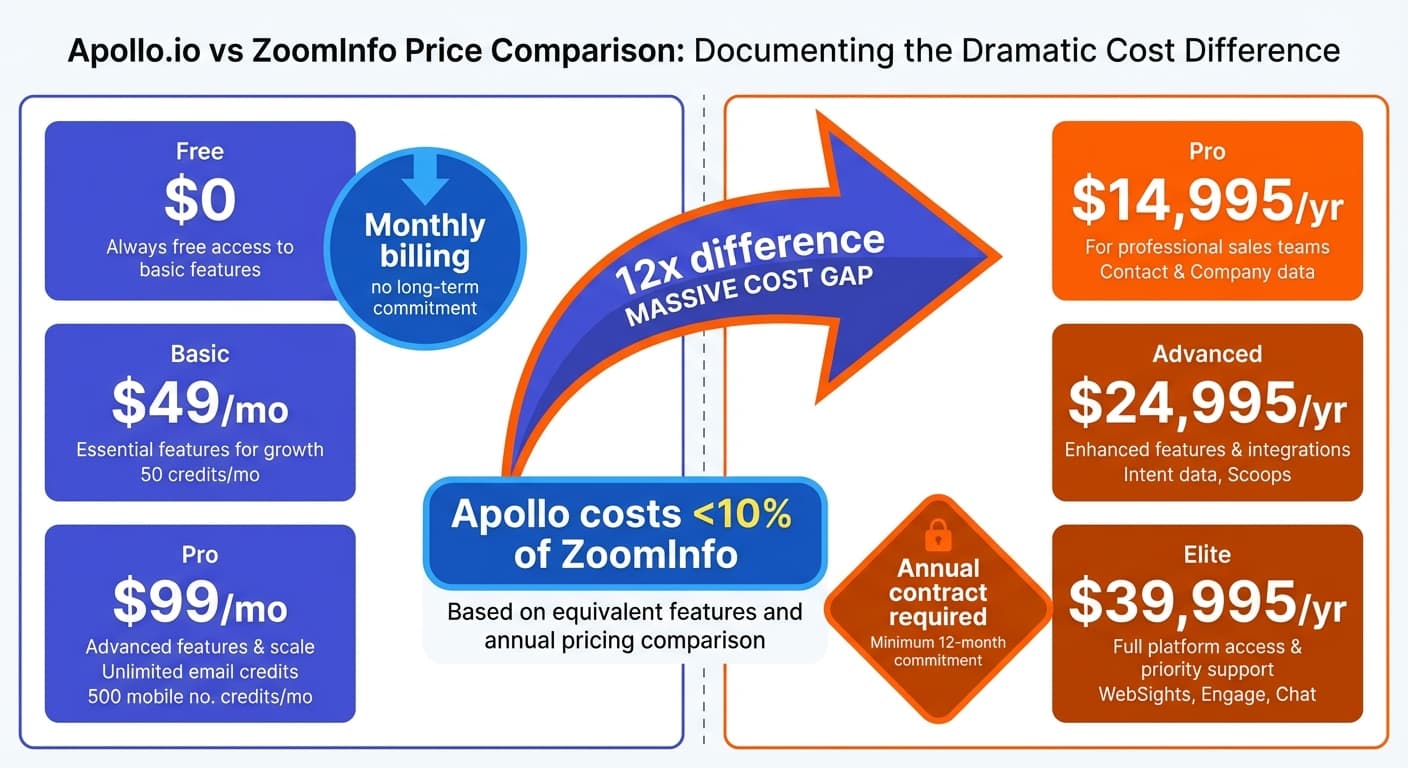
ZoomInfo requires annual contracts on all paid tiers. Per-user pricing often applies, meaning total cost scales with team size. Actual pricing varies based on negotiation and specific requirements.
Source: zoominfo.com/pricing
Pricing Analysis
The pricing gap between these platforms is significant:
For budget-conscious teams: Apollo's Professional plan at $79/month ($948/year) costs less than 10% of ZoomInfo's entry-level paid tier.
For enterprise organizations: ZoomInfo's higher pricing includes more advanced data signals and larger support infrastructure. Organizations processing high volumes of leads may find value in the additional capabilities.
For testing and small projects: Apollo's free tier (900 credits per seat per year) provides meaningful access. ZoomInfo's free tier (10-25 credits/month) is essentially a trial.
Data Enrichment Features
Apollo.io Enrichment
- Contact enrichment (email, title, company info)
- Company enrichment (firmographics, employee count, revenue)
- Form enrichment for lead capture
- CRM data cleansing and deduplication
- Visitor identification for website traffic
- Real-time enrichment API
ZoomInfo Enrichment
- Contact enrichment with verified phone numbers
- Company enrichment with detailed firmographics
- Technographic data (technology stack insights)
- Intent signals covering 11,000+ topics
- Org chart mapping
- ZoomInfo Copilot for AI-powered recommendations
Enrichment Comparison
Both platforms handle standard enrichment (filling in contact and company details). The differences emerge in advanced data signals:
Technographics: ZoomInfo provides detailed technology stack data, showing which tools and platforms companies use. This is valuable for targeting accounts based on their current tech infrastructure. Apollo offers more limited technographic information.
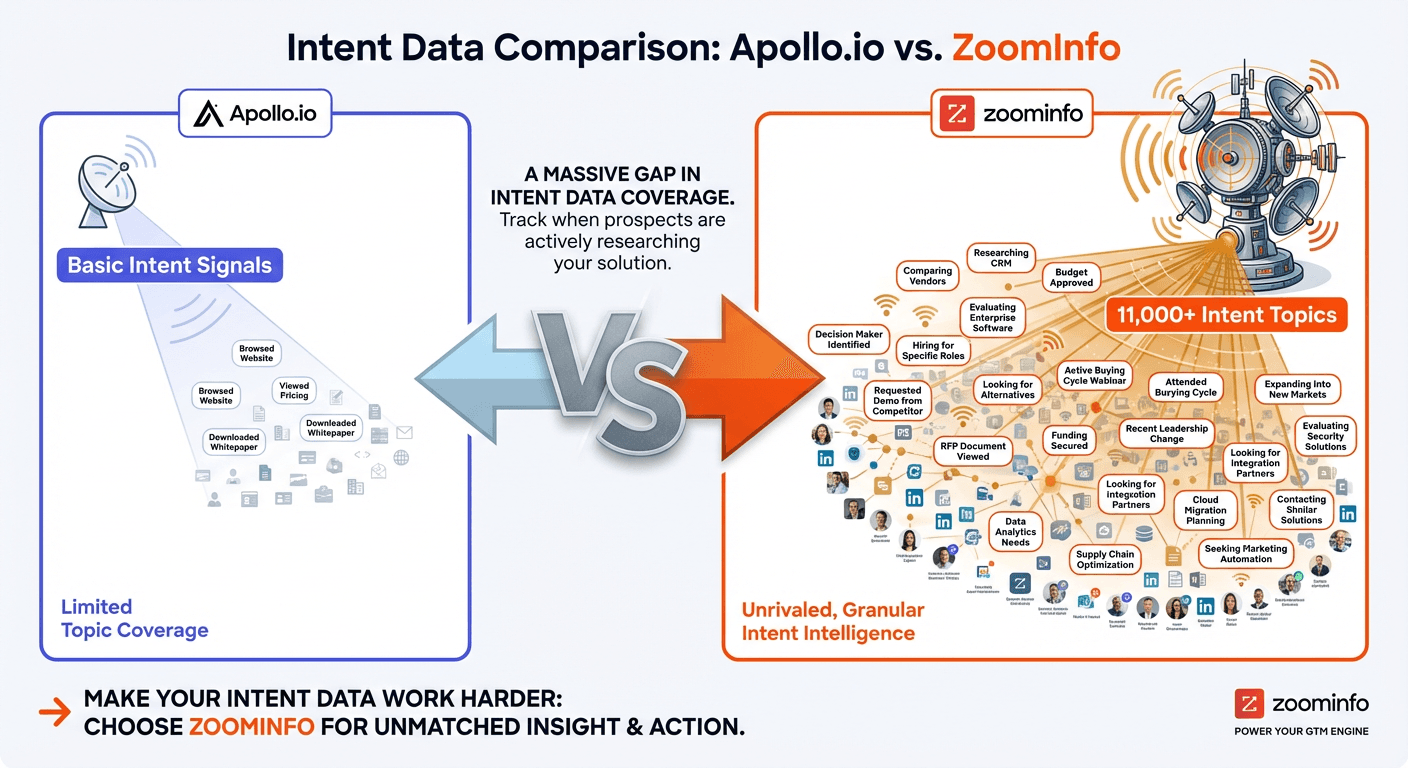
Intent Data: ZoomInfo's intent signals track buying behavior across 11,000+ topics, helping identify accounts actively researching relevant solutions. Apollo has some intent functionality but with less depth.
Visitor Identification: Apollo includes website visitor identification to reveal anonymous traffic. This feature is available on Apollo plans without requiring a separate tool.
Sales Engagement Features
Apollo.io Engagement
Apollo includes native outreach tools:
- Email sequences with automated follow-ups
- A/B testing for email campaigns
- AI-powered campaign creation
- Email deliverability guardrails
- Call logging and recording
- Task management
This positions Apollo as a combined data plus engagement platform, reducing the need for separate outreach tools.
ZoomInfo Engagement
ZoomInfo offers:
- GTM Studio for workflow building
- ZoomInfo Copilot AI assistant
- Integrations with major engagement platforms
ZoomInfo integrates with dedicated engagement tools (Outreach, SalesLoft) rather than trying to replace them. This approach works well for teams already using those platforms.
Sales teams weighing a dedicated CRM against a separate engagement layer can review the Close versus Groove workflow comparison to see how pipeline tracking and multi-channel outreach tools complement each other.
Engagement Comparison
For teams wanting an all-in-one solution, Apollo's built-in engagement tools eliminate tool switching and reduce total software costs.
For enterprise teams with established sales tech stacks, ZoomInfo's integration approach maintains existing workflows while adding data intelligence.
Integrations
Apollo.io Integrations
- CRMs: Salesforce, HubSpot
- Engagement: Outreach, SalesLoft
- Marketing: Marketo, SendGrid
- Social: LinkedIn (Chrome extension)
- API access for custom integrations
ZoomInfo Integrations
- CRMs: Salesforce, HubSpot, Microsoft Dynamics 365
- Engagement: Outreach, SalesLoft
- Marketing: Marketo
- API access for custom integrations
Integration Comparison
Both platforms cover major CRM and engagement integrations. ZoomInfo's Microsoft Dynamics 365 support is notable for organizations in that ecosystem. Apollo's Chrome extension for LinkedIn prospecting is a useful addition for individual prospecting workflows.
Use Case Recommendations
Best Fit for Apollo.io
- Startups and SMBs: Affordable pricing makes quality data accessible to smaller organizations
- Solo sales reps: Free tier and Chrome extension support individual prospecting
- Teams wanting all-in-one: Built-in engagement reduces tool count and cost
- Budget-conscious organizations: 90%+ cost savings compared to ZoomInfo
- Flexible needs: Monthly billing without long-term commitments
Best Fit for ZoomInfo
- Enterprise sales organizations: Comprehensive data and support infrastructure
- Intent-driven selling: 11,000+ intent topics for identifying in-market accounts
- Phone-heavy outreach: Extensive direct dial coverage (65M+ numbers)
- Tech-focused targeting: Detailed technographic data for selling to specific stacks
- Established sales tech stacks: Works alongside Outreach, SalesLoft, and similar tools
Data Quality Considerations
Data quality in B2B databases is inherently imperfect. Both platforms deal with data decay as professionals change roles and companies.
Apollo.io uses a combination of automated data collection and user-contributed verification. Users can report incorrect data, which helps maintain accuracy. The lower price point means more organizations use Apollo, potentially increasing data validation through volume.
ZoomInfo invests heavily in data verification processes and employs dedicated research teams. The higher price point is partially justified by these data quality investments. However, no database achieves perfect accuracy.
Practical recommendation: Regardless of platform choice, build verification into your workflow. Email verification tools, bounced email monitoring, and regular list cleaning remain necessary.
Beyond database accuracy, deliverability depends on separate tooling, a distinction explored in this campaign execution versus inbox warmup comparison.
Feature Comparison Summary
| Feature | Apollo.io | ZoomInfo |
|---|---|---|
| Contact database size | 240M+ | 260M+ |
| Company records | 30M+ | 100M+ |
| Direct dial coverage | Limited | 65M+ |
| Free tier | 900 credits/seat/year, granted monthly | 10-25 credits/month |
| Entry paid tier | $49/month | ~$14,995/year |
| Intent data | Basic | 11,000+ topics |
| Technographics | Limited | Comprehensive |
| Built-in engagement | Yes | No (integrations) |
| Contract requirements | Monthly available | Annual required |
Getting Started Recommendations
If Choosing Apollo.io
Week 1: Setup
- Create free account and connect Chrome extension
- Integrate with your CRM
- Build initial prospect lists using filters
- Verify data quality on a sample before bulk export
Week 2-3: Optimize
- Set up your sending schedule and message templates within Apollo
- Configure engagement tracking
- Test deliverability on small batches
- Refine search filters based on results
If Choosing ZoomInfo
Pre-purchase: Evaluation
- Request demo and trial access
- Test data coverage in your target market
- Evaluate intent signal relevance
- Compare pricing against alternatives
Post-purchase: Implementation
- Work with implementation team on CRM integration
- Set up intent alerts for target topics
- Train team on platform features
- Establish workflows with existing engagement tools
Final Thoughts
Apollo.io and ZoomInfo serve different segments of the B2B data market.
Choose Apollo.io for: Accessible pricing, built-in engagement, flexible contracts, and strong coverage for most use cases
Choose ZoomInfo for: Maximum database size, advanced intent signals, comprehensive phone coverage, and enterprise-grade support
For many organizations, starting with Apollo.io makes sense. The low cost of entry allows testing data quality in your specific market before committing significant budget. Organizations that outgrow Apollo's capabilities or require ZoomInfo's advanced signals can evaluate the upgrade when needs justify the investment.
Because Apollo.io often works alongside a CRM rather than replacing one, teams can explore the Apollo and HubSpot CRM comparison to see how enrichment and pipeline management fit together.
The platform you choose matters less than how you use the data. Accurate targeting, relevant messaging, and persistent follow-up drive results regardless of data source.
Related Reading
- ZoomInfo vs Clearbit: Enterprise Sales Intelligence vs Marketing Data Enrichment
- Apollo.io vs Lusha: Which B2B Data Enrichment Platform Fits Your Sales Stack?
- Apollo.io vs ZoomInfo: Cross-Category Comparison
If you would rather have this run for you, RevenueFlow books qualified meetings on a pay-per-meeting basis and publishes client results.
Pricing and features verified as of January 2026. Visit official websites for current information.
Frequently asked questions.
Frequently asked questions- Is Apollo.io cheaper than ZoomInfo?
- Yes, Apollo.io is significantly cheaper. Apollo's paid plans range from $49 to $119 per month, and its Professional plan at $79/month costs less than 10% of ZoomInfo's entry-level paid tier. ZoomInfo's pricing starts around $14,995/year and requires annual contracts, making it far more expensive overall, especially for small teams.
- Which platform has the bigger database, Apollo.io or ZoomInfo?
- ZoomInfo has the larger database, with 260M+ professional profiles and 100M+ company records compared to Apollo.io's 240M+ contacts and 30M+ companies. The roughly 50 million contact gap matters most when targeting niche industries or specific personas; for common industries, both provide adequate coverage.
- Does Apollo.io have a free plan?
- Yes, Apollo.io offers a free tier that provides 900 credits per seat per year, granted monthly, which the article describes as meaningful functionality. ZoomInfo also has a free Lite tier, but it only offers 10-25 credits per month, making it essentially a trial rather than a usable plan.
- Which platform is better for enterprise sales intelligence, intent data, and technographics?
- ZoomInfo is positioned for enterprise sales intelligence and offers more advanced data signals, including intent data covering 11,000+ topics, detailed technographic data on company tech stacks, org chart mapping, and ZoomInfo Copilot for AI-powered recommendations. Apollo.io offers more limited technographic information by comparison.
- Does ZoomInfo require an annual contract?
- Yes, ZoomInfo requires annual contracts on all of its paid tiers, and per-user pricing often applies so total cost scales with team size. Actual pricing varies based on negotiation and specific requirements, with published tiers ranging from about $14,995/year to $39,995/year.
About the author.

Tim Carden is CMO / CTO at RevenueFlow, which builds and operates outbound revenue engines for B2B companies. Studied at McGill University.
Tim Carden · CMO / CTO
Connect on LinkedIn →Explore more.
Ready to scale your outreach?
We build GTM engines that book real meetings. See the receipts.
Related articles.
Cognism vs Upcell: A Data Provider Against a Data Layer
Cognism sells compliance-first contact data by quote and credit; Upcell sells a layer that runs your providers, Cognism included, through one record. Read 18 Sep 2026.
PromptLoop vs ZoomInfo: Web Research Against a Database
PromptLoop builds a dataset from the live web in credits it publishes; ZoomInfo sells access to a maintained database by quote. Both pages read 18 September 2026.
Apollo.io vs Proofy: Data Enrichment Tool Comparison
Compare Apollo.io and Proofy side by side. See pricing, features, and integrations to choose the right data enrichment tool for your needs.
Best PhantomBuster Alternatives in 2026
Looking for alternatives to PhantomBuster? Compare the top data enrichment tools by pricing, features, and integrations.
Apollo.io vs Bouncer: Data Enrichment Tool Comparison
Compare Apollo.io and Bouncer side by side. See pricing, features, and integrations to choose the right data enrichment tool for your needs.
AiSDR vs Apollo.io: Sales Engagement Platform Comparison
Compare AiSDR and Apollo.io side by side. See pricing, features, and integrations to choose the right sales engagement platform for your needs.