Cognism vs Upcell: A Data Provider Against a Data Layer
Cognism sells compliance-first contact data by quote and credit; Upcell sells a layer that runs your providers, Cognism included, through one record. Read 18 Sep 2026.
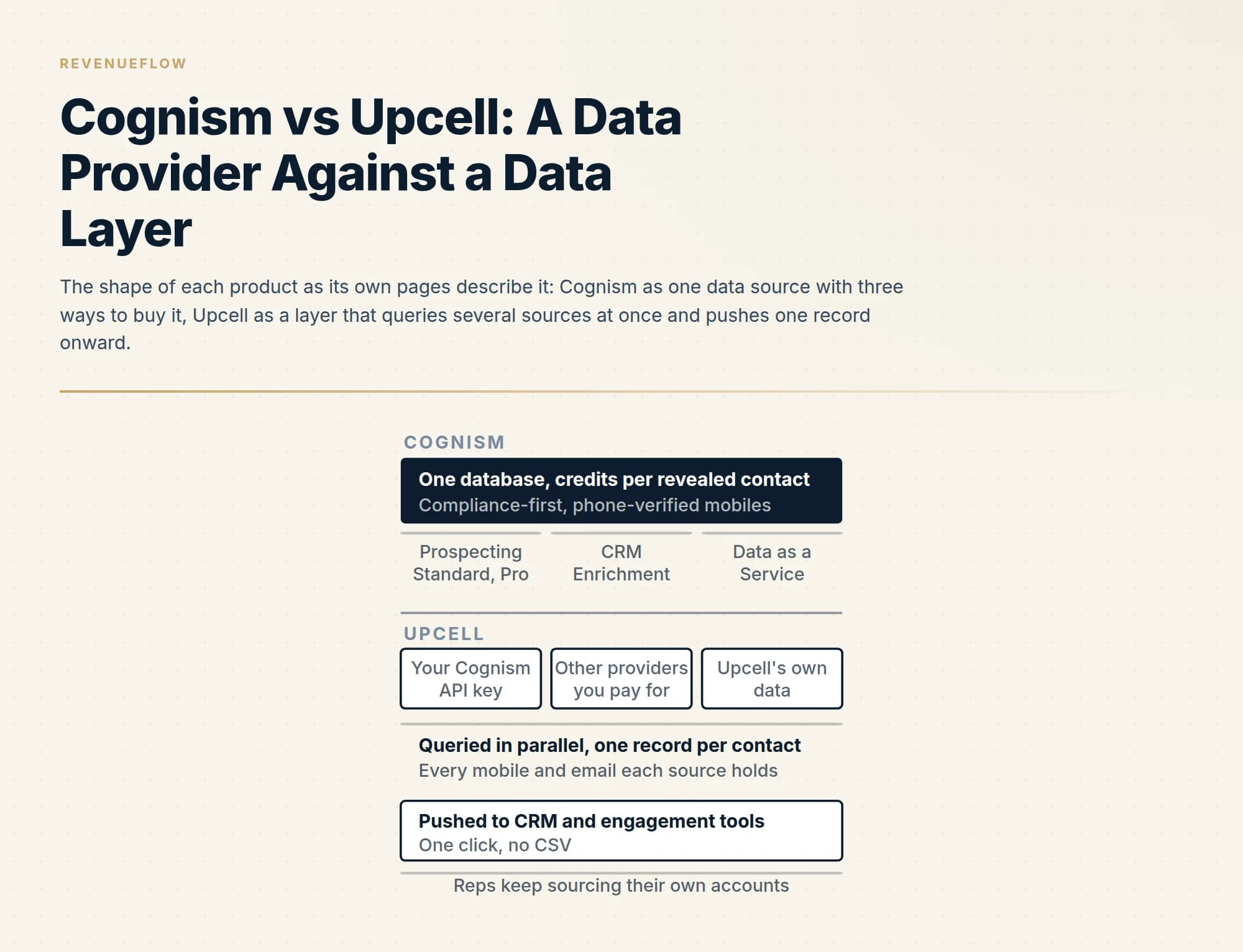
Cognism is a compliance-first data provider sold in Standard and Pro prospecting packages with five seats included, one credit per revealed contact, CRM Enrichment and Data-as-a-Service as add-ons and no published rate. Upcell is a rep-facing layer that connects the providers a team already pays for by API key, queries them in parallel and pushes one record to the CRM.
Key takeaways
- Cognism's pricing page on 18 September 2026 publishes Standard and Pro packages with five seats each, a credit rule of one credit per revealed contact with free re-use until a job change, and a line that API access requires a Prospecting seat; no rate appears.
- Upcell's home page describes one prospecting platform for every data source a team uses, with bring-your-own-key for providers such as Cognism, ZoomInfo or Lusha, parallel querying into one record, and a push to CRM and engagement tools.
- Upcell's pricing link renders its home page with a savings calculator and a Request access button; the figure in the calculator is an editable input, not a price.
- Upcell is not UpLead: the live Cognism against UpLead comparison covers a different vendor with a published credit ladder.
Reviewed and updated September 18, 2026
Upcell's home page, read on 18 September 2026, describes the product in one sentence: it brings every data source your team uses into a single prospecting platform, so all your contact data lives in one place and you stop paying for a pile of overlapping tech. Cognism's pricing page, read the same day, describes the opposite kind of product: a data provider that sells Standard and Pro prospecting packages with five seats included, meters them in credits where one credit is one revealed contact, and prices the whole thing by quote.
That is the comparison. One vendor sells data. The other sells a place to put several vendors' data, including, by its own account, Cognism's. A reader typing this pair is usually deciding whether to renew a single provider or to put a layer in front of it, and the two products answer different questions in that decision.
A note on names before anything else. Upcell is not UpLead. The live Cognism against UpLead comparison covers a different vendor with a published credit ladder, and the search results for this pair mix the two. Everything below is about upcell.io.
What each vendor says it is
Cognism's pricing page splits its offer into three products: Sales prospecting, CRM Enrichment and Data-as-a-Service. Sales prospecting comes in Standard, for teams that need core prospecting workflows, and Pro, for teams that need advanced prospecting workflows, each with five seats included. The page's feature table gives both tiers company revenue, headcount and headquarters, emails, mobiles, job titles and work history, technology usage, hiring, funding, M&A and job-change signals, AI company research, an AI persona builder, AI search, CSV enrichment and SSO. Three rows separate them, marked for Pro only: a premium mobile filter, mobile verification on demand, and intent data. CRM enrichment and API access are add-ons on both tiers.
The page also publishes the credit rule in full: one credit equals one revealed contact, there is no charge for viewing previously revealed contacts, the same credits work across the prospecting platform, Enrich and the API without extra cost, and a credit is used again only if that contact changes jobs. And it publishes one constraint that shapes the Upcell comparison directly: API access requires a Prospecting seat, while bulk delivery is available standalone.
Upcell's home page describes a rep-facing platform rather than a database. The problem it names is that every provider means another extension, another login, another invoice, and, in the page's own estimate, that teams end up running four or five of them to cover one pipeline. The fix it names is one platform instead of ten: connect the providers you already use, and Upcell brings every insight into one login, one workflow and one click. Its data section says it pulls every mobile and email your connected providers have on a contact into one record, then pushes it straight to your CRM and engagement tools. Its comparison page about Cognism adds the mechanism: bring-your-own-key, plugging in the providers you already pay for, named as your Cognism, ZoomInfo or Lusha API, alongside Upcell's own data, and querying providers in parallel rather than stopping at the first hit.
Pricing, as published on 18 September 2026
Neither vendor publishes a rate, and the two absences are different shapes.
Cognism's pricing page carries no monthly, per-seat or starting-from figure. Its FAQ says pricing is tailored based on the product you need, your team setup and how you plan to use the platform, that Sales Prospecting is offered in Standard and Pro packages, and that CRM Enrichment and Data-as-a-Service are priced on subscription structure, usage and delivery requirements. Every call to action is Talk to sales or Talk to an expert. What is published is the structure: two packages with five seats included, credits allocated per seat, additional credits purchasable at any point, and a Data-as-a-Service line priced on volume and delivery method. The Cognism price guide reads that structure in full.
Upcell's pricing link resolves, on the fetch made this day, to the same page as its home: a savings calculator inviting you to plug in the tools in your stack, the average cost per tool per seat and your seat count, a Request access button, and no rate card. The comparison page's phrasing, that you stop paying per seat to access your providers and equip the whole team instead, describes a pricing posture rather than a price. A vendor page that states no figure is a fact about that page on that day, and the honest reading is that both quotes arrive in a conversation.
The one figure a reader will meet elsewhere is worth naming so it can be ignored: the number in Upcell's savings calculator is an illustrative input the visitor can change, not a published price for anything.
Cognism: structure, no rate
- Standard and Pro prospecting packages, five seats each
- Credits per seat; one credit per revealed contact
- Re-use of a revealed contact is free until a job change
- CRM Enrichment and Data-as-a-Service as add-ons
- API access requires a Prospecting seat
Upcell: posture, no rate
- A pricing link that renders the home page
- A savings calculator with editable inputs
- Request access as the route in
- Bring-your-own-key for providers you already pay for
- A stated aim of not paying per seat for provider access
The compliance and coverage claims, and who can test them
Cognism's own pages make claims a buyer can check, and the Cognism review sorts them into testable and not. The compliance page states that Cognism processes data under legitimate interest and screens against do-not-call lists, and the pricing page's Pro tier sells phone-verified mobiles and on-demand verification. Those are properties of the data, and a sample against your own accounts tests them.
Upcell's comparison page about Cognism is candid in a way that is unusual for a rival. It says that Cognism earned its reputation on compliant, phone-verified European data, that the regional labels vendors attach to their data are positioning rather than measured properties, and that no public independent benchmark it is aware of shows any one provider's data out-performing another's on a buyer's own accounts. Its own answer is that the buyer should measure, and that measuring is what the platform is for: showing the data from every provider side by side on your own accounts and helping you see which ones net results. That is Upcell's claim about Upcell, and it is the claim a trial of the layer would test.
What Upcell does not claim is to be a data source in Cognism's sense. Its page describes its own data as running alongside the providers you bring, and it describes the biggest databases as never sold inside a shared waterfall, which is why bringing your own key is, in its words, the only way to combine premium data with everything else in one place. Read together with Cognism's own line that API access requires a Prospecting seat, that produces the practical constraint of the pair: routing Cognism through Upcell still needs at least one Cognism prospecting seat, on Cognism's own terms, whatever Upcell's seat posture is.
| Vendor claim about itself | Page | How a buyer tests it |
|---|---|---|
| Phone-verified mobiles and on-demand verification on Pro | Cognism pricing | Dial a sample of Pro mobiles in your territory and count connects |
| A revealed contact stays usable without a second credit until a job change | Cognism pricing | Re-open revealed records across a quarter and watch the credit balance |
| Every connected provider queried in parallel into one record | Upcell compare page | Load one account list with two keys connected and count fields per contact |
| Side-by-side visibility of which provider nets results | Upcell compare page | Run a list for a month and read the per-provider tally against replies |
| Contacts pushed to CRM and engagement tools in one click | Upcell home | Push twenty records and read them in the CRM row by row |
The decision underneath the comparison
Upcell's own page frames the choice as a fork in how a team prospects, and the framing is useful even for a team that buys neither product. Rep-driven, bottoms-up prospecting means each rep works a named book and picks the person to reach; top-down, ops-driven prospecting means a central function builds and enriches lists programmatically and hands them down. Upcell places itself, Cognism, ZoomInfo, Apollo and most single-source providers in the first camp, and Clay and the list-building tools in the second.
That sorting matters because the two products in this comparison are in the same camp. Cognism sells the data a rep-driven team draws on; Upcell sells the surface a rep-driven team draws it through. A team that has decided to go top-down has a different shortlist, worked through in the account-based platforms comparison and in the waterfall guides, and neither of these two is its answer.
For a rep-driven team the question reduces to one of coverage. If a single provider covers your accounts, the layer is overhead. If it does not, the vendor's own compare page names the three ways teams usually respond, switching providers, stacking a second one, or moving top-down, and argues for a fourth, which is its product. The argument is coherent and it is still the vendor's. The test is the one both vendors point at: your own accounts, counted.
| Row | Cognism | Upcell |
|---|---|---|
| Is itself a source of contact records | Yes | Partial |
| Combines several providers into one record | No | Yes |
| Phone-verified mobiles as a product line | Yes | No |
| Compliance page and do-not-call screening | Yes | No |
| Bring-your-own provider keys | No | Yes |
| Pushes records to CRM and engagement tools | Yes | Yes |
| Publishes a rate | No | No |
The partial in Upcell's first row reflects its own wording: it names its own data alongside the providers you bring rather than as the reason to buy.
Where either one sits in an outbound stack
Neither product sends anything. Cognism's pricing page ends at reveal, enrich and export; Upcell's ends at push to CRM and engagement tools. Everything that decides whether a campaign works starts after that handoff, and it is the same list whichever vendor supplied the record: an offer worth reading, sending infrastructure separate from the corporate domain, and one message per campaign.
Our own practice is worth stating because it changes which claims matter. We run email and LinkedIn rather than phone, so Cognism's phone-verified premium, the thing its Pro tier is built around, would sit idle on our stack, and the coverage question we would put to either vendor is about verified email on a named list. We verify every address immediately before it enters a campaign whatever source it came from, which is the last column in any table that ends in a send, and we send one message per campaign with no bumps and no thread replies, so a wrong record is a lost prospect rather than a retry. The wider field of European data vendors sits in the Cognism alternatives.
The short version
Cognism is a compliance-first data provider sold in Standard and Pro prospecting packages with five seats included, metered at one credit per revealed contact, with CRM Enrichment and Data-as-a-Service as add-ons, no published rate, and API access gated on a prospecting seat, all as published on 18 September 2026. Upcell is a rep-facing prospecting layer that connects the providers a team already pays for by API key, queries them in parallel into one record and pushes it to the CRM, with a pricing link that renders its home page and no published rate.
They are not substitutes. A team asking whether to renew a single provider is asking Cognism's question; a team asking why it pays for four is asking Upcell's. The test both vendors point at is the same: your own accounts, run through the data, counted.
If the data is the easy part and the campaign behind it is the gap, RevenueFlow builds and sends the first campaign against your market on a pay-per-meeting basis, with the qualification criteria agreed in writing before launch.
Package contents, the credit rule, the add-on structure, the API seat constraint and the pricing FAQ are per Cognism's pricing page; compliance statements per Cognism's compliance page; Upcell's product description, bring-your-own-key mechanism, parallel querying and pricing posture per upcell.io's home, pricing and Cognism comparison pages. All fetched 18 September 2026. Upcell's statements about Cognism are reported as a rival's claims. Verify current terms with both vendors before relying on them.
Sources: Cognism pricing, Cognism compliance, upcell, upcell pricing, Cognism alternatives, upcell.io
Frequently asked questions.
Frequently asked questions- Is Upcell a replacement for Cognism?
- Not by either vendor's description on 18 September 2026. Cognism's pricing page sells contact data in Standard and Pro packages metered per revealed contact. Upcell's home and comparison pages describe a layer that connects the providers you already pay for by API key, names Cognism among them, queries them in parallel and pushes one record to your CRM. A team can run Cognism through Upcell, and Cognism's own page says API access requires a Prospecting seat.
- How much do Cognism and Upcell cost?
- Neither publishes a rate as read on 18 September 2026. Cognism's FAQ says pricing is tailored to the product, team setup and usage, with Standard and Pro packages at five seats each and credits allocated per seat. Upcell's pricing link renders the same page as its home, with a savings calculator whose figures are editable inputs and a Request access button. Both quotes arrive in a conversation.
- What does Cognism sell that Upcell does not?
- Data of its own, with the properties its pages describe: phone-verified mobiles and on-demand mobile verification on the Pro package, intent data on Pro, a compliance page describing legitimate-interest processing and do-not-call screening, and CRM Enrichment and Data-as-a-Service as separate products. Upcell describes its own data as running alongside the providers you bring rather than as the reason to buy.
- What does Upcell sell that Cognism does not?
- A single record assembled from several providers. Upcell's pages describe connecting the providers you already pay for by API key, querying them in parallel rather than stopping at the first hit, showing each provider's data side by side on your own accounts, and pushing the result to CRM and engagement tools in one click. Cognism's pricing page describes one database with three ways to buy it and no multi-provider layer.
About the author.

Tim Carden is CMO / CTO at RevenueFlow, which builds and operates outbound revenue engines for B2B companies. Studied at McGill University.
Tim Carden · CMO / CTO
Connect on LinkedIn →Explore more.
Ready to scale your outreach?
We build GTM engines that book real meetings. See the receipts.
Related articles.
PromptLoop vs ZoomInfo: Web Research Against a Database
PromptLoop builds a dataset from the live web in credits it publishes; ZoomInfo sells access to a maintained database by quote. Both pages read 18 September 2026.
Zoom Revenue Accelerator vs Gong: An Add-On vs a Platform
Zoom's support centre documents Revenue Accelerator as a licence on a Zoom account in two classes; Gong sells a platform per user plus a platform fee. Neither has a rate.
Chili Piper vs LeanData: Form-First Against CRM-First
Chili Piper publishes a seat floor and bundles scheduling and chat; LeanData prices by Salesforce object and sells scheduling separately. Both read 18 September 2026.
Metadata vs 6sense: Paid Media Execution vs Intent
Metadata runs paid B2B campaigns through seven AI agents; 6sense ranks accounts on intent and sells contact data by credit. Neither publishes a rate. Read 18 Sep 2026.
Mailshake vs Pipedrive: A Sender and a CRM, Side by Side
Mailshake sells per-user sending with a two-way Pipedrive sync from its middle tier; Pipedrive is a per-seat CRM with sequences from Growth. Both read 18 September 2026.
Apollo.io vs Proofy: Data Enrichment Tool Comparison
Compare Apollo.io and Proofy side by side. See pricing, features, and integrations to choose the right data enrichment tool for your needs.