Chili Piper vs LeanData: Form-First Against CRM-First
Chili Piper publishes a seat floor and bundles scheduling and chat; LeanData prices by Salesforce object and sells scheduling separately. Both read 18 September 2026.
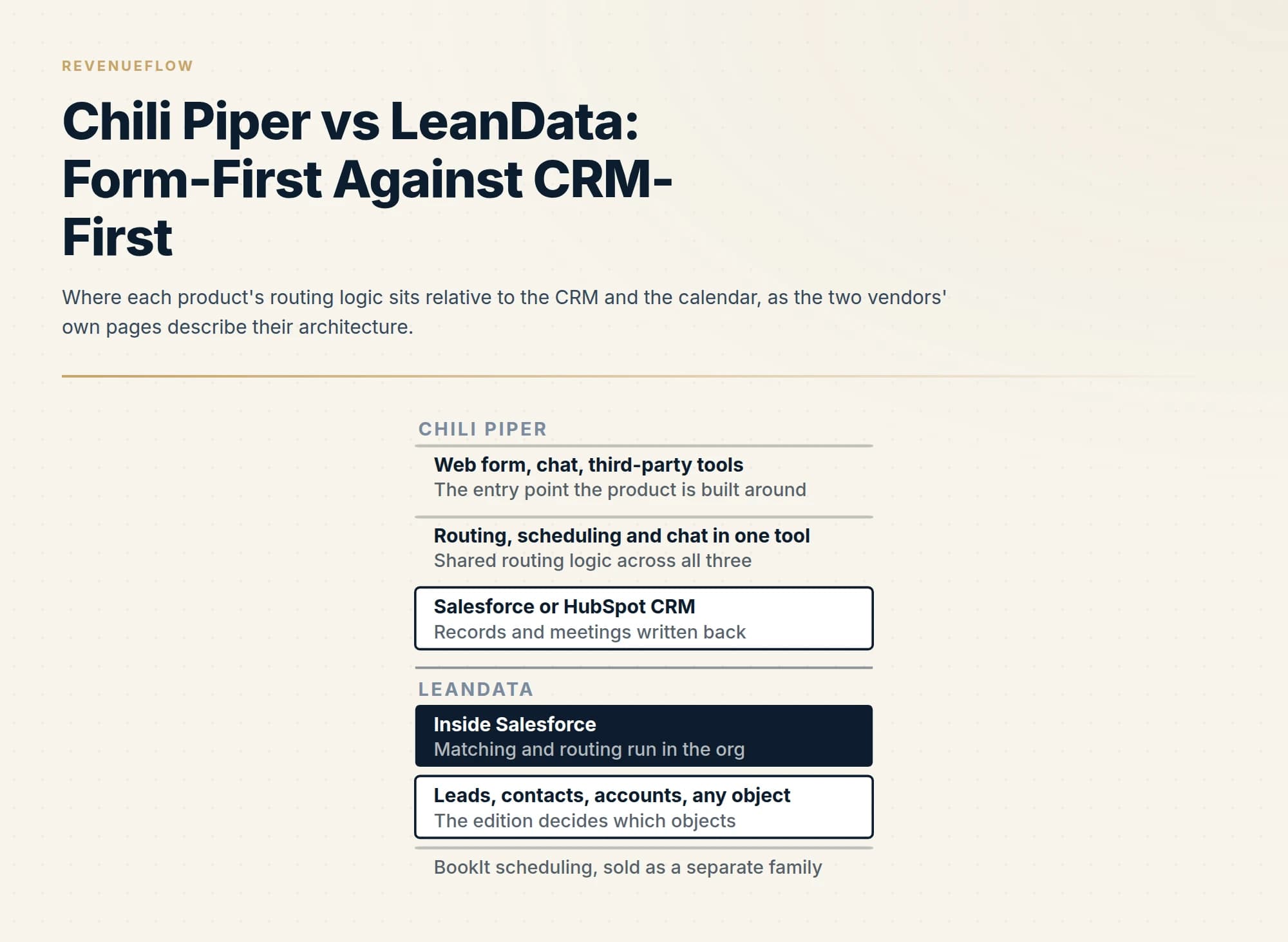
Chili Piper's pricing page publishes a platform fee with a seat allowance, bundles routing, scheduling and chat in every seat and lists HubSpot beside Salesforce. LeanData publishes three orchestration editions priced on features, objects and Salesforce users or queues, no rate, scheduling as a separate BookIt family and buying groups as an add-on. Pick by the door your problem enters.
Key takeaways
- As published on 18 September 2026, Chili Piper's Routing and Scheduling tier starts at 1,250 dollars a month with 15 seats included and 45 dollars per seat after that, 15,000 dollars a year on the page's own table; Experiences starts at 3,500 a month with 30 seats.
- LeanData's pricing and packaging page carries no currency figure; its FAQ prices packages on features, objects and the number of Salesforce users or queues, and states that setup and onboarding are billed separately for all packages.
- Scheduling is inside every Chili Piper seat, and its calendar is also sold standalone at 12 dollars per user per month with a 200-seat minimum; LeanData sells scheduling as the BookIt family, available standalone per its FAQ.
- Each vendor's comparison page about the other is positioning: claims a vendor makes about itself are reported and dated, claims about the rival are never adopted as fact.
Reviewed and updated September 18, 2026
Chili Piper's pricing page carries its floor in the browser tab: plans starting at fifteen thousand dollars a year, as served on 18 September 2026. LeanData's pricing and packaging page, fetched the same day, carries three editions, a scheduling family, a buying-group add-on and no currency figure anywhere on it. That asymmetry is the first thing to understand about this pair, and it is a fact about disclosure rather than about cost.
The second thing is that the two products enter the same deal from opposite doors. Chili Piper's own comparison page calls it the only tool that consolidates Routing, Scheduling and Chat, and its pricing page names the top tier Routing and Scheduling. LeanData's pricing page calls its product an Intelligent GTM Orchestration Platform, prices it by edition on which Salesforce objects it routes, and sells scheduling as a separate family called BookIt. One starts from the inbound form and works backward into the CRM; the other starts inside the CRM and works outward to the calendar.
Everything below comes from the two vendors' own pages. Where either vendor's comparison page makes a claim about the other, that claim is reported as the rival's and never as a fact. The live Chili Piper pricing and LeanData pricing guides carry each ladder in more depth; this page puts them side by side.
What each vendor says it is
Chili Piper's pricing page lists two priced tiers and one unpriced. Routing and Scheduling is described as turning inbound traffic into booked meetings from web form to calendar, and its published contents are instant qualification, routing and scheduling from any web form, automated chat journeys, inbound lead distribution and round-robin assignment, routing and assignment of any Salesforce object, SDR-to-AE handoff, funnel analytics, smart scheduling links for every rep, SSO and SAML, spam checker and meeting prep agents, and re-engagement flows for visitors who did not convert. Experiences adds agent-powered web experiences, live calling from forms and handoffs, account identification and ABM targeting in chat, and admin controls. A third tier, Chili Data Platform, is listed as coming soon.
LeanData's page describes three orchestration editions. Standard is for organisations building a foundation and accelerating speed to lead: intelligent lead-to-account matching, basic routing and assignment rules covering round robin, territory and account-based, standard deduplication and enrichment, audit logs and routing insights, notifications and managed reports. Advanced adds matching and routing for contacts and accounts, multi-criteria assignment, signal-driven workflow automation, enhanced deduplication, SLA tracking with escalations and dashboards, and integrations with sales engagement, enrichment, intent and gifting tools. Premium adds routing and matching for any standard or custom Salesforce object including opportunities and cases, advanced international and territory matching, scheduled recurring automations, complex cross-object assignment, channel and partner motions, and the AI capabilities.
The word Salesforce is doing a lot of work on LeanData's page and comparatively little on Chili Piper's. Chili Piper's compare table lists both Salesforce CRM and HubSpot CRM under integrations. LeanData's own comparison page states that LeanData lives within Salesforce, so you no longer have to worry about API call limitations or CRM integration issues, which is the vendor's own description of where its logic runs.
The two ladders, as published on 18 September 2026
Chili Piper's ladder is a platform fee with a seat allowance. As published on its pricing page on 18 September 2026, Routing and Scheduling starts at 1,250 dollars a month with up to 15 seats included and 45 dollars per seat per month after that; the page's compare table gives the annual equivalent as 15,000 dollars a year. Experiences starts at 3,500 dollars a month with up to 30 seats included and 50 dollars per seat after that, which the table gives as 42,000 dollars a year. Both carry an annual AI credit allowance, 45,000 on the first tier and 150,000 on the second, described as used for enrichment, agents and AI actions. ChiliCal, the scheduling-link layer included with every seat, is also sold standalone at 12 dollars per user per month with a minimum of 200 seats, no AI credits and no routing. The page's calculator publishes multi-year discounts of 15 percent at two years, 25 at three and 40 at four.
LeanData's page shows no rate, on any edition, on any billing basis, as read the same day. What it publishes instead is the meter. Its FAQ states that package pricing is based on features, objects, and number of Salesforce users or queues, that add-ons such as BookIt and Buying Groups Blueprint are available for additional flexibility, and that BookIt and certain add-ons are available standalone. The same FAQ states that setup and onboarding are tailored and billed separately for all packages.
So a Chili Piper quote can be computed from the page, and a LeanData quote cannot. That is a difference in what a buyer can know before the first call, and it is not evidence that either product is cheaper. The routing rivals sorted by the job they replace page reads the wider field the same way.
Chili Piper publishes
- A monthly floor per tier and its annual equivalent
- Seats included per tier and the rate for each seat above them
- An annual AI credit allowance per tier, unit undefined
- A standalone calendar tier with a seat minimum
- Multi-year discounts on a public calculator
LeanData publishes
- Three editions defined by which objects they route
- A meter: features, objects, Salesforce users or queues
- A scheduling family sold standalone
- A buying-group add-on to the top edition
- Setup and onboarding billed separately on every package
Routing against scheduling: the split both vendors describe
Both vendors sell routing and both sell scheduling. Where they differ is which one is the product and which one is the add-on.
On Chili Piper's page, scheduling is inside every seat. The compare table's scheduling rows include meetings from any web form, from third-party tools, in-app, from email campaigns, before and after events, multi round-robin, weighting and meeting limits, instant phone or video connect from a form, one-click booking, timezone detection, handoff scheduling between teams and live handoff between SDRs and AEs. Its Salesforce routing rows include routing any standard or custom Salesforce object, SLAs, advanced lead-to-account matching described as fuzzy, duplicate matching and merging, weighting and capping, converting leads to contacts and creating records such as accounts, tasks and opportunities.
On LeanData's page, scheduling is a family of three products beside the orchestration editions. BookIt for Forms turns static forms into instant booking experiences with intelligent CRM matching, pooled availability, webform integration, chatbot compatibility, advanced routing logic, smart redirects and conversion tracking. BookIt Handoff schedules the right team member at each stage, with a one-click Salesforce button, smart rep suggestions, instant meet-now booking, multi-host support, round-robin distribution and CRM record context. BookIt Links covers personalised scheduling links with single-use links, dynamic link building, managed links for teams and link analytics. The FAQ's line that BookIt is available standalone means a team can buy LeanData's scheduling without its orchestration, or its orchestration without its scheduling.
The consequence for a buyer is that the same feature word appears on both pages at different positions in the bill. A Chili Piper seat includes the calendar. A LeanData edition may not, and the scheduling line is a separate quote.
| Row | Chili Piper Routing and Scheduling | LeanData orchestration editions |
|---|---|---|
| Inbound form routing | Yes | Yes |
| Round-robin and weighted assignment | Yes | Yes |
| Lead-to-account matching | Yes | Yes |
| Routing any Salesforce object | Yes | Partial |
| Scheduling links for every rep | Yes | Partial |
| Native website chat | Yes | No |
| HubSpot CRM listed as an integration | Yes | No |
| Buying-group orchestration | No | Partial |
| A published rate | Yes | No |
The partial cells are edition or product gates on LeanData's page: any-object routing sits at Premium, scheduling is the BookIt family, and buying groups are an add-on to Premium. The no against HubSpot on LeanData's side is an absence from the fetched pricing and comparison pages, not a claim that no connection exists.
What each vendor says about the other, and what to do with it
Both vendors publish a comparison page about this pair, and both pages are marketing. They are reported here because a buyer will find them, and because the claims are testable.
Chili Piper's page lists thirteen reasons revenue teams choose it over LeanData. The ones that describe Chili Piper itself are the vendor's own claims: routing logic reusable across chat, CRM record routing and scheduling; lead-to-account matching that combines domain-based logic and Salesforce duplicate rules with exact or fuzzy match; automatic skipping of out-of-office reps read from Google or Outlook calendars; multiple flows on one object; form shortening with real-time enrichment from providers such as LeadIQ, Apollo and ZoomInfo. The ones that describe LeanData, such as that routing logic cannot be shared across channels or that BookIt is a paid add-on, are a rival's characterisation and are not adopted here. LeanData's own page confirms only the second: BookIt is sold as a separate family.
LeanData's page about Chili Piper makes the mirror-image move. Its own claims about itself are that it lives within Salesforce, supports any distribution model including round robin, territory, account-based, overlays and explicit users, and provides audit logs, dashboards and implementation services. Its claims about Chili Piper, that matching relies on Salesforce duplicate rules and that Distro limits a decision to two outcomes, are a rival's characterisation. Chili Piper's own page describes its matching as combining domain-based logic and Salesforce duplicate rules, which partly agrees with the first claim and adds the half the rival omits.
The test that settles any of this is the one both vendors would accept: two hundred of your own inbound records, run through each product's matching, with the routing log read afterwards. Lead routing covers what the rule set is deciding, and round-robin assignment covers the distribution method both products default to.
Vendor claims about itself
Usable, dated, and attributable to the page. Chili Piper on its shared routing logic and fuzzy matching; LeanData on running inside Salesforce and on its distribution models.
Vendor claims about the rival
A rival's characterisation. Reported as such, never adopted as fact, and checked against the rival's own page where one exists.
What both pages agree on
Scheduling sits inside every Chili Piper seat and is a separate LeanData product; LeanData's logic runs inside Salesforce; Chili Piper lists HubSpot as well.
Who each one fits
Read from the two pricing pages alone, the fit follows the door each product enters by.
Chili Piper fits a team whose constraint is the minutes between a form submission and a booked slot, whose CRM may be HubSpot rather than Salesforce, and whose team size sits near the fifteen seats the entry tier includes. Its published floor means a five-person team pays the same platform fee as a fifteen-person one, which the live pricing guide works through, and the standalone calendar's 200-seat minimum makes it the enterprise door rather than the cheap one.
LeanData fits a team whose constraint is assignment inside Salesforce across more than leads: contacts and accounts at Advanced, opportunities, cases and custom objects at Premium, with buying groups as an add-on above that. Its meter of users or queues rather than seats alone means an org with many queues can price above a larger team with a tidier setup, and its FAQ's line on separately billed onboarding belongs in the first quote rather than the third.
A team that needs neither should say so. Native CRM assignment rules cover territory and field-based routing, and the four boundaries where dedicated software earns its place, fuzzy matching on a free-text company name, live capacity, rule order and an explainable log, are set out in lead routing software.
Where this sits for an outbound programme
Routing exists to answer inbound. On the outbound side ownership is decided before the campaign, so the records that need a rule are the replies. Our own practice keeps that requirement small: every campaign carries exactly one message, with no bumps and no thread replies, so a reply is a single event with a single owner rather than one turn in a thread whose ownership may already have moved. Much of what either product handles in a multi-step motion is thread state a one-message programme never creates.
If the real problem is that too few companies are willing to take a meeting at all, routing is downstream of it. RevenueFlow books qualified meetings on a pay-per-meeting basis, against criteria agreed in writing before launch, which is the number a routing tool then has something to distribute.
The short version
Chili Piper publishes a platform fee with a seat allowance, includes scheduling and chat in every seat, lists HubSpot beside Salesforce, and starts at fifteen thousand dollars a year for fifteen seats as of 18 September 2026. LeanData publishes three editions priced on features, objects and Salesforce users or queues, no rate, scheduling as a separate family, buying groups as an add-on, and onboarding billed separately.
Pick by the door your problem enters through. A form-to-calendar problem on a mid-sized team is Chili Piper's shape; an object-routing problem inside a large Salesforce org is LeanData's. Treat each vendor's page about the other as positioning, and test matching on your own records before either quote is signed.
Tier contents, seat allowances, rates, credit allowances and the multi-year discount ladder are per Chili Piper's pricing page; edition contents, the BookIt family, the Journeys add-on and the pricing FAQ are per LeanData's pricing and packaging page; architecture and matching claims are per each vendor's own comparison page. All fetched 18 September 2026. Verify current terms with both vendors before relying on them.
Sources: Chili Piper pricing, Chili Piper vs LeanData, chilipiper.com, LeanData pricing and packaging, LeanData vs Chili Piper, leandata.com
Frequently asked questions.
Frequently asked questions- What is the difference between Chili Piper and LeanData?
- By their own pages on 18 September 2026, Chili Piper is a routing, scheduling and chat product built around the inbound form, with a published platform fee and seat allowance and both Salesforce and HubSpot listed as CRMs. LeanData is an orchestration platform whose logic runs inside Salesforce, priced by edition on which objects it routes, with scheduling sold as a separate BookIt family and no published rate.
- How much does Chili Piper cost compared with LeanData?
- Chili Piper's pricing page publishes Routing and Scheduling from 1,250 dollars a month with 15 seats included and 45 dollars per additional seat, which its table gives as 15,000 dollars a year, and Experiences from 3,500 a month with 30 seats. LeanData publishes no rate on any edition; its FAQ says package pricing depends on features, objects and Salesforce users or queues, and that onboarding is billed separately. Both figures are as read on 18 September 2026.
- Does LeanData include scheduling like Chili Piper does?
- Not inside the orchestration editions. LeanData's pricing page lists scheduling as a separate family, BookIt for Forms, BookIt Handoff and BookIt Links, and its FAQ says BookIt and certain add-ons are available standalone. Chili Piper's page includes ChiliCal scheduling links in every seat and also sells the calendar on its own at 12 dollars per user per month with a minimum of 200 seats and no routing.
- Which one works with HubSpot?
- Chili Piper's compare table lists both Salesforce CRM and HubSpot CRM under integrations. LeanData's pricing page defines its editions by Salesforce objects and its own comparison page says the product lives within Salesforce; HubSpot does not appear on the LeanData pages fetched on 18 September 2026, which is an absence from those pages rather than a statement that no connection exists. Confirm with the vendor if HubSpot is your CRM.
About the author.

Tim Carden is CMO / CTO at RevenueFlow, which builds and operates outbound revenue engines for B2B companies. Studied at McGill University.
Tim Carden · CMO / CTO
Connect on LinkedIn →Explore more.
Ready to scale your outreach?
We build GTM engines that book real meetings. See the receipts.
Related articles.
Metadata vs 6sense: Paid Media Execution vs Intent
Metadata runs paid B2B campaigns through seven AI agents; 6sense ranks accounts on intent and sells contact data by credit. Neither publishes a rate. Read 18 Sep 2026.
Zoom Revenue Accelerator vs Gong: An Add-On vs a Platform
Zoom's support centre documents Revenue Accelerator as a licence on a Zoom account in two classes; Gong sells a platform per user plus a platform fee. Neither has a rate.
Cognism vs Upcell: A Data Provider Against a Data Layer
Cognism sells compliance-first contact data by quote and credit; Upcell sells a layer that runs your providers, Cognism included, through one record. Read 18 Sep 2026.
Mailshake vs Pipedrive: A Sender and a CRM, Side by Side
Mailshake sells per-user sending with a two-way Pipedrive sync from its middle tier; Pipedrive is a per-seat CRM with sequences from Growth. Both read 18 September 2026.
PromptLoop vs ZoomInfo: Web Research Against a Database
PromptLoop builds a dataset from the live web in credits it publishes; ZoomInfo sells access to a maintained database by quote. Both pages read 18 September 2026.
Apollo.io vs Proofy: Data Enrichment Tool Comparison
Compare Apollo.io and Proofy side by side. See pricing, features, and integrations to choose the right data enrichment tool for your needs.